
the faith of Northwest Arkansas with Mike Rusch (conclusion).
The season three finale of the underview. After 25 conversations with the faith communities of Northwest Arkansas, one finding. Belong, then believe builds meaning. Believe, then belong builds power. On Christian nationalism, silence, money, the Imago Dei, and the thief on the cross.


episode notes.
Season 3 Conclusion.
Twenty five rooms later, with an Episcopal priest, a Disciples pastor, a Methodist, a Church of Christ minister, a Hindu priest, a Muslim leader, Baptists of four kinds, a Buddhist abbess, historians, a musician, and a pastor who paid the cost for opening his doors, the answer comes down to the order of two words.
Belong, then believe is a structure of meaning.
Believe, then belong is a structure of power.
What follows is a warning and a commitment. When belief becomes the test at the door, it makes room to decide that someone is not a neighbor, and that road has no stoplight.
The episode names what keeps turning the order around. One is loud, white Christian nationalism. One is quiet, the silence of pulpits and of the rooms that hold power. One is comfortable, the money that changes the test to earn, then belong.
It measures the claim of a Christian nation against Arkansas itself, holds the tension between the prophetic middle and the refusal to stand halfway on human dignity, and closes on a condemned man beside Jesus who asked only to be remembered.
The faith of Northwest Arkansas turns out not to be a creed.
It is a decision, and it belongs to all of us.
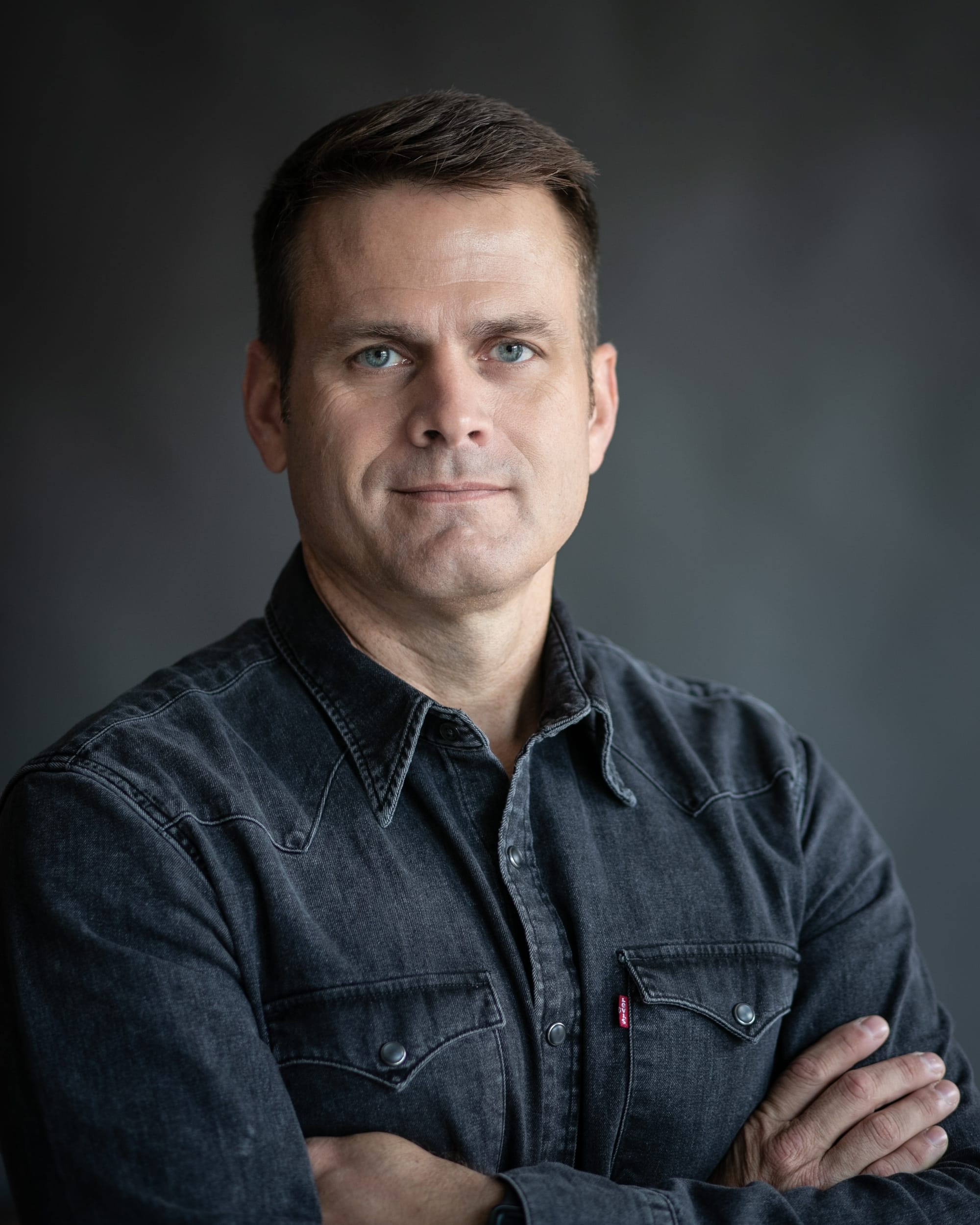
about the host.
Mike has called Bentonville, Arkansas home since 1986. He graduated from Bentonville High School and attended the University of Arkansas, earning a degree in Computer Science and Computer Engineering. He is currently pursing his M.A. in Applied Anthropology.
Mike is a Veteran of the United States Marine Corps and began his career at Walmart, before moving on to iconic companies such as Hershey Foods, The Walt Disney Company, and Nickelodeon/Viacom.
Mike Rusch joined the startup team at Pure Charity, an organization developing fundraising technology for nonprofit organizations striving to address some of the world's most difficult problems. Mike serves as one of the Managing Directors of Pure Charity today where they have helped over 1,250+ nonprofits raise over $250MM.
Mike currently serves on the Board of Directors for several nonprofits, including Equity Impact Fund, 99 Balloons, Laundry Love, Mercy House Global, and New Beginnings Northwest Arkansas. Additionally, he served as a founding Board member of Canopy Northwest Arkansas, helping to create the first Refugee Settlement site in the State of Arkansas.
In addition to his professional and nonprofit engagements, Mike has been a part of the Northwest Arkansas cycling community. As an avid Gravel Cyclist, he has participated in endurance events such as Unbound Gravel XL, MidSouth, Big Sugar Classic, Rule of Three, Telluride Gravel, Birdeye Gravel Fest, and attempted Leadville MTB 100 but failed at mile 79 (that story is not over). He has also completed other endurance events like the Ironman Triathlon and numerous Marathons and long-distance cycling events including the Arkansas Traverse & Arkansas Graveler.
Mike was a part of the first graduating class of the Northwest Arkansas Community College Bicycle Assembly & Repair Technician accredited certification program and is currently a member of the Northwest Arkansas Community College teaching staff as an Instructor for the Continuing Education Program for Bicycle Maintenance Fundamentals.
He was a part of starting Bentonville Ride Club as a place of deepening local community around the thrill of riding in our community and helped organize events like the Arkansas Traverse (Documentary Link) and rides across Missouri and Oklahoma.
Mike married the most incredible woman in the world, Corrie, and together they have four children. His love for a great story, whether told through nonprofit endeavors, professional achievements, or cycling adventures, reflects his appreciation for the diverse and interconnected narratives that shape our lives.
episode references.
- Arkansas ranks 43rd in the 2026 Kids Count Data Book, Arkansas Advocates for Children and Families: https://www.aradvocates.org/arkansas-ranks-43rd-in-2026-kids-count-data-book/
- The Kids Count Data Book, economic well-being, Arkansas Advocates for Children and Families: https://www.aradvocates.org/the-kids-count-data-book-economic-well-being-2
- How one Arkansas county helps ICE make hundreds of arrests, Associated Press via KATV: https://katv.com/news/local/how-one-arkansas-county-helps-ice-make-hundreds-of-arrests-and-spreads-fear-among-immigran
- Antisemitic graffiti removed from Razorback Greenway, KNWA: https://www.nwahomepage.com/news/antisemitic-graffiti-removed-from-razorback-greenway/
- Lockheed Martin expands in Camden with $420 million investment, Talk Business and Politics: https://talkbusiness.net/2026/11/lockheed-martin-expands-in-camden-with-420-million-investment/
- Southern Baptists vote to advance a formal ban on churches with women pastors, Associated Press via WTOP: https://wtop.com/national/2026/06/southern-baptists-vote-to-advance-a-formal-ban-on-churches-with-women-pastors/
- Truth and Unity amendment receives initial two-thirds approval, Baptist Press: https://www.baptistpress.com/resource-library/news/truth-and-unity-amendment-receives-initial-two-thirds-approval/
- Matthew 25:35-36, "I was hungry, and you fed me": https://www.biblegateway.com/passage/?search=Matthew+25%3A35-36
- Luke 23:39-43, the thief on the cross: https://www.biblegateway.com/passage/?search=Luke+23%3A39-43
- Romans 8:22, creation groaning: https://www.biblegateway.com/passage/?search=Romans+8%3A22
- Send us a Voice Message, the underview: https://www.theunderview.com/
episode outline.
- the gravel road in November, a dry summer and the liturgy of the earth (01:06)
- the April questions, can I belong before I believe (01:06)
- the answer in the rooms, Garner, Morrow, Morris, Brown (04:13)
- not only a Christian answer, Swamiji and Shahid Sheikh (06:33)
- Robert Burns on respect (07:32)
- John Ray, belief is the outcome (08:06)
- belong then believe, a structure of meaning and a structure of power (08:14)
- conditions, not categories, and the imago dei with Dustin Barton (08:14)
- what the other order does, belonging with a price on it (10:19)
- Rachel Whitaker and the first church minutes, you have to dehumanize (11:28)
- "not my neighbor," a pastor in Northwest Arkansas (12:50)
- naming dehumanization, structures of violence and structures of dignity (13:08)
- Brian Hirschy and Monica Kumar, power, fear, and love (15:09)
- what is driving it, the loud, the quiet, and the comfortable (15:54)
- Andrew Whitehead on Christian nationalism (16:21)
- are we a Christian nation, a test run in Arkansas (16:45)
- John Ray, Darrel Harvey, and the water (18:46)
- Paul Lindsey, not my foundation (19:58)
- Ben Gibson and Alejandro Rojas, the pulpit, the law, and a person (20:27)
- the midterms and the hunger underneath (21:19)
- the quiet, Ashley Mathews and Don Morrow on silence (22:40)
- the rooms that hold power (23:36)
- the comfortable, earn then belong, with Mark Schatzman (24:36)
- the line runs through, not between (25:39)
- what a church gets to say, and what no church gets to say (26:37)
- the churches that reckoned, Father Jason Tyler (27:47)
- women, the unfinished reckoning, and Jared Phillips on nostalgia (28:07)
- the middle, holding Michelle Morris and the imago dei together (29:34)
- Adam Russell Taylor, everyone (30:56)
- what do we do, a communal theology of place (31:22)
- begin small, Sư Cô, Gary Wheat, and Jonathan Lowder (31:58)
- a prisoner of hope, Advent, and the missing slice (34:13)
- the faith of Northwest Arkansas is a decision (34:21)
- the thief on the cross, remember me (36:30)
- who had the power on that hill (39:30)
- from I to we, what we hold (40:15)
- thank you and what comes next (43:47)
episode transcript.
[00:01:06] mike rusch.: Well, the wheels on my bike, they find the hard ground pretty easily now, maybe too easily. It was a dry summer in the Ozarks, and the creeks ran low, and the pastures went brown early, and the gravel out here, it turned to powder. I've come to think of that kind of pressure on the earth as something more than just weather. It feels like all of creation groaning, as the old letter says, waiting to be made right.
It's November now, and the hayfields remind me of a paper sack. The sycamores along the creek, they have let their leaves go without much of an argument. And on the church calendar, we're once again headed for Advent, this season of waiting. In the earth, the waiting has already begun, though. Once again, I feel like the tradition of the church is entangled with the liturgy of the earth, and I still think that both are calling out to be reunited.
Truth be told, I have not spent as much time on my bike this year. Maybe it's the heat or the travel, a lack of focus, some excuse, or I could be honest and say it's probably partly the anxiety that I don't feel like would go away after a bike ride. That anxiety that's brought about by the changes in our world and in this place. And so my legs, they're struggling more than they usually would today,, but maybe that's a measure of where my mind is, that it has struggled to find its place in this story of faith here in these Ozark Hills.
My feelings of belonging and community and faith, they feel, well, unsettled.
So here I am on the same road I was in April when the season began. The parking lots of the churches are full again. When I began in April, I stood outside of one of these, and I asked a question: could I belong here even if I did not believe everything that they believe? Or is it my belief? Would it be considered a category of my belonging? And I asked a second question also, how did a faith rooted in love become, in some expressions, a faith rooted in fear?
I knew I could not answer either one of those alone. I am way too far inside my own tradition or my culture or the understanding that I think I have of what this place is. So I asked Monica Kumar to walk down that road with me. And I think she gave us a method for this process in one word,. Proximate. Get close enough to hear, and so we did that. In fact, we got really close. Twenty-five rooms later and the same questions in every one of them, we treated every person across the table as someone who carries the image of God, even if we knew we may not agree with what they would say.
This is the end of that road, and I'm going to say this probably more plainly than I've said anything else this season. I will tell you what I think we found, and I will tell you what the alternative does to this place and this people. My questions about a faith that is both a structure of meaning and a structure of power, I think they've come to some answers. And that, as I said, has made me unsettled. But I think there's a little bit of hope that we can move forward together.
So when we began this journey, I asked whether a person could belong before they believed. And at St. Paul's Episcopal Church in Fayetteville, Reverend Evan Garner did not hesitate.
evan garner.
[00:04:13] rev. evan garner.: How we do church and whom we welcome through our doors is a reflection of a belief that whoever shows up belongs.
[00:04:24] mike rusch.: And I don't know if I thought because it was our first conversation or maybe my lack of exposure, I thought maybe that's just an Episcopal answer. But in Bentonville, Reverend Dr. Don Morrow of First Christian Church, well, he took it a step further
[00:04:38] don morrow.: And I think there's this underlying idea in Christianity a lot of the times that we don't deserve this, but God so graciously gives God's Son, though we don't deserve it. I think the radical nature of the-- what happens in Jesus is God saying, "You do." The whole point is you deserve this. You may not have earned it, you deserve it just by virtue of who you are because you are a child of God.
[00:05:05] mike rusch.: By virtue of who you are.
And then again, at First United Methodist in Bentonville, Reverend Dr. Michelle Morris told me who sits in her pews, people who disagree with each other about almost everything
[00:05:19] rev. dr. michelle morris.: And I love them all because my love cannot be contingent upon a political alliance. It can't be contingent on what year you were born. It can't be contingent on whether you're rich or poor, because God's love not contingent on that. We truly believe in the United Methodist Church that God loves all people. There is no exception to that.
[00:05:45] mike rusch.: not contingent.
And at Flagstone Church of Christ, Marshall Brown told me what he would do with anything that does make it contingent
[00:05:54] marshall brown.: And so if there are things that are, that cause people to feel like, oh, they won't accept me there because this, and this. Is that something that we can get outta the way? Then let's get it outta the way, or that, is that something that we can at least have a conversation about? Then? Let's talk about it. So that we can bridge those gaps 'cause ultimately we just want people to have a faith of their own, but also be a part of a community that cares about 'em. And if there's anything that's, manmade or traditional that's keeping that from happening, then let's get it outta the way.
[00:06:25] mike rusch.: I Want you to hear that this is not only a Christian answer.
At the Hindu temple in Bentonville, Swamiji told me about the people who walk in and do not share his religion
[00:06:35] swamiji.: I see there are so many people who walks in who are not, uh, who are not into religion, this religion, but they still walk in, and we welcome them. We try to have them a feeling that they are not entering into a strange place. It is their home.
[00:06:55] mike rusch.: It is their home.
At Bentonville Islamic Center, Shahid Shaik answered the oldest question about my own tradition better than I've honestly heard most Christians answer it
[00:07:05] shahid sheikh.: Islam doesn't ask me to choose and prioritize between people. Like when I say: Who is my neighbor? Who am I in community with? It's everyone.
[00:07:17] mike rusch.: Who is my neighbor? Everyone?
And then Robert Burns, who sat with us to talk about economic development and growth and plans for this space. He also talked about losing his place in the church and then finding it again, and he told us what he expects of the people around him
[00:07:34] robert burns.: I always respect people are on their different journeys and have different faith beliefs, and that word respect to me is absolutely key. I don't have any expectation that somebody is going to be of my faith. And that's totally fine because I wanna understand theirs, and I can find often just a lots of commonality about it.
[00:07:56] mike rusch.: So the answer in those rooms was yes, and underneath the yes, I found the thing the whole season could come down to came from John Ray, a pastor in Fayetteville, who paid the cost for being a place of belonging.
[00:08:09] john ray.: we talk at Vine & Branch about belong, become, believe, that belief is actually the outcome. It's not the starting point.
[00:08:17] mike rusch.: Belief is the outcome?
Somewhere out here, that sentence turned my question over in my hands. I had been asking, "Can I belong even if I don't believe?" And every room was really answering something else. They were answering the question of which they thought came first.
Belong then believe? That sounds like a structure of meaning.
Believe and then belong. That sounds like a structure of power.
If I could reduce this entire season to one thing, it may be the order of those two words. Every person who sat across from us said something about them, even though some of them maybe did not express it in those terms.
And I don't think I have to guess about which order my own faith teaches.
I can only read the words of Jesus.
"I was hungry, and you fed me. I was a stranger, and you took me in. I was in prison, and you came to me."
There is no category of person in those. Hungry is not a kind of person. Stranger is not a kind of person. Those are conditions, and conditions can change.
The church has a name for what you are supposed to see inside those conditions. Pastor Dustin Barton, a Southern Baptist preacher in Greenland, told me that a pulpit cannot be quiet about it.
[00:09:28] dustin barton.: There are things that pastors must address from the pulpit, like with issues of Imago Dei, how people are treated, how we care for people. We have to talk about those things. You can't look at scripture and not talk about it .
[00:09:38] mike rusch.: The Imago Dei. The image of God in every human being. It puts belonging first. That is what I found.
So let me say it whole the way a creed may say it.
Everybody has a place here. Everybody belongs. Everybody has worth. Everybody has dignity. The dehumanization of any person by any pulpit, any council, any court, any political party, or in any boardroom is at the bare minimum, unacceptable.
And honestly, I think that may be all of it.
The rest of what I have to say is what it costs to mean that in a place like Northwest Arkansas. And I'm not saying it to be agreed with. I'm saying it in a way that I understand we're still wrestling with these questions.
what the other order does.
[00:10:22] mike rusch.: So we'll begin with a warning, and I'm gonna say it as clearly as I know how.
Because here is the hard part. The people on the other side standing on some belief that we may not agree with, they may actually understand belonging better than most churches do. They know how hungry we are for it as a culture and as a people.
A young man with no house, no crew, and nobody asking where he was on Sunday, will honestly sit through a lot of different ideas to have a seat at somebody else's table, and I don't blame him. And I hold the rest of us, frankly, responsible for not setting a better one. Because belonging with a price on it is not belonging at all. It is belief first wearing belongings clothes.
When belief comes first, when it has to pass a test before you belong, you have made room for something else. You have made room to decide that a person who fails the test is not your neighbor, and that's not a theory. It's the oldest record we have in these hills.
In April, I said the church built the first two structures here, one of meaning and one of power. And historian Rachel Whittaker reads the minutes of those first congregations, and she showed me the second one.
[00:11:31] rachel whitaker.: And if you aren't conforming and they decide to ostracize you or shun you in some way through the church congregation, that's putting you outside the protection.
[00:11:43] mike rusch.: Outside the protection, and she told me what has happened in a person before they can do that to someone.
[00:11:50] rachel whitaker.: It's not just a matter of race. It's not just a matter of religion. It's you have to dehumanize in order to make that decision to cut somebody out.
[00:11:58] mike rusch.: You have to dehumanize.
Whether you see it as that or not, that space, however small it begins, it will grow.
That is the mechanism.
Believe, then belong. It gives you the justification to open the door a little bit, to see someone as less than my neighbor, to find a reason that they are different, a way to label them or to categorize them into someone who doesn't belong. Because someone who can't belong could never be my neighbor.
It gives me the ability to walk right past their humanity and see only the one thing that I have decided is wrong with them. I get to see them in their condition and make it a category.
And I've heard it done very explicitly. A pastor in this region said that, "Love thy neighbor is true, but if you came here illegally, you are not my neighbor."
[00:12:53] a pastor in Northwest Arkansas: And the beautiful thing about love thy neighbor is that verse is 100% accurate. But if you came in here illegally, you're not my neighbor. So, I mean, neighboring nation maybe. But you can say whatever you want, you know, God is love or whatever. Yeah, God is love, 100%. Yeah. But He also has laws.
[00:13:11] mike rusch.: Say they are not my neighbor, , that is a category providing a reason to look past their humanity. Say they are not my neighbor, and that is dehumanization from the pulpit to the congregation, giving everyone listening the same mechanism of dehumanization to carry out of those doors and apply them in their spheres of influence
So let me name what it is.
You dehumanize when you measure a person's worth by what they earn, by the color of their skin, by where they were born or how they came into this country, by who they love and whether the body they live in is the one that you expected it to be, by what they believe or do not, or by the worst thing that they've ever done. You dehumanize when you look at the human being and see a category. And when an institution takes that category and writes it into policy, it uses a structure of power to create a structure of violence.
That becomes a dehumanization with the blessing of God, and that becomes a dehumanization with the state's signature on it.
There are only two things that any of us can build with the power that we have. We can build structures of violence or we can build structures of dignity. Believe and then belong builds the first. Belong and then believe, it builds the second.
And here's why I'm maybe raising my voice in this. Because once you begin to dehumanize someone, there really is no stoplight. There is nothing on that road that tells you where to stop. Every one of the worst things that human beings have done to each other, they started exactly there, with a reason why those people did not count.
Indigenous removal started there. Enslavement started there. This land knows it all too well and the blood in the ground can tell the story. When you dehumanize, you have lost the Imago Dei. And a faith that has lost that has lost the only thing it was really given to carry.
Brian Hirschy, who is the musician under every episode of this season, He told me what it is to open the book and then to look up at the world.
[00:15:12] Brian Hirschy: And especially in the last 10 years when we've failed to address the tension of hey, my faith, what I read in the pages of these scriptures no longer align with what I see happening in the world. I see power glorified over humility. And I see the people who need help the most getting re-- being demonized.
[00:15:33] mike rusch.: The people who need help the most. And Monica told me in our very first conversation where that road leads
[00:15:40] monica kumar.: And to me, the closer you get to fear, the further away from God you get Because for me, the feeling of God is love.
[00:15:48] mike rusch.: And I think that's the answer to my April question. A faith rooted in love becomes a faith rooted in fear when it changes the order, when it puts the test at the door.
what is driving it.
[00:15:57] mike rusch.: So what keeps turning that order around? And I think this season we heard three things that seem to live where belief comes before belonging.
One is loud, one is quiet, and one is comfortable. The loud one has a name, and we called it white Christian nationalism. And I'm not talking about the man in the pew. I'm talking about the people selling it to him. I asked Dr. Andrew Whitehead, who's spent his career trying to understand what it is and how to measure it
[00:16:24] Andrew Whitehead: Christian nationalism, we show empirically, is this desire to see a very particular expression of Christianity privileged in American civic life, and wanting to see the government at its various levels privilege that particular expression of Christianity in how we define who is an American, what our national identity is, what our future should be.
[00:16:48] mike rusch.: Who is an American? You hear the order? Believe this, and then you belong. It is the church ledger from the 1830s at the size of a country.
I have stopped arguing about whether this country was founded as a Christian nation. I don't think it was. Others see it differently, and I'm not sure that anyone gets argued out of either perspective. But if the question is asked today, if the question is whether we are a Christian nation today, I would apply a different test, and I can run it without leaving the state.
I see the poverty. One in five children in Arkansas lives in it. That is a hundred and thirty-eight thousand children. We rank forty-third in the nation for the wellbeing of our children and forty-eighth for their health.
I see the stranger turned away at the door. I see immigration enforcement in my county at the highest level possible without reason or cause, to the point where our county is looked at nationally as a hot spot for immigration enforcement. The damage that that has done to fear and to people that are here legally is almost unthinkable.
I see the racism. I see the swastikas that are painted on the trails that I ride. I have seen the stickers on the signposts from Novo Now and White Lives Matter.
And I see what we spend on weapons and war.
Put all of that next to what it would take to feed and house and educate and heal every one of us, starting with the most vulnerable. Those are not the numbers of a Christian nation. They are the numbers of a place that has decided what comes first.
Fix those, and maybe I'll reconsider.
Because I have no interest in debating if we started as a Christian nation. The question is whether we are one today, and I would ask for the proof.
And that person to name it first on this show was John Ray, and he said it with a confession.
[00:18:35] john ray.: Look, I didn't just drink the Kool-Aid, I sold it. This was my life. I believed that it was the answer. I sold everything and joined an organization to proselytize people into a system that was based on that. And I thought it was so good,
[00:18:57] mike rusch.: in April, I said the most dangerous liturgy is the one that you do not know you're practicing. John called it the water.
Darrel Harvey, who spent a career in the same evangelical world that I grew up in, he told me what the water teaches you to feel.
[00:19:12] darrel harvey.: And to question capitalism or power or, anything like that, you can not only feel like a heretic, you feel like a, that you're not patriotic, that you don't belong here. And so it's very risky to, to have these conversations in places and so we tend not to have them, I think.
[00:19:31] mike rusch.: That you don't belong here, a test of belief that is not about God at all
And I heard that test refused in a place that I didn't expect, Paul Lindsey is a deacon at Little Flock Baptist Church, and it's as conservative as a church as we sat in in all year.
[00:19:47] paul lindsay.: Truthfully, I love the Constitution. I love the f- the sense of liberty and I stand firmly behind it, but that's not my foundation.
[00:19:56] mike rusch.: Not my foundation.
Pastor Ben Gibson of Phillips Chapel in Springdale, he may hold some convictions that I do not share, but he sat with us to have a conversation at the table together. And in that conversation, he was generous enough to tell me how he believes what gets taught on Sunday becomes policy on Monday
[00:20:15] ben gibson.: We influence politics by making disciples, and then those disciples go, and they're voted into office. Laws change. Culture begins to change, that kind of thing.
[00:20:27] mike rusch.: The pulpit, then the school board, and then the law. And at the end of that road, we can never forget that there is always a person.
Pastor Alejandro Rojas leads a Spanish-speaking congregation in Cave Springs. His experience of belonging includes community, and it also includes exclusion.
[00:20:44] alejandro rojas.: And she say, "Go back to your country." And I told her, "Well, this is my country," 'cause, you know, my kids grew up here, so I also feel USA as my country. I love it. I pray for this country. I pray for, And you know, in every city we've been, we pray for the people, and not only for Hispanic people, we pray for everyone.
[00:21:07] mike rusch.: He prays for the place that told him to leave.
And I wanna be honest about where this stands. The midterm elections this month, I don't know that they settled anything. If people voted out of anger or voted because of the cost of living, I understand. But I also doubt that they voted for some grand vision of the country by the other political party, and I'm afraid those realities aren't likely to change soon.
The hunger underneath is still there, and someone is going to feed it. I expect the fires of white Christian nationalism will continue, and now maybe burn even stronger. And I expect it to point at the very thing that I'm describing, a place where everyone can belong and say, "This is why we must fight."
And then the second thing that I heard, I think is quiet, and it is most of what we heard, because most of what we heard this year was not much. Housing, wages, the county jail, the poultry line, Sunday after Sunday, not a word. Those are the things a young man lies awake over. When the church said nothing about them, somebody else did. And we are taught that peace means not bringing up the hard things, that keeping the room calm is the same thing as keeping the faith. I used to believe that. I thought quiet was the safe place to stand.
But in my conversation with Reverend Ashley Matthews at Christ the King Anglican, she took that away from me.
[00:22:28] ashley mathews.: And I don't think we're better if we just stop having it and pretend that we can just function s- separately. But the encouragement that I have received over the, you know, last decade of my life in this space for people to be like, "Don't, don't pretend that there is some apolitical part of your life or faith." That's, that's not real. You're engaging with your neighbors every single day. The laws of the land shape the way that you live and they live, and you therefore at the very least need to be aware of them and at the best participating in them in redemptive ways, being honest about your convictions or how your convictions meet certain issues.
[00:23:03] mike rusch.: And then Don Morrow told me what that quiet does.
[00:23:07] don morrow.: When you start not talking about something because it's political, you're being political just by not talking about it, and you're allowing the state of affairs, the status quo to take the day. silence is complicity, as they say.
[00:23:25] mike rusch.: The status quo takes the day.
Silence is not neutral. Silence is how the wrong order wins without anybody having to preach it.
And then there was a second kind of quiet this year, and I believed it was aimed at this conversation. Look at who opened the doors. The mosque did, the temples did, a church of thirty people did. Communities with far more to lose than to gain by sitting at the microphone. The congregations where many of the people who govern this region sit on Sunday did very little speaking to us at all. I do not take that personally, I take it as information.
The more power a room holds, the less that it has to explain itself. That is one of the things that power is. A room that will not speak, it still leaves a record. The votes, the budgets, the laws. Those of us who live under those decisions have every right to read it, and we have been reading it. And I would still rather hear their meaning together at a table, but until I do, their power will have to speak for them.
comfortable
[00:24:24] mike rusch.: And then the third thing we heard this season is comfort. And it comes to the other thing we're never supposed to talk about, which is money. And it has set its own test at the door, which is slightly different than believe and belong. It's changed it to earn and then belong.
The rooms that we sat in do not agree about this one either. Don Morrow called the prosperity gospel an American ideology and not a biblical one. And he told me that a system doing exactly what it was designed to do still leaves people behind.
And then from inside of one of the largest churches in this region, Mark Schatzman was honest enough to name the danger himself. I asked him what he fears for this place, and he gave us one word
[00:25:06] mark schatzman.: Hubris. We can become so full of ourselves with our amenities and our prosperity and our growth that is... we should be so grateful for. But instead of using that to, to be blessed, to be a blessing, we use that to just live the fattened life, where we're- ... fattened by our own self-gratitude.
[00:25:27] mike rusch.: From gratitude to ownership. In April, I called that the first wound, a church thanking God for the land that it believed it was given. The Osage and the Quapaw, they did not own these hills. They belonged to them. We turned that sentence around, too.
And as I speak today, I want to be careful. It would be easy to draw a line through this region and put the good churches on one side and the bad ones on the other. But I sat in the rooms and I see that the line does not run between them. It runs through them.
The same Ben Gibson that I may not agree with, he told me this
[00:26:04] ben gibson.: And I know a lot of the rhetoric in Christian circles right now has to do with immigration and deportation and that kind of thing, I think that's a way to keep people incited and fearful and angry, and I don't necessarily know that it's that helpful because if we make millions of disciples... jesus told us to make disciples of all nations, and God has brought the nations to us,
[00:26:26] mike rusch.: You see, that is a neighbor that I disagree with about the order of two words. But he is not my adversary or my enemy or any other label. He is my neighbor.
And that also includes the young men and women listening to the voices that I just described. They belong here, too. Because if belonging doesn't first mean them, it does not mean anything.
So Here is where I come down.
a church gets to say what it believes to hold its convictions. It gets to say who can join its faith. But what no church gets to say is who belongs in this place or who counts as a human being. And every church and every council can be measured by the thing it says it believes, its own gospel, its own charter, its own oath, but not mine.
The oldest churches here know what it costs to get that wrong because they did. St. Paul's told us that there are enslavers in its founding roles. At First United Methodist Church, Michelle Morris told us that they were on the wrong side of history, and that they can own it, and that they can still be here. And at St. Joseph's, where the first baptism in these hills was of enslaved people, Father Jason Tyler told me who the church is for
[00:27:35] father jason tyler.: At the very least, my hope would be that the let's see, the priests and the others at the time who facilitated that would that was their that was their outlook was to say we're here ultimately for everybody. And that means yes, even the enslaved person or especially really, it's really better way to say it, especially the enslaved person is in need of that support and that, that grace of God.
[00:27:55] mike rusch.: They did not hide their minutes, and they are not weaker for it. They have reckoned with that history, and a church that has reckoned with its history no longer has to defend it. It is now free to defend and serve people instead.
But that reckoning is not finished. In some rooms, the words ran out when I asked about things like immigration and race and gender .
And then if you remember this June, the largest Protestant denomination in the country, it voted to move toward putting out any church that calls a woman a pastor.
At the same time, we have Rachel Whittaker reminding us that the women, actually says Black women, have been the glue holding the church together in this place the whole time. Are we asking questions of what we can learn from them? Why not? If we're not, why not?
And Dr. Jared Phillips, he boldly said what stands in the way,
[00:28:50] dr. jared m. phillips.: nostalgia is probably the most dangerous force in our cultural life. I think it's more dangerous than Christian nationalism. Without nostalgia, we wouldn't have Christian nationalism. Without nostalgia, we wouldn't have the lost cause mythology. Without nostalgia, we wouldn't have so many of these different things that are out there, right?
[00:29:03] mike rusch.: Nostalgia is the memory you want. History is the memory you need.
In April I called the two sides of this accommodation and resistance. They are the two orders by other names. Accommodation is believe, then belong. Resistance is belong, then believe.
the middle.
[00:29:22] mike rusch.: Now I have to tell you about something I have not settled. Michelle Morris told me where her church stands the middle is prophetic. I have carried that sentence all year, and I believe her with my whole heart. A room where people who disagree about nearly everything, who stay in the same pew, it's the bravest thing that I saw this season. The middle is not soft, and I know it costs her something every week. When there is a room for all of us here, that is belong and then believe.
But there is tension that I still carry. Not in contrast to Reverend Dr. Morris. I spent a good part of this year trying to stand in the middle of belong and believe, and standing there trying to listen has been very difficult, to say the least.
So if the order is believe, then belong, and it turns into dehumanization, I know there is no middle between a person's dignity and its denial. And I will not stand halfway on whether someone is worthy of dignity or of being seen in their full humanity.
I do not think one of those cancels out the other. I think we have to learn to hold both. Her middle is about people. It is the room. Mine was about the question, and I will sit at the table with anyone, but I will not sit in the middle of the question of the Imago Dei.
And I'm not asking for a party to win. Reverend Adam Russell Taylor of Sojourners, he told me what he is asking for,
[00:30:44] Adam Taylor: that vision, is to build a society where neither punishment nor privilege is tied to our race or our ethnicity or our gender to our ableness, et cetera. And it's to build a country where everyone has an equal voice, everyone is equally respected, and where everyone is enabled to thrive, and where our growing diversity is viewed and treated as a strength and not as a weakness or something to be feared.
[00:31:10] mike rusch.: Everyone. That word keeps coming back to me.
So what do we do? When this season began, I named the work "A Communal Theology of Place." The things that we believe together about ourselves, about each other, and about the ground that we share.
This season, I think we found what that means. Belong and then believe.
And it comes with one test for any sermon, any ordinance, any bill. Does it widen who belongs here or does it narrow it? And I think it starts small. At Tu Kwang Temple in Fayetteville, the abbess that we know as Su Co told me how
[00:31:46] Sư Cô: think about compassion that the way they can connect each other no matter who you are, where you from, what language you speak, we still have the same thing to share. How we living, loving, all, all everybody love each other. But how we practice it? We go from very small action. We dream big. Compassion a big dream for everybody. But begin act small I said.
[00:32:10] mike rusch.: No matter who you are, where you are from, what language you speak, you begin small and do not wait for people to come to you.
Pastor Gary Wheat of the Assembly in Siloam Springs, he told us that
[00:32:24] gary wheat.: if we really want to build that bridge, we can't just expect people to come to us. We have to go sit at their table. And that's what Jesus did at the well and. And then be okay of being uncomfortable because I've been in a situation where I'm like I don't know. This isn't my culture. You know what and it's okay to ask questions. And so I think understanding, understanding the culture, understanding the background, understanding where people come from and, and finding those common ground.
[00:32:56] mike rusch.: Go sit at their table. And when you get there, know who you're looking at.
The image of God has a face and it has an address. It may be the Marshallese family in Springdale, the woman on the poultry line, the farmer who cannot pass the farm to his kids, the school teacher. And at St. James Missionary Baptist Church, Pastor Jonathan Lowder said it in six words
[00:33:19] jonathan lowder.: And because you're here, you matter.
[00:33:21] mike rusch.: Because you're here, not because you believe, not because you earned it, But he would not let us stop at just sitting at the table
[00:33:29] jonathan lowder.: and then we gotta stop just sitting at the table. Once we've come to conclusion, let's get up from the table and do something about it. ' cause then that way when we get back to the table, we can see what we've accomplished and now begin to work on the next issue.
[00:33:41] mike rusch.: So we find something to build together with people who are not like us. That could be a house, a community, a meal for somebody else's table. That is where a person finds out if they belong.
We have to be real. We all know the work of belonging. It will not happen quickly. Brian Hirschy told me what it feels like to hope anyway.
[00:34:01] Brian Hirschy: What does it feel to be a prisoner to the idea that things can get better? What does it feel to be a prisoner to the idea that things can get better and you might not see it?
[00:34:09] mike rusch.: A prisoner of hope, that is Advent. That is the dry ground waiting on rain, and it's what Barbara Carr taught us in an earlier season when she said that there is no such thing as wholeness, that there is always a slice missing. I used to hear that as grief, and I think I now hear it as a discipline. The missing slice keeps the door open. It keeps us moving forward to find out who is missing and how to fill it.
And so out here on this gravel road where the sun is lower, and it's turned the color of rust, I pass the last church, and the gravel gives way to pavement.
I named this season The Faith of Northwest Arkansas, so before I arrive at home, I think I owe you an answer of what that is.
I went looking for a creed, and I did not find one. What I found is a decision.
Belong then believe or believe then belong.
The faith of this place has always lived between those two forces, a structure of meaning or a structure of power, and I believe that it still does.
Every conversation we had was spoken from one side or the other. The line runs through every pulpit and every pew, and I have to be honest and see that it runs through me as well.
And today, that divide is real, And from my perspective, I see it continuing to grow. So I'm not going to pretend that I do not know which side is right.
I can only read the words of Jesus, and I can listen to a Muslim and a Hindu and a Buddhist tell me the same thing in their own words.
Putting belief before belonging is contrary to the collective wisdom of not just Christianity, but all of the other faith traditions that we spoke to.
Putting belief before belonging, it makes room to dehumanize, and nothing good has ever come through that door. And so I can't seem to move from this one story in the Christian tradition that settles this for me. And you do not have to share this tradition to hear it.
It comes from one of the four accounts of the life of Jesus, this one was written, the tradition says, by a physician named Luke, a careful man, and the only one of the four Gospels where it's recorded. It takes place on the day that Jesus is executed. These are some of the last recorded words before Rome put him to death on a cross in public.
There are condemned men also hanging on crosses on both sides of Jesus. This is a story about one of them, a thief. That's what he's called.
But we don't know much about him. We are not told what he stole. We don't know if he stole bread so that he could eat. Did he steal a coat so that he could be clothed? Did he end up on the wrong side of a Roman guard who had been trained to see him as a threat because he wore a cloak over his head?
Had he been convicted before and served his time? Had he stolen again and been caught again? Or because of his background, was he simply assumed to be the most likely to have done it, so that all it took was an accusation.
We are not told his name. We don't know where he was from or what nation he claimed. We do not know if he was in his country legally or not. We do not know what language he spoke or whether it was the right one. We do not know the color of his skin. We do not know how he prayed or whether he prayed at all. We do not know who his parents were or if he came through a state system like foster care. We do not know whether he had a job or if he worked enough hours to deserve a doctor. We don't know if he made minimum wage and it wasn't enough, if he was behind on rent and was facing eviction. We don't know if he paid his taxes on time or if he had the right permit or the right license or the right ID. We do not know if he was lonely. We do not know if he had been told that he was the problem. Or if he was truly guilty of the most horrific of crimes and his punishment was what the law prescribed. We are not told. Thief is what he was called. And the story never says what he believed. Every line we use to sort each other, the story leaves out.
But here is what we do know. The state had decided that he should die. He says himself that he is getting what he deserved. He does not sound like a man who thinks he belongs anywhere.
And then he utters one sentence, and he asks for one thing, "Remember me."
I know that some will say that his asking was a sign of his belief. Maybe it was. Even so, look at what he was not asked for. No creed, no proof, no promise to change, no audible reciting of a prayer of guilt. The answer that that man heard was not a question, it was not a test, it was not a condition. Jesus simply responded, "Today you will be with me." The thief on the cross, he finally belonged. Even if we do not know if he ever believed. And those are not my words. We either believe that this is the way faith works or we do not.
I've spent the last three seasons talking about power as the thing that wounds, the power that removed, the power that enslaved, the power that stands at the door asking for your proof of citizenship.
And then I think about that hill and who on it actually had the power.
It was not the ones holding the nails. Because what if true power is the ability to open the door, to hold a place for someone who does not believe what you believe and may never. To believe on their behalf that they belong here?
Most of us have been told we have no power, told it so often that we've stopped believing that one voice or one vote or one act of compassion could make a difference, and I wanna say today that is never true.
I have said the word I for three seasons, and I'm gonna stop here and say we. Because none of us can find any of this alone, and the work can only be done together.
We are not powerless to understand our stories, and we are not powerless to admit what was done in our names. We are not powerless to decide again what will be remembered, and we are not powerless to walk into the rooms where the decisions are being made and open the door wider.
So this is what we hold. We hold that everybody has a place here, that everybody belongs, and we will say so when anyone is dehumanized from any pulpit or platform, whatever it costs us, because the one thing that is true is that it will cost us something.
We will not be bound to a political party. We will measure every institution by what it says it believes, and we will hold ourselves to the same measure. We will tell the truth about who built the structures of violence in this place, And in the process of asking everyone to reckon with them, we will begin to break down these structures.
This place was built to work for men who look like me. I have had the benefit of that, and I will not step away by pretending otherwise.
And while I can't speak for all, I've heard a lot of men younger than me feel like something has been taken from them, and some of it has.
The house, the wage, a clear definition of masculinity, But what is not true is who took it.
I Believe that white Christian nationalism working through the church has been working on an answer for that young man and this next generation, and it will keep offering it. Silence and comfort are what let it work quietly.
It happens at the conventions and the committee hearings where the structures of belonging and belief get assembled, and that work is centuries old. But we have learned, we have reckoned, we are changing, and we can change, and every one of us has agency to do so.
Because if the moral arc of the universe bends towards justice, it does not bend on its own. So let us get to the work of bending it together.
We can use the power of faith to form a communal theology of place where everyone can belong, not on the conditions of a creed or an ideology or an institution. We will clear away every test at the door because we begin at the place where everyone is created in the image of God.
And we will say the rest plainly together.
When faith is used to dehumanize anyone, it is no longer a private matter. It has lost the right to be treated as a personal preference. And when that dehumanization is carried into an institution, made its doctrine or its policy, and written into law, we have work to do. It begins with stopping the silence.
In April, I asked whether faith could renew this place instead of dividing it. I believe it can. We have heard from so many faith communities that are already doing that work, and what they share is this: belonging comes first.
They have answered the question of who belongs, and their answer is everyone. But we all decide this, all of us together, or it was never belonging to begin with.
This has been an exploration of the faith of Northwest Arkansas, a place where belonging and believing run through the Ozark Hills and the hollers and its people, building structures of meaning and structures of power. The work of belonging begins where we are, in the proximity of our own lives. And if today, in the place where you stand, requires a certain belief before you can belong, or a certain comfort, or if from where you stand you cannot hear any of this, then maybe the first step is to change our proximity
episode outro.
[00:43:35] mike rusch.: well, I wanna say thank you for listening and following along this season. It has truly been a life-changing journey for Monica and me, and I hope for you also. The Send Us a Voice Message button will be live on the website for a while longer. We'd love to hear from you what you think this season has meant. Your voice matters, and we'd love to hear it.
And to my co-hosts this season, I know you didn't fully know what you were stepping into, but you trusted me, and we walked that path together. Thank you for your kindness and your friendship and your faith. They have widened my view of who belongs and how that work of belonging can be done. Behind The scenes from what everyone could see, you have been so faithful in asking the hard questions, holding this space as holy, and seeing the world through the lens that we all needed. Thank you for your voice, and thank you for your leadership.
And so now what comes next? Well, just like the seasons before, we're gonna take a break, and we may have some periodic episodes to share. It is now becoming our form of ordinary time.
For everyone that has been following along this season, Monica and I owe you a depth of gratitude that we cannot express. And so I wanna say thank you for listening, and thank you for being the most important part of what our community is becoming.
This is The Underview, an exploration in the shaping of our place and our faith.