
the origin culture with Jazlyn Sanderson.
Indigenous culture endures - art, history, and legacy shaping Northwest Arkansas beyond the myths we've inherited.
season 2, ep. 5.
listen.
episode notes.
the origin culture with Jazlyn Sanderson.
In this episode of the underview “the story of Northwest Arkansas,” Jazlyn Sanderson, Director of the Museum of Native American History, invites us to explore the profound legacy of Indigenous cultures in Northwest Arkansas.
From the artistry of Arkansas pottery shaped by local clay to the stories etched into Lone Dog’s Winter Count, Jazlyn highlights the creativity, resilience, and deep connection to the land that defined these communities. These cultures are not relics of the past but living legacies, offering enduring wisdom about identity, belonging, and harmony with the natural world.
Through their art, traditions, and stories, Indigenous peoples remind us of the beauty and depth that comes from grounding ourselves in the history of those who came before us. Jazlyn challenges us to reconsider the myths we’ve inherited and to approach these histories with openness and humility. Understanding these cultures isn’t just about the past—it’s about enriching our present and shaping a more meaningful future.
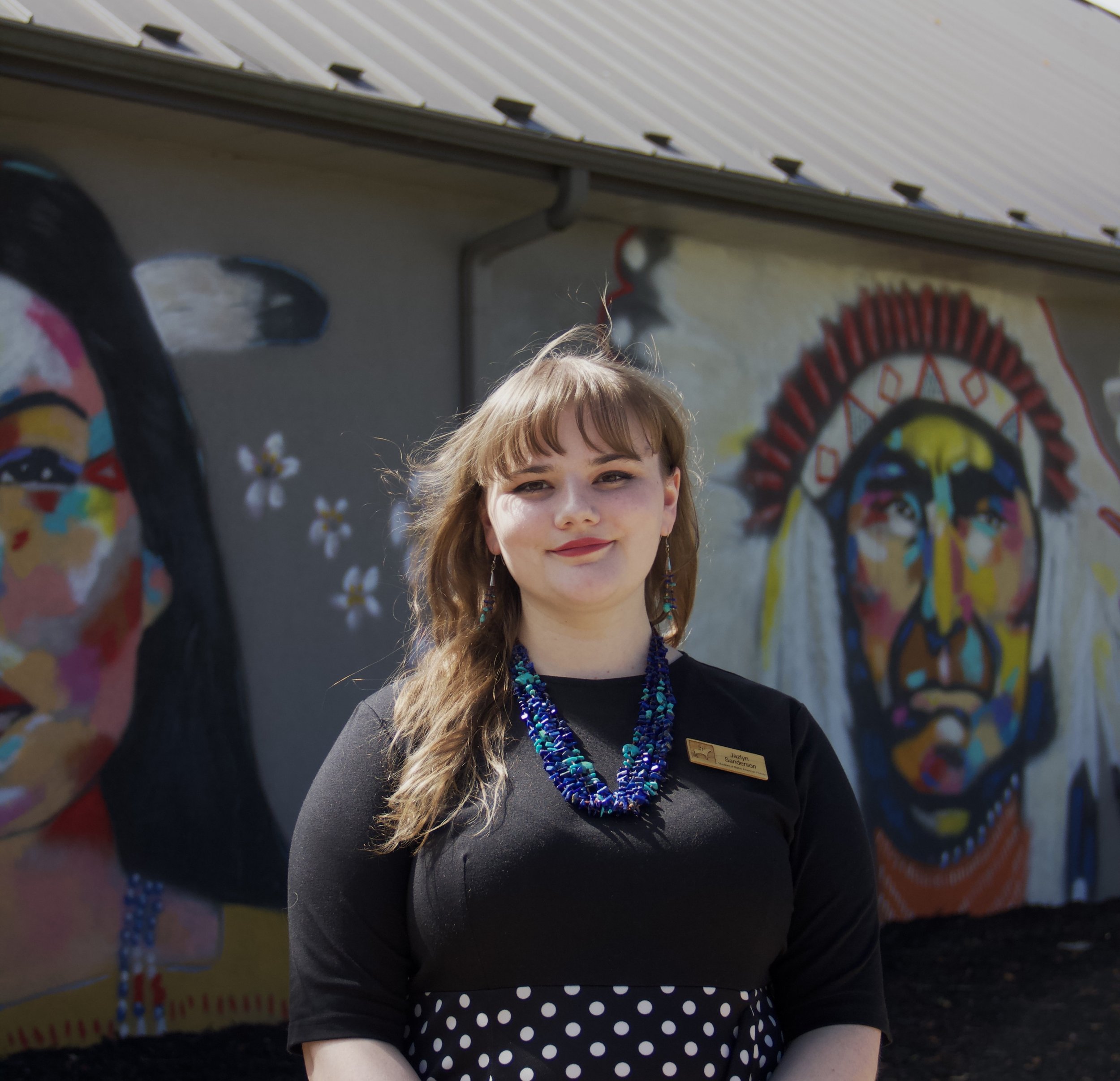
about Jazlyn Sanderson.
Jazlyn Sanderson is the Director of the Museum of Native American History in Bentonville, AR, where she spends her day hosting visitors and creating a space for them to learn about indigenous peoples of the Americas in a 24,000-year story. She grew up in Gentry, AR, watching this area prosper for the past 25 years. Jazlyn received her Bachelor of Arts in Art History with a minor in History from the University of Arkansas in 2020, where her studies focused on pre-Columbian Mesoamerican art and craft, primarily textiles. When she is not at the museum, her hobbies also involve textile arts and crafts! She is also a frequent volunteer in the Northwest Arkansas theater community behind stage or front-of-house, supporting her fiancée, Edward Mountz, who is often on stage.
episode notes & references.
- Museum of Native American History (MONAH)
Website: https://www.monah.us - Arkansas Archeological Survey
Website: https://archeology.uark.edu - Osage Nation
Website: https://www.osagenation-nsn.gov - Caddo Nation
Website: https://www.caddonation-nsn.gov - Quapaw Nation
Website: https://www.quapawtribe.com - Haskell Indian Nations University – Environmental Research
Website: https://www.haskell.edu - Doctrine of Discovery Resources
Overview: https://doctrineofdiscovery.org - Killers of the Flower Moon (Movie by Martin Scorsese)
Info: https://www.imdb.com/title/tt5537002 - Laura Harjo – Indigenous City Planning
Overview: https://link.springer.com/article/10.1007/s10668-020-00996-3 - Dan Wildcat – Environmental Science and Indigenous Knowledge
Book Overview: https://www.fulcrum.org/concern/monographs/n870zr57f
episode outline.
- Episode Preview: 00:00–00:01
- Introduction to the underview and Season Theme: 00:01–00:04
- Why Start with Indigenous Cultures?: 00:04–00:06
- Introduction of Jazlyn Sanderson: 00:06–00:07
- Jazlyn’s Personal Story and Passion for Art History: 00:07–00:09
- The Importance of Arkansas to Indigenous Cultures: 00:09–00:11
- Overview of the Museum of Native American History: 00:11–00:13
- The Evolution of Indigenous Art and Pottery in Arkansas: 00:13–00:16
- Significance of Spiro Mounds and Trade Networks: 00:16–00:19
- The Role of Art in Expressing Identity and Connection to Land: 00:19–00:22
- Indigenous Cultures Today and Ongoing Traditions: 00:22–00:25
- Collaborations with Tribal Nations and Artists: 00:25–00:28
- The Interplay Between Rapid Growth in Northwest Arkansas and Indigenous Perspectives: 00:28–00:31
- The Story Told by the Museum to the Community: 00:31–00:33
- Engaging Schools and Communities with Indigenous Histories: 00:33–00:35
- Barriers to Understanding Indigenous Histories: 00:35–00:37
- The Responsibility of Preserving Indigenous Stories: 00:37–00:39
- Fears and Hopes for the Museum’s Role and Cultural Awareness: 00:39–00:42
- Lone Dog’s Winter Count and Its Cultural Significance: 00:42–00:45
- Closing Reflections on Learning from Indigenous Cultures: 00:45–00:46
episode transcription.
[00:00:00]
episode preview.
jazlyn sanderson: Understanding history, understanding the land that you live on, understanding the culture of what that land originally inhabited is so important. It gives you a different perspective on life, for sure. It reminds you that, you're not the only person in the world who finds what you love important There are other people out there who have different perspectives and different ways of life. That they also feel is important.
episode intro.
[00:01:00]
mike.: You are listening to the underview, an exploration in the shaping of our place. My name is Mike Rusch, and this is the story of Northwest Arkansas. Together, we're working to uncover the layered, and often complicated, history that defines the place that we call home.
It's a story of its people, the land and our collective identity. This is not just about remembering. It's about reckoning, reckoning with the complexities, confronting the uncomfortable truths and finding the values that guide us towards a more just and compassionate world.
In this story of Northwest Arkansas, we will encounter much to reckon with. Problems, conflicts, and controversies that have shaped this region. And while it may be tempting to dive headfirst into these struggles, instead we begin by trying to capture a glimpse of the lives and cultures of those who walked this land [00:02:00] long before European settlers arrived.
Why start here?
Because there is a persistent myth that those who lived in this place before us needed something. Even more, that it was something that we had to offer. And I want to invite you to question that myth, and instead consider another story. In this episode, we pause on the edge of history to honor the brilliance of the indigenous cultures that shaped this place.
This is a moment to resist the feeling that we should rush into the problems of colonization and allow the beauty of an advanced culture to unfold. Through their stories, we discover a legacy of creativity and wisdom, and it's a reminder of what it means to belong deeply to a place and to a people.
To attempt this, we begin with what was left behind, and that is the art from early Indigenous communities. It offers a window into their worldview, values, and ways of life, revealing deep connections to the land, their spiritual beliefs, and their cultural identity. Far from being [00:03:00] simple, their art reflects advanced creativity, technical expertise, and symbolic meaning. It challenges historical misconceptions, and it honors the enduring wisdom of these cultures. By attempting to understand their art, we gain insights into their community and resilience, recognizing these cultures as vibrant, growing societies whose lessons remain profoundly relevant today.
Today, I have the privilege of sitting down with Jazlyn Sanderson. She's the director of the museum of native American history. The museum is a space where people can experience this rich and diverse indigenous culture of all of the Americas through prehistoric and historic art, telling a 24, 000 year old story of the lands that we now call North and South America.
Our focus today will narrow on the cultures of this place, its people, creativity, and legacies. And while we may not have a complete picture of what was, we have enough to begin.
From what remains, we start our journey, building on this understanding in the episodes that [00:04:00] will come, as we will explore how these traditions and cultures have been carried forward into this present day.
All right, we got a lot to work through. Let's get started.
main episode.
mike.: Jazlyn, thank you for sitting and spending some time with me. I'm anxious to hear your story and maybe we start there.
jazlyn sanderson: Thanks for having me. I'm a local here to Northwest Arkansas. I grew up over in Gentry. , I born and raised there, and then I went off to college at the University of Arkansas, where I got my bachelor's there for art history and a minor in history.
There I studied a lot of pre- Columbian Mesoamerican art. And that's where I found my passion. And I knew from a young age that I've always wanted to work in a museum. And so going and pursuing my passion in art history, and then fortunate enough to get a job here at the Museum of Native American History.
It just all fell into place where I'm surrounded [00:05:00] by these beautiful cultures of North and South America, So that's what drove me to where I'm at right now. And of course everything that we do here at the Museum of Native American History just drives my passion even further.
We tell the story of the peoples of North and South America in a 24, 000 year story. And it starts in the paleo period, works its way into the late historic period, which ends at about 1920 to 1940. The gift shop, of course, highlights contemporary indigenous artists. Everything that we do here is to honor , their art and their legacies, their history and culture.
Yeah, that's a little bit about me.
mike.: Maybe we back up for a second. I'd love to understand what does Arkansas mean to you?
jazlyn sanderson: Arkansas is my home. That's for sure.
Of course, growing up in the Ozarks. I am no stranger to the beautiful arts scene,. nature. The rich craft history here. But, [00:06:00] being in the space that we're in today. It's a much broader perspective of who, who was on these lands prior to settlers. And here in Northwest Arkansas specifically, it's home primarily to Osage hunting grounds.
But Arkansas as a broader narrative is home to the Quapaw , Osage, and Caddo people, along with some other smaller Indigenous tribes, or sometimes. Going back further into history, we don't have names for them as well. So like the paleo and archaic people of Arkansas, we call them Ozark bluff dwellers because they lived in the bluffs around here.
So as history goes on, tribes begin to have names and the culture and shifts in identity are constantly evolving. But of course, it just all blends into our modern narrative of what this place is. So, It never means one thing. It means multiple things to me in that regard, [00:07:00] but it's definitely very rich in its culture and art. So that's what I think of whenever I think of this beautiful home.
mike.: Tell me about the place where we are right now.
jazlyn sanderson: . Yeah we're just a couple minutes from downtown Bentonville. This is the Museum of Native American History. it is this beautiful building, housing, so many cultures, so many arts and wonderful craft pieces from all over the Americas, which is so unique to this place.
Cause we tell the story from Canada to South America, 24, 000 years of history. And of course, that accumulates a lot of things. We have over 10, 000 artifacts in this building. And we have one of the largest prehistoric tool collections there is out there. So as you're walking through the halls, we make it a point to start you at the earliest points of man made creation.
Here [00:08:00] in north and South America. so It's the paleo period where Tusker, our 12, 000 year old woolly mammoth, he greets you at the door. And then you walk your way through, through history then you get a nice foundational period of where everybody began. And as you're walking through, you're starting to see the evolution of art and culture and how they play into each other along with the lands and how the land plays into the art and the culture as well.
So for example, in the room that we're sitting in right now we're surrounded by art pieces from Arkansas. There's beautiful pottery pieces here and you could see like the rich red clay home to around the Mississippi River.
Or you could see like the darker clay, which is home to Southwest Arkansas where the Caddo reside. So you could see how these materials play into the art pieces that are found. But [00:09:00] Arkansas is actually home to of course, the Quapaw, Osage, and Caddo people. But their clay is, or their pottery traditions are actually so rich and so sought after across the country because you don't see these art forms pop up in very many places.
And that's because of three things. The people here they're primarily peaceful so they had a lot more time on their hands and a lot more freedom to create expression of art. The clay here is very pure. So it's, of course, a lot easier to manage in that regard and it makes a beautiful piece of pottery. But there's also mussels in our rivers. So they would not only use the mussels for food, but they would also use them to ground up and put into the pot to temper the pot. So it fires evenly and creates like a nice strong foundation for the pottery.
Just seeing how things like that play into these traditions.
[00:10:00]
mike.: anyone who's in Bentonville and Northwest Arkansas area should come here because as I'm listening to you, I'm looking around the room and these are not just bowls to eat out of these really do have exactly what you're describing of this art aspect of creating something, not just for purposeful use, but for the, just the beauty of creating. Explain to me a little bit more about this intersection between this rich history and the art aspect of how this comes together.
jazlyn sanderson: Whenever people are evolving into who they are today, but starting back in the, what we call the Woodland Period that's whenever you start to see the outbreak of art. So , just across the way, there's one of the earliest pottery pieces you'll see in North America.
But outside of that, you see some great effigies, which effigy means likeness. So it takes on the form of, sometimes a deer, sometimes a bear, sometimes a person. Sometimes you don't know what it is, and you just leave it at [00:11:00] effigy. But they have outbreak of art because their lifestyle has changed so dramatically that they now have time to make art.
And so beforehand, they were spending all their time trying to find food, hunting, gathering. But in the Woodland Period, that's whenever you start to see farming. And so it becomes such an important lifestyle to, to settle and take care of your crops and protect them as well. But because they're not following the herd as much, they now have time to, to think about who they are and their identity. So as you're walking through that hallway and entering the Mississippian period, which is home to where we have all this beautiful artistic Arkansas pottery, they certainly have mastered that skill and or still mastering it in some way.
So they're starting to include a lot more details. They're looking at the nature and the animals [00:12:00] and thinking about religion a little bit more and how this all kind of plays into each other. So as you're looking around this room, for example, you'll see. what, like a cat serpent, so it's a mythical being, but it's also taking the form of what they are familiar with around them. Over in the corner though we've got the Spiro Mounds, which Spiro is located near Fort Smith. It's just on the other side of the border, so it's just in Oklahoma, not too far from Where we're standing right now.
But Spiro is one of the major trade centers of the Mississippian world. So there are a couple of big ones like Cahokia over in St. Louis, but what's so interesting about Spiro is you see materials from coast to coast some of those pearls, some of those shells , different materials are being traded across what today is the United States so from west coast, east coast, Gulf of Mexico, and somehow ending up [00:13:00] near Fort Smith, Arkansas, which is really interesting because, there's the there weren't roads at all, really, there were trade paths, maybe This was a time before horses even, came to this continent.
So it must've been very grueling to, to try and track across these wild lands. But somehow they managed to do it because they found importance of housing this ceremonial and trade center here in Arkansas and Oklahoma, which is so interesting to me. But you see a lot of different artistic expressions pop up over there, like the shells.
You could see the way that they dressed or the facial features that they thought were important to depict across time. Because they're engraved or the resting warrior effigy pipe, it's a magnificent artistic expression. But it's interesting how they're looking at the surroundings around them and they're pulling it together and thinking about.
What do I [00:14:00] want to depict on this piece of pottery or teapot, bowl, anything.
mike.: It sounds like how we approach art today.
jazlyn sanderson: Oh, absolutely. We're not so different. That's for sure. Of course, our society has changed. Our ways of life has changed, but we're still absolutely taking ideas from around us and what's in our world, and putting it into, to the art today. So absolutely.
mike.: I would love to spend A couple hours just listening to you speak about this because it brings a richness and a depth to it that I have, I've been ignorant of And it, it definitely brings it to the future today, and it also brings alive a culture and a people that is not here anymore.
jazlyn sanderson: They still are here.
mike.: Okay. Correct me if I'm wrong. I'd love to. What's the connection to this place today then?
jazlyn sanderson: Of course, unfortunately, , the people of these lands were removed to Oklahoma during [00:15:00] the Indian Removal Act but , they're still very much alive.
So for example, Betty Gaedtke she's a Quapaw potter who still works in the same traditions as what you're looking at around us. She's a magnificent woman and she pops into the museum every once in a while to say hello. But she is still harnessing her ancestors ideas and traditions and putting it into the pottery today.
And then same way with the Caddo people, they're still making some beautiful arts and we're, and it's interesting with the Caddo people is because they are actively working with the Arkansas Archaeological Survey which is, housed in Fayetteville, but they go all over the state.
But they are working on different archaeological sites to try and recover these beautiful pieces of pottery and, bring them home to them, but also make sure the story is told for [00:16:00] everyone. So the different governments and cultural centers and everything are still keeping their ancestors ways alive and their stories told.
Yeah.
mike.: How do we follow along with those stories today?
jazlyn sanderson: Of course, you could follow the Arkansas Archaeological Survey, they're constantly posting about their findings and how you can get involved with it. Because anybody can join and help out if you'd like. You could also, follow the different tribal governments because they all have social media and they're also posting about, their heritage and ways you can help and ways you can just learn like the Osage Nation, for example, if you go to their website, they have a lot of fantastic lesson plans available , for teachers or whoever just wants to learn about their ways of life and, those are some great ways. And of course, come to the museum because , we tell their stories too, but they tell it, of course, a lot better in the way that they want.
mike.: And just from my education, are [00:17:00] you working actively with those communities, Osage, Caddo, Quapaw communities, and And how this place tells their story or how this story continues to evolve.
jazlyn sanderson: Yes. , whenever we have the opportunity, we absolutely do. For example, chairman of the Cato nation, Bobby Gonzalez, he's on our board of directors. So he like we're actively working with him on improving. Things at the museum, we're including different things. So we're trying to, for example, we're trying to get more Cato artists into our shop.
So people around here and travelers alike can come take something home and not only support the museum, but support these indigenous artists as well.
The Osage Nation. They have recently we're in partnership for killers of the flower moon which is a movie by Martin Scorsese. And it has a lot of big names in it. And Lilly Gladstone, just won a golden glow. Which is so.
But whenever they were making that movie. Julie O'Keefe [00:18:00] with the Osage Nation, she was a consultant on the movie for design. She came and she documented our Osage wedding outfits to be used, replicated, or bits and pieces taken from, in the movie, but it not only documents it for the Osage Nation and the movie, but while she was here, she was, she noticed that there were some things that we could have done better to display them. And, we've of course followed her advice. We got a grant from the Osage Nation to better get some mannequins that can better display their clothing.
And. That's what we did. We're actively working with, these nations as they point different things out, or if we go to them and ask questions, they're, they absolutely want to make sure their story is told right. So we love working with them.
mike.: Northwest Arkansas is growing by leaps and bounds. The space you occupy here is a reminder of What this place was and the foundation of it all how do [00:19:00] these two worlds come together? Do they come together?
jazlyn sanderson: It's a, that's a tricky question.
And, one that Is almost asked a little late, and in most occasions because like you said we're actively growing and expanding so rapidly it's a completely different landscape from what I remember it even 10 years ago, but of course, keeping in mind the different nations and how they want this land to be used is a great, perspective working with them actively is always the best you can do of making sure you ask questions or have a consultant on, a committee board or different things like that is, is always extremely helpful, but also just doing, research on city planning and land use.
For example Laura Harjo, she's Muskogee and she, her, she's got some work in city planning and [00:20:00] And she's a wonderful resource , for understanding and going forward with it because she includes , indigenous ways of thinking and community at the same time and how do these, things go together and Dan Wildcat, he, or Dr.
Dan Wildcat, they're both doctors, but He is an environmental scientist up at Haskell and he's doing great work with, of course, environmental science, but thinking of his perspectives of land use, water use, air use and incorporating indigenous practices of how to better manage these resources is.
It's also super helpful because indigenous people they've been doing this for thousands of years of cultivating and keep caretaking of the land. So it's important to, to keep their methods in mind because they're they were scientists as well. Yeah.
mike.: I may not even ask this question the right way, so maybe I'll ask for forgiveness to begin with, but [00:21:00] from your perspective if you could say something to people in Northwest Arkansas about why this place matters, how would you start that?
jazlyn sanderson: Um. It, to me, it just makes sense.
It's, it just is right. It's a hard, it's hard to, for me to explain that in words to people other than just it, it should matter. But I think. Understanding history, understanding , the land that you live on, understanding the culture of what that land originally inhabited is so important. To me, being a history nerd that I am, I, of course, love learning about, people other than me arts and culture and all of these different things.
But. Coming here and seeing all of this in one [00:22:00] place, it gives you a different perspective on life, for sure. It reminds you that, you're not the only person in the world who finds what you love important . There are other people out there who have different perspectives and different ways of life.
That they also feel is important.
And to a lot of people who come in here they come back out the museum and they often say, I had no idea. So whenever I see them get so excited that, these. art pieces in these cultures exist. It makes me feel good that, this is what I do.
Cause There's a lot of people who come out the other end and they're like, I had no idea there was so much. I had no idea they were so artistic. I had no idea they used so many beautiful materials or whatever it is, but it always excites me that [00:23:00] people want to learn more and and listen listen better as well.
Because it is very important to, to know and understand and learn from it. .
mike.: in many ways, sitting in a museum to be reminded of the connection that people who live in this space live in this land have to the history here is not something we see every day.
As you talk about the art here and the people this is not just an art of people, but it's an art of the land, and it reflects The unique beauty of this place in so many ways and something that feels very disconnected today.
I'm curious if you see that disconnection as well?
jazlyn sanderson: I know not everybody sees it through my perspective of, , piecing these together. There's a lot of people who understand these art pieces as just pieces of art. They're objects, and not a lot of people connect it to the [00:24:00] people and the cultures that were here.
And even less people connect it back to what those people might have been thinking whenever they created it.
So I mean , I think just going through and understanding that better and seeing it less as an object and more as like a representation of that kind of understanding of someone's thoughts and actions and ways of life are very important.
Cause then you do get , that connection back to what did this land look like before. And of course that dramatically changes over time and, perceptions change over time. For example, all of the artwork that we're sitting here today, most of them were done before contact and they're still very representative of the lifestyle that was going on before the Spanish came through or Europeans came through more broadly.
But as you go further through the museum, you start seeing bits and pieces of [00:25:00] traded materials and how these cultures evolved to incorporate different ways of life and different materials that may have better reflected the art that they wanted to create sometimes.
mike.: Can you share a little bit about maybe how this art has changed over time between cultures that were not in contact with Spanish or Europeans or has that changed what do you see in that?
jazlyn sanderson: Sure it's changed pretty dramatically. Before, , people, indigenous people to the Americas, they were really working with, of course, with the materials that were homed here.
A lot of people don't realize, for example, that there were no horses here in North America before the Europeans came over. There were no pigs or chickens or anything, but same way with materials. There weren't a lot of different dyes there like the species, of [00:26:00] course, of what they're depicting changes dramatically after european contact as well as the different traded materials.
For example I like to talk about Mesoamerica a little bit. Whenever the Spanish came through they recorded , , halls of gold especially for, the Inca. But we don't really think of gold or silver.
In association with those cultures today, because whenever the Spanish came through, they decided to melt it all down for their own uses. When the Spanish came through, they're talking about halls of gold.
But you don't see that today because the Spanish melted it all down. And there, you only see what was left behind from that contact.
And that includes, of course, like a lot of pottery and stone materials you see very little textiles, but we do have some textiles from that period.
But, whenever. you think of cultures [00:27:00] of the Southwest, you think of maybe pottery, but you think of a lot of silver work as well and, turquoise, which those, the turquoise especially is very home to the Southwest, but different materials are introduced to a lot of these cultures and, They use that to produce a much broader range of art is what I guess I'm trying to talk about how like whenever Europeans came over a lot of things were lost but there were some things that were gained as well.
mike.: Just to make sure that I'm tracking like what we see here while beautiful and representative of the people that were here is not a complete picture.
jazlyn sanderson: No, it is not a complete picture um there, there's a lot that has been lost or damaged or just changed in general. Around here, of course, you're not seeing anything that's been, it's perishable.
There's no textile, [00:28:00] fibers paint, if there's any, has been, little to none. , or there's. Wood, wood perishes a lot, so you don't see any wood in anything, really. And if you do it's very um, small or in between. For example like the textiles over in our Inka exhibit, or their moche, but, They're tattered and torn, but it's the first introduction of textiles that you see in the museum, and that's because of their climate.
It preserves a lot differently than here in Arkansas . So as you go through, and once you hit European contact, that's when you start seeing the different textiles show up and you start seeing what they're making at that time, cause it's a lot closer to our own time period. So we have those beautiful garments to display here because of that.
But you don't see that really before because they just get lost to time, [00:29:00] unfortunately.
mike.: It's fascinating being here really makes it come alive when you sit in a place and listen to you speak. The depth. Is definitely something that I have missed and not paid attention to as I should have before.
So I'm super, super appreciative of that.
jazlyn sanderson: Yeah. You're not the only one.
mike.: And. I think in our world we are in such a hurry that to come and just sit in this space and selfishly to get to be able to sit with you here to have you really unpack it and respond to my questions is a privilege to do that.
And so I'm super thankful for that .
Let me ask you this, what is the story that this place is telling to our community?
jazlyn sanderson: Not only is it a historical story of the indigenous peoples that were here before us, but it's a story of perseverance. it's a story of how these people overcame the environment and, [00:30:00] and tragedy around them and how they came out on the other side.
Today there are 574 federally recognized nations within the United States. There are over 600 in Canada and there are over 800 in Latin America. So of course we can't tell all of their stories within the museum because we would need more wall space.
But, you start to get that glimpse of how all of these cultures started from basically nothing and came into the vibrancy of what they're known for today.
So as you go through the paleo period, you see the stone tools and the slight inventions that we might see as quite literally archaic but to them it was life saving tools, inventions, and creativity that got them through their day. Whenever you see things like the atlatl that was one of the most important inventions to man until [00:31:00] Chinese invented gunpowder, which was, a couple thousand years later.
But as you're walking through, you start seeing the art and expression and interaction with the environment around them. And finally, whenever you go to the historic period, you're seeing all the vibrant colors, textiles feathers and other ways of invention that's, a lot closer to what we think of in our mind as native Americans, like what we see in like TV and different things like that. But, whenever you finish your journey in our gift store, you see the contemporary arts and you have the opportunity to ask the staff questions. And we've got, a wonderful library where you can learn more about whatever subject inspired you while you're in the gallery .
So I think, it's a story that makes you ask more questions and learn more. .
mike.: How does our community today help create a better engagement [00:32:00] with this place and the people that are responsible for the art that we see here and the tools and the textiles and all of it?
jazlyn sanderson: Absolutely. Of course we encourage, the school systems and and, families alike to bring their kids here so they could learn and understand a whole lot better. Because of course it's very foundational whenever you're a child and learning about these things.
However it's important for community members like city planners or, maybe you're just building a house and you want to learn more about the land that you're on. That's so important. And so asking those questions, whether it's here, whether it's going to directly one of the nations or getting involved with a different like indigenous nonprofits.
It's just very helpful to, to learn and understand because there's no such thing as learning too much. That's for sure. And I don't know everything. That's also for sure. It's a constant [00:33:00] battle to be able to know more but it's so important that people do just understanding the people, the culture, and how you can help is all that you can do.
mike.: What are the barriers from people doing that today?
jazlyn sanderson: Some of the barriers I would say are, is based in the feeling that you might not be able to help enough or Just because a lot of these people, they've already lost their land and a lot of their culture and it's not like someone can come in and give that back in the way that, feels right, but, there are small ways that people can help or get involved to, to help do research or or, just understanding how land was cultivated , in the past and and how people today can [00:34:00] try and revitalize that. For example The Quapaw nation, they're revitalizing , their Buffalo herds , and taking that back food sovereignty is like a big thing to them and helping.
Helping them in some way achieve that goal, that, that would be fantastic for anybody wanting to get involved, or even just, coming and learning something and then just teaching another person. That's also fantastic.
mike.: I'll say this and you can respond if you want, but sitting in this place, I feel a much greater sense of responsibility to understand the story that's being told here, the people that are represented
jazlyn sanderson: here.
Oh, yes, absolutely. I feel that responsibility every day because I, myself, I'm not indigenous. I, like I said I studied, Pre Columbian Mesoamerican cultures and their art in college, but my stepdad, he is a member of the Creek Nation [00:35:00] and so are my siblings. But, it's not directly my heritage but even though I have a connection through them, I've got a connection through my degree, and then I also have, of course, the connection with me being the director here, and I do feel that heavy responsibility to, to make sure these stories are being told right and to make sure people do know how to help and get involved and things. Whenever somebody comes and asks me a question I try my best to answer and if I don't know, I go back and I research so I know when someone asked me the question again or I may direct them to a book that I know knows way more about the subject than I do because I never want anybody to leave here feeling like they, they haven't learned something.
mike.: One of the questions that I've tried to ask every person that I've spoken to is from your point of view, what are your fears for this place? Do you carry fears for this cultural moment or [00:36:00] for the work that you're doing here through the museum?
jazlyn sanderson: I don't fear for that as much at all. In the past few years, you're seeing a lot more Indigenous representation, not only in, in media, but in the arts as well. And There are more and more people coming to the museum every day, and they're sharing that with everybody else.
And fortunately, everything here is more on the up and up, and people are finally recognizing and understanding that and they're wanting to learn and rediscover the past in a different way than they have ever before. We're very fortunate in that regard.
mike.: It's good to hear. I'm glad to hear that. I, we use this term wholeness. What does wholeness look like to you?
jazlyn sanderson: Because we tell such a unique story I don't think we could ever be a whole museum, because then that would mean encompassing All of the cultures that I had just talked about, the 574 federally recognized nations, including the unfederally [00:37:00] recognized and also including, all the different peoples who aren't here anymore, like the Ozark Bluff dwellers, there are, thousands of indigenous people.
Tribal communities that are archaic and have no name that we know them by officially, because I'm sure the Ozark Bluff Dwellers did not call themselves Ozark Bluff Dwellers. As a museum we encompass too broad of a story to, to be whole officially but the wholeness that I think is important to, to hear is that the stories that we do tell are right.
People understand the truth a little bit more. They understand the cultures that are behind these objects. And so I think. While we can't be whole in the sense of we have everything in this one building. The wholeness comes [00:38:00] within the, what we do tell and that we tell that
mike.: within this place, which probably has thousands and thousands of pieces, do you have a single one? Is that even a fair question to ask of you? That maybe you say, this really captures my, yeah, my, my soul or captures the spirit of what I feel like this place is.
jazlyn sanderson: Oh. Yes, I would
mike.: I'm not asking you to play favorites,
jazlyn sanderson: I'm just Yeah, it's not, it's My favorite is different from the soul of the museum, I'll say that.
Cause, I would say, the There's a particular artifact in here that captures everybody's imagination. And it's one of our most important ones. And it's Lone Dog's Winter Count which is a basically a calendar. It's represented on a buffalo hide, but it depicts over 70 years of the and [00:39:00] it's an eyewitness account of history.
So each pictograph on this calendar represents the most important event to happen to the Dakota tribe in that year. And it goes from like 1800 to 1870, 1871. And there's a pictograph for every single year. But over on the side of the winter count, we have a display that explains each one.
So it's got the year, and it's got what happened that year. And there it's a great way of looking at the past from an Indigenous perspective. It's understanding their lifestyle a little bit better. And it's also encouraging you to retrospect a little bit of what was the most important event to happen to me last year?
And, things like that, but it's called Lone Dog's Winter Count because Lone Dog was the last keeper of that count. And they, he would [00:40:00] meet with the tribal elders within the, in the winter. Their year starts at the first snowfall. And they would think about what that most important event was, and they'd record it for generations to come.
There are less than a hundred winter counts in existence today, and we have two here at the museum. We've got Lone Dog's Winter Count and we've got the Wajaja Winter Count which is a different tribe.
And on each of those winter counts, there's one year that they have the same event depicted, and it was a meteor shower, which is interesting to think about. It was something so significant that both of these tribes decided that was the most important thing to happen to them that year. And in history, that particular meteor shower was supposedly one of amazing beauty and terror, almost.
Because it really did feel like the stars were falling in a firing, ball. It's [00:41:00] interesting to put yourself in the shoes of that, lone dog, let's say and think about. The events that may have transpired to make sure it went on their winter count like that.
So I would say that's the thing that people, call to most whenever they come outside and ask questions. They always ask about the winter count. But if you're asking me my favorite object that would be the Moche textiles in Peru
mike.: As you talk about those I feel like in my mind I'm transported to a place in my mind where I'm trying to picture What that must have been like for Lone Dog In a meteor shower for each year to sit with the tribal elders To even have a conversation about what was the most important thing that happened to us as a people we don't do that today.
It's not a part of our practice. And I just, I guess my, one of the big [00:42:00] things that I will continue to process is I just, there's a lot to learn from the people and cultures that are still here and still active. and have created a great history for us. And Jazlyn, I'm incredibly thankful for the work that you've, that you're doing. Thank you for , your ability to try to expose all of this , to me. It's incredibly relevant to our conversations culturally about our values and how we grow and how we shape and how we form and how we make decisions about this.
And yeah, thank you for your time. Thank you for what you're doing. And please keep doing it.
jazlyn sanderson: Thank you. Yeah, no problem about that. I will be here every day that we're open, making sure people know the same things I'm telling you.
mike.: Okay, then I'm going to ask as many people as possible to come and see this place through your eyes.
jazlyn sanderson: Good.
mike.: So that they can take ownership of that for themselves. Thank you very much.
jazlyn sanderson: Yeah, thank you so much for having me.
episode outro.
mike.: Well, thank you to Jazlyn for helping to set a place for us to begin to [00:43:00] understand that indigenous cultures, they are not relics of history, but they're living, evolving communities whose stories continue to shape our understanding of the world around us.
In these coming episodes, we're going to continue to reflect on the ongoing influence of these cultures and our responsibility to preserve and engage with this deep heritage.
So thank you, Jazlyn, for underscoring the importance of what it means to understand and honor the land's original cultures.
next episode preview.
mike.: In our next episode, this is where our work really takes some big steps forward. I have the privilege of spending some time with Melissa Horner, a PhD candidate at the University of Missouri, who is working to examine the social structures of everyday ongoing settler colonialism in the United States.
Melissa is a citizen of the Manitoba Métis Federation and a first generation unenrolled descendant of the Turtle Mountain Band of Chippewa. She also has settler lineages including German and French, so her study is not just academic, it's deeply personal.
melissa horner.: In thinking about settler colonialism as a [00:44:00] framework of society, it automatically corrects this narrative of settler colonialism being an event that happened in the past, that was horrible, and that a few explorers who came over on ships and hats did. That's not what it is. That did happen, of course, but that's not the totality of settler colonialism.
Today, and in the past 500 years, it's an ongoing process that shapes just about every domain in U. S. society, from education, to media, to law, health, medicine, environment, what have you.
mike.: So we will continue to go back to the origin of settler colonialism, and critically examine its impact into the formation of the United States and its ongoing impact to our society today. I can't wait to share this two part conversation with you.
Until then, I just want to say thank you for following along, and thank [00:45:00] you for being a part of the shaping of our place.