
the story of Northwest Arkansas with Mike Rusch.
the story of Northwest Arkansas - conflict, resilience, and belonging shape the past, present, and future of this place.
season 2, ep. 3.
listen.
episode notes.
the story of Northwest Arkansas with Mike Rusch.
In this second season of the underview: the story of Northwest Arkansas, we trace the stories that have shaped this region, from early conflicts between Indigenous nations and European settlers to the creation of the state and the ongoing struggles for freedom, community, and belonging. This is not just a journey into the past—it’s an exploration of Northwest Arkansas through the voices of those living today, whose lives are profoundly shaped by our shared history. Join Mike Rusch as he invites us to remember, honor, and repair these stories, working together to create a Communal Theology of Place.
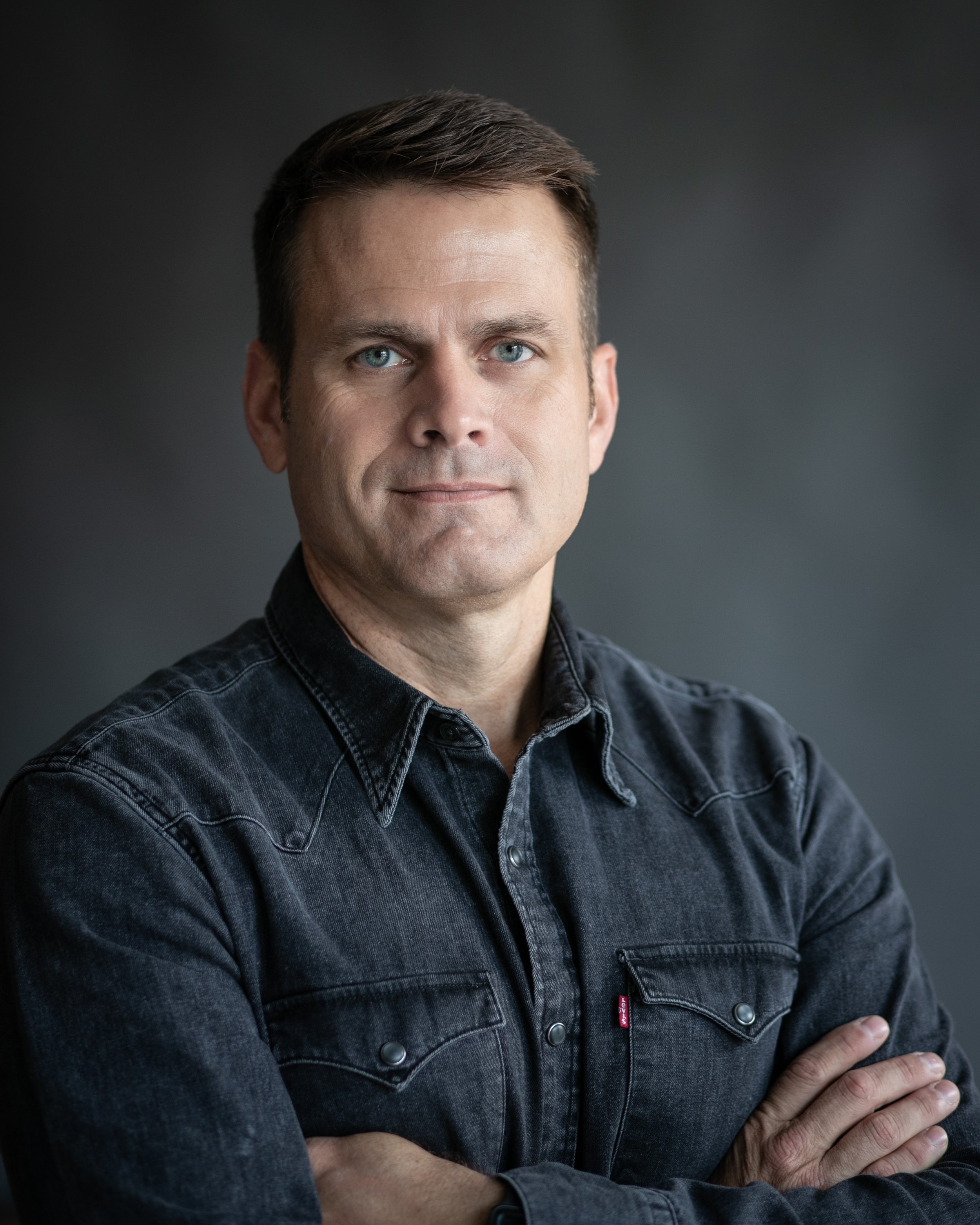
about Mike Rusch.
Mike has called Bentonville, Arkansas home since 1986. He graduated from Bentonville High School and attended the University of Arkansas, earning a degree in Computer Science and Computer Engineering.
Mike is a Veteran of the United States Marine Corps and began his career at Walmart, Information Systems Division before moving on to iconic companies such as Hershey Foods, The Walt Disney Company, and Nickelodeon/Viacom.
In 2010, Mike Rusch joined the startup team at Pure Charity, an organization developing world-class fundraising, technology, and strategy solutions for nonprofit organizations striving to address some of the world's most difficult problems. Mike serves as one of the Managing Directors of Pure Charity today where they have helped over 1,250+ nonprofits raise over $250MM.
Mike currently serves on the Board of Directors for several nonprofits, including 99 Balloons, Laundry Love, City Sessions, Mercy House Global, and New Beginnings Northwest Arkansas. Additionally, he served as a founding Board member of Canopy Northwest Arkansas, helping to create the first Refugee Settlement site in the State of Arkansas.
In addition to his professional and nonprofit engagements, Mike has been a part of the Northwest Arkansas cycling community. As an avid Gravel Cyclist, he has participated in endurance events such as Unbound Gravel XL, MidSouth, Big Sugar Classic, Rule of Three, Telluride Gravel, Birdeye Gravel Fest, and attempted Leadville MTB 100 but failed at mile 79 (that story is not over). He has also completed other endurance events like the Ironman Triathlon and numerous Marathons and long-distance cycling events including the Arkansas Traverse & Arkansas Graveler.
Mike was a part of the first graduating class of the Northwest Arkansas Community College Bicycle Assembly & Repair Technician accredited certification program and is currently a member of the Northwest Arkansas Community College teaching staff as an Instructor for the Continuing Education Program for Bicycle Maintenance Fundamentals.
He was a part of starting Bentonville Ride Club as a place of deepening local community around the thrill of riding in our community and helped organize events like the Arkansas Traverse (Documentary Link) and rides across Missouri and into Oklahoma.
Mike married the most incredible woman in the world, Corrie, and together they have four children. His love for a great story, whether told through nonprofit endeavors, professional achievements, or cycling adventures, reflects his appreciation for the diverse and interconnected narratives that shape our lives.
route.
episode notes & references.
episode outline.
- Introduction and Setting the Scene: 00:01:00
- Questions of the Land's Past: 00:04:00
- Transitioning Landscapes: 00:06:00
- First Nations and Early Cultures: 00:07:00
- European Contact and Consequences: 00:09:00
- Manifest Destiny and Expansion: 00:10:00
- The Indian Removal Act: 00:11:00
- Arkansas Statehood and Civil War: 00:12:00
- Modernization and Transformation: 00:13:00
- Reflections on History and Mythologies: 00:14:00
- Closing Thoughts on Belonging: 00:16:00
- Preview of Next Episode: 00:21:00
- Route for Exploration: 00:22:00
- Final Reflections and Closing Quote: 00:23:00
episode transcription.
mike.: [00:01:00] the wheels of my bike, they struggle to keep the momentum that I've rightfully earned as the ground pushes upward in front of me. Losing speed, I have to shift my body to a standing position in a final attempt to maintain my speed. The wheels, heavier with every turn of the pedal, like something is pushing against them, like something is silently working against me.
It may be a short and insignificant climb, it may not even be worthy of being called a climb, but today I can't escape the feeling that this is going to be harder than I was prepared for.
You see, no one comes this way, no one would take this road on purpose. The road doesn't really go anywhere unless you know the reason that you would want to come this way. And not many do, myself included. In fact, I'm not fully sure why I came this way today, except maybe, other than the sounds of my tires on the gravel road beneath me, it's quiet here.
The gravel roads in this part of Benton County are largely left to the mercy of time and weather. They're seldom touched by the hands of Judge Moerhing's county road crews, And so with each rainfall, the limestone gravel is slowly washed away. It exposes the bare, unyielding bedrock beneath [00:02:00] it. It's a bedrock that was created at the beginning of time without any concept of a gravel cyclist, or rubber tires.
So it creates a really delicate dance between a cyclist and their bike. I have to negotiate in real time with my bike who will absorb the fury of the road below me. It's a constant reminder that I'm never entirely separated from the land. No matter how I ride, I'm forever connected to the earth below me. Today, well, I'm just thankful to be above it.
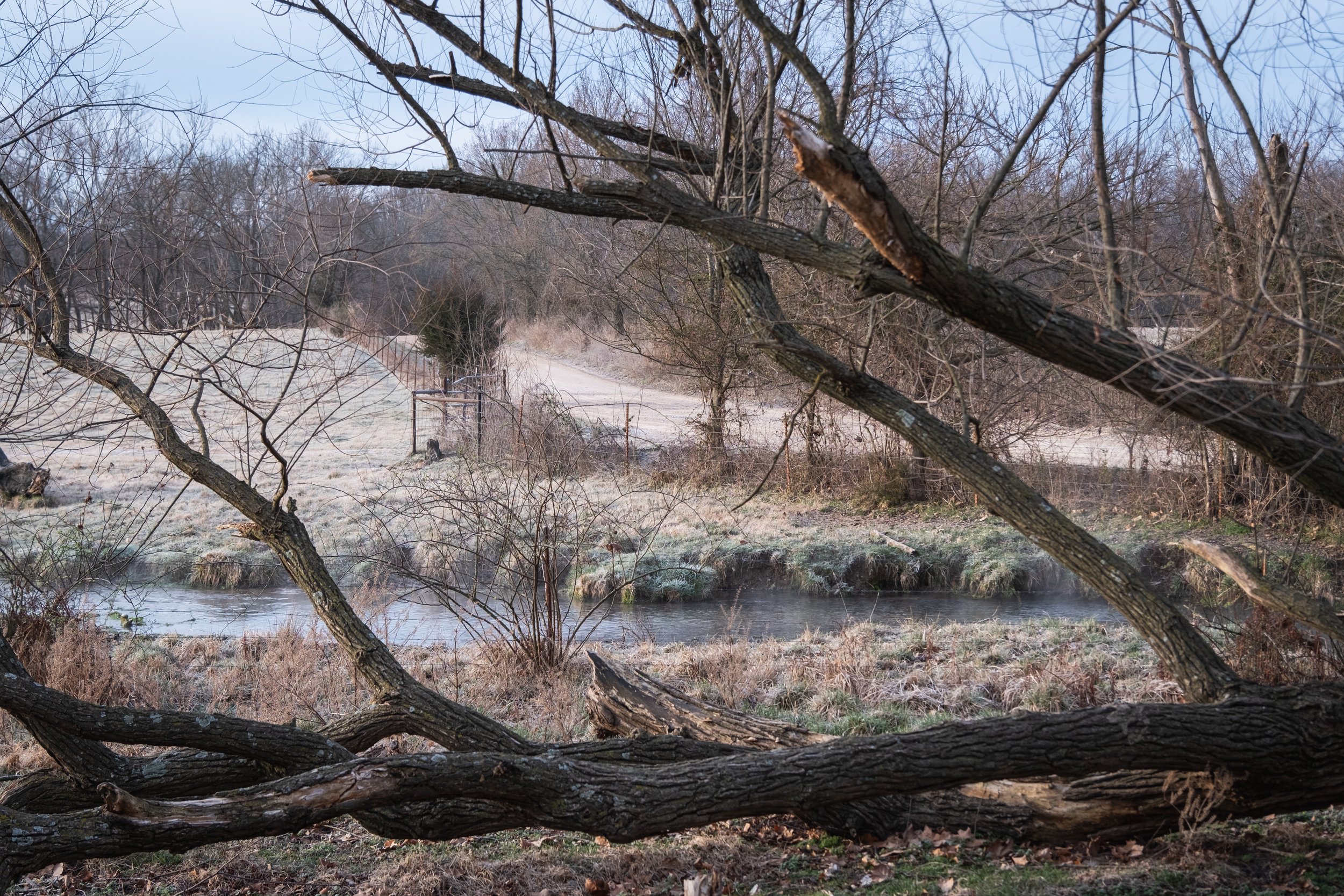
I'm passing an old spring southwest of my hometown in Bentonville, Arkansas, and as I approach the small clearing in a rusted fence line, my legs ask for permission to stop.
The sign reads, "Restricted Area, No Trespassing."
But the fence in front of me, like a mall security guard, says, It doesn't seem ready or capable of enforcing that directive. The heel of my foot moves to the right, which releases the clip on my shoe from the pedal. And as my foot touches the ground, it shifts slightly to find its place in the Ozark gravel below me. It's cold today, but the sun still shines low in the winter sky. The temperature on this winter day, it won't let me stop for long.
In fact, it's already starting to work through my outer [00:03:00] shell and the wool-insulating layer beneath where it turns the sweat cold against me. January is cold on the bike. The gravel roads in the winter, they're hard and they're dry. It's a difficult time of year to ride, much less to begin a new journey. The days are shorter and the winter sky is gray. It's uninviting. It's easy to listen to the voices in our heads urging us to stay home, to stay close, And to not venture too far outside of our comfort zones. It lends itself to the solitary few who are willing to brave the elements and follow these roads wherever they may lead.
And that makes my mind drift back to last year. In this kingdom of gravel, summer is the season of waiting. It's a type of advent. In October, it's that celebration of a promise, a type of salvation. But December and January are the months of fasting. They are the cold and barren places that are waiting for renewal, that are waiting for a promise.
These months, they've never known a spring. Like an ancient faith, they have been told of the promise of a spring resurrection. The land, however, whispers of a vernal equinox, the people of Easter, and [00:04:00] wavering between the two. I'm not really sure what to believe yet in both. There's a common hope. And that hope is that what may seem dead is really only waiting for the sun.
So for now. We wait.
And here under the bare branches that provided shade in the warmer months. I set my focus to the field towards the South. There's a hayfield here beside the gravel road. But other than that, from my view, things could have been this way for centuries. I know the land has changed, But I have to rely on my imagination to show me where. In the silence, in this quiet place where my movement has stopped, I hear myself starting to ask,
"what happened here? what happened in this land before the hayfields and the gravel roads, the broken fences, before there were territories and states and borders?"
And then the questions, they start to flow like stormwater. They become unstoppable.
"What stories does this place hold? What mythologies, what pain, what life, what ghosts? Who's walked this land? Who's worked this land? Who's lived here? Who died here? Who remains here?" [00:05:00]
And it's a question I barely have the courage to ask because the graves in the hayfield to the south of me, they hold brutal memories that still haven't been fully acknowledged. I've lived in Northwest Arkansas for 35 years now and to these questions, honestly, they never mattered to me before. It never had an impact to my life or to my plans. And maybe that's exactly the problem.
My questions of this place, they're all centered around me. Me, quintessential theme of all Western philosophy. Me, myself, and I. Some call it the unholy trinity of Western civilization. The individual of me, upon which very few of these stories actually include.
But this is not just land, it has a story. It is a place with meaning, and it was I who needed to understand it, because this land has already known me. It already knows my story, or at least people like me, and the blood in the ground could testify to it. And if this place was going to become a part of my understanding of home, there was work that I needed to do.
Here today on this gravel road, I'm about halfway between where we started and where we're going. [00:06:00] As the crow flies, I'm about 16 miles to the west of Brightwater Crossing on Little Sugar Creek. That's where Season 1 began. But in this short distance, the landscape has taken on a new identity. This is the beginning of the transition to the Great Plains. The first name of this place has been lost to history.
The Osage call this place Nì Ŏkašį”. I'm sorry, you'll have to forgive my language skills.
But then the Spanish flag flew here and next to the French flag. It was called the Louisiana Territory until the United States flag flew over this land, and then it became the Arkansas Frontier, then Indian Country, Lovely's Purchase, and its modern border is only 16 miles to my west. its name today is derived from a Choctaw Indian word that means "red people" or commonly referred to as Oklahoma.
This is a borderland, a place where lines on maps and fences, property lines, rivers and roads, they become the embodied realities of the laws and systems and institutions of our American story. Some may call it an American mythology that changed this land and changed the people [00:07:00] here.
first nations.
mike.: However, before there were borders, this was an ancient land with a developed culture. A culture that thrived. It's believed that between 200 and 400 of the Common Era, the Dhegiha Siouan tribe started migrating down the Ohio River Valley to the confluence of the Mississippi and Ohio Rivers.
It's common for people to say these tribes were known for their mound building, but it was more than that. These are earthworks, as some call them. An example of that is the city of Cahokia, which is near present-day St. Louis. It was one of the largest and most sophisticated urban centers on the continent. It had extensive trade networks, complex social organizations, and advanced agricultural systems based around corn cultivation.
The Osage and the Quapaw Nations descended from this larger group of Siouan-speaking people that were split during their westward migration. The Quapaw followed the Mississippi River downstream and settled in its confluence with the Arkansas River. There they built communities along the Great River focusing on agriculture and establishing trade networks that connected [00:08:00] them with other tribes and eventually early European explorers. The Osage, they crossed the Mississippi River and moved into the plains, controlling large areas including parts of present-day Arkansas, Missouri, Kansas, and Oklahoma. The Osage were skilled hunters and warriors, and they used the Ozarks and surrounding areas as seasonal hunting grounds that were critical to their survival.
europeans.
mike.: And then in 1541, everything changed.
A Spanish explorer, a foreigner, Hernando de Soto, led an expedition into present-day Arkansas and made contact with the Quapaw people. De Soto was one of the earliest Europeans, if not the first, to enter the region, and with him, violence and disease that devastated indigenous populations. De Soto's expedition failed and no lasting Spanish presence would remain after him. But the stories of this place made their way back to Europe, stories of a great Mississippi River and a new land. And so those would be the stories that would call for others to follow.
A hundred and twenty years s later in 1682, French [00:09:00] colonizer LaSalle claimed the Mississippi River and all the lands drained by it for France. He named it Louisiana after his king and created a new border despite the estimates that between 50 to 70 indigenous nations already lived on this land.
And then another 120 years later by 1803 further events in Europe and a revolution in Haiti Led to Louisiana becoming part of the United States through what we call the Louisiana Purchase, as Napoleon was giving up his aspirations of a new American colony.
manifest destiny.
mike.: The United States purchased 828,000 square miles, or a half a billion acres, of new territory west of the Mississippi River. Again, no indigenous claims were considered. But this doubled the size of the United States, and it rooted the idea that American expansion across North America was God's will. Manifest Destiny took root, and it laid the foundation for the new country's westward expansion.
treaty with Fort Clark.
mike.: In 1808, the Treaty of Fort Clark [00:10:00] between this new United States nation and the Osage nation, ceded 52 million acres of Osage land in Missouri and Arkansas, north of the Arkansas River, to the United States. In return, the Osage were promised an annual $1,200 payment, which is equivalent to about $164,000 today.
1818 treaty with Quapaw.
mike.: In 1818, the treaty with the Quapaw Nation seated approximately 30 million acres of the Quapaw's homeland to the United States. This encompassed much of what is now the state of Arkansas. In exchange that Quapaw were to be compensated with an immediate payment of goods valued at $4,000, followed by the promise of annual deliveries worth a thousand dollars for 11 years.
The name Arkansas came from the French interpretation of the word for the Quapaw people, or O-gah-paw as they refer to themselves. And as white settlers began to occupy the homelands of both the Quapaw and the Osage, it transformed the region into what was called the Arkansas frontier.
And while the Quapaw's name remained tied to the state, their presence and sovereignty over the land [00:11:00] was removed.
then in 1819, Arkansas was officially organized as a territory of the United States.
indian removal act.
mike.: In 1830, the Indian Removal Act, signed by President Andrew Jackson, shifted U. S. policy from treaties to removal, and authorized the forced relocation of Native nations from their ancestral homelands to designated Indian territory west of the Mississippi River to the Arkansas frontier, primarily in present day Oklahoma.
And then, after much of the frontier land had been settled, and the removal of Native Nations largely complete, it opened the land for further agricultural and commercial development.
arkansas.
mike.: And on June 15th of 1836, Arkansas was formally admitted to the Union as the 25th state. And like other southern states, Arkansas developed a plantation economy based on cotton and slave labor. It was a significant factor in the state's social and economic development leading up to the Civil War. And then on May 6th of 1861, the Arkansas Secession Convention reconvened and the delegates voted overwhelmingly, 69 to 1, to [00:12:00] secede from the Union, making Arkansas the ninth Southern state to join the Confederacy. And with it, a new border was established. Seven years later, after about 10, 000 lives from Arkansas had been lost in the Civil War, Arkansas officially rejoined the Union on June 22nd of 1868, and an old border was returned.
After the Civil War, Arkansas followed the path of Reconstruction followed by the rise of Jim Crow and segregation, economic changes, and the Great Depression, including the New Deal, the Civilian Conservation Corps, and the Works Progress Administration, or the WPA. And then came World War II, and with it, internment camps to southern Arkansas that held American citizens of Japanese descent. Then, further economic diversification like the poultry industries, manufacturing and transportation, the civil rights movement and school integration, the rise of Tysons and J. B. Hunt and Walmart, and eventually national prominence as a man from a hope was elected the 42nd President of the United States.
But those are just the headlines of [00:13:00] Arkansas and Northwest Arkansas story. Behind those headlines are other stories that have been hidden and their significance unknown to many.
stories.
mike.: These are the stories I seek, stories to understand the fullness of our collective history, stories to better understand myself today, and stories that can help lead our community forward. I am only beginning to understand how my sense of belonging is deeply rooted in history, not just a record of events, but is a force that has shaped the foundation of how I understand myself, my community, and our collective place in the world.
The facts of history, they don't change, but our understanding of how history shaped our present day especially when we're able to consider the full account of that history. Well, these meanings shape the stories that we tell, the values that we hold, and how we understand both our past and our future. They are never created in isolation. They are passed down through generations and shaped by the understanding of others. That influences how I, in turn, shape those around me.
My environment, meaning my culture, my experience, and my [00:14:00] assumptions, they affect what I see, what I'm taught, and even what I choose to forget. And herein lies the critical truth. When our culture decides to remember something, it is also deciding what will be forgotten. Most often, these decisions have been made for me, without my awareness or my understanding.
It's in this tension between memory and forgetting, this is where our collective mythologies are created. Mythologies, meaning the stories we tell ourselves about who we are and our place in the world.
This season isn't about rewriting history, it's about finding a complete history. Finding the parts of the story that have been overlooked, ignored, and left untold. The parts of history that I have not learned about in my history books.
I have to acknowledge that so much of what I know as history has been recorded primarily from the perspective of white European settlers, slaveholders, landowners, industrialists, and capitalists, most of those white men like myself. These dominant narratives have shaped our mythologies. Just as our mythologies have shaped our understanding of history. [00:15:00] Our institutions, the schools, governments, churches, and civic structures, they serve as carriers of these mythologies, embedding them into the ways we learn, govern, and live. They reflect and reinforce the stories we choose to elevate and the ones we silence becoming both the product and the perpetuator of what we believe about ourselves and our place in this world. And over generations, these mythologies are assumed as facts. They become part of the foundation of our own identity and our society.
This season is about remembering. It's about ensuring that the mythologies I've accepted as fact do not go unchallenged. I won't claim this as a comprehensive history no single account ever could be.
But I am asking that we listen closely to the voices and the stories ahead of us. These are the voices of those who have not always been given a chance to be added to our history making, at least not to the version of history that I learned. This is not a distant history lesson, but a journey to help us all remember and reconnect.
Ahead is the [00:16:00] story of Northwest Arkansas, told through those who are here today, and who are also asking the question, what happened here, and what does it mean for us now? It is a story told by those that have been deeply impacted by our histories, and those who continue to be shaped by them today.
This is the road ahead, and we will travel it together, making the choice to have an honest and authentic conversation about ourselves, our place, and the community we are shaping today. To those who might push back, this is not a reimagined history. This is the work of creating a more complete history, even if it challenges the convenience of our current mythologies.
This season we'll explore how our national and state mythologies, those symbolic stories that communicate our values and belief, how they shape our understanding of history, and it will examine how history, in turn, reshapes those mythologies.
Now I'm approaching this season with an honesty, a curiosity, and a willingness to confront not only what I know, but what has been left out. I believe that it is through this work that we are all able to deepen our [00:17:00] connection to the place we call home. I believe this is the work of wholeness.
The writer, John Steinbeck said,
"we only have one story. All novels, all poetry are built on the never-ending contest in ourselves of good and evil. And it occurs to me that evil must be constantly respond while good, while virtue is immortal."
And so from the gravel road where I currently stand, my starting position is this. I simply seek the immortal.
a year ago.
mike.: It was a year ago when we first started Season 1 of The Underview. From this gravel road in western Benton County, I can see the land that was once the Arkansas frontier. I can feel the pull of westward expansion and the delusion of manifest destiny, and all the struggles for land and power that shaped early Arkansas and American history. All of those mythologies not only lived here, They thrived here, and if you look closely, you can see that they're still here.
The graves in the hayfield to the south of me, and on the slope behind me, they bear a silent witness that serves as a stark reminder of [00:18:00] all of these stories. They aren't stories from somewhere else. They're stories from here. They're stories from Northwest Arkansas.
There are stories of this land, stories of this place, stories layered on top of each other that continue to shape us today. They continue to shape our communal theology of place.
I do understand the desire to look forward. We should. But does that actually limit what's possible?
The naysayers will argue it's not relevant to where we are today, and I would say it's never been more relevant.
Business leaders may claim that they don't have time for this, but I would say we must make time if we want to lead with clarity and purpose.
Political leaders may dismiss this as revisiting a past that divides us, calling it a distraction from progress. Yet I would argue that without a true and complete picture of our history, we'll forever remain hindered in moving forward.
Religious leaders may say our faith teaches forgiveness, so we should leave that past behind us. But I would say true forgiveness is only possible when we confront the harm done and [00:19:00] seek repair.
Others may say the past is the past, we can't change it, it only divides our community. But I would say the opposite. Understanding our community stories can be the bridge to a better, deeper understanding of each other and ourselves.
And so I'm going to repeat how we ended season one from this thought from Wendell Berry that I asked my dad to read.
gregg rusch.: "To deal with so great a problem, The best idea may not be to go ahead in our present state of unhealth to more disease and more product development. It may be that our proper first resort should be to history to see if the truth we need to pursue might be behind us where we have ceased to look."
mike.: and so you've heard me speak often about the borders we've created. The Borders that have driven some forward, borders that have held others back. Borders that have shifted over time across the land, displacing people in their wake. This season we'll explore not only those physical borders, [00:20:00] but also the ideas and policies that act as borders.
Economic borders, global borders, local borders, borders in our minds and borders in our hearts. And if you're willing to confront and acknowledge these borders, this season is for you. It will challenge us all to ask the hard questions.
Are there borders that we are willing to cross to truly understand our place?
And if you're willing, as before, I can't promise this journey will be easy, but I can promise there is great beauty here.
So I want to welcome you to season two and to the ongoing pursuit of a collective understanding of who we are and what we believe about this place that we call home, our communal theology of place.
This is The Underview, an exploration of the shaping of our place.
next episode preview.
mike.: Well, I want to thank you for listening. We've got a lot of ground to cover this season.
And so, to begin with, [00:21:00] we're going to go back as far as we can. I have the privilege of talking to our Arkansas State Archaeologist, Dr. Melissa Zebecki She sits with me to take me all the way back to the beginning of known time to set a foundation for how we can view today's understanding of our place.
melissa zabecki.: I absolutely don't want to justify what happened. But, back then, we're talking about pre science culture. the white folks did not under, not that they would have cared if a scientist would tell them this, and unfortunately, people still sometimes don't care when scientists tell you this.
We are all exactly the same. We share the exact same everything. Nobody's smarter than another person.Nobody has more athletic capability than another.
Nowadays, we know that people are the same. We have the genetic, the DNA proof that everybody's the same. And like I said, unfortunately, some people still don't believe that. [00:22:00] We're all the same. we just we just fulfill our needs differently. And some people don't like that.
mike.: Well, I love my conversation with Dr. Zabecki and I really look forward to sharing it with you. I think you're going to walk away with it just like I did, with a new awareness of the foundation beginnings of this place.
route.
mike.: And for this episode, I've included a route in the hope that you can go and experience the beginning of this story for yourself and with others.
The route begins in downtown Bentonville and heads west towards the border of Oklahoma, taking you through some of the most important places related to the origin of this season. I have intentionally not marked some areas to help hold the privacy and dignity of some sacred sites. However, we will revisit these stories in the coming episodes to share more.
And so I want to leave you today in closing with one more quote from author and poet Wendell Berry. He says,
" the past is our definition. We may strive with good reason to escape it or to escape what is bad in it. But we will escape it only by adding [00:23:00] something better to it."
So I want to thank you again for joining us this season. And thank you for the work that you're doing every day to build our collective community.
Welcome to Season 2, The Story of Northwest Arkansas, an exploration of the shaping of our place.