
the story of northwest arkansas with Mike Rusch.
In this final episode of season two, host Mike Rusch reflects on the story of Northwest Arkansas from Indigenous removal and slavery to immigration, labor, and power today.
season 2, ep. 38.
listen.
episode notes.
In this final episode of season two, host Mike Rusch takes us back to the gravel road where the story of Northwest Arkansas began, a road overlooking unmarked graves, a place of silence and memory. From that ground, the season has traced centuries of history: Indigenous nations removed from their homelands, enslaved people forced to labor, families rebuilding after the Civil War, immigrants shaping new communities, and the global systems of capitalism, faith, and labor that continue to define the region today.
This episode weaves together the voices of archaeologists, historians, descendants, organizers, and elders who guided us through the hidden stories of this land. It is both reflection and reckoning: a recognition that systems of power and exclusion remain, but also that we hold the possibility of repair, renewal, and belonging. As the season closes, we are reminded that the story of Northwest Arkansas is not finished. It is still being written in the lives of those who call this place home.
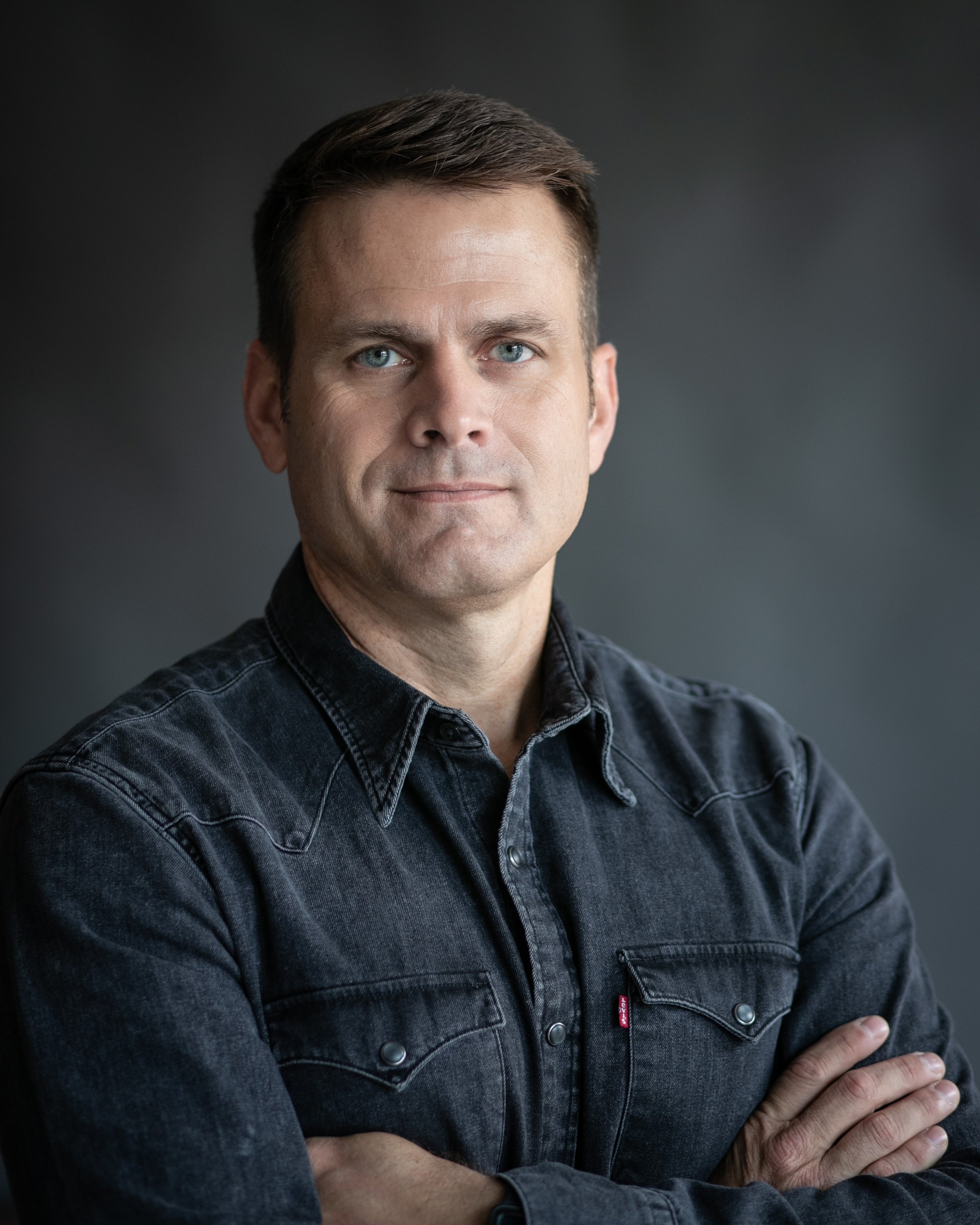
about Mike Rusch.
Mike has called Bentonville, Arkansas home since 1986. He graduated from Bentonville High School and attended the University of Arkansas, earning a degree in Computer Science and Computer Engineering.
Mike is a Veteran of the United States Marine Corps and began his career at Walmart, Information Systems Division before moving on to iconic companies such as Hershey Foods, The Walt Disney Company, and Nickelodeon/Viacom.
In 2010, Mike Rusch joined the startup team at Pure Charity, an organization developing world-class fundraising, technology, and strategy solutions for nonprofit organizations striving to address some of the world's most difficult problems. Mike serves as one of the Managing Directors of Pure Charity today where they have helped over 1,250+ nonprofits raise over $250MM.
Mike currently serves on the Board of Directors for several nonprofits, including 99 Balloons, Laundry Love, City Sessions, Mercy House Global, and New Beginnings Northwest Arkansas. Additionally, he served as a founding Board member of Canopy Northwest Arkansas, helping to create the first Refugee Settlement site in the State of Arkansas.
In addition to his professional and nonprofit engagements, Mike has been a part of the Northwest Arkansas cycling community. As an avid Gravel Cyclist, he has participated in endurance events such as Unbound Gravel XL, MidSouth, Big Sugar Classic, Rule of Three, Telluride Gravel, Birdeye Gravel Fest, and attempted Leadville MTB 100 but failed at mile 79 (that story is not over). He has also completed other endurance events like the Ironman Triathlon and numerous Marathons and long-distance cycling events including the Arkansas Traverse & Arkansas Graveler.
Mike was a part of the first graduating class of the Northwest Arkansas Community College Bicycle Assembly & Repair Technician accredited certification program and is currently a member of the Northwest Arkansas Community College teaching staff as an Instructor for the Continuing Education Program for Bicycle Maintenance Fundamentals.
He was a part of starting Bentonville Ride Club as a place of deepening local community around the thrill of riding in our community and helped organize events like the Arkansas Traverse (Documentary Link) and rides across Missouri and Oklahoma.
Mike married the most incredible woman in the world, Corrie, and together they have four children. His love for a great story, whether told through nonprofit endeavors, professional achievements, or cycling adventures, reflects his appreciation for the diverse and interconnected narratives that shape our lives.
episode outline.
- Opening on the Gravel Road in Western Benton County: 00:00–05:36
- Season Recap & Purpose of the Journey: 05:37–06:37
- Origins of Place (Dr. Melissa Zabecki & Jazlyn Sanderson): 06:38–08:52
- Settler Colonialism & Mythologies (Melissa Horner): 08:53–12:23
- Warnings of Disconnection & Costs of Belonging (Melissa Horner): 12:24–13:09
- Voices of the Quapaw Nation (Betty Gaedtke & Barbara Kyser-Collier): 13:10–15:21
- Trail of Tears & Removal (John McClarty & Boyce Upholt): 15:22–17:39
- Early Settlement & Enslavement (Steve Anderson & Dr. Kelly Houston Jones): 17:40–20:27
- Preservation & Reckoning with History (Vanessa McKuin, Dale Phillips, Rachel Whitaker, Chelsea Stewart): 20:28–25:46
- Immigration & Exploitable Labor (Emily Pianalto-Beshears & Larry Foley): 25:47–28:17
- Mythologies of the Ozarks (Dr. Jared Phillips): 28:18–30:21
- Civil Rights & Erasure (Dr. Michael Pierce, Tommie Flowers Davis, Alli Quinlan): 30:22–33:10
- Ongoing Change & Its Consequences (Dr. Jared Phillips): 33:11–34:54
- Latino Immigration & Global Capitalism (Dr. Steven Rosales & Olivia Paschal): 34:55–36:40
- Workers’ Voices & Organizing (Magali Licolli & Irvin Camacho): 36:41–38:48
- Religion & Power in the South (Dr. Jared Phillips): 38:49–40:10
- Reckoning with History (Dr. Kelly Houston Jones): 40:11–41:41
- What Does It Mean to Be Fully Human? (Dr. Todd Stockdale): 41:42–42:50
- A Vacancy of Belonging (Melissa Horner): 42:51–44:34
- Settler Colonialism as an Ongoing Structure (Melissa Horner): 46:09–47:01
- Warnings from the 1850s & Polarization (Dale Phillips): 47:02–47:53
- Reconnection & Renewal (Robin Wall Kimmerer quote): 47:54–48:41
- Closing Stories – Rock Van Winkle, Jerry Moore & Barbara Carr: 48:42–51:31
- Reflections on Power & Community Memory: 51:32–53:03
- Conclusion on Renewal & Responsibility (Mike Rusch): 53:04–55:13
- Reading of Wendell Berry’s The Dream (Gregg Rusch): 55:14–57:19
- Closing Reflections on Renewal & Belonging: 57:20–59:22
- Post-Credits Reflection & Season Wrap-Up: 59:23–End (≈1:01:00)
episode transcript.
introduction.
[00:00:56] mike.: Well, it was a cold January day when I was first here. This out of the way gravel road in Western Benton County. It overlooks a hayfield where an old story is buried. This land was filled with silence. The silence of those buried here, unknown names and unmarked graves. Yet even in their silence, I could still sense the weight of the structures that placed them here.
It's August now, here in the Ozark Mountains of Northwest Arkansas. The early spring rains are a memory. And the summer sun still rules the sky. Even though the days have started to grow shorter.
School has begun, and with it, a familiar rhythm has returned, and there's a familiar hope that's not too far behind, and that's the promise of October.
Even though it feels farther away than it really is, I still feel the anxiety inside to hurry towards it because in this settled place, October brings with it a much needed grace.
A time when the land speaks back to acknowledge the gratitude it holds for those of us who have been waiting so patiently for it. To honor the promise of October's coming. We must find contentment in the moment. And while that heat is predictably difficult, the swimming holes along little Sugar Creek have brought some relief.
And for a gravel cycle as such as myself, this is a season of waiting, a season of advent of sorts in October, a type of salvation and this kingdom of gravel.
My bike GPS, is that I've ridden a little over 3000 miles in the past eight months since we began this season. And while we have come a long way, it also tells me I'm not where I should be. I'm pretty far behind my pace in order to reach my annual mileage goal.
I could blame the longer winter or the spring rains, and maybe I should. However, this year has been different and my focus has been pulled in many other directions, not from the gravel roads necessarily, but my focus has drifted as our national posture has changed towards the world, our people, and our hopes.
It's taken its toll.
Even now, I look around my city and I see these ancient patterns returning in our schools where there's battles over education that are tangling with the return of religious nationalism, in our neighborhoods, isolated behind gates and garage doors that hide questions about whether our neighbors are in this country legally or not, and in our city council meetings where inclusion itself has now become divisive.
I wish I could say that these are new problems and we could find new solutions, but we're not experiencing new problems. We're experiencing the same answers to the questions that have haunted this place for centuries.
Who gets to belong? Or stated more clearly who should be allowed to belong?
I've spent the past two years asking our community what it means to belong here, and I've found that almost universally, everyone carries the same fear and that fear is that someone else is trying to take away their ability to belong.
You can hear it in the way people talk about their neighborhoods or their jobs, and you can see it in who shows up in our public spaces and who stays home.
But it's the same fear that's been cycling through this place for two and a half centuries or more.
Indigenous people, fearing removal, enslaved people, fearing violence, and complete erasure of the humanity, immigrants fearing deportation, and working families fearing displacement. The faces change, but the fear remains constant, and this fear is doing the real work of that division.
So if the world feels different now, that may just reveal something about your place in this story. For many of us, this isn't the world changing. It's just the moment that we see clearly what's already been here.
However, throughout this season's conversations, I've come to understand and see this more clearly. The relationships that I hold with this place that are both physical and of memory, they're changing. The relationships have grown and their roots have gone deeper, and my view has become wider. The story that was once hidden beneath the surface, it's risen. It's been spoken through the voices of those who have carried it in silence for generations.
In January, that story felt faceless. Yet here in August, after listening to our guests this season, that story has found its voice in this place, and it speaks with a clarity that I could have never anticipated. It's allowed me to see that those systems of power did not disappear. They have just adapted and we see how they are still adapting today. And that clarity has been the embodiment of the belief that we as a community can simply do better than fear. That we don't have to accept it, and we have the ability to reconnect and to remember, and to repair and to renew. And we can rightfully reckon with our own stories, and by facing them, we can move through them together.
And on the other side of that reckoning, I see that we have a power to dream, a different dream for our community. One that includes a place for everyone to belong. We have the power to change our stories, to learn from our past, and to recenter those priorities, to return to something true, something good and something beautiful.
season recap.
[00:05:37] mike.: We began the second season of the underview, the story of Northwest Arkansas, to trace the stories that have shaped this region from the origin of our place, from the early conflicts between indigenous nations and European settlers, to the creation of the state and the ongoing struggles for belonging.
This was not just a journey into the past. It's been an exploration of northwest Arkansas through the voices of those that are living here today. Whose lives have been profoundly shaped by our shared and often unknown history.
Our region didn't just emerge out of nowhere. Over the centuries, those who have gone before us, they have built institutions and mythologies. And today, as we see this unprecedented economic growth alongside growing social divides, we want to understand if those forces from the past are still shaping us Today.
Our goal was to understand these stories and to work together to create a communal theology of place, meaning the things that we believe about ourselves in the place that we live.
This is our collective work, and this has been our collective journey.
the origin.
[00:06:38] mike.: we began the season with Dr. Melissa Zabecki, our state archeologist, who shared with us the origin of our place and about the rich culture that existed here.
[00:06:46] melissa zabecki.: History started here probably somewhere between 10 and 14,000 years ago. There used to be a belief that Native Americans did not settle here, or they didn't have a long term settlements here, and we're finding out more and more that's false. People did live here for long periods of time and people settled here. This place was filled withwhat people would think of as high civilization. Incredible trade networks from all over the country, all over the continent.
[00:07:15] mike.: But it was also much more than that as Jazlyn Sanderson shared that this story demonstrates the resilience of a people, many people.
[00:07:22] jazlyn sanderson: Not only is it a historical story of the indigenous peoples that were here before us, but it's a story of perseverance. It's a story of how these people overcame the environment and tragedy around them and how they came out on the other side.
Today there are 574 federally recognized Nations within the United States. There are over 600 in Canada, and there are over 800 in Latin America.
[00:07:51] mike.: We began with the relationship between place and people that for millennia, this was a thriving place, not an empty one. And then everything changed
[00:08:00] melissa zabecki.: and then they were living perfectly fine until the Europeans came through and messed everything up. Eventually everybody got moved out to Indian Territory in Oklahoma and lost so much of their culture because they were forced to speak English and of course moved into housing that they weren't used to living in traditionally, so that happened
and then we have white settlers, right?, And unfortunately they're enslaved folks that were brought in and then so you think about it, this happened three, four, 400 years ago that people were starting to settle here. 400 years is not anything to shake a stick at, right? So if you have relatives that were here for 400 years you feel like you have a claim to that land, so it's still, it's hard to tell people but no, you still are immigrants. There were people here before you, you just kicked them out.
the framework of settler colonialism.
[00:08:53] mike.: During this process of European settlers arriving, and as those two very different cultures began to interact, a new type of relationship would take root. We've read about this in our history books, in our schools, but I wanted to hear this from a new perspective, from those who represent a people and a culture that were here long before the arrival of white European settlers.
To truly understand what this contact between indigenous people and European settlers set in motion here, we needed a language for the structures that were brought here and imposed on the people.
Melissa Horner, a doctoral candidate and a citizen of the Manitoba Mattee Federation, and a first generation unenrolled descendant of the Turtle Mountain Band of Chippewa came to share with us the ideological basis for those systems known as settler colonialism.
[00:09:40] melissa horner.: In thinking about settler colonialism as a framework of society, it automatically corrects this narrative of settler colonialism being an event that happened in the past, that was horrible, and that a few explorers who came over on ships and hats did. That's not what it is. That did happen, of course, but that's not the totality of settler colonialism. Today, and in the past 500 years, it's an ongoing process that shapes just about every domain in U.S. society from education, to media, to law, health, medicine, environment, what have you
american mythologies.
[00:10:23] mike.: But this ongoing process doesn't operate in the shadows. It wraps itself in our most cherished American mythologies, westward expansion, manifest destiny, and the idea of the frontier. And these aren't just historical events, they've become the moral and religious justification for an entirely different system of relationships to take root between land and people. A system that would form our American mythology as our divine right.
[00:10:49] melissa horner.: Manifest Destiny. It's this idea that the United States was destined by God to expand its dominion and spread democracy and capitalism across the entire North American continent. These are realities that are trying to be fulfilled through a combination of legal, religious, political, spiritual, cultural avenues.
[00:11:16] mike.: This divine mandate fundamentally transformed how people viewed their relationship to this place itself. What had been a relationship became property. What had been reciprocity became extraction. The change was more than economic. It was spiritual, redefining the very nature of how humans connect to the land and to each other.
relationality.
[00:11:35] melissa horner.: And so if we think about it as settler colonialism has put in place a lot of social behaviors, a lot of cultural norms that really indicate to us that the deep and wide and reciprocal relationships between all of these things don't really exist, then it creates a really perfect sort of slot for other kinds of relationships to exist, which are primarily rooted in property and ownership in the United States.
I think this is really important *to really understand some of the foundational Basis of settler colonialism comes down to really differing understandings of relationships*
[00:12:23] mike.: and with this fundamental shift in how we understand relationships, Melissa left us with a sobering warning about what this costs all of us.
a warning.
[00:12:32] melissa horner.: Even though the settler colonial systems and structures that are in place in this country do privilege different people differently and harm different people differently.
It doesn't spare anybody. there are costs to everyone, and one of the things is the cost of not belonging to a specific place, knowledge system, language that we can track for centuries in terms of white folks, white communities in the United States. That's a loss. And we see that over and over again through different symptoms and manifestations of disconnection in this country.
[00:13:09] mike.: For most of us, this is the beginning of our understanding of what it means to belong to this place and to each other. We're a disconnected people that often view land and people as something to change and to control and to conquer. This isn't an abstract theory, it's the living memory of those who lived on the other side of this system.
quapaw nation.
[00:13:28] mike.: And to better understand this, we traveled to Oklahoma to talk with tribal elders of the Quapaw nation, the first people of Arkansas, and of which Arkansas draws its name. We had to remember who was here first.
The Quapaw whose story has always been bound to this land, even when others tried to erase it. I was able to sit with Betty Gaedtke, a member of the Quapaw Nation Cultural Committee. She's working to reclaim her culture through rescuing the ancient ways of pottery, while keeping in perspective that the qua people's own story, it carries the pain of removal and displacement.
[00:14:01] betty gaedtke.: We've lost so much. The trail of tears was so hard, and when you have all these traditions that you live your life by and they're handed down from generation to generation and then all of a sudden you don't have it anymore.
And it's because the Trail of Tears robbed us of 80 to 90 percent of our people. That's a lot of traditions that went to the grave. So that trail is just paved with dying traditions that never made it to Oklahoma.
[00:14:36] mike.: Betty's words carry the weight of an unimaginable loss, yet in the face of such devastation, what struck me the most was not bitterness, but resilience. When I sat with Qpa Elder Barbara Kaiser Collier, I witnessed something profound about the power of cultural survival.
[00:14:51] barbara kyser-collier.: I think about my ancestors and what they must have gone through so that we can be sitting here today, you and I. they endured and they sacrificed a lot of things for us to continue to be Quapaw today. So I'm very proud of that. Words can't express how glad I am that I'm, was brought up like I was, and that I lived the life I did as a Quapaw
[00:15:21] mike.: Barbara's perspective reveals something essential. Even an attempt to erase a people could not extinguish what it meant to be a quapaw. Her story along with Betty's represents an important thread in a much larger tapestry of displacement that swept across our region.
trail of tears.
[00:15:36] mike.: John McClarty now retired, shared his decades of work. Mapping the Trail of Tears with Heritage Trail Partners to make sure that these historic pathways that flow through so many areas in Northwest Arkansas would be remembered for the impact that they had.
[00:15:51] john mclarty.: There's so many misconceptions that the Trail of Tears was this singular event that used one road and that this March en mass of 16,000 Cherokee, and it was actually over time, even though it's a limited time framework, but there were 17 detachments in the Trail of Tears that took different roads, and it's just such a bigger story.
the bigger picture of the whole idea of removal. It's so much part of the American story and it's a tragedy. It's a dark story, but it has to be told. These aren't just lines on a map for a trail. from lines on a map to a story that must be told as I learned more about the Cherokee story. But the tragedy they went through really struck me. That's when it became stories that needed to be told.
influence of mississippi river.
[00:16:43] mike.: These roads and routes through our state and our region still hold stories that we are trying to understand. But the rivers and waterways through this state also had a huge impact along with the Great River that fed so much of our American mythology to understand how those currents of expansion and violence reached the Ozarks. We needed to see how they first took shape along the Mississippi River.
Author Boyce Upholt, shared this with us.
[00:17:08] boyce upholt.: One of the lasting legacies of these early years on the Mississippi river is, there's this Jeffersonian vision of expansive land, and we have done that, but more so this wild, feral idea of American masculinity emerged on the Mississippi River, I tend to think and
that's what American men on the frontier wanted to be. They didn't want to be gentlemen farmers. They wanted to be these rough and tumble half horse, half alligator men.
And I think today, like I look at what's happening today in our political culture and some of the schisms in our culture. And I'm like, that's never gone away.
Anderson family.
[00:17:40] mike.: Those men on the frontier took on names and deeds. One of them was Hugh Allen Anderson, who began the early settlement of the Ozark, specifically in northwest Arkansas. Anderson was one of the very first white settlers to this region. His fifth generation descendant, Steve Anderson, is still in the area today.
[00:17:58] steve anderson.: Hugh Allen Anderson a prominent individual. Served in the war of 1812. Came to Northwest Arkansas, to the territory, as they called it then. 1821 to 1823. He first came here on horseback with a person that's never been named, and um, found the little valley out by what is now the airport. Had a nice spring, and decided to claim that under a land grant from the War of 1812. He uh,went back to Alabama. Loaded all the things to start a homestead. The uh, pigs, the cows, the sheep, unfortunately, the slaves and came back here in 1823 to 1826,
[00:18:43] mike.: Steve's family history reveals something crucial. Hugh Anderson's homestead wasn't just about farming. It was about the establishment of this new system here in the Ozarks. The pigs and the cows and the sheep, they were one kind of property. The enslaved people were another, but both were essential to the settler colonial vision of prosperity in this new territory.
The story of this family's homestead only makes sense inside these twin engines of removal and slavery that built Arkansas. What looks like individual actions was actually part of a much larger coordinated transformation of the land and its people.
The process of indigenous removal and the importation of enslaved people was part of the same movement as Dr. Kelly Jones shares.
removal and enslavement in Arkansas.
[00:19:28] kelly houston jones.: I am certainly convinced, and I'm not the only one, that The process of Indian removal and establishment of chattel slavery based on race in Arkansas and beyond Arkansas are really two parts of that same process.
It's all part of one big process where Native people are pushed off of land so that people of African descent can be forced onto it, so that land can change into a place where enslavers can extract either, , and very often it's that cotton cultivation, pushing westward, but it's timber, it's certainly it's corn cultivation, it's cattle, hogs.
[00:20:14] mike.: Dr. Jones makes this clear that it wasn't a coincidence. It was design. Arkansas, as we know it was built on this foundation, and when Arkansas achieved statehood in 1836, this system became permanently embedded into its identity.
[00:20:28] kelly houston jones.: Slavery has from a very early point been an essential facet of the creation of Arkansas as a political entity, Arkansas as a place, Arkansas as a concept.
What comes to Arkansas in 1819 with that political organization was chattel slavery based on race. And so in 1819, when the territory comes in without those restrictions, they're able to do that and anchor that into the society and the politics. Just like all of those things that we study and all of those things that we think about when we try to understand a place's history. Slavery is in all of those.
cane hill legacy.
[00:21:12] mike.: These threads weave through the early DNA of our region, visible in its founding families and their early settlements. And you can trace them through places like Historic Cane Hill, where Director Vanessa McKuin grapples with what it means to preserve and interpret this complex legacy.
[00:21:28] vanessa mckuin.: I think what we are trying to do here is more reflective of the complex history that is here and to both celebrate the things that make, this place interesting and special but also to grapple with the things that make our history difficult, and that those themes that are still with us and that we're still grappling with today. Not to glorify the people here who were complex, who were, those, the early settlers who were in a lot of ways problematic. But history is built on that, and Northwest Arkansas is built on that.
[00:22:07] mike.: But this system built on removal and enslavement, it contained its own contradictions. The moral tensions it created would eventually tear the region apart when those threads finally snapped. The result was catastrophic conflict, a violent solution to a violent problem that left our region utterly devastated.
As historian Dale Phillips shares with us.
the civil war.
[00:22:29] dale phillips.: At the end of the war in 1865, this was a no man's land. Benton and Washington County were basically devoid of population. Bentonville had been burned to the ground. Fayetteville had been heavily damaged. McDonald County in Missouri was heavily damaged. The courthouse burned. Basically by 1865, Southern Supporters had fled the area. Northern supporters had to move into fortified camps. This was a no man's land. It was guerrilla warfare. So when the war ended and this land was vacant, Confederate and Union veterans began to move back into this area, live side by side. They are buried together today in our area, in our cemeteries. You will find Union veterans and Confederate barons buried next to each other who came back and rebuilt this area from basically nothing.
[00:23:16] mike.: As many of you know, this is something we are still reckoning with today. We see this in the lives of those early power holders and the legacies that they created and how they built back their power and their wealth and it wasn't done on their own. The need for labor and systems of segregation and power continued.
Standing in the ruins of reconstruction, Arkansas had choices to make, continue the power structures of the past or find a new way forward a way for everyone.
Shiloh Museum historian Rachel Whitaker shares this,
different choices.
[00:23:46] rachel whitaker.: There's these moments, there's watershed moments where we could have gone a different direction. We could have not, spread into Arkansas, the Ozarks to start with via Louisiana purchase. Maybe we didn't wanna pay four cents an acre to Napoleon. But also maybe, we wouldn't have wanted to spread slavery or we wouldn't wanna push the Native Americans out of these areas. And so there are these moments where we could have made a different choice. And I think especially now that's important to understand that history is not always just this linear. There's branches, there's opportunities for different choices and different ideas.
[00:24:24] mike.: but we didn't make different choices. Instead, we doubled down on the same patterns, embodied in the same powerful families. The Andersons, the Dinsmores, Governor James Barry, Samuel West, and many more.
While the Civil War was devastating, it didn't break the structures of power. Instead, power simply reorganized and found new ways to make it work.
Take Samuel West Peel, for example. His influence on federal Indian policy may have been one of the most significant roles in shaping indigenous sovereignty through the development of policy around the Allotment Act and the Indian Boarding School policy.
It's a hard part of our region's history, but this is the reckoning that is required. Peel museum historian Chelsea Stewart understands the larger context of this reckoning with our past.
[00:25:09] chelsea stewart.: I think that wholeness looks like, the first thing that comes to my mind, which usually tends to be the most honest thing with me, is it's acceptance.
It's acceptance of the history we have here. It's acceptance of what happened in that history, good or bad. I think in order for the community to be whole and healthy, that we need to keep all of that in mind. You can't really go forward and not confront that I feel. I feel like it is very important that we keep all of the history in mind as we go forward.
[00:25:47] mike.: Chelsea's call for acceptance reveals something really important. Confronting this history isn't about dwelling in the past. It's about understanding how these patterns persist, and they do persist adapting to new circumstances while serving the same essential functions.
As the region rebuilt and grew, the quest for exploitable labor simply shifted to new targets. Historian and direct descendant of the original immigrants of Tonittown, Emily Pinalto-Beshears speaks directly to these structures that eventually brought Italian immigrants here.
tonitown history.
[00:26:18] emily pianalto-beshears.: there was a huge prejudice against the Italians because they were the new other, the new immigration populace that's coming in and taking jobs, and taking land, and taking up space.
The Italians were just seen as a problem upon a problem. They keep coming in. We can't stop them. By the, 1910, there are immigration laws specifically written to keep Italians out of America. Those laws are still in place, but they are not targeting Italians anymore. They're targeting the new other.
It's this revolving door of, who's the new group that's coming in en mass. It's not just, oh, there's a few people coming from Italy and we're worried. It's, there are thousands of people coming every day from Italy and we're worried, well, why are you worried?
[00:27:07] mike.: Emily's observation about the "revolving door" reveals the machine at work always needing a new other to exploit and to exclude.
Larry Foley University, professor, filmmaker, and creator of the film "Cries from the Cotton Field" around the story of the founding of Tontitown can see these historical patterns as well.
[00:27:26] larry foley.: It amazes me sometimes to see the stories that happened then and to see how closely related they are to some of the things that are going on today. And it saddens me and sometimes it angers me because as a long time teacher, I've taught students from all kinds of nationalities and all kinds of from socioeconomic backgrounds, and my job is not to pass judgment on anybody.
There's some kinship to what was going on in the story that I tell. I hope that we will get through this time in history as we got through that angry mob that tried to burn down the church in Tontitown. And over time, I think the folks around here realized these are good people. These are God-fearing people. We don't need to be afraid of them.
[00:28:17] mike.: Larry's insights raises this deeper question. If we keep recycling the same patterns using race, ethnicity, and immigration status as tools to create exploitable labor, where does it stop?
mythologies of the Ozarks.
[00:28:28] mike.: and at the same time, a new identity for the Ozarks began to form an identity given to this place that served to uphold our American story. University professor and president of the Ozark Studies Association, Dr. Jared Phillips, he shares this with us,
[00:28:43] jared phillips.: there's a lot of mythologies around why the South is the way that it is, why places like the Mountain South, that's Appalachia and the Ozarks, why they are the way they are. And in some of those mythologies there are things that are true.
There, there was a strong drive for independence for people. There was a desire for liberty. There was a desire for this Jeffersonian ideal of a democracy or a republic of yeoman farmers, and that land was going to be the drive for independence.
Some of these impulses are there and they're true, but they're also balanced by things that are also equally problematic, right? So you look at, we look at the legacy of enslavement. We look at the legacy of removal at the legacy of unintended consequences
[00:29:21] mike.: but Dr. Phillips goes on to further explain that the mythology of the Ozarks doesn't stop there.
[00:29:26] jared phillips.: And so on the one hand, we're holding up this the idea, the mythology, the American dream, because it is a mythology. There's nothing wrong with it. All nations have to have a mythology to have cohesion. But it is a mythology And like all mythologies, it's got, it can be dangerous, but it has to say, it has to hold up on the other hand, the mythology of what it is better than, and what it is better than is the dirty, ignorant hillbilly in tucked up in the backwoods, who's afraid of progress and can't get on in the modern world. And so we have, but if you eradicate that entirely. Then you no longer have anything that you've set yourself as better than or as like improving from right and so Folks that work on the hillbilly mythology and the hillbilly image in American life Myself included we tend to see the hillbilly is standing as a As the, as the foil for the American dream.
And so it has to be maintained even if it's not real.
[00:30:21] mike.: While these mythologies played out in popular culture, the work of exclusion was still moving forward through policy and law. The same forces that created the hillbilly stereotype were actively denying belonging to black arkansans through segregation and systematic exclusion.
So belonging in the Ozarks was never guaranteed.
civil rights movement.
[00:30:40] mike.: Dr. Michael Pierce speaks to the civil rights movement here, where the fight for equal ability to belong in Arkansas became impossible to ignore. Where the tone shifted, where we decided before that as a state, we were not gonna follow the path of inclusion.
[00:30:55] dr. michael c. pierce.: This is the point in which Arkansas goes from being the leader of integration in the Jim Crow South to the road to Central High in 1957. And so after the Southern Manifesto, the conversation changes from this is a decision we don't really like, but there's nothing we can do about it. We might as well make the best of it to, how do we organize to stop this from happening?
Tommie Flowers-Davis in southest Fayetteville.
[00:31:26] mike.: These weren't just abstract policy debates. They played out in real neighborhoods, in real families' lives. And you can trace the impact directly through city records about places like Southeast Fayetteville where residents like Tommy Flowers Davis have watched the impact of policies of removal and segregation work to slowly make communities disappear.
[00:31:47] tommie flowers davis.: and I also see how just bits and pieces of our community, it's not there anymore. So at some point in time we won't have that story, we won't have that history, we won't have that acknowledgement or any awareness of us being there and how we contributed to the fabric of Fayetteville.
I know a lot of our structures are no longer there. Just, in talking about the first black elementary school in Fayetteville, Arkansas, the fact that was not an important enough structure to be historic or maintained. I have a problem with it.
[00:32:26] mike.: What Mrs. Davis describes isn't accidental. It's systematic to dig deeper. Architect and urban planner, Ali Quinlan helped us understand the mechanism behind this erasure. The city's zoning codes themselves, which are not unique to Fayetteville. These are the same zoning codes that are used throughout other cities, our region and our state.
[00:32:45] alli thurmond quinlinn.: The thing that I wanna tell everybody. There is this big, awful thing that we inherited. A huge chunk, majority of our land is still held under these codes that were designed explicitly to make housing expensive and to segregate neighborhoods. They can use their resources to help change that. Zoning reform is critical. Single family zoning and RSF four zoning explicitly came out of trying to segregate neighborhoods. Zoning reform is critical.
[00:33:10] mike.: so we see how the cycle perpetuates from our mythologies and becomes real through the policy in the very landscape itself. But today, the consequences of that change is becoming something different. We return to Dr. Jared Phillips with questions about how the recent changes in our area is impacting this region.
[00:33:27] jared phillips.: Change is normal in history and the Ozarks have been a place that has experienced change continually. But what I would say about the change that we've seen since say the end of the civil War has been, it has been change of form, but not principle. And what I mean by that is that the currents that held Ozark communities together may have looked a little bit different, but they were the same. And so the small scale, pseudo agrarian kind of ideas were there because of the realities of the landscape.
That's important to point out because the change that we're seeing today is breaking principles of the past. And that's where people that sit in my shoes, sit up and be like, now wait a minute.
One thing or another one piece of ground conserved here or whatever, is not in and of itself a problem. But if it's part of a broader trend that breaks the social system, tears the social fabric, that has sustained the place pretty well for the last 150 years.
From where I sit and the statistics that I look at and the stories that I see, that is what's happening, that's when I get worried about the kind of change that we're seeing.
That doesn't mean that I think change is bad. I've been accused before of being like, you want this nostalgic vision of the Ozarks. I don't, because what the full story of the Ozarks is a troubling story. I don't want everything from the past. I only want things that are useful from the past.
latino and latin american immigration.
[00:34:55] mike.: So as the region transforms, the fundamental need for labor continues to grow. And once again, the old patterns have remained and has found a new target in Latino immigrants as Dr. Steven Rosales explains.
[00:35:09] dr. steven rosales.: This is the magnet. It's always has been. This is the melting pot. This is where you can go, you, you get exploited along the way to get here. There's obviously something about this country that has served as a magnet for people for all over the world, if not for themselves, at least for the children, right? To set up a foundation for posterity and I don't know why you would be surprised that also hasn't included Latin America, but who you are, where you come from, how you look plays a role in how receptive people here are to you.
[00:35:40] mike.: Dr. Rosales observation forces us to zoom out and ask bigger questions. Where does Arkansas fit into this global system that creates these kinds of migration patterns?
For the companies that are here in Northwest Arkansas, what role do they have in it?
capitalism in Northwest Arkansas.
[00:35:53] mike.: Historian Olivia Pascal has focused her work to understand this, and she shares her questions about this growing influence today.
[00:36:01] olivia paschal.: The questions that are really interesting are where do the Ozarks sit in this system of globalized capitalism, global labor, and supply chains? What can we learn from other places where similar dynamics are at play and how are people doing things differently?
And I do think the question of capitalism, good or bad, is actually a really good starting point for looking at these other questions because if you are not willing to question the system, then maybe you aren't seeing the other alternatives. Northwest Arkansas alone is not gonna make or break the capitalist system, but we do happen to have two major players in it, in our own backyards.
[00:36:40] mike.: But to understand how these global systems impact people in our community, we have to listen to the people inside of these systems. Maybe the ones whose voices we hear from the least.
Organizer, Magaly Licolli has spent years documenting the experiences of workers in Arkansas's poultry plants.
[00:36:57] magaly licolli.: I think for me, it was a change in my life when I became responsible for listening the stories. Knowing that the stories of the worker, it was a story of hundreds of workers.
Then when I began talking with community leaders about do you know what is happening inside these poultry plants? What is happening inside all these companies? And people were like, "oh yes, we heard, we know, but we don't wanna talk about it."
Because it was the situation that people were advocating for the immigrants. But they didn't want to recognize that those immigrants were also poultry workers and they divided the identity like I care for the immigrants, but I don't really wanna talk about the jobs that those immigrants are doing in Arkansas.
[00:37:47] mike.: We have to face the duality of this reality, and we cannot let ignorance about where our prosperity comes from be a part of the same pattern. We want the benefits of the system, but not the responsibility for its costs.
Meanwhile, the political narrative around immigration continues to grow and increasingly hostile, drowning out the voices of the vulnerable.
Community rights organizer, Irvin Camacho shares this
[00:38:11] irvin camacho.: these are humans who are trying their best do things the right way. They're here because there wasn't any opportunities in their country. They're here because they escaped some sort of like persecution in their country, all these different scenarios. And I think that sometimes the nationwide politics tries to paint this violent picture of who they are as individuals, but we know our parents, we know our cousins, we know the people that I went to high school with, and we know how hardworking they are and how much they want to contribute to the society and how they're not violent criminals.
religion in the south.
[00:38:49] mike.: And we can't just look only at the corporate and civic institutions. We have to ask these same questions of our religious institutions, the institutions which should be spaces of sanctuary and justice. They have become entangled in these systems of power and exclusion. Over time this struggle has resulted in faith and politics almost becoming inseparable.
Dr. Jared Phillips shows us again how religion has always shaped power in the south, including right here in our own home.
[00:39:16] dr. jared m. phillips.: And I think what what we see happen is that the evangelical world becomes an evangelical world that doesn't just think about sharing good news through good actions or sharing good news just share it through, sharing good news. But it becomes a world that is, there is a fundamental set of beliefs about not just what we think of in the Bible, in the New Testament, in the Old Testament, whatever, but in how we understand what culture is and how we understand what morality is and that those things equal evangelicalism.
[00:39:46] mike.: And so we see the through line very clearly.
For centuries power in the form of wealth, labor, and even faith has been intertwined in Northwest Arkansas. And while that is not unique to northwest Arkansas, it did happen here. It is happening here.
The structures that first arrived here two and a half centuries ago are still active and they're still working. Their form has shifted and changed, but their essential functions remain the same.
move on.
[00:40:11] mike.: And I know some of you at some point will say, when do we move on from this history or that this history is not true or that it focuses on the wrong things?
But Dr. Kelly Jones would say otherwise.
[00:40:22] kelly houston jones.: Sometimes you'll hear people say well, that was so many years ago. It's over. Slavery ended in 1865, so it's done. We don't need to talk about it anymore. But of course, just because the thing called the Confederacy failed doesn't mean that the values that inspired its creation and sustained the fight for as long as it did, doesn't mean that those dissipate.
And in fact, that's a big failure of so much blood spilled and property destroyed to not have really answered the question, who we are, what do we stand for? What is this going to be like, or at least not answered it in a way that we should have, right?
[00:41:00] mike.: So, no, we don't move on, especially when the same systems still animate us forward, especially when our federal government has begun to change the public history of slavery and at the same time begun reinstating Confederate statues and the names of Confederate leaders on our military bases.
I think when these questions come up, it's important to recognize something. This isn't about forgetting. These things did happen. That's not up for debate. We want to move forward and we cannot avoid reckoning with this history because we simply don't know where to start.
Today, the reality is that we are faced with these mythologies and ideologies that are confusing or are rooted in the same institutions that were founded long ago.
These deeply anti-relational systems.
what does it mean to be human?
[00:41:42] mike.: So if our institutions are tangled in this form of power, is there anything beneath all of it that we can use to build a new foundation?
Beneath the church and party, beneath Capitalism and Policy sits a bedrock question, what does it mean to be fully human? And can we understand what it means to be fully human when belonging is typically measured by power?
Professor Todd Stockdale reminds us that even our most basic assumptions about human value, they come from somewhere, that they can change over time, and that they can be changed again.
[00:42:14] todd stockdale.: The Idea for me is first and foremost recognize that our views, our values, our systems of labor have come from somewhere. It's just not the way the world has always been. It won't be the way the world always is. So can we imagine a different future, a different way of being, a way that privileges the human being, a way that privileges the human experience, a way that is not alienating and dehumanizing. Imagining a different future and what we prioritize, and are we prioritizing things that are going to lead to human flourishing?
a vacancy.
[00:42:51] mike.: So if our priorities need to change, there is one thing that we need to address within the dominant culture of this place.
Melissa Horner describes it as a vacancy.
[00:43:01] melissa horner.: I feel like this comes up in my classes a lot. My students will oftentimes when we're talking about settler colonialism, I always invite them to think about their own histories and home places and families, and inevitably they often bring up that the students who are white and come from families of settler descent oftentimes have a hard time tracing which people, places, languages, cultures they come from, or that they're connected to beyond immediate generations of relatives, and I think this is a really common settler colonial reality that can create a pretty profound sense of disconnection for a lot of people.
And one of my own wonderings is wondering if it's one of the reasons the 23andMe and Ancestry DNA tests have become so popular because people are really trying to understand and learn and connect to something, some place, some culture, some way to feel rooted in relationships, whether that's relationship to a place or a people or a language or knowledge.
And I think on top of that, a lot of white communities also aren't very aware of the millennia long histories of the places that they call home, and so it's a kind of vacancy that lives on two levels, both in their own families and selves at times, as well as on a sort of broader historical social level.
[00:44:35] mike.: And here on this gravel road I feel the weight of that vacancy that Melissa talks about. A vacancy that is longing for something different, a way to connect to our place in the story of its origin, but with a chance to choose differently this time, to make new choices about power and labor and wealth and land, the patterns of removal and extraction, they're still with us.
First, the Osage, the Quapaw, and the Caddo were removed. Today. It's the immigrant.
First, enslaved people were used to extract labor. Today, the vulnerable or exploitable are the laborers in our poultry plants.
The region has been built on power and political influence, capitalism, and religion.
And yet here we are in these same struggles and I wonder, has anything really changed?
We seem to be a placeless people disconnected from the land, unrooted from each other, unbound from ourselves, and that disconnection costs us all something.
The vacancy is real and our path towards filling it, it requires a broader understanding of what it means to be fully human.
The vacancy can be filled, and in doing so, I believe that this is the path towards wholeness that is missing.
Belonging isn't theoretical, it's physical, and it's found in the work of sharing a table together and then committing to stay at that table as we work towards understanding each other and working for our common good. And if for some reason we can't remain at that table, then we commit to returning to it to find our common ground once more.
Melissa Horner reminded us that while we try to work within the systems of our country today, that we are constantly fighting against something that is deeply anti relational and that impacts all of us.
a warning.
[00:46:09] melissa horner.: Settler colonialism impacts all of us. It's structural. It's cultural. So very few of us in the U.S. are able to not participate in it. This is part of just barrier around white communities in general, that there's a belief system that settler colonialism doesn't apply to them in their lives and that they're exempt from it somehow. It's not just the job of Native peoples to recognize settler colonialism. Settler colonialism is not a Native problem. It is an everybody problem. the sooner folks can get a toehold in understanding the prevalence of settler colonialism and how it does impact everybody, the sooner we can have a different starting point for conversations.
[00:47:02] mike.: This impact on all of us and the need to have a different starting point from fear is real. So what is the way forward? What must we learn and where can we start?
Historian Dale Phillips, reminds us about a time in the 1850s right before the Civil War and that had something to teach us that we can learn from our history.
[00:47:19] dale phillips.: What we're going through today with polarization, you see very much the same in the 1850s. And once they began to become the focal point, the two extreme ends of the spectrum, that is eventually what would lead us into conflict.
And that is something we have to work at today, even though we are very polarized, we need to find middle ground. We need to not see each other as anything other than Americans.
We cannot let the polarized extremes take hold like they did in the 1850s, which led to that bloody conflict.
[00:47:54] mike.: It's past time to move from the extremes and to be rooted in our place together. It is time to settle not by removing or extracting, but by becoming whole in the place that we live. Not to use it as a commodity, but to embrace it as a part of us.
In her book, "Braiding Sweetgrass," author and indigenous scientist, Robin Wall Kimmerer, describes it like this. She says,
_"the problem with these people is that they don't have both feet on the shore when it's still on the boat. They don't seem to know whether they're staying or not."_
My ancestors were once indigenous to a place, just not this place. I wouldn't know how to return. So the question for me becomes practical. How do I put both feet on the shore and now become faithful to this place?
I believe that leads to the work of reconnection, remembering, repair, and renewal.
closing story.
[00:48:42] mike.: And I think our story of Rock Van Winkle may serve as a guide. So as we come to the end of this season, we return to the story of the Anderson family who brought a people here long ago. In our remembering of those lives, that the margins, we can find wisdom and peace, that takes away the fear. Those ideologies weren't just abstract. They lived in families and in legacies.
Jerry Moore, the sociologist and historian who had a huge role in what our public memory holds of Rock Van Winkle. He reminds us that Rock's story, while one of enslavement, labor, and erasure that we are trying to reclaim, is also one that commits us to working for a community despite the circumstances.
[00:49:21] jerry moore.: Most of us have seen society change politically, religiously, economically, racially, but still in the back of our minds we sometimes have trouble to throw away the past that I feel had been overplayed and we had to build a future out of something. It's like birth. We come into this world being fed by somebody else, clothed by somebody else, bathed by somebody else, kissed and hugged, and even ignored by somebody else. That's how society is. Someone else built something for us, and it's how we take what they build to make our life better.
[00:50:08] mike.: And Barbara Carr, as the descendant of Aaron Anderson Rock Van Winkle. She remind us that this story is not finished, that it still walks amongst us today.
[00:50:17] barbara carr.: When I found out about Rock, I was proud because I've dealt with prejudice, not from everybody, not from all people.
That white man didn't see a difference between him and a black man. He saw that black man as being a businessman that made money.
Rock had a plan that this is what I'm going to do and I'm gonna see how far it goes. And if it goes as far as I think that it will, then this is what we going to do. And that's what he did. And I was proud of him.
I'd like to known him 'cause he stood up.
[00:50:55] mike.: So in this account of Rock Van Winkle's Life, Jerry Moore wants us to remember this.
[00:51:00] jerry moore.: Rock had more power than politicians of today. And I'm gonna put it that frank about it. They don't owe anything to Rock. Rock gave them a better life than they probably would've had, and we get wrapped up in the mayors and the city directors. That's politics. What runs the society? The families that make the people and the economy that feed or starve you. And to me, the elected officials come and go. Only thing that changes is the name. The power structure is the same.
[00:51:32] mike.: This story of Northwest Arkansas is the story of how power takes root through removal, enslavement, labor, exploitation, war, and migration.
But it's not the only story of one kind of power.
It's also the story of power of those who endured, resisted, and remembered and went on to create a better community.
The Quapaw power is still here.
The Andersons the van Winkles, the peels and their descendants, they're still here.
And at the Anderson Cemetery where I began the season asking the question, "what happened here?"
What I have learned is that that answer is not only about history, it's about the relationships with the living descendants who still walk this land.
The blood in the ground is still there, but it's more than blood. It is memory, and that calls us to responsibility. Settler colonialism has changed this land and its people, but in the mythology of America, it cannot cover what we now know. The mythology was never the whole story.
This season, I have tried to reassemble a fuller story, one that embraces both memory and repair.
Our region stories are not something to fear, there's something to embrace because they teach us a new way to live and new ways of relationships.
This season is just one thread of our story. There are so many others that are waiting to be uncovered, so many more that are waiting to be told.
And by peeling away the mythology, we have the right to return to the belief that all are created equal and we have the opportunity to have that vision fully realized.
conclusion
[00:53:04] mike.: So as I place my foot back on the pedal to take me home from the Anderson Cemetery, I carry the weight of those graves in the hayfield. I cannot wash away what rests in the ground and I will not try.
The blood is turned to memory and that memory can reshape our relationships with this place and its people.
The land may still be marked with scars, but it is also asking us to remember, to reconnect, to repair, and to renew.
A border has been crossed between what I knew before and what I know now, and it is a border that I cannot and will not cross back over.
Colonialism and capitalism are still here, and they are still the structures of our society, but they do not have to direct every part of our lives. We can confront their harm and we can seek repair. We can choose relationship over erasure, and responsibility over denial, and renewal over restoration.
This is a place where belonging can no longer be built on exclusion, but on our shared stewardship of this place's memory.
This renewal begins and exists in the ordinary places of civic life. In the city council meetings where we ask questions about intent rather than assigning categories to human beings. How we learn the names of the creeks that run through our neighborhoods, or creating a home using native plants over invasive ones, and to fully know the indigenous history of the land that we call home. Becoming faithful to this place means understanding that land possession and land relationship are different things entirely. That true belonging comes from remembering rather than from ownership.
As we close and I reflect on this season, I see the strength of the influence that these systems and structures in our American mythology have had on my life. I see these structures for what they are now, and it brings a form of freedom to understand critically and to consider a new way forward, a way that heals and repairs and renews what is possible in our community.
Our work is far from over, but for now I can see how things can be different. Long before the season began, the poem that follows, which I asked my dad to read, was a dream at best. Something altruistic and without form, but today its ability to become real has come near.
[00:55:14] gregg rusch.: The dream by Wendell Berry,
I dream and inescapable dream in which I take away from the country, the bridges and roads, the fences, the strung wires, ourselves, all we have built and dug and hollowed out, our flocks and herds our droves of machines.
I restore then the wide branching trees. I see growing over the land and shading it the great trunks and crowns of the first forest. I'm aware of the rattling of their branches, the lichened channels of their bark, the saps of the ground flowing up to their darkness, like the afterimage of a light that only by not looking can be seen. I glimpse the country as it was. All its belongings belong wholly to it. They flourish in dying as in being born. It is the life of its deaths.
I must end always by replacing our beginning there, ouselves and our blades, the flowing in of history, putting back what I took away, trying always with the same pain of foreknowledge to build all that we have built but destroy nothing.
My hands weakening. I feel on all sides blindness growing in the land on its peering bulbous stalks. I see that my mind is not good enough. I see that I am eager to own the earth and to own men. I find my mouth and a bitter taste of money, a gaping syllable. I can neither swallow nor spit out. I see all that I have ruined in order to have all that was owned for a lifetime to be destroyed forever.
Where are the sleeps that escape such dreams?
[00:57:20] mike.: Today here in the Ozarks of Northwest Arkansas, these words,
"to put back what I took away, trying always with the same pain of foreknowledge, to build all that we have built, but to destroy nothing."
This is our collective reckoning.
If this can become our collective belief, our communal theology of place, then we have the opportunity to make a new future available to us all.
There are no limits on what we can dream for ourselves. This path forward is open wide for, it allows everyone to belong, for repair to take root, and for a community to form in a way that wholeness can grow.
This is not restoration for it goes beyond repair. This is renewal.
And so I'm asking, can we move together on these shared roads?
Can we find a way towards a renewed spirit, a renewed community, and a renewed hope?
This is the underview, an exploration in the shaping of our place.