
the arkansas graveler with Scotti Moody & Community.
Scotti Moody, Event Director for Arkansas Graveler. Our conversation focuses on the state of Northwest Arkansas and how the Arkansas Graveler is working to connect people to the state and the communities of this state to each other.
season 1, ep. 34
listen.
episode notes.
Episode 34 is a discussion with Scotti Moody, Event Director of Arkansas Graveler.
Our conversation focuses on the state of Northwest Arkansas and how the Arkansas Graveler is working to connect people to the state and the communities of this state to each other.
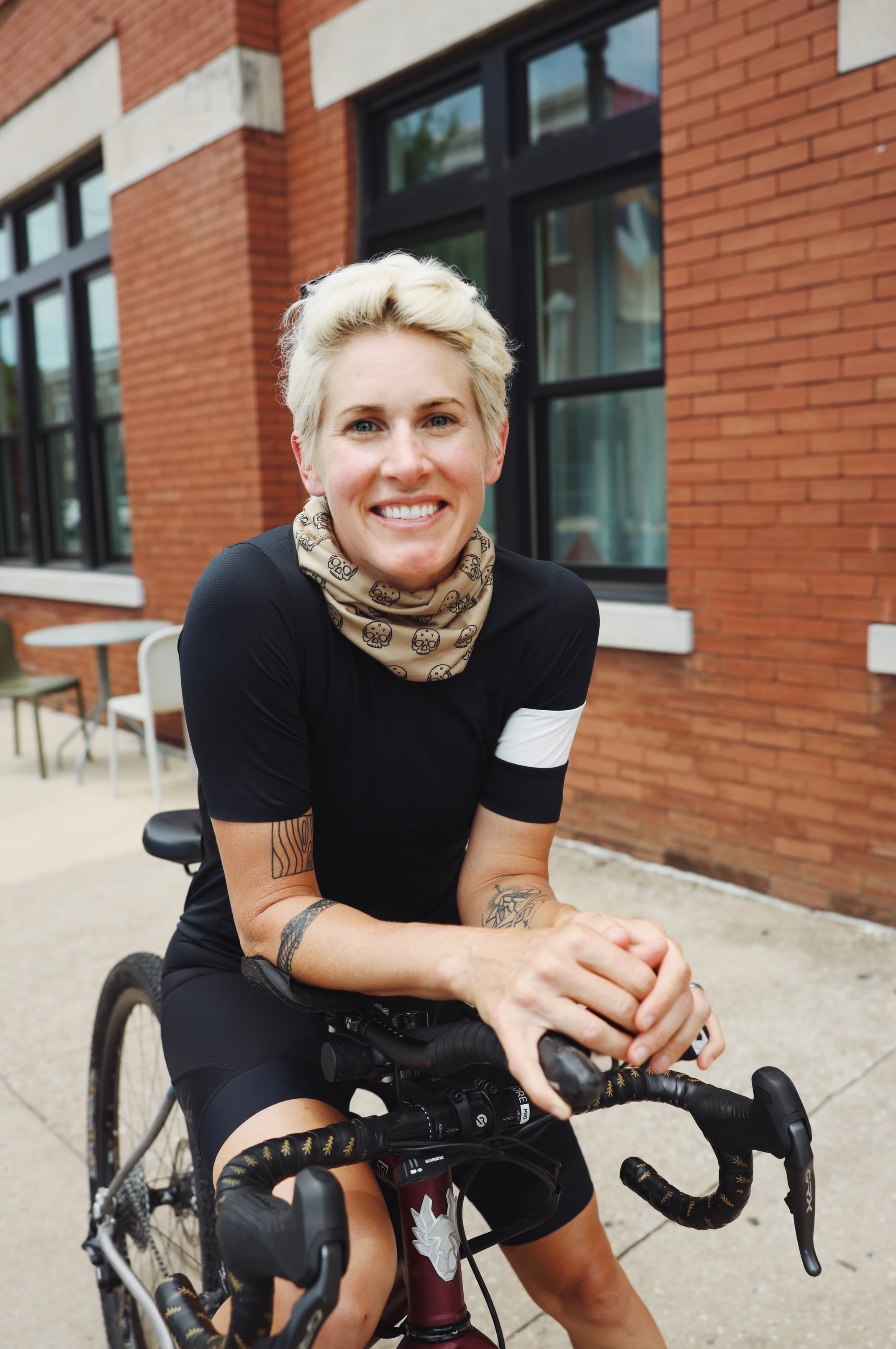
about Scotti Moody.
Many know Scotti Moody as the "Queen of the Arkansas High Country." A former UCI pro cyclist and record-holder in the 1,000-mile Arkansas High Country Race, Scotti raced bikes professionally worldwide for over a decade. Scotti has a heart for travel but loves calling Arkansas home.
An entrepreneur and a mother of two, Scotti lives in Bella Vista and enjoys working in the outdoor recreational space.
In 2023, she became the Ozark Foundation’s Event Director for the inaugural Arkansas Graveler event.
Scotti rides all over the Natural State, locating scenic rural roads, welcoming host communities, and working with county organizations to promote this state-wide cycling event.
route.
Total Mileage of 366.3 miles & 26,691 feet of elevation
The route for this episode is all six days of the Arkansas Graveler.
Note: Aid Stations are marked here, but those were for the official event. You must plan refuel stops that do not include the marked Aid Stations.
music.
episode notes & references.
episode transcription.
episode preview.
[00:00:02] scotti moody.: I think, as riders got to connect with each other through the experience of the day, the pedaling part, they also got to experience connecting with people who they could consider other than.
but who were providing all this hospitality and welcome and they realize, wow, okay, these people live so differently than me, but we're really not that different. That for my own experience, when I've traveled by bike has made me so much more openhearted to people who maybe are not identical to the way that I think or do the same things that I do.
But. It makes me want to listen.
episode introduction.
[00:01:20] mike.: You're listening to the underview, an exploration in the shaping of our place. My name is Mike Rusch, and I read somewhere that the state of Arkansas has almost 70, 000 miles of gravel roads. I'm not sure if that is just a legend that we tell ourselves in the hope of finding some undiscovered prosperity, or if it may actually be true.
However, it gives us permission to step into a question about how our communities may be connected through these roads. I think it speaks to an interconnectedness, an interconnectedness that over time means that we are not as isolated or divided from each other as we may have been told. It's an interconnectedness that acts more like a river carving our stories into the land until progress eventually forgets them. These gravel roads are those deep channels that carry us towards a common story.
But the gravel roads aren't the only ones that connect and shape us. Whatever the number of miles, I'm sure we have way more paved roads than gravel roads. And I fear that while those roads may be more traveled, there are also the roads that may not actually make a difference.
So when the opportunity arrives to find my way back to these gravel roads, I'm not one to let it pass me by especially one that is rooted in my state.
Last month I had the opportunity to participate in the first ever Arkansas Graveler. It's a six day bike ride from the Ozark Mountains in Fayetteville to the Mississippi Delta town of Jonesboro. It spanned 366 miles and it climbed over 28, 000 feet of elevation. That's an Everest climb of sorts, assuming you could try and climb Everest on a bike.
We saw over 300 people from over 35 states gather together to experience the powdery dust of these gravel roads rise into our lungs. We could feel the June sun peel away the layers of our air conditioned comforts that we use to insulate ourselves from every day. It reminded us that while we are people born into a modern age, our souls have memories rooted in the beginning of time.
I think it was fitting to cross this land, a land where the genesis of time is still tangible. It's still alive. It's still asking you to believe that the land can hold and sustain us in ways that we may have long forgotten.
So over the course of 366 miles, I had a chance to meet so many people who, like me, wanted to experience this event as a part of the shaping of our place.
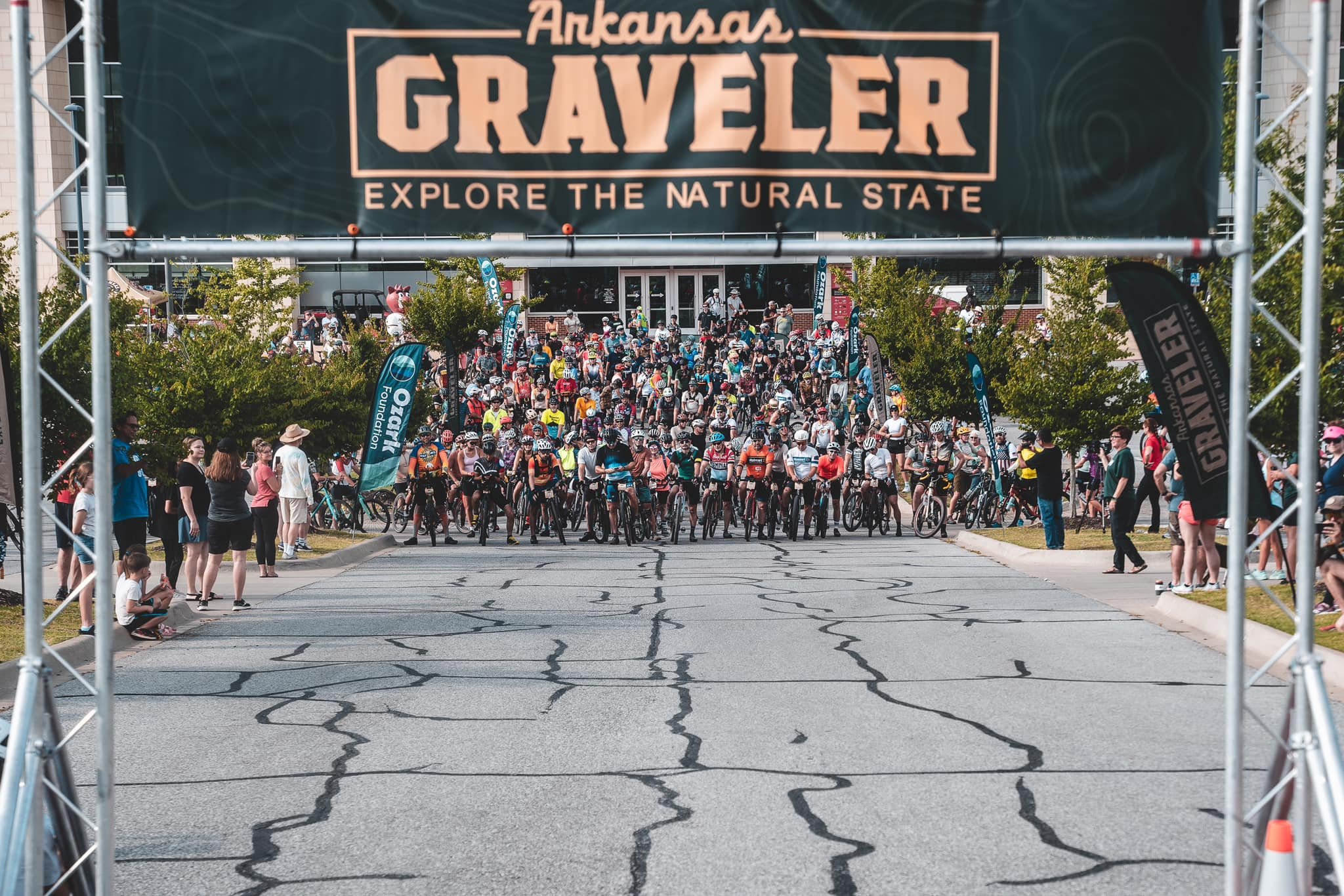
Day one, it was the grand depart from the university of Arkansas and Fayetteville. It had all the pomp and circumstance of an Arkansas Razorback home game, woo, pigs, suey, and all.
We traveled 51 miles and climbed over 4, 000 feet up into the Ozark Mountains to a little place on the Mulberry River called Oark. And that's where we crossed the day's finish line at Byrd's Adventure Center. It was a hot day, to say the least, but we did it.
Day two started much earlier in the coolness and morning shadows as we rolled along the river towards Newton County, which is close to the Buffalo National River.
And while those first two days were truly incredible, I have to say that it still felt like Northwest Arkansas. It still felt like home. Because I've ridden these roads before, I'm familiar with the gravel and the elevation, the beauty. It's incredible and it's worth a whole episode in and of itself.
[00:04:09] mike.: However, to really understand this experience, I
think I have to ground this episode in two things.
First, in the places unfamiliar and unknown to me. The places outside of our home here in Northwest Arkansas.
And second, I wanted to ground it in my conversation with Scotti Mooney, the event director for the Arkansas Graveler.
Scotti cycling resume and her story is really incredible. She began as a professional UCI level cyclist, but to us locals, she's known as the "queen of the Arkansas high country." It's a title she earned in 2021 Arkansas high country race. That's a 1000 mile race, climbing over 75, 000 feet through both the Ozark and Ouchita mountains of Arkansas, where she won the race.
Actually, let me repeat that. She won it. She won it outright. She beat everyone.
So her experience and her connectedness to these gravel roads was actually the guide or better yet, the champion that we needed.
All right, let's dig in with Scotti and her story. I'm going to ask for forgiveness in advance because there's a few places where I'm going to stop our conversations because I want to dig into what Scotti is saying in these moments.
I had a chance to meet so many incredible people out there and I think that they're going to add even greater context to the power of what Scotti and the Ozark Foundation have created through this event.
All right, let's get rolling.
episode interview.
[00:05:20] mike.: Scotti, thank you for the opportunity to sit down and talk with you about the Arkansas Graveler. In full disclosure, I was a participant out there and it was amazing and I loved it and I want to do it again.
So if you're doing it again next month, let's go. But no, I don't want to wait a whole other year to, to sit and do this, but, incredible event. Congratulations.
Yeah. Tell me a little bit about who you are and your story.
[00:05:43] scotti moody.: My name is Scotti Moody. I have been in the cycling scene, professionally, and now I would say more career minded if you want to put it that way.
I began my entry into the sport of cycling through racing. And so this was road racing at the time back in 2012 and had a very vibrant career on the road. Raced professionally on teams. UCI level racing, got to travel the world for bikes. It was incredible. And after a while I wanted to just have a different side of cycling exposed to me.
And that's when I found gravel. This was about 2018, 2019. I made a transition off of road racing and into ultra endurance cycling. And a whole new world opened up to me at that time. I really dove into the community in a different way and realized that cycling has a different purpose. This family aspect to it and the people that you meet along the way become lifelong friends.
And there's just a shared commonality there within this sport. That's really special to this sport. And I've been hooked ever since. And I say that it's still my career because now I'm just in a different vein of it on the event directing side, I've coached for years now. And so I love giving back some of what I learned as an athlete, but now understand from a community standpoint, the power of cycling to bring people together.
[00:07:15] mike.: That's a very humble description of your past cycling world. But yeah, I love that. I feel like there's a lot more to that story and maybe we'll get into that as we dig in, but I would love to understand like, What does this place, Northwest Arkansas, like what does it mean to you?
[00:07:32] scotti moody.: Yeah, right around the time that I was making my exit from professional road racing, I'd heard rumors that Northwest Arkansas was becoming the cycling Mecca, and it just made sense to at least come check it out.
And so I actually transitioned to living here the winter of 2019, right into 2020, right before COVID actually, I moved up here with my family and we immediately found that to be true. trail building community rides, different levels of cycling within mountain biking road, gravel, everything seemed very accessible up here.
And it just made sense to plug into a community where that was of importance to the people that lived here. And so for me I came here knowing that I had a landing pad. It was very familiar in a way because my industry friends were moving here and there were people I've known in the sport for years who were looking at Northwest Arkansas as the next place to call home, all tied together because of cycling.
So it just made sense. And we made that transition and it's felt like home. And I think whether you're from here as a native or coming in as a new person, I think that cycling, if that's your thing, really does, there is an easy entry point for people who are on two wheels. You just fall right in line.
So it's been a nice transition for me.
[00:08:59] mike.: Yeah. And you, as you have come here to Arkansas, you've obviously made a name for yourself with your cycling accomplishments, but now you're which, we can talk about that if you want. I feel like many people have talked to you about that, but you're taking this I would say influence the sense of place and you're it feels like you're just asking the whole world to come now, participate in that.
And so I think we had a chance, I had a chance to talk with Mike Spivey about and while we were out on the Graveler, but I would love to dig in to this event to, to see how all of these things tied together. So maybe we'll start with like, why did you say yes to doing this?
[00:09:37] scotti moody.: Yeah. So it literally was several months after I moved up here that I met Mike Spivey and learned about the Ozark Foundation.
And got an email that connected several key people within the cycling bubble up here with Mike as the driver asking a question of who would like to spearhead this ride across the state. And he went into detail on having this thought of connecting the two universities, the university of Arkansas and Fayetteville with Arkansas state in Jonesboro and building a route that. And at the time I remember a lot of focus was on mountain biking trail development was exploding here. And so I raised my hand and said, I'm really interested in that. If you decide to move forward, please contact me. And I was starting my own business at the time up here. And just it just fell off the radar for a couple of years.
And I saw Mike here and there, just various projects that we were, crossing paths in. And I asked him one day, this was like 2022, I think, whatever happened to that idea? And we sat down over coffee several times and started talking about if it was the right time to bring that to life.
And in January of 2023, the Ozark foundation contracted me to spearhead the inaugural Arkansas graveler. We didn't even know that was the name at the time, but in January, 2023, I started plugging into route development and community involvement and the branding and all of that just started to snowball from there.
And so that's really my connection point to this event. And I'm so grateful to the Ozark foundation for me take part in it in its inaugural year and getting to have a real, a really close and personal touch in this event. Because once I started building it, I realized this meant a lot to me. I've ridden across Arkansas.
I've competed in the Arkansas high country race. I've traveled a lot of these roads, but it was with a different mindset of, Oh, I'm racing. This is for speed. This is for distance. This is for time. I'd never really given myself the opportunity to stop and enjoy all these hidden gems across the state.
And so when I started doing route development for the Graveler, I was blown away at the things that I'd missed. I'd ridden through a lot of these places either at nighttime on a racetrack racetrack, or, just not with the intentionality of stopping and really steeping myself into that local culture.
And just beginning to build the route in 2023, I was like, this is special. The roads are special. And I knew that already. I've already been challenged by the gravel of Arkansas plenty. And knew that it was going to be a real adventure for people on the pedaling portion, but the people I started to meet along the route really just grabbed my heart.
And I realized like Arkansas is a very unique place to ride a bike and to do this point to point. Hub access structure that we've built into the Graveler now. So that's where it started.
[00:12:57] mike.: Take me back to the, I guess the moment when this idea came across your, I guess your inbox
[00:13:03] scotti moody.: and
[00:13:03] mike.: you said, I'm interested in this, what I want to understand that moment.
What was it that, yeah. Seize your attention.
[00:13:10] scotti moody.: Touring by bike has always been really unique for me. Whenever I've stopped and taken, a few days of vacation or gotten away on my bike and I've gone point to point, not a loop, but actually going somewhere completely different that night and staying there or moving on the next day, that experience in and of itself opens an awesome world to people.
I think it's. It's easy to drive to the next town, but you don't really get to experience the smells and the flavors of just being outside and having this man powered way of traversing your way there. And so it's also too slow to walk. So the cycling is this perfect blend of the right speed, And the right ability to get you to this next place on your own human ability.
And then you get there and you can stop into a local restaurant or camp in the middle of a national forest. We have all those things here. And arkansas is equipped to offer this type of either self supported or like our event was, supported experience of touring by bike. And the nature of gravel is that you're doing it in a little bit safer environment than when you're out there on your road bike.
And so when Mike brought this up, just the adventure aspect alone of going across a whole state, Really spoke to me and I knew that it would speak to other people if we could equip it with the right support level for people to tackle that sort of challenge.
[00:14:42] mike.: As you started to look at what this be, as you started to look at what this could become, this point to point, the cities, the roads, the communities, what were you looking for?
What was the criteria as you started to dream about what this could be?
[00:14:57] scotti moody.: Yeah, that's such a key part. Are amazing places everywhere in the state. I knew I had a start line and a finish line as dictated by the universities and that everything else in there was up to me. And Landscape, for one, dictated where we would go.
Everybody that participated this year knows that the Ozarks are not easy to ride. And people ask me why I made it so challenging, and I was like, This was the easy way through, believe it or not. We had some options on what cities would connect, and so as I started to build the route, some of the landscape features dictated where I could go.
I didn't want people to be on pavement all the time. And I also didn't want people to be on gravel all the time because it's hard. So I wanted a good mix of those two things. And I wanted to find stopover cities that had the ability to host 300 people overnight and not from the standpoint of, Oh, we need a bunch of hotels and things like that because we're camping, but just simple things like access to electricity, water.
Some restaurants, some amenities, things like that. But most importantly, I was looking for communities that were excited about the thought of something like this, visiting their town. When I started to get in touch with mayors and deputy sheriffs and chamber of commerce leaders in these key towns, it was really evident to me that some of them were absolutely ready.
And eager and willing to pour their soul and their pride from their hometown into this project. And for me, that was the green light that I needed. It's okay, the route connected well to this place and the people who live here, work here and play here are excited that we're going to come. And that sort of collaboration was integral to the success of this project.
I can't say enough how much the local community champions. Helped make this incredible in year one.
[00:17:00] mike.: I'm curious because Northwest Arkansas obviously has this incredibly growing very quickly, this cycling culture that I know the rest of the state is aware of, but maybe hasn't had a chance to participate or to benefit from it.
And so I'm curious, as you started to interact with some of the communities along this route. What did you find? What was their attitude? What was Their level skepticism or was there really excitement? You mentioned it.
[00:17:25] scotti moody.: If there was skepticism, it was simply because they don't have as much experience with the cycling sport as we do here.
And so they asked the right questions. If there was any hesitation, it was generally because they wanted to make sure that they could hit the mark for us. And a beautiful place like Marshall in Searcy County. Searcy County is, to me, one of the most beautiful counties in this state and They've got the Buffalo, just incredible natural resources and features there, but it's a small town.
They don't have a lot of big hotels or anything like that. And so what they do have is people who like the way that Searcy County feels for their way of life. These are people that there's a lot of folks there that grew up there and intend to stay there and they have a real pride in their community.
And so the fact that has become sort of an intersection for a lot of cycling routes now throughout the state is very cool and it speaks to their hospitality. And it speaks to them saying, let's make our community open to the people who traverse their way through on bikes here. And you can tell when you're there that there's just so excited that we stopped over in their hometown. And so that to me is what I will continue to look for, our route will change next year. And as we're rebuilding for 2025, those types of qualities are very important to how we select host cities.
[00:18:55] mike.: As you think about these communities that we traveled through. The bike as a mechanism to really experience it in a way that I would argue I'm biased that I don't think you can't any other way.
Yeah. But you've got people from literally all over the country coming over 35 states. Yeah. Interact some probably who have never been to Arkansas coming through communities that historically are yeah they're more rural. They're probably not as connected to the hustle and bustle. Especially of a place like Northwest Arkansas.
[00:19:25] scotti moody.: Right.
[00:19:26] mike.: I'm curious, how do you create these relationships in a way that shows the beauty of these communities without or bringing these different cultures together in a way that obviously becomes, in my opinion really positive.
[00:19:39] scotti moody.: Yeah. I think it happens through relationships. I've been guilty of blowing through a town like Marshall on my bike and just grabbing what I needed from a convenience store and going on my merry way. But I realized early on in building this project, if this was going to have a positive impact, longevity, and the ability to affect these towns, in a positive economic way as well.
We were going to have a lot of conversations with the people who, like I said, are local champions. I leaned on them because they know their community best. They can message it best. They can leverage it best. And so for me to think that I could come through a town like that and not get there by in.
It would be crazy. And so I started to realize relationship building is one is what is going to bridge the gap for some of these communities that maybe don't have the same touch of cycling as we do in Northwest Arkansas. Maybe they have some preconceived notions that I can break down in conversations about what people on bikes are like, these are things that you think about when you're going through rural roads, because, Some people don't want to be in the hustle and bustle of Northwest Arkansas.
They love their privacy. They love how quiet their neighborhood is. And so we want to respect that, but at the same time, expose their small towns to what I consider tourism. This was a tourism event on some level, and we were able to see some of those positive impacts along our route.
[00:21:14] mike.: I realized every community that we went through is different and unique.
And I think, I feel like I carried my own version of Arkansas into some of these communities very early. And. It took, a moment to realize that these communities are not where I am from. And so each one of these communities carries a real beauty and I'm curious like what did you see in maybe one community or an example of that, of maybe where that beauty really shines through.
[00:21:41] scotti moody.: Yeah, I think the beauty of these communities and I resonate with that as well so much It's like I sometimes ride through and what do people do out here? Where do they buy their groceries, but They live there for a reason. And a lot of times that reason is they like being off the grid a little bit.
And to go back to your question, what makes them so beautiful is that the ones on our route this year, each have an identity that when folks come through, even if it's not for bikes that they share with people who are inbound.
Mountain View, great example, like the folk capital of Arkansas and some Would argue our region beyond Arkansas. That place has prioritized crafts that some places are losing. These are things like letter presses and pottery and blacksmithing things that were really native to our experience earlier in Arkansas history. And they share that with people and they make it accessible and fun. And we got to listen to great music there that night at the Ozark folk center.
That is just like stepping into someone else's world and being spoiled by it.
experience in Mountain View.
[00:22:55] mike.: Well, I'd like to pause for a moment, if you'll permit me. I'd like to share my experience about what Scotti is saying.
Because in Mountain View, this is when the ride became real to me. The first three days was a battle of the will against the heat and the hills, but this day was different. On day four, as we headed to Mountain View, the weather pattern was changing.
Storms and lightning were coming in from the northwest, which created the need to hold in a little town called Leslie until the storms had cleared. Lightning and bikes, they just aren't the best combination.
It was about eight o'clock in the morning on a Wednesday when we arrived in Leslie and the owner of the local coffee shop Hadn't yet opened.
I don't know much about coffee shops, but maybe in Leslie the fact that it wasn't open at 8 a. m On a Wednesday was my first sign that things here moved a little bit different than I was used to a little bit different than my normal routine. So of all people, the mayor of Leslie came and found us. He called the owner of the coffee shop and asked her to drive in from her home to come and open it up for everyone that was there.
This mandatory stop forces us to see this place and get a little sneak peek into its rhythms and see the people that live there, how they move through it, and to watch the storm clouds envelop the Ozark Mountains.
This was really the first time in the ride where our role was simply to be present. I think I could have easily spent another week there exploring every story that seemed to pass me by.
And after the storms cleared, it may have also allowed our minds to clear, to clear from the fog of the first few days and to be open to a new possibility for this day and maybe a new possibility for this ride.
Five hours later, we reached Mountain View, the self proclaimed folk capital music of the world, where we all gathered in the Arkansas state parks, Ozark folk center to cool rest and enjoy the music of these mountains. This place was new to me, the experience and the music. It was unknown. It was really beyond my understanding.
And Travis, the lead singer of the Sons of Otis Malone, they were our musical gift for the evening. I think he captured it better than I could. Somewhere in his music, he said, "we are bound to destroy the things that we don't understand."
It was in that place, even though our national dialogue seems to infest us and find us wherever we are, that it opened my eyes to the need to be still, to listen, and really truly try to understand.
And as the Sons of Otis Malone played, their strings filled the amphitheater with sounds that felt like they were carried to these hills by the earliest of settlers in the 1800s.
And then, without warning, a guitar string broke. And it may not seem like a big deal, but it caused a small unplanned reset, one that opened the door for Lucas Poole, a local musician, a banjo maker, and the president of the International Federation of Banjos, to remind us what these sounds were.
Lukas Pool.
[00:25:29] mike.: And so in that place, it was the artist who opened the door. It was the artist who understood these mountains. And it was a broken guitar string that maybe, divinely, created the space to let a banjo made from the hands of these hills to be used by a player made for these sounds to show us the perfect union of a people and a place.
And so the next morning as we rolled out of Mountain View, both the land and the people seemed to reveal to us this Appalachian influence of the earliest Tennessee settlers who began this unique Ozark town in the mountains of Arkansas.
And I don't know if it was the folk music, the banjo maker, the simple white steepled top churches, or the chosen flags of their national politics. It felt like they were all trying to speak something that neither they, or I, had language for. But this isn't something in a forgotten corner of America that could be dismissed. This feels like the resurrecting elegy of a nation. A colonial story of struggle, a longing to be noticed and yet forgotten, an incomplete history, and a people who don't want to fit into a new and modern world.
It took me four days to realize that I couldn't bring my version of Arkansas this far east.
Despite traveling with familiar faces, familiar brands, and familiar stories, Mountain View showed a different Arkansas, one that was unknown to me, wrapped in a story that I don't often want to acknowledge.
The paved highways give us the illusion that we're all the same. They mindlessly connect town to town and every dollar general and Sonic and Taco Bell to the next one and the next town and the next one after that, and the next one after that, and the next one after that, but they have failed to connect people to people. These ribbons of asphalt holding caravans of vehicle and practicing methods of extractive capitalism are simply not capable of healing the fabric of our soul, or maybe that of our nation.
And as this traveling city of the Arkansas Graveler moved east, the imprint of Northwest Arkansas within me finally rested to give way to try and see something hopeful. And as Scotti said earlier, it made me want to listen.
And I believe that people are honestly trying to do their best with what they have, with their stories and their histories, with their communities.
All right, let's go back to Scotti because I think she has some hope to share about how this day ended.
arrival to Cave City.
[00:29:04] scotti moody.: Cave City is another one known for their watermelons and their watermelon growers made sure to get us the earliest batch they could, even though it's not technically their season in late June.
But it,
[00:29:17] mike.: I would assume that was a pretty tense conversation to ask them to deviate from their historical pattern of their art, but keep going.
[00:29:24] scotti moody.: I know, right. And they were delicious. And their biggest concern was, Oh, we hope that they're ripe enough. And we're all like, this is incredible. It's cold and sweet and delicious.
But Cave City, I don't know that anybody looking at Arkansas from out of state would necessarily put Cave City on there google maps. And now they have a reason to, it's like they got touched by the hospitality that's so integral to that town. And yes, it's small, but it has so much authenticity that people want to go back now and experience that. And maybe they'll go to the watermelon festival later this month. And it's just showcasing what each town wants to be known for. And that takes work. That takes conversation. It takes, how can we give back to your community while you are giving us. ,
Bob Finster quote intro.
[00:30:10] mike.: And since we were in Cave City, I wanted to stop and talk to Bobby Finster. Bob and his wife, Amy, were absolutely critical to making sure that this event came to Cave City and that Cave City could reveal herself to us.
Bob Finster quote.
[00:30:22] mike.: Bob, we're sitting here in Cave City, Arkansas on the Arkansas Graveler. Do me a favor. how do we end up in Cave City?
[00:30:31] bob finster.: About two years ago, I was at the Arkansas Governor's Convention on Tourism and I was hanging out after a after the night, and I ran into Brannon Pack and Brannon Pack showed me a few potential routes That was when I come across Arkansas just the whole concept of the Arkansas Graveler before I'd ever heard of it. It just sounded amazing.
And one of these routes was coming through my hometown and something, that I'm passionate about, that I fell in love with, is gravel cycling. And so the opportunity to expose this area for the true beauty in the gravel roads, it was just, I was like, you have to come through Cave City.
As a cyclist, I have a core group of Less than 10 people that I ride with, and that's, there's some road cyclists in town, but the, the gravel scene is very slim here. And, I just simply want more people to ride with and I think it's important to show, everyone, the youth included, especially the youth that there's so much extracurricular activity to do, especially outdoor recreation and cycling that our area is a gold mine for that.
And I've got hundreds of gravel miles out here routed together that I think are as good as any I've ridden all over the country. So, that's just, that's how we're here is we, we made the connections in a meeting with Scotti and we introduced Scotti to the county judges of both counties here in Cave City and the mayors and they've all been super supportive and it spun into this two years later and it's just been amazing to be a part of it now to see, all the fruits of our labor, because it's, I only played a small part, but there's a big staff doing this and it's, it's been amazing.
[00:32:13] mike.: what does this kind of event mean to, to the city?
[00:32:17] bob finster.: Yeah, it's, it's huge. It's, a town of 1, 800. you've got, three days a year, you have the watermelon festival. And that brings in a a lot of people, I think close to 30, 000 people to this small city park, three days a year, and then that's it, The small businesses love welcoming, all the riders and get to see, a difference, and they know that, for me, it's, stimulating this local economy in some way and that's through events and that's what I'm really out to do is, is help build the gravel community here in Cave City. And I'm excited about what the future holds. And I think this event coming through my hometown is just, opening the book to what's fixing to happen.
[00:32:56] mike.: Bob, thanks for sharing your town with us. It seems like a beautiful place. Thanks for Being a, a pivotal part of, bringing this community to see, to see yours. So thanks for opening your town for us. We really appreciate it.
[00:33:06] bob finster.: Yeah, thanks so much.
[00:33:08] mike.: And I've had the privilege of chasing Bobby around some of Arkansas gravel roads in the Delta and also in Northwest Arkansas. So it was great to see his hometown. I'm super thankful for all the work that he and Amy did to make that possible.
All right, enough for me. Let's get back to Scotti.
back to Scotti .
[00:33:21] mike.: I love it. I'm biased, of course trying to understand like the version of myself or the version of my community that I want to take into other places and trying to leave that behind.
And when you take 300 people or more into those spaces, I'm curious what You think, or what your perspective is on what some of these riders, you would hope they would take away from those experiences.
[00:33:46] scotti moody.: Yeah, that's such, I wish I had more time to dive into getting know all 300 participants. We had some incredible people here.
I spoke to doctors, geologists. We had a very diverse crowd in terms of what people brought with them to Arkansas. And my hope was just that they got as smitten with rural Arkansas as I have in building the route. And I think from what our survey has, corresponded back with us that happened.
People really got to feel like they were seen and warmly welcomed. I think people were don't know what they were expecting, but I think they went home with more than they expected in terms of just this warm welcome from Arkansas and the natural state is something that we've really driven hard with this project because, our hashtag is more than a ride. We wanted people to go home feeling like, yes, I pedaled my bike all the way across the state, but I also saw some incredible rivers, landscapes. I got to shoot archery with the Arkansas game and fish commission, all these off bike activities, the music and the meals, they were really designed to drive home the further aspects of community that happened here through the outdoor recreational scene and the activities that we take on off the bike too. And so that was also a really intentional thing that I was hoping people would go home with is, okay, this was more than just the ride. It was, I made lifelong friends through all these different aspects of this event.
Andy Chasteen intro.
[00:35:26] mike.: And just to reinforce this hope that Scotti had about how people connected during this ride, I was able to find someone who understands at a very deep level what cycling can mean to the formation of a community.
Andy Chasteen quote.
[00:35:38] mike.: sitting here in Cave City, and Andy Chasteen is here sitting next to me. Tell me why are you here? What, what do you see as you move through the space?
[00:35:46] andy chasteen.: I guess why I'm here is when they announced this event, uh, I've done RAGBRAI before in Iowa. And I, I had such a wonderful time with all the people, you're, you're all doing the same thing, you're riding across the state together, you're meeting new people out on the roads every day, then you're running across them at dinner that night, and you're you're making new friends, and I wanted to be a part of this inaugural event because I believe this thing has an insane amount of future potential to grow to something that's bigger and more meaningful than even what it is this year.
[00:36:19] mike.: as we rode these roads today, all I can think about is, even Arkansas rural recreational roads initiative and how it's connecting communities. To me, this feels tangible proof that these initiatives and this way of thinking about community. it may actually be possible.
[00:36:35] andy chasteen.: Yeah, I agree. One of the things that I, that really stuck out to me over the past two or three days was these little small communities who probably don't see bikes that often, how welcoming they have been to us. And some of them might be obviously that they've heard that Northwest Arkansas is like very cycling friendly and it's bringing a lot of tourism.
I get that. But these people are generally interested in our stories, which is really cool. Like we'll stop on the side of the road and chat with somebody. I don't know if you stopped today that lady that was, doing water on the side of the road outside her house. We stopped and chatted with her for a while.
And it's just really cool to meet all these people in these rural areas that, now I'll be honest, I grew up in a rural area, and so like I feel like these people are my people, right? I have a connection to them, even if they don't know that I have a connection to them because of my upbringing. But I think what stuck out to me is these people like, we want you here. We like, we, we're glad that you're coming through our town. This is such a great thing for us. And I was like, I'm blown away by it. So cool.
[00:37:38] mike.: What's been your favorite part so far?
[00:37:40] andy chasteen.: Oh gosh. My, my, my heart kind of lies in Newton County. So I have to, that's the, in my mind, it's the best gravel riding in the state. It's also the most difficult gravel riding in the state. But it's wild and remote and, physical and Pitchy and climbing and brutal and all the things. So I guess I would have to say that's my favorite, it's all pretty freaking great. Like I, I haven't ridden through any area that I haven't been amazed at, which is cool.
[00:38:10] mike.: What do you want to walk away from this place with?
[00:38:13] andy chasteen.: I walk away with new friends, which is really cool, which is always at the top of my list of important. But I also walk away not, not making a plug for this event in any way, although I am.
Very well ran. I, I find this one of those cool events where you can get white glove treatment for the week without white glove prices, which I think is cool. Like we all want to have a ride a big, whatever training camp or I wouldn't call it a training camp, but a multi day ride where everything's being taken care of for you. I don't ever get that. That's cool.
[00:38:43] mike.: Not one stitch of single track so far. How does your soul feel about that?
[00:38:50] andy chasteen.: It's a nice change. I ride single track every day back home, so this is totally good. Yeah, I'm loving it. I'm loving it.
[00:38:56] mike.: Andy, thanks. It's been fun seeing you out here, so appreciate it.
[00:38:58] andy chasteen.: I'm honored you would even want to chat. Thank you.
Chef Biju introduction.
[00:39:00] mike.: And speaking of White Glove Service, we were gifted with the one and only Chef Biju Thomas. Chef Biju has decades of experience, not only in how food can fuel athletes, but he also launched an outdoor sport and events service company called the Base Camp Canteen, which puts him at the center of all these outdoor events around the United States, where he's providing food that can fuel these active communities.
He's also the host of an outside TV series called "The Road Less Eaten," and I'd highly, highly recommend that. So it was great to catch up with Chef Biju. Honestly, I had to interrupt him, but he was willing to sit down and talk with me to understand a little bit about how food brings this community together.
Chef Biju quote.
[00:39:34] mike.: Chef Biju, thank you for the amazing food that you've had out here for us, and thanks for helping us connect to these communities in a really amazing way.
Tell me, what, what do you see out here when you Watch all these people from all these places come and start to, get involved in this state and and the cycling that's happening here. And you're fueling us all, so we're all dependent upon you.
[00:39:55] chef biju.: Man, thank you. Yeah, yeah, thank you. We are trying to fuel everybody, but the craziest thing is even and I've only been in Arkansas for a couple of years, but still as you get further in any direction, the state is so different, right?
The vibe, the culture, the countryside, the hills, the roads. it's a whole universe just within the state, which is the craziest thing because we get to see a one type of Bentonville that's like a medium to big city version of it. But man, there's some awesome stuff out here.
That's the really cool part. And then seeing all the riders come in and they're all having a very, very specific and individual experience every day, right ? Everybody is having a different day with the hills and the roads and the temperature. But it's crazy.
[00:40:40] mike.: One of the things that, we've talked about a lot is just, the ability of the bike to form community, but food obviously is a huge part of bringing people together as they share tables literally from all around the country.
[00:40:53] chef biju.: Yeah for certain being on the bike is obviously great, but it's especially on these really hot and hard difficult days, people aren't really getting a chance to talk to each other. And a lot of the roads here, they're so twisty up, twisty down, you got to focus. So people aren't really getting a chance to Interact and talk and hear about each other out there.
But so it's so great to see how we have the table set up. The last few nights are giant group tables and complete strangers sit down next to each other and get to have a great dinner and talk. And it's just really, really cool. So I'm super stoked that we get to be part of that. Look at that. It's a dinner started two hours ago. People are all still sitting here. So it's pretty great. That's best case scenario right there.
[00:41:35] mike.: Deeply thankful for everything that you've done. we would have been done after day after day one without you.
That does make me think too, because day one, I wasn't there for day one and I know it was really rough. We started day two dinner. That was an intense day.
[00:41:50] chef biju.: Coming into Horseshoe Canyon, I'm driving the big truck, 26 foot refrigerated truck. The brakes were on fire. I thought the truck was gonna catch fire coming down that hill. It was so ridiculously steep. And then finally getting to the venue where the riders just looked so cracked.
That was hands down the hottest day of the week. And I think just having really good food. Being able to bring our energy and a whole different vibe because I think the whole, the folks running the event were just also tired and stressed and cracked and we got to skip all that and just to show up with really great food and different energy and I think that helped bring everybody back down a little bit, make it easier for everybody to get going the next day.
So I'm super happy that we got to contribute to that because that first two days sounds awful and brutal, but then look, they survived that. Day four, five, six are easy. Like people like, Oh, this is one of the easiest days I've ever done after eight hours on the bike. That's bananas.
[00:42:47] mike.: What's been your favorite part of this so far?
[00:42:49] chef biju.: I think as far as favorite stops go
Marshall. the Kenda theater in Marshall. Turns out Kenda's real person. I thought it was a name for the tires. And so Kenda walks up and goes, Hey. She's asking me like, what do you think? How's it going? Oh, it's great. What's your name? She goes, oh, it's Kenda. I was like, oh, come on. So Kenda was great.
Mountain View the cabin's back in the woods that was awesome. And being here at the city park this is amazing. What a great venue to have an event. This is like the perfect venue between the stage and there are multiple places to go sit, and having a great big patio to cook and have folks.
This is one of those little town event spaces that you just see in movies and TV. Like, where it was perfectly designed for this. For the whole community coming to hang out, right? It's like our square in Bentonville.
It's designed for people to come hang out. These places still exist, and we would not have seen this except for the bike.
[00:43:41] mike.: Thanks, chef biju. Appreciate you and incredible team. Thanks for doing all you've done.
back to Scotti.
[00:43:44] mike.: Well, a huge thanks to Chef Bijou and his team for all the incredible food that they provided to all of us. We definitely would not have been able to make it through what we did without the work that they had done.
All right, I'm going to quit interrupting Scotti and let you get back to what I think is probably some of the most important words that she has to share.
resume interview.
[00:44:00] mike.: I think as you now are on the other side of this, you've had a chance to hopefully sleep and rest.
What do you take away from this? What does this mean to you now seeing this idea that you've planned and dreamed about for years?
[00:44:14] scotti moody.: It was so fulfilling for me. In Jonesboro to watch the last riders come across that line. Because I realized when I started building this route, this is really going to challenge people. And in our messaging prior to the event, I wanted to let people in that this was not going to be an easy ride.
And on top of that, we had heat index that was crazy high that week that
[00:44:39] mike.: I noticed.
[00:44:40] scotti moody.: Oh my gosh. If I could have turned the sun down, I would have, but these are just the things that you can't plan for. And as I was in Jonesboro watching everyone celebrate smiles, tears, they had this huge sense of accomplishment in themselves.
And so that was one thing I had really hoped everybody would feel is when they finished this experience, they would have a sense of pride. And we saw riders walking up hills sometimes and they would still make it to the finish line and they would just feel so happy and proud that they'd done something that challenging.
And that always makes me feel good cause I've been that person on that bike on my own. And I love walking people through just that opportunity to push your limits a little bit. But beyond that, I think, okay. I saw clusters of friends form throughout this whole event, people that showed up from different places, but they just found their tribe within this event.
And people started like getting to know each other and then they were riding together and then they were eating together and doing the off bike activities together. And that was really my grand hope for this was that we would People would come, experience the hospitality that I know Arkansas has to offer, experience our outdoor recreational scene that's phenomenal, but go home feeling like they are part of something big.
And they're part of individually having an impact on our home state while taking a piece of it with them wherever they go. And that's really cool, and I think Arkansas really showed up in ways that I couldn't have even planned, water stops hosted by homeowners on the side of the road and just beautiful stories of people who came out to support that I didn't even know would be there.
So it was really cool to see.
[00:46:39] mike.: I think for whatever it's worth, if I could ask you to go back and change anything, I would actually ask you to change nothing.
No, and I'm not just saying that because I think I had rested. I like, like you said, like I, I resonate with, yeah, it's a challenge, but it, I think it's who we are as human beings that, that these are the experiences that we choose. It's a, it's an incredible privilege to be able to choose, to put yourself into those environments, but it's what makes that connection, in my opinion, to a community. And when I can go out and be with friends and we can suffer and yet triumph together without those things, I don't know how you create the experience that you're actually describing.
[00:47:17] scotti moody.: Yeah.
[00:47:18] mike.: And so I, yeah, I would change zero things, about that. about what I experienced for my own self.
And so that just gives me a great sense of, just gratitude for the time, and what you've created with your team as well, too. That's
[00:47:31] scotti moody.: awesome. Thanks for sharing.
[00:47:32] mike.: I'd love to understand too what you think or how you view this event. What does it mean to our state? In the, maybe the big scheme of outdoor recreation, but just the experience and connection to our state.
[00:47:45] scotti moody.: I think people will learn about Arkansas from this event. And my hope is it becomes a legacy event for this state.
I think the intimacy of our smaller group is very important to me. So while we may scale it, it's never going to be a RAGBRAI. I think the size of our group and the grassroots level of where we're going, dipping into our national forests, our state parks, the beautiful things that people can do. I want to keep that alive because that grassroots feel is what allows people to sink into our landscapes on a bike. And I, I really think that over time, this event will become an iconic gravel cycling festival for Arkansas.
[00:48:37] mike.: I would argue it already has, but keep going.
[00:48:40] scotti moody.: Yeah. Thank you. That really is what I hope people see it as. It's not a race. And from day one, when we let this thing fly, I'm pretty sure I said in the very first Instagram post, this is not a race. This is an experience. And that allows people to drop in and relax and enjoy it's them taking their phone out, and capturing a beautiful landscape at the top of a ridge line.
And when we started to get the support of the Arkansas department of parks, heritage, and tourism. They caught the vision for how this can not only showcase outdoor recreation as a whole, but how it can positively impact these rural communities where cycling maybe isn't as much of a language, and so I was really excited when they came on board as a supporter because they can help us elevate arkansas as a whole and make everyone here more aware that bikes are friendly. Bikes are a means of traveling from place to place just in a different way than when you're in a vehicle.
And so I think it's going to help with the safety of riders across our state. I think it's going to help with smaller towns feeling like they have a positive connection point to the cycling community. And I just think only good things are ahead in terms of showcasing all of the hidden gems that this state has to offer.
[00:50:09] mike.: I'm biased, the power of the bicycle, I think, to make this happen, but I'd love your perspective either in your own life or what you saw through the graveler how does the bike become this mechanism for community building?
[00:50:23] scotti moody.: I think you touched on it a little bit earlier. Riding a bike is not easy. It's definitely not easy when there's 7, 000 feet of elevation gain and 95 degree temperatures, you guys were going through something together. And I think everyone can relate in finishing a challenging ride and how just rewarding that feels. There's a level of fatigue, but you're like, Oh, I earned that. And I think going through that with people right next to you who are feeling the same things and pushing themselves in really similar ways, it builds connection points. And then beyond that, where you're doing it and how you're doing it and how you're rewarded at the finish line, which is what I really wanted to treat people to in our event.
I've done a lot of rides by myself. That didn't have the party at the finish line. And the party at the finish line is what helps you remember what you did and why you did it. And so for me, I wanted each day to feel almost like a celebration for every rider. They did the hard thing. They got handed a cold beer. They rinsed off in the Mulberry river or wherever they wanted to go. And then they had some cool activities and food waiting for them. Live music every night. So the festival aspect of this is Really important to me that it wasn't a race and that we could all just really drop into this experience together
[00:51:45] mike.: This may not be a fair question, but I'm gonna I'm gonna ask it
I think for me and for the conversations that we've been having, it's about, building these communities where anyone that wants to participate is really welcome. But what that means is that you're bringing people together who you put them down at a table and you probably ask them where they stand on the issue of the day. There's probably a whole lot of differences.
[00:52:08] scotti moody.: Yes.
[00:52:10] mike.: How does that change in the environments like the Graveler that when people come together, maybe focus on something else to begin with. I love your perspective.
[00:52:21] scotti moody.: Yeah. I think going through an experience like the Graveler, eliminates the need to hash out differences because there's so much commonality that's happening between riders who are in it together, but also they're getting to see the way that other people live and what you're still in the state of Arkansas, but you can, you were there. People in Cave City or on the east side of the state have a different style of life than we do here in Northwest Arkansas.
I could say the same thing about Little Rock feeling different, even though it's a big city, we each have our own unique flavor and culture, what we find important. And so I think, as riders got to connect with each other through the experience of the day, the pedaling part, they also got to experience connecting with people who they could consider other than.
but who were providing all this hospitality and welcome and they realize, wow, okay, these people live so differently than me, but we're really not that different. That for my own experience, when I've traveled by bike has made me so much more openhearted to people who maybe are not identical to the way that I think or do the same things that I do.
But. It makes me want to listen. It makes me want to ask them what, what brought you here? How did you choose this as your method of travel? I want to know what makes someone pick up a bike and ride across the state. And I think even in the host communities, Those people are asking what, what makes these riders want to come here?
And it just opens the door for all this positive connectivity in a way that you don't normally get when you just show up in your car at the gas station. It's like when you show up and you're dirty and sweaty and you're on a bicycle, they're like, what are you doing today? Tell me who you are. Where did you ride from?
And you tell them, Oh, I rode 45 miles from the next city down. And they're like, what, it opens conversation. And I love that about cycling. I think it's very unique to our sport because swimmers don't get that, football players don't get that they're playing in an arena and yeah, they travel from place to place, but we actually get to involve ourselves with our landscapes and our communities by bike. And that's very unique to this sport.
[00:54:48] mike.: What does that make possible in our world?
[00:54:51] scotti moody.: Connectivity. I think it builds community and you don't have to be fast. You don't have to have a certain bike. That was one of the things that surprised me, honestly, at the start line. I looked around and I saw a huge variance of cycling styles. I saw flat peddlers in vans, I saw clipped in spandex, and everything between e bikes and just a full gamut and full range of ages. And that was really cool because you realize it doesn't really matter how expensive your bike is or what your age is.
You're all going to go on this journey. You're each going to have this individual story. And at the end of the day my level of success is seeing how many people are sharing those stories. And we all have something cool that happened, whether it was funny or terrible or, you know, beautiful, whatever it is, everybody had a story from every day and then you start to tell your stories and this just synergy happens through cycling and I've seen it on every level, especially in gravel though, because the ability for lots of different types of people.
[00:56:06] mike.: what was that moment where you said this is what I wanted it to become.
[00:56:12] scotti moody.: Day one for me personally felt intense because I was very worried about everybody. The heat index was really high and I knew that the challenges of getting people from Fayetteville over the Ozarks.
I would call them the Highlands of Arkansas.
[00:56:28] mike.: Yeah, it's not insignificant amount of work.
[00:56:30] scotti moody.: It is a huge day. And I was worried that some folks were going to struggle and some people did struggle. And that day for me, it was like, we were hashing out our team working together for the first time, putting our big venue together for the first time.
We had a lot of firsts. And so once we started to get into day three, day two and day three, it's everybody started to, they knew what to expect. The riders knew the flow of things. Our team knew the flow of things. And on day three, which was also a very hard day. I think for the first time I was like, this is it.
I can start to see it now. I can tangibly feel the synergy that's happening between riders. I can tangibly see the connectivity with the community. People are coming in just completely shattered from having ridden the hardest day in the Ozarks, but they're smiling, and they are getting together and enjoying a meal and having a great time.
And I was like, that's what it's about. You go do the hard thing, and then you celebrate it with stories every night. Day three is when I really sank into it myself and realized, okay, everyone's going to be all right. We got to still take care of people, but we're going to do this and we're going to take care of you guys.
And started to really allow myself to have a little more time to communicate with the riders, be out on course more and feel really a part of the event.
[00:57:54] mike.: Yeah. I love that. you're going to lead this again next year, right? Okay. You have to, that wasn't a question that was like, you have to please.
[00:58:04] mike.: it may be too early to ask this, but like, how does what happened this year what do you say? I have to carry these things forward to make sure that we're true to, to the vision that you want to become. what do you think about as you carry this and start thinking about next year?
[00:58:21] scotti moody.: Yeah. The challenging nature of our ride this year, I got a lot of feedback on that from riders, but I would say more so than not people welcome the challenge. And, I don't ever want it to be a walk in the park in terms of the peddling portion of this event. I think a little bit of a challenge is a really good thing.
It makes you dig a little deeper. And what you see when people have a little bit of that emptying of self is they have time to process their own life stuff. So you've got a bunch of individuals who have time on their bike. They're off work. This is vacation, but they're doing something challenging on a personal level.
And I think just based on the stories and emails that I've gotten since the event, a lot of people went through a life transformation out there. That's what I'm in for. That's what I connect with the most because I've also had experiences like that on the bike myself. Yeah. And so to be a part of providing that for other people and watching them go through that kind of ringing out of self is really beautiful.
And it's what keeps me coming back for more in the cycling sport. And I don't think I can let that go for next year. So it'll be a challenging route. It'll be a multi day route. I think people love point to point, never seeing the same thing twice. So that will also be a part of next year, even though we're going to showcase a different part of Arkansas.
I want people to have that freshness of every day looking forward to what they're going to see next.
Host communities. I can't wait to pick them out. I'm already gung ho to plan next year, and I know that we're going to have now a template that we can actually show a host community and say, this is how we did it last year. Can we get your support at this level for next year? And, it was really special to me because in year one, we were dealing with people who didn't have a visual template of what this meant. Now we have great media, we have pictures, we have, a venue plan, all the things have been dialed and that will make it a little easier in selection process for year two.
Yeah. I would love it if the Arkansas Game and Fish Commission came back. That's one thing I would really love to see a continued part of this event is having their involvement, their team and their volunteers allowed us to fish, shoot, do archery, and they made it fun. They made this little off bike competition out of it. It was really well done.
Music, Jared with city sessions NWA was our musical production team. He lined up some amazing talent and he paired it perfectly for the cities that we were in. And I think music is something that I would love to keep as a part of this event.
So to say, to, I don't want it to sound like it's going to be a replica because it'll be a unique flavor of its own, but we have some, I would call them core features, that we will absolutely keep intact for next year.
[01:01:29] mike.: It sounds amazing. So please keep doing what you're doing in so many ways. I've asked this question to a lot of the guests that I've had the chance to talk to, and I want to look at the other side of like, When you think about this work cycling, the Graveler, or what this means to our state, I'm really curious what are your fears for this space?
[01:01:59] scotti moody.: One struggle is the entry point for cycling. Bikes are expensive. And I think There's no way around that. So for people that maybe don't have that discretionary income, cycling seems as something that's maybe out of reach. So even though we have a huge scene here, I'm still aware that there are a lot of people who don't consider cycling as an accessible thing in their lives right now.
And that's why partnering with someone like Pedal It Forward. They hosted our bike valet parking, and they're a non profit that helps people get a bike if they need a bike. Things like that, I want to continue to support with this event because that's a reality, and the further you get away from Northwest Arkansas, the bigger a reality that is.
So I think, One of my fears is that Northwest Arkansas seems like some place that's just the Wizard of Oz kind of, of cycling. And the rest of Arkansas is oh where are bike trails? And I don't have a safe mountain bike trail I could send my kid on here. I, it's not a perfect world.
And I think progress takes time. And I think we're building some really awesome molds that people can take and implement in their own communities. So I think good things are in store, but I would say in terms of there is a discrepancy between the cycling bubble that we've built here in Northwest Arkansas and the rest of Arkansas.
So you'll have pockets where cycling is real familiar, and then you'll have places where you will feel like. People have never seen a bike or someone riding in the style that we ride in. And I've experienced that firsthand. And I'll say I've had, 99 out of a hundred positive interactions with those people.
Mostly they're curious. Why, where are you going? Do you need a ride? I've been asked that so many times like I must look pretty bad, but yeah, I think we still have a lot of work to do in terms of making cycling accessible across the state. Yeah.
[01:04:10] mike.: It was encouraging to me. Yeah, seeing pedal it forward out there, but as we went into Jonesboro, starting to see the Arkansas rural recreation roads and how these tools are being used to make accessibility.
And it felt really beautiful to be able to ride in Jonesboro and say, gosh, what is happening here in Northwest Arkansas is starting to create opportunities for people to think about accessibility to the state, accessibility to the roads. And the beauty of it in a way that maybe they've not thought about it before.
And and I think your spirit of walking into those communities and listening and learning is our responsibility in so many ways. . And so, I appreciate the sentiment. 'cause obviously the big challenges and through all of these conversations. Really the goal is to try to understand what does this idea of community wholeness really look like? And I'm a hundred percent biased around what that looks like and what the bike makes possible in that space.
What does that mean to you when I say, community wholeness within the space that you've been working?
[01:05:08] scotti moody.: I think, and this is something I teach my soon to be 13 year old twin boys. We talk about work and we talk about how important it is to step away from work and what you do when you're not working. And I think here it feels easy to recreate. I love living here because I can ride my bike from my front door.
And so for me, a wholeness in terms of community means that there's an ease to getting outside for me, that's really important. I love sunshine and just being outdoors and here that's readily accessible. And I think In terms of wholeness, it's like inviting people into that space to disconnect from devices, to unplug.
And recreate in a way that feels good to you, whether that's bikes or not. It's go stand up paddle boarding on one of our beautiful lakes and, or maybe take up trail running. If you don't cycle, it's whatever helps you find that balance point. And I think here we are building and seeing a community of healthy, Families.
These are people who are active lifestyle. They're prioritizing good food choices too, because of that. Like it's shifting the whole way that we live, work, play, and the balance of all of that. And there's always plenty of work. That's why I tell my boys it's good to have a job. It's good. It's good to work and to be employed, but it's also good to prioritize stepping away and having that life balance.
And for me being able to get on my bike and go. Camping over the weekend, self supported style, or joining an event here. It's just, there's always somewhere to either disconnect if I need time alone or to plug in if I need to find some friends and have some connection points. And that's a really unique thing that does not exist everywhere.
So very grateful for it here.
[01:07:05] mike.: I love it. It's a great way of viewing it.
Scotti, thank you for your time. It's a privilege to be able to sit with you. I say thank you for creating this experience for us to all go and struggle against and see the beauty that I think our state holds, our community holds, the people we ride next to.
I think my only complaint would be, I told the other guys that I was riding with, this was a race and that I won.
So I may need to rerecord some of those things. It's just, you can't have them thinking that. Wait, that I didn't win, but no, and I'll just thank you for doing what you did. Thank you to your team. Unbelievable experience. And I want to be the first in line to sign up for next year.
[01:07:45] scotti moody.: We had a rockstar team and that's something I didn't get to touch on as much as I should have, but the team, man, they made all of it possible. And so thanks for recognizing them just now. And we would love to have you back next year.
[01:07:59] mike.: Thank you very much. It's a pleasure to sit with you.
[01:08:01] scotti moody.: Yeah. Thank you, Mike.
episode outro comments.
[01:08:02] mike.: Well, I have no way to say thank you enough to Scotti for her time and all that she has done to bring this event together. Turns out she wasn't just our guide, she was our wayfinder.
And I also want to say thank you to the Ozark Foundation and all the sponsors and volunteers, like our resident gravel expert, Randy Jackson, the state of Arkansas, and everyone that made this Arkansas Graveler possible.
And on the last day of the Graveler, as we rode east towards Jonesboro into Craghead County, there's also an Arkansas Rural Recreational sign there to greet us. It's really beautiful to see how our friend, Martin Smith from Birdeye, is using these same initiatives that we have in Northwest Arkansas to expand access to these roads.
And so before we close this out, I did catch Brannon Pack, who's responsible for the Graveler Operations Team, and he was there to send us out and back home. And I asked him to give me a little bit about what it meant to him.
Brannon Pack comments.
[01:08:47] brannon pack.: Good morning, Mike. Good to see you. Brannon Pack. I'm with the Ozark foundation, the production team behind the inaugural Arkansas Graveler sitting here on beautiful, beautiful beach the Arkansas state campus ASU here in beautiful Jonesboro, Arkansas, the Motley crew, about 220 cyclists rolled into Jonesboro last night after six, just truly beautiful days of riding across the state of Arkansas.
Just the amount of, Mike, the amount of joy that we saw as these riders across the finish line, tears were shed, Mike, tears were shed and the feeling of accomplishment that everyone who participated in this year's event is taking home with them.
I tell you, our team is running on pretty high right now. I think this team rose to the occasion and whatever the experience these cyclists were looking for this week, we were able to provide that for them. They found it. They found it in Arkansas. They've learned why we call this state the natural state and man, we can't be more excited to start exploring, what special experience we can create in 2025.
[01:09:49] mike.: Congratulations to you and your team. You guys just absolutely crushed it. What an incredible experience. incredible route, incredible places. Just, yeah, congratulations to you and your team for sure.
[01:09:59] brannon pack.: My ,congratulations to you too. You, sir, are an Arkansas Graveler.
[01:10:02] mike.: I am, and my legs will be feeling it for many, for many weeks, I'm sure.
Thank you,
final comments.
[01:10:07] mike.: Well, I'm partial, but I believe the Arkansas Graveler is positioned to be a powerful force in connecting our communities all around the state, to draw people to Arkansas to show its unique beauty, to help grow the outdoor recreation and tourism industry and help bridge a thriving Northwest Arkansas to the rest of the state and how cycling can be a true strength.
And you know, in a state with about 70, 000 miles of gravel roads, maybe every county in this state truly does have an undiscovered prosperity that is just waiting to be found.
So thank you to Scotti, the Arkansas Graveler team, the Ozark Foundation, and all the partners at city, county, and state levels who made this possible.
I also have to acknowledge my riding mates, Steve Hudson and Kirk Robbins, who rode beside me every mile of this experience. There's nothing like 366 miles together on a bike to grow a deep appreciation for their friendship and their kindness.
As we finished in Jonesboro, I find myself back in the Delta, a place that is part of the origin story of The Underview, and a place for which I'm growing a deep, deep affection for.
We've used these gravel roads to guide our conversations and the understanding of our communities and of each other. And now it's time to go back and answer the questions we began with.
What is the state of Northwest Arkansas?
We've learned so much. We still have some questions remaining, but we have some observations for us to consider. these roads have now brought us back to the land and it's given us some language and context to recognize maybe our place in all of it.
route.
[01:11:27] mike.: I'll close today with the routes for this episode. It's going to be day three, four, five, and six of the Arkansas gravel road. Go do it. Absolutely. And please pay attention to the Arkansas Graveler social media, go to their website and sign up for the newsletter, because I really want to see you out there again next year.
And again, I want to say thank you for following along. Thank you for being a part of this journey. And as always, I want to say thank you for being a part of the shaping of our place.