
the foundations of community with Nick Ogle.
Nick Ogle, PhD. Our conversation about the state of Northwest Arkansas pauses momentarily to dive into the fundamental aspect of communities, which is the relationships we have with each other.
season 1, ep. 17
listen.
episode notes.
Episode 17 is a discussion with Nick Ogle, PhD. Our conversation about the state of Northwest Arkansas pauses momentarily to dive into the fundamental aspect of communities, which is the relationships we have with each other.
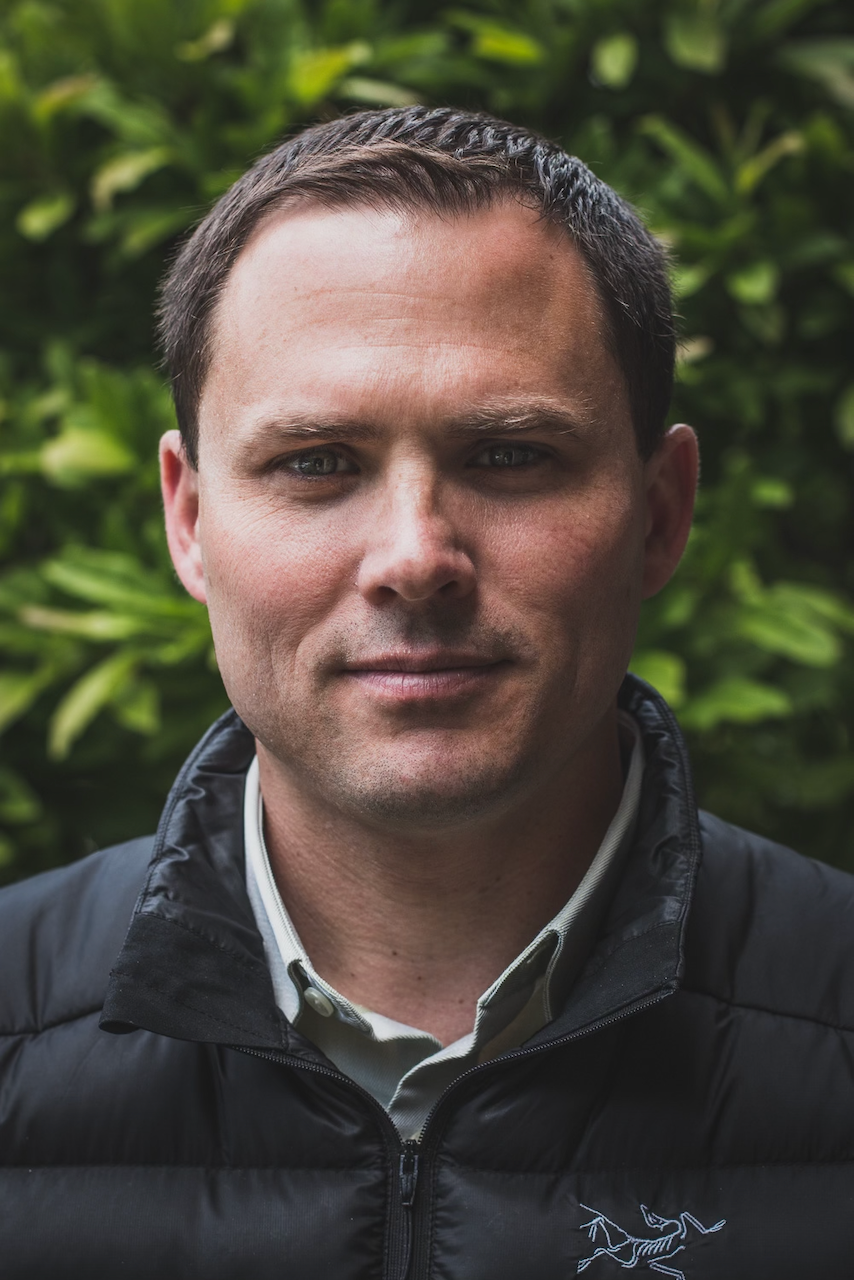
about Nick T. Ogle, PhD.
Nick Ogle received his Undergraduate Degree from John Brown University, a Masters Degree from Denver Seminary in Community Mental Health Counseling, and a Ph.D. in Counselor Education from the University of Arkansas.
Nick is the founder of Family Office COO, @familyofficecoo
Nick has had an incredible career journey of creating and building programs, clinics, and divisions for healthcare organizations such as Mercy and Centene. He served as the architect of HARK to address social determinants of health issues in NWA and has worked with stakeholders to build wraparound services in states such as Washington, Oregon, and Nevada. Nick frequently speaks at conferences for corporations on topics such as community building, mental health, burnout, and organizational development. Currently, Nick serves as the COO for a Private Family Office based out of Arkansas and spends over 3 months a year in Africa working alongside organizations and governments to build sustainable communities.
Nick lives in NWA with his wife, Chanika, and their 5 kiddos. Most days he can be seen serving as a chauffeur (carpool dad), chef, or riding his bike!
Photo by Brad on Unsplash
route.
The route for this episode is an oldie but goodie. This is the most common route that Nick and I ride when it's just the two of us. It's a route that winds its way out to Avoca through the Brightwater Tunnel, and then back on Little Sugar Creek, one of my most favorite gravel roads in all of Northwest Arkansas.
And so just so everyone is aware, I do want to remind you that I still am the local legend on Sugar Creek grinding westward. That means I've ridden that segment the most of anyone in the region in the last 90 days.
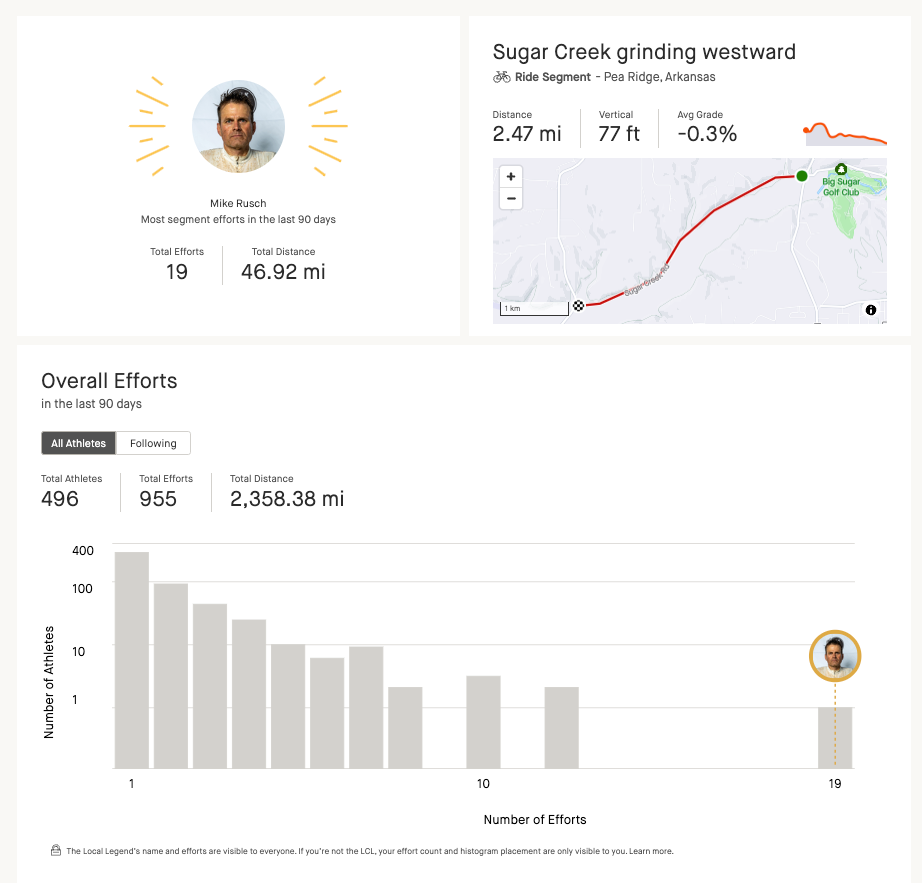
Sugar Creek Grinding Westward Segment as of March 28, 2024 [/caption]
music.
episode notes & references.
episode transcription.
episode preview.
[00:00:02] nick ogle.: You can't get unity and harmony if it's just about I all the time. You get unity and harmony by looking at the we and how we experience this together. And from that, we have to walk through hard things. We have to experience hard things together.
We have to have the conversation and it not turn so conflictual that one person shuts down and the other one becomes irate. Which is what we watch 90% of our Political interactions become where we watch 90% of our harder decisions as a community become. It can't do that to get to
wholeness we have to back up and get more into a repair, resilience mindset that says, Hey, these two live in harmony together. We need the hard things because by going through the hard things together, we ultimately get to a place of creating unity with one another, which then allows me to reconcile things inside of myself.
episode intro commentary.
[00:00:53] mike.: You are listening to the underview, an exploration in the shaping of our place. My name is Mike Rusch, and in my last two conversations with Chris Seawood and Mireya Raith, as I listened to their words, I began to realize I have a lot to learn about what community means.
As these conversations have built over the past 16 episodes, I just now am beginning to see the true need, not to build just a stronger and deeper community, but stronger and deeper relationships.
These past couple conversations have been heavy, and when they involve topics like racism, historical violence, disenfranchisement, segregation, and not some textbook idea of it, like the real thing, the real thing right here in Northwest Arkansas, I felt the need to pause and bring in some more experienced perspectives, some better ideas, some broader definitions of what the core of communities really are, which is the relationships among people.
You see, in my previous episode with Mireya, I ended the episode with a statement.
And it sounds like you're you are on the front lines of trying to bring hope and, and maybe healing, if I can use that word to the space. And so, yeah, thank you for the work that you're doing
And when I said the word healing, I could see in her eyes that what I said at the time was not appropriate. She was gracious with me, and I won't forget that, but I realized that healing actually implied something that wasn't possible just yet.
It wasn't possible yet because the offensive racism and the ongoing weaponization of immigration is still happening. You can't heal when these wounds are still being torn wide open.
So I needed to pause because I realized I wasn't in Mireya's shoes, and I didn't know what I was saying or asking for. I needed to go back to the core of our humanity and find out really what is the foundation of building community.
Where does it start? Where does it begin? What must first happen before I can see, or even attempt to understand, what Mireya and the Hispanic Latino community here in Northwest Arkansas experiences every day?
Thankfully, not only do I know an expert, but I can also call him one of my dearest friends. Dr. Nick Ogle holds a master's degree in mental health counseling from Denver Seminary and a PhD in Counselor Education, School Counseling, and Guidance Services from the University of Arkansas.
His experience includes being the Executive Director at Hark, the Center for Collaborative Care, the Director of Behavioral Health at Mercy Health Systems, and the founder of the Joshua Center here in Arkansas.
And so in addition to all of this, I just call him my friend. He and I ride a lot of miles together. And I've learned that when he talks about relationships, it's not an academic exercise. It's rooted in people, real people, real relationships, sometimes really hard relationships, hopes, disappointments, And decades of experience helping so many see who they really are.
So I asked Nick to sit and talk with me about this all too familiar, yet totally foreign concept of how we as people relate to each other.
All right, let's get started.
interview.
[00:04:19] mike.: Nick. So we've been having this conversation about community and this idea of what is kind of forming and shaping Northwest Arkansas, but probably at the core of all of that is obviously people. And so when we talk about, like, our community forming and shaping, it's not this abstract idea of, like, well, a building goes here and a building goes there.
What we've tried to really do is kind of focus it in on the people and the dynamics of the people, because ultimately that's what builds our community and builds our society. There are institutions that exist, but at the end of the day, people are what make those up.
And so, I think today it's really this idea of trying to pause for a moment from this conversation of economic growth, but to really dive into what does it look like from a people perspective, to think about how we build communities, how our communities are formed and shaped either by factors that we're aware of, maybe factors that we're not aware of.
And so, this is your world. This is not mine and so I think the invitation today is to really just step back for a moment and ask ourselves as individuals and then by implication, us as a community, when we think about this idea of shaping and forming communities, like where do we start?
[00:05:29] nick ogle.: Yeah, I think that's a great question, Mike.
And I think One of the places I would like to start with it is actually moving it away from the business of building community and more into the personal side of what it looks like to build community.
There's an ongoing study right now and it pops itself up in the New York Times and in the Washington Post all the time. It's basically a study that started in the 60s and they went around, they asked everybody, How many best friends do you have? How many close friends do you have? And in the 60s, the average individual would say, I have 12 best friends. I have 12 closest friends, they're my closest community, they're who I do life with.
And then you watch the study take place through the 70s, the 80s, the 90s, and into the 2000s, and you slowly watch it go from 8 to 5 to 4 to today, where we would say on average we have one to two close friends. And the reason I bring that up is I think as we talk about community so much, the idea goes, really you're talking about friendship, you're talking about relationship, you're talking about what it looks like to truly interact, live life, do life together.
And we're trying in many ways in the communities that we're building to fabricate a place where people can build community, But we're not really talking about what it looks like to build friendship, what it looks like to build relationship. All of us, as we keep talking about on this, on this podcast, as we keep talking about in you and I's conversation, are looking to build that significant relationship and significant relationships in our life on a regular basis.
We can't do that without friendship. So when we talk about building community, you have to back up and go, what does it look like for me to build a place where we can interact, become friends, and in that, what do friends do? We commune. We do activities together. We take part in life on life kinds of things. So what do we need to do that?
Well, we need restaurants and we need happy hours and we need bike trails and we need gyms and we need pools and we need community centers and we need YMCA's and we need, fill in the blank of what that looks like for places for us to go and build that community in that relationship. That's what we're talking about when we're talking about community.
From there, how does that get strengthened? How does that get deeper?
Well, in that we have to build spaces where all of a sudden we're not just creating mini me's. So we're not just building friendship and relationship with people that look like me, think like me, act like me, be like me. That's kind of the, the statements that we make a lot of times when it comes to a therapeutic standpoint.
You look at the healthiest people throughout the world and they're people that build relationship with people that have different ideologies, different stances, different ways of being than they themselves do. And by naturally engaging in those relationships, they're broadening this horizon. And as that friendship deepens, they begin to see things differently. They begin to speak differently. feel things differently and experience the world differently. So if we create communities where all we do is create pockets of friendships that are be like me, act like me, think like me, ultimately, you're me.
Then all of a sudden, we've missed the point of what it looks like to build friendship and community with people that are different than us, that create that interaction, that space for us to see the world differently. Now, when it comes to that, You can go all sorts of ways of what that looks like. You can look at that from a, Hey, we have different religious values, political values. We have different stances on what it looks like to be an American. We have different stances on what it looks like to be fill in the blank, a biker, right? We make jokes all the time about how, you know, right. Road cyclists, they're not real cyclists, you know,
[00:08:57] mike.: but that, but. But that's true though.
[00:09:00] nick ogle.: And while it's true, we're really kind of jerks for not engaging in relationship with road cyclists.
Because we've shut down our horizon and our understanding of what that community looks like. So when you're talking about community, you've got to build places. Place is very important for that, for these friendships and relationships to exist. And in that, it has to be a platform in which it is not an "I" centric culture.
This is prominent, Mike, to everything that you're talking about. The reason we are starting to fall apart is because if you look at the trajectory of America right now, and this is not going to be super popular with people, we have moved into an "I" culture. It's all about how I feel, how I see the world, how I experience the world, what is happening to I all the time.
And you look throughout history, when civilizations have fallen, you look at the Roman culture, you look at the Greek culture, you look at what's happening throughout different American cultures right now. When we become so I Centric, and it's all about me, me, me, how I was hurt, how I was wounded, here's my opinion on this.
I only interact with people that have these same values of me. All of a sudden, you lose the we culture. And when we're not thinking about the greater good of the we, all of a sudden now, we don't have an ability, we don't have the ability anymore to move our culture forward. Because every step we take to move forward is about I.
It's about how I experience it, it's about how I see it, or it's about just I and the many me's I have around me. It's not about the bigger context of everybody, and that's where we're missing community. We have to recognize and interact in that bigger circumference of everybody around us that sees it and experiences it differently, or we will lose ourselves.
And iCulture is just about I, it's not about we.
[00:10:51] mike.: It feels like we've built a culture and society to reinforce every aspect of this "I" culture, though.
[00:10:58] nick ogle.: Yes, we literally have the iPhone.
[00:11:01] mike.: That's funny. I didn't think about that. Maybe I should get an Android. No, cut that out. Yeah, I mean, we, thank you. I think, you know, that kind of starts to put us in a different space of conversation, because everything that we've done as a culture, or it feels like everything that we're doing as a culture, the way we communicate, the way we live, the way we drive, the, yeah, all of these things seem to reinforce this structure or this ease of being an iCulture, is really like how reinforced is that just in our day to day lives? How do we even begin to recognize this?
[00:11:34] nick ogle.: Yeah, it's really hard. And, and, and there are great authors, let me be very clear, that are diving into this. You look at like the Simon Sinek's that are really like pushing on this idea that we've gone too far into iCulture. Ryan Holiday, if you don't follow Ryan Holiday, you've got to follow Ryan Holiday's stuff and the Daily Stoic.
And the idea of all of a sudden, everything we do is about I. So if I'm making decisions about my city, about the place where I exist, I'm just looking at how it impacts my property value. I'm looking at how it impacts my children. I'm looking at how it impacts my friendship groups and where we can convene and feel safe.
And that I ness all of a sudden becomes everything that we focus on. And we lose that sense of the greater good of what we used to stand for in American values. We used to think bigger picture. We stood up for one another. We were present for one another. We wanted communities that interacted and experienced more.
And now we've fubbed that up all throughout history. But the idea is the larger shift that's happening is more to the I culture than the we culture. And if we don't get back to that, Bigger sense of we, we miss the greater good. We're going to talk about this a little bit later when we talk about wholeness But i'm gonna dive into it here for just a second because I think it's really important when you ask the question about what? How do we define what is wholeness? I love it from what's called a gestalt perspective. There's a theory in psychology that we all learned about psychology 101 called the gestalt and it's the idea of this. "The sum is greater than the whole." The whole of all of the parts are greater than what the actual thing is.
And the reason that that gets emphasized, and some people get lost in the philosophy and philosophical nature of this, but it's really important to grasp. If we create an object, it's awesome. The car is great. However, the car's really not great without each one of every one of the little components that exists within it to make it the car.
From a scriptural standpoint, we talk about the body, but the body's really not good if you don't have the hand and the eyes and the feet and the torso. All of the sum of those parts makes what is great.
When you talk about building a community, you need a gestalt.
When you talk about wholeness, you need a gestalt.
You need us to get into a space where all of a sudden we recognize the role and the part that each individual aspect plays in order to make it a community. It's not a community of I, it's a community of people that see it and experience it and make different incomes and have different children perspectives and have different religious perspectives and all of the, some of those little things are what make a community.
A community is not just, oh, this is our group of people, hey, we're Northwest Arkansas, we're Bentonville, we're Fayetteville, we're, we are this, no, no, no, we're the sum of all these individual things interacting and becoming one over time and that's what makes it great. So we have to think more from a gestalt mindset than anything else that we're doing.
[00:14:37] mike.: Where, where is this rooted? Like, why do we as human beings, or maybe it's just me where does, where, what are the roots of this? I mean, like, what, is this a natural human response or desire to live in this idea of we? I mean, it feels like, especially in our culture of this individual society, that we celebrate the individual. We celebrate the ability of the individual to rise up, to overcome, to achieve, which feels very contrary to what you're describing today.
[00:15:09] nick ogle.: Yeah, I, I, again, I think that's because we've evolved into this place. This is not where the mass majority, and hear this, this is not where the mass majority of our philosophy, our theology, our thinkers, our theorists throughout time have, have ever created theories based on.
They were never created on iCulture. Just to be very clear. So if you go back to the beginnings of even like you look at religious history, it wasn't an I, I salvation, I Roman road experience. It was more about the communal we. It was the bigger picture. You look at what happened with the Stoics or the great philosophers of our time.
It wasn't about I have achieved this. I've arrived at this enlightenment, this awareness of what the world should look like and how we interact as individuals. It was the bigger. Hey, this is we not just my experience in this. This is how we as a community should live in order to achieve these greater levels of awareness and greater levels of impact, greater levels of excellence, whatever word you want to put there.
So what's happened is slowly we've, we've we've derived our different theorists in our different belief systems into more the I, the we, some people make jokes about like the self help psychology world that we live in now, or kind of the, the therapy world that it's all about I achieving this. But the reality is, Whatever theory base we have, it used to be rooted in that bigger we meaning culture and we've just come into a phase where now all of a sudden it's more about who I am and what I'm achieving and how I feel or how I experience things or what I am a victim of or what I am, you know, losing and when we think like that and we live like that, All of a sudden we've lost that greater good, but all throughout history, it really wasn't until about 110 years ago, Mike, that we all of a sudden evolved out of that bigger we gestalt type of thinking.
So to answer your question there, cause I kind of went a little bit off there, is to go back to the idea of going, the mass majority of theorists throughout time came at this from a we community model. They did not come at it from an individual perspective because we can't live our lives devoid of other people.
You look at the mass majority of humans that live in isolation and the mass majority of them rate their satisfaction in life lower than those that truly live in community.
There's a story that maybe some of your readers will remember. It was, we had to read it probably back in middle school, early high school. It's in most of our textbooks. Literature books that we all had back then, but it's a story called The Bet (https://en.wikipedia.org/wiki/The_Bet_(short_story)) . It's a short story that was written by a Russian author, and I don't know if you recall it, but The Bet was this, this individual basically went into a pub, a bar area, met a very wealthy individual.
They got up to drinking and laughing, and all of a sudden, you know, they start talking about living in isolation, and this multi, multi millionaire, very wealthy individual bet the guy, Hey, I bet you a million dollars you couldn't live in isolation for a year. You 365 days completely alone and devoid of it.
And the individual is like, Sure, I can. I can totally do that. If this is legitimate. They get the lawyers, they get the contract, they write it all up. It's a really cool little short story on how they do this. Eventually, as they're writing this contract, he goes, I bet you couldn't do it for five years.
I'll make it 10 million. And so the bet just keeps growing to become this thing. And all of a sudden this individual goes into isolation. He tells his story of what it looks like the first year. You know, he went through loneliness brokenness, sadness, everything. The second year he all of a sudden wanted knowledge, the third year he wanted them to bring in a a piano, books, all these different things.
And basically as he gets into the fourth year, he's getting close to finishing the And the night before he finishes, he walks out and doesn't even win the money because he realized all that emptiness that came from lonely isolation, living my life by myself, I missed the bigger picture of living in community with other people.
It's not about winning this money. It's about going and experiencing life with other people. And that's how this ancient story ends with this Roman and with this Russian individual. And that, to me, Mike, shows a lot about what we crave as humans. We crave relationship, we crave community, we crave being a part of something.
But yet, everything that we're experiencing right now is driving us to just care about ourselves. And I'm not going to get into an anti social media diatribe here, but That is one thing that's driving the iCulture, it's about I post this, how many likes did I get, how many views did I get, how can I expand where I'm at with that, and it becomes this self absorbed, constantly evaluating myself based on that, and we don't even realize how intrinsic it is.
We don't realize how intrinsic our phones have become to iCulture. All the time. We don't realize, and this is something you and I have talked about, how when we sit around a dinner table sometimes, an individual will constantly tell stories about themselves. And it just becomes about them and how they were wronged and how they are hurt and how their lives aren't evolving or they didn't get what was coming to them.
And it's, there's this negative tension. Undertone that exists in I culture. And what we're watching is that erode people's mental health. We're seeing people's levels. You hear this all the time, the news depressions at its all time high, anxiety is that it's all time high, fear is that it's all time high, mental health.
You know, people seeking treatment is at its high, medication treatments at its high, like. Because we've become so focused on I. But to go back to the core of who we are, and live in community, and find meaning, and value, and find friendship. That's where all of a sudden we'll see ourselves thrive again.
And that's what the great theorists and psychologists have been saying throughout time. It's what your, your biblical individuals should go back to. It wasn't ever about I. It was about we.
[00:20:59] mike.: Are we I mean, given where we are today, Nick, how can we go back to that? How do we go back to that?
[00:21:08] nick ogle.: Yeah. We need inspiration.
Mike, we need individuals that are in positions of leadership that are driving back to the larger "we" culture that are not saying I was wrong. This was stolen from me. I feel this. I, I, I, I know we need people that are leading us that are going back to, Hey, we are not great as just an American culture or as Northwest Arkansas or as Bentonville, we are great when we look at the sum of all these individuals and communities that are making us the we that we are.
And each one of those stories needs to be told and interacted with and experienced. And all of a sudden, then And we begin to see what the greatness of who we could be truly is. Because we're losing the I. And it's the sum, it's all these things that truly make us great.
You know, it's interesting, you ask what's at the core of all this and one of the theorists that I really love, or I don't even, I probably call him more of a philosopher, beginning of actually existential theory would be Nietzsche.
If anybody's ever really truly read Nietzsche. But Nietzsche talks a ton about the idea of wholeness and the only way we get to wholeness is through a concept called unity. And I love that idea. And now Nietzsche takes that from two perspectives. It's finding unity in ourselves from all the dichotomous and hard and good experience that experiences that we have in our own individual life.
But then also in creating unity and harmony with the world and the community in which we live. You can't get unity and harmony if it's just about I all the time. You get unity and harmony by looking at the we and how we experience this together. And from that, we have to walk through hard things. We have to experience hard things together.
We have to have the conversation and it not turn so conflictual that one person shuts down and the other one becomes irate. Which is what we watch 90 of our Political interactions become where we watch 90 of our harder decisions as a community become. It can't do that to get to wholeness we have to back up and get more into a repair resilience mindset that says, Hey, these two live in harmony together. We need the hard things because by going through the hard things together, we ultimately get to a place of creating unity with one another, which then allows me to reconcile things inside of myself.
Does that make sense?
[00:23:39] mike.: Yeah, I I mean, reconciling stuff with inside myself sounds a little scary, if I'm honest, like, I think what you're speaking is a great perspective of, like, how we just step back from our own lives and our own community and our own culture to, to kind of put that idea of I just down, or at least put it on the table, kind of in a proverbial sense to be open that there might be a different way of looking at how our lives are orientated in the first place.
And I think, I think the question or maybe the challenge is we think about how we build these communities, how we build these friendships is like, given where we are today, like, where do we start?
Like, where do we, what should our, Hope be, what does that mean that we have to put down of our own interests, maybe our own self interest for a moment and realize that in this conversation of, of, of we, of friendships, that means I'm going to have to think about how I orientate my life in a different way before I can even begin to maybe even step into those kinds of conversations or, or realm of possibility.
And, and if I do it, as an individual and that's not received or reciprocated, do we, like, is there hope, I guess, in some way of like, where do we start to think about this idea of friendship that starts to take traction?
[00:25:13] nick ogle.: I really like that, that, that question and that idea. And I'll go back to where we started here with the idea of talking about what it means to build community.
And there's a, again, a famous psychologist that all of us speak to, recognize from our psychology 101 classes that we were forced to take in high school and college. And it's an individual by the name of Carl Rogers. Carl Rogers created a theory called person centered therapy, which a lot of our therapies today have evolved out of.
The premise for person centered therapy, for creating relationship or community, exactly what you're talking about, basically sat on the pillars of three things. The first one was congruence, or what can be translated or called authenticity. It's living in relationship and truly being able to be ourselves and be accepted for who we are.
There's an authenticity that exists in that, which also requires A vulnerability for us to be able to share that, which I question whether or not we are ever really allowed to be vulnerable anymore. The second thing that he said that it required was an unconditional positive regard for the person before you.
Catch that.
An unconditional positive regard for the person before you. When was the last time we really had unconditional positive regard, which just simply means I value you for the simple fact that you are a human being before me, breathing and interacting and have a different opinion than myself.
We are being trained over and over again in our culture today to believe that people that have opinions that are different than ours are the enemy, that they are wrong, that they are bad, that they are not good, that they will destroy us, that they will take from us, that they will steal something from us.
That's what we're hearing over and over again. Whether we recognize that or not, that's what's happening. So we have to back back up and go to an unconditional positive regard. I value for the very simple fact that you are a human being and I give you the benefit of the doubt. We've got to give people the benefit of the doubt.
We've got to get back to a place of acceptance of one another for the fact that we are living in this and we need one another together. And the last thing that Carl Rogers pushed on was the idea that we need empathy for one another. Deep levels of empathy.
We have to have a sense of understanding that one another's perspectives are different.
And in that we can give to the other person a sense that empathy. I get where you're coming from. Even if we don't fully understand, if we're not fully aware, we don't see or feel the same level of impact, I give it to you. I understand it. And Mike, when we talk about community, we've got to get back to those three things and being authentic, have unconditional positive regard and empathy for one another.
If we don't get back to the core of those three things and we don't have leaders that are driving us to those three things, we're in a very scary place because you know what we'd become? The Roman or the Greek Empire, and we will fall. We cannot survive as a group of people without getting back to that humanity first.
empathy.
[00:28:06] mike.: Let's go back to this idea of empathy because I think you know something about this. This was the topic of your dissertation for your PhD was this idea of empathy. So you could probably talk about it for hours and hours and hours and hours. But when we think about this idea of empathy, like give us a starting point.
[00:28:23] nick ogle.: Yeah. You know, first I, you know, I'm going to thank you for being one of the individuals that went and looked at my dissertation and the U of a library and telling me that the 20 bill that I put there in 2008, it's still there. But you know, You look at empathy and empathy is comprised of basically two mechanisms.
There's two types of empathy that exists. There's affective empathy and there's cognitive empathy. And these two are very different. And my dissertation is, as we talked about, was focusing on studying whether or not we could teach these types of empathies to our students. to males versus females in college students.
And so if you look at affective empathy, affective empathy is I can truly feel what you feel. So it's the idea that somebody's sharing a deep, heartfelt story about losing a parent, and all of a sudden the other individual feels that, they get the goosebumps, they get that rush of that coldness that comes across their body and they start to cry because they truly feel what the other person's feeling.
Cognitive empathy is a little bit different. On the other side, cognitive empathy says, I can put myself in your shoes. And it's not that I feel what you feel, but I get what you're trying to say. I can relate on some level to what you're trying to connect with.
And Mike, what we're seeing throughout culture is an absence of those two things.
This idea that, hey, one, I want to feel what you feel, and two, if I can't quite feel it, I can at least understand it. But to be able to do that requires a lot of things, one of which is we all have to slow down a little bit and be more aware of our surroundings and more aware of of who people are and start to create a value system in that.
But empathy is what we require and need for deep, authentic, vulnerable, and, and interactive relationships. And without empathy, over time, relationships falter and begin to fall apart and they begin to drift. If there's no empathy from our leadership or there's no empathy that comes across from our bosses, imagine how you feel in those spaces.
All of a sudden it's like, well, you don't get where I'm at. And because of that, I don't feel valued by you. And because I don't feel valued by you, I'm going to begin to retreat from you and pull myself away from you. And so I disconnect from the conversation. I disconnect from the interaction. I disconnect from the work that I'm doing.
Empathy is what's needed. I can feel what you feel, or at least I can understand what it looks like to walk in your shoes. Cognitive and affective empathy are deeply needed.
episode outro comments.
[00:30:45] mike.: We're going to stop here for today because we need to be able to sit with this for a minute, or at least I do. This foundational value of working towards communities based in the pursuit of friendships, and then friendships rooted in empathy, is something that I need to hear all too often.
After listening to Dr. Ogle talk through these things, it actually gives me a little hope, maybe even a little idea of what my role in all of this may be. Maybe what everyone's role is and where we can start, like with some practical next steps.
How can I posture my response to people in a way that leaves with empathy? Like practically, while I'm on my bike or in my car and someone is slowing me down from where I need to get to. How do I listen without trying to formulate a response in my head while they're talking? How do I give someone the respect and dignity just because they are human? Whether that be a prominent citizen or a person without a place to call home at all.
So I leave you with Nick's words. They are really, really helpful to me and I hope they're helpful to you as well.
As these conversations continue, I definitely have more of these conversations with Nick to share. They're going to help us step back and hopefully give us tools to make a new path together. The tools to write our stories together, the ability to collectively form that communal theology of place that expresses the things we believe about ourselves and our place.
In episode two, I quoted Christiana Figueres saying that "systematic transformation is deeply personal. And so that if you're going to take this journey with us, it has to get deeply personal." well, here we are.
next episode preview.
[00:32:09] mike.: So on our next episodes, we're going to get back on the road that we were traveling before this conversation is going to resume again with our next guest, Andy Chasteen. Whenever I think about Andy, I always think of this mythological creature that ebbs and flows on his bike the hills and hollows of the Ozark Mountains.
I asked Andy into these conversations because first, he is one of the driving forces behind Northwest Arkansas in establishing its identity as its premier cycling destination. But he's also more than that. He's forming and shaping this culture in a way, and I'm biased, that I think is really beautiful.
And at the core, I think he's this poet practitioner, someone who sees a better tomorrow, puts it into words, and then puts those words into action.
[00:32:49] andy chasteen.: That's what this boils down to face to face conversations with people that you may not have anything in common with, or maybe you have different political beliefs or whatever the case may be. You can always find common ground with people. It doesn't matter who they are. You can always find some common ground.
And that's what we're trying to do with everything that at least I'm working on. Let's find some common ground. Let's make some friends. Let's wave to everyone we see on the street and let's keep this place a friendly, welcoming location for anybody who comes here.
[00:33:21] mike.: And for those of you in Northwest Arkansas within those cycling circles, this is a fun conversation because Andy actually shares a little bit of insider information about some of the upcoming events and plans for cycling in Northwest Arkansas.
route.
[00:33:34] mike.: And so the route today is an oldie but goodie. This is the most common route that Nick and I ride when it's just the two of us. It's a route that winds its way out to Avoca through the Brightwater Tunnel, and then back on Little Sugar Creek, one of my most favorite gravel roads in all of Northwest Arkansas.
And so just so everyone is aware, I do want to remind you that I still am the local legend on Sugar Creek grinding westward. That means I've ridden that segment the most of anyone in the region in the last 90 days.
I only include this because Nick's probably the only one that knows just how silly this little game is that I'm playing with apparently only myself.
music.
[00:34:08] mike.: And then in closing today for music, we're going to go back to Ben Rector because first of all, he's amazing and his status as a University of Arkansas graduate really creates a great connection to this place.
But his song, Old Friends, is just perfect for the topic of this episode. I hope you'll see how this type of idea of friendship is just really what we need right now. And if you're on Spotify, you'll roll right into his music.
And if not, please visit the episode web page for links to his music and all his great work.