
the weary land with Dr. Kelly Houston Jones, part 1.
Part 1: How slavery was foundational to Arkansas, shaping its economy, politics, and social structures. The rise of the “second slavery,” the lived experiences of enslaved people, and how its legacy continues to influence economic and social disparities today.
season 2, ep. 12.
listen.
episode notes.
the weary land with Dr. Kelly Houston Jones.
In this first episode of a two-part series, Dr. Kelly Houston Jones, author of A Weary Land: Slavery on the Ground in Arkansas, explores how slavery was foundational to the state’s formation—shaping its economy, politics, and society from the beginning. We examine the rise of the “second slavery,” the daily lives of enslaved people, and the ways Arkansas’s geography influenced the institution. More than a history lesson, this conversation challenges us to reckon with the legacies of slavery that still shape economic and social disparities today. In part two, we’ll turn to the Civil War and Arkansas’s fight to preserve slavery—and how that fight ultimately led to its end.
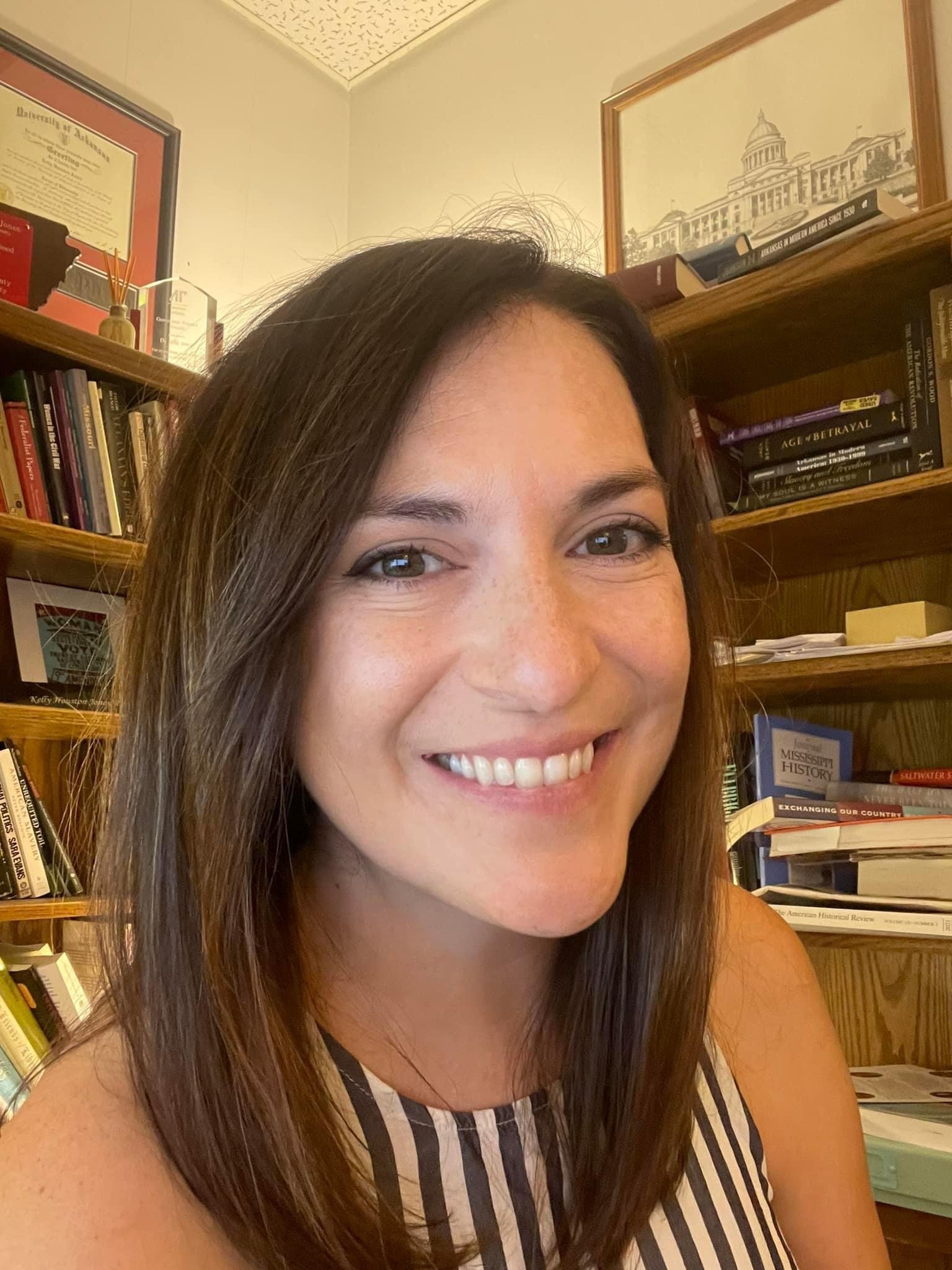
about Dr. Kelly Houston Jones.
Professor Kelly Houston Jones, associate professor of history and graduate program director at Arkansas Tech University, specializes in American slavery, usually focusing her research efforts on the Trans-Mississippi South, especially Arkansas. After receiving a BA at the University of Arkansas at Little Rock and an MA at the University of North Texas, Jones earned a PhD from the University of Arkansas in 2014. Since then, she has worked on uncovering the histories of slave life on the ground in Arkansas.
Her first book, A Weary Land: Slavery on the Ground in Arkansas, was published in 2021 by the University of Georgia Press and received the Arkansas Historical Association's John William Graves Award. Professor Jones carries an enduring interest in the history of Arkansas as the western edge of the American South, which informs her teaching and participation at public history events. She is currently at work on a book manuscript regarding the vigilante murders of enslaved people.
education history.
- BA-University of Arkansas at Little Rock
- MA-University of North Texas
- PHD-University of Arkansas
additional publications.
“White Fear of Black Rebellion, 1819-1866” in The Elaine Massacre and Arkansas: A Century of Atrocity and Resistance, 1819-1919, edited by Guy Lancaster (Little Rock: Butler Center Books, a subsidiary of the University of Arkansas Press, 2018).
“Bondswomen on Arkansas’s Cotton Frontier: Migration, Labor, Family, and Resistance among an Exploited Class,” in Arkansas Women: Their Lives and Times, edited by Cherisse Jones-Branch and Gary Edwards (Athens: University of Georgia Press, 2018).
“Freedom at the Pine Bluffs, 1864: A Research Note,” Arkansas Historical Quarterly, Spring 2018.
“Doubtless Guilty: Lynching and Slaves in Antebellum Arkansas,” in Bullets and Fire: Lynching and Authority in Arkansas from Slavery through the 1930s, edited by Guy Lancaster (Fayetteville: University of Arkansas Press, 2017).
“Chattels, Pioneers, and Pilgrims for Freedom: Arkansas’s Bonded Travelers.” Arkansas Historical Quarterly 75 (Winter 2016): 319-335.
“Women after the War” in Competing Memories: The Legacy of Arkansas’s Civil War, edited by Mark K. Christ (Little Rock: Butler Center Books, a subsidiary of the University of Arkansas Press, 2016). of Arkansas Press, 2016).
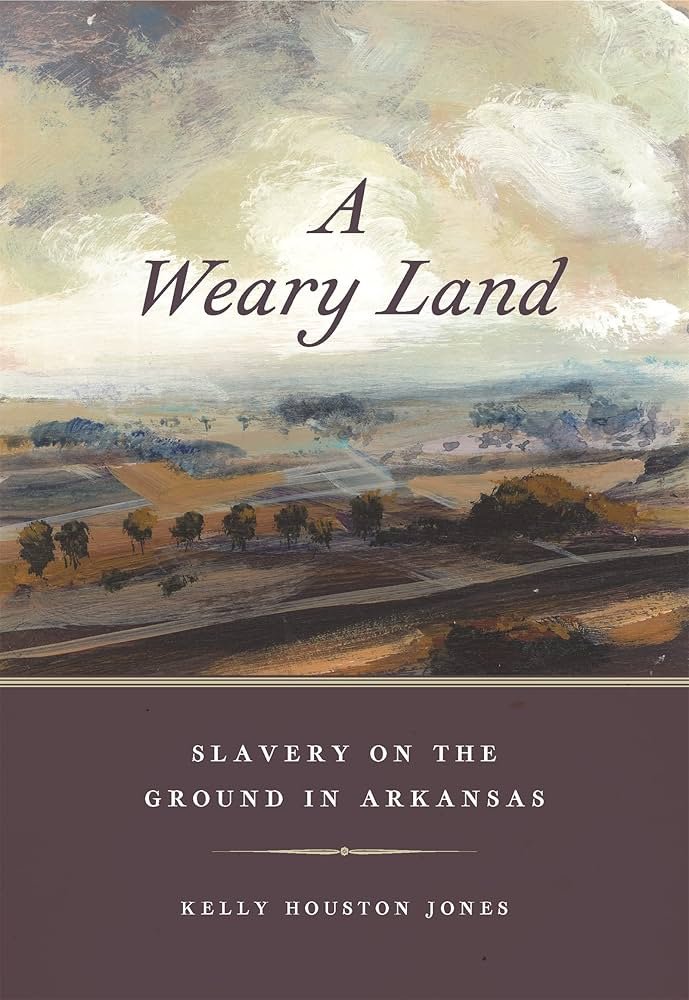
A Weary Land: Slavery on the Ground in Arkansas
A spatial analysis of slavery in Arkansas.
In the first book-length study of Arkansas slavery in more than sixty years, A Weary Land offers a glimpse of enslaved life on the South’s western margins, focusing on the intersections of land use and agriculture within the daily life and work of bonded Black Arkansans. As they cleared trees, cultivated crops, and tended livestock on the southern frontier, Arkansas’s enslaved farmers connected culture and nature, creating their own meanings of space, place, and freedom.
Kelly Houston Jones analyzes how the arrival of enslaved men and women as an imprisoned workforce changed the meaning of Arkansas’s acreage, while their labor transformed its landscape. They made the most of their surroundings despite the brutality and increasing labor demands of the “second slavery”—the increasingly harsh phase of American chattel bondage fueled by cotton cultivation in the Old Southwest. Jones contends that enslaved Arkansans were able to repurpose their experiences with agricultural labor, rural life, and the natural world to craft a sense of freedom rooted in the ability to own land, the power to control their own movement, and the right to use the landscape as they saw fit.
[caption id="" align="alignnone" width="4464"]

episode notes & references.
- Introduction to the Episode – 00:00–01:40
- Dr. Jones’ Background & Research on Arkansas Slavery – 01:41–04:34
- The Role of Slavery in the Formation of Arkansas – 04:35–11:18
- "Second Slavery" and the Expansion of Chattel Slavery – 11:19–16:38
- Slavery and Arkansas' Economic Development – 16:39–18:44
- Connections Between Indian Removal and Slavery – 18:45–24:18
- How Slavery Varied Across Arkansas (Cotton vs. Corn Regions) – 24:19–30:35
- Slave Patrols and Enforcement of Slavery – 30:36–34:04
- Religion, Justifications, and the Hypocrisy of Slaveholders – 34:05–41:11
- The Long-Term Consequences of Slavery in Arkansas – 41:12–46:00
episode outline.
Dr. Kelly Houston Jones – A Weary Land: Slavery on the Ground in Arkansas
"Second Slavery" – A historical framework for the expansion of chattel slavery in the 19th-century U.S. South
Indian Removal Act of 1830 – U.S. legislation authorizing the forced relocation of Native American nations
Henry Rector's Secession Speech (1861) – Arkansas governor’s speech justifying secession
WPA Slave Narratives – Interviews with formerly enslaved people conducted during the 1930s
Biblical Justifications of Slavery – Religious arguments used to defend and critique slavery
Economic Impact of Slavery on Arkansas – A discussion of slavery’s role in wealth distribution
Reconstruction Era Failures in Arkansas – The challenges of post-Civil War racial and economic justice
episode transcript.
episode preview.
[00:00:02] kelly houston jones.: Slavery has from a very early point been an essential facet of the creation of Arkansas as a political entity, Arkansas as a place, Arkansas as a concept.
What comes to Arkansas in 1819 with that political organization was chattel slavery based on race. And so in 1819, when the territory comes in without those restrictions, they're able to do that and anchor that into the society and the politics. Just like all of those things that we study and all of those things that we think about when we try to understand a place's history. Slavery is in all of those.
The term that historians have used lately is the “second slavery.” So the “second slavery” meaning a newer, harsher form of chattel slavery based on race.
episode introduction.
[00:01:41] mike.: You are listening to the underview, an exploration in the shaping of our place. My name is Mike Rusch, and I don't know if you've noticed, but things are changing, both in our country and in our state. Of course, change is always happening, I understand that. But lately, the shift feels different. It feels faster, more intentional.
Especially in how we're remembering and telling the stories of our history. Last week, I heard Dr. Tad Stoermer, a public historian, educator, and filmmaker, say this.
[00:02:09] Dr. Tad Stoermer: The _Fight for honest history is now a guerrilla war. If you care about public history, or history in public, these are two different things. You need to understand what just happened to the National Endowment for the Humanities, the NEH, and what it means for the future of who gets to tell America's story. Even what that story is. This is not about a funding shift. It's not a policy adjustment. This is a hostile takeover of public history. The battlefield has changed. The war for honest history is now a guerrilla war. _
[00:02:40] mike.: You know, six months ago, when I was putting this season together, I had no idea how relevant this conversation would be. But as you've heard me say before about the idea of the underview, our goal has remained the same. That goal is to have an honest reckoning of our history. Not for the sake of the past alone, but because I believe it helps us build a sense of belonging and it moves our community forward.
And yet we live in a moment where how we remember our history is being revisited, and the old rules of what gets remembered and what gets left out may no longer apply. When funding is stopped, when books are banned, when conversations are silent, we should ask the big question of why.
Because changing, editing, or not telling the full memory of our history isn't just problematic, it can be dangerous. I say this because a history that is not honest is something entirely else. It can turn into propaganda.
I ask people all the time what they fear, and if I'm honest, this is at the top of my list. Propaganda is dangerous. Nations have risen and fallen because of it. Because if you can control what people remember, you can control what they believe, and you can control who belongs, who has power, and who gets left out of the story altogether. it may be that the current backlash against diversity, equity, and inclusion programs isn't just about black communities. It could be about reverting back to power structures that have traditionally excluded anyone outside of a very narrow definition.
And this doesn't just impact one group the same forces that can try to erase black history, can also try to erase indigenous history, Latino history, the history of women, immigrants, disabled people, LGBTQ plus communities, basically anyone outside of a preference found in the founding documents of this country. Anyone who isn't a white, able-bodied man.
So if this history is now a battleground, then today we find ourselves on the front line.
We begin the first of a two part series in the history of slavery in Arkansas. To help us explore these questions, I'm joined by Dr. Kelly Houston Jones. an associate professor of history at Arkansas Tech University. She's also the author of A Weary Land, Slavery on the Ground in Arkansas. Her work provides the first book length study of slavery in Arkansas in more than 60 years. It offers an unflinching look at how the institution of slavery took hold, evolved, and shaped the state's trajectory.
And to this conversation, I want to be honest, I'm bringing all of my questions.
How did slavery take root here? What role did it play in shaping this state? How does its legacy still influence the place that we call home? Was slavery an afterthought? A regrettable footnote?
Or was it the foundation to Arkansas's development woven into its very identity?
What did slavery look like on the ground in Arkansas? How is the economy built upon the forced labor of enslaved people and beyond the systems that upheld it, what were the lived experiences of the men, women, and children who had to endure it?
This is not just a history lesson. This is about asking the hard questions about an institution that shaped Arkansas economic, political, and social structures.
Before we begin, I want to be clear.
This conversation isn't about placing blame or reopening wounds for the sake of it. It's about truth telling.
What happens when we fail to acknowledge our history? What are the consequences of leaving its impact unexamined? What do we risk by repeating the mistakes of the past? And who stands to suffer the most?
This is why this work matters.
I'm not afraid of the questions or the hard truths. I'm not afraid of the past.
What I'm afraid of is a world where questions stop being asked and the truth disappears altogether. And so we begin here with the pursuit of an honest history. Nothing more and nothing less.
Let's get into it.
episode main interview.
[00:06:26] mike rusch.: I have the privilege today of sitting with Dr. Kelly Jones, who is an associate professor of history at Arkansas Tech University. And,uh, I'm really looking forward to our conversation about the history of slavery in the state of Arkansas, but Dr. Jones, thank you for your time. It's great to connect.
Thanks. I'm really pleased to be invited to have a conversation with you about it.
I had the privilege of reading your book and I said, I have to have Dr. Jones in this conversation because this is a conversation about the story of Arkansas and specifically about Northwest Arkansas, but the desire is to really understand the forming and shaping and how slavery is a part of our place you are obviously more than well qualified to be able to dig into this and maybe we can just start. I love your background and your story and who you are first.
[00:07:13] kelly houston jones.: Thanks. I am an Arkansas native. I'm from Conway County, and I was born in Moralton, which incidentally is also where historian C. Van Woodward, one of our giants of the field of Southern history spent his childhood, and so I always love to point that out. Southern history and being a historian is it has its deep roots in Conway County. Elizabeth massey a civil, one of the earliest women to be recognized in the field of civil war studies was also from Moralton. So it was cool, but I'm actually really from the Northern part of Conway County where the, Ozarks and the River Valley kind of meet in a way and so that's a fun perspective to have as well. I feel like I know my River Valley people and I know my Ozark people in the background, with the students there. So Arkansas native, I went to, I got my bachelor's degree at the university of Arkansas at Little Rock. And and I originally, I thought that my questions about the South had been answered.
And I guess I'm forgiven in that because Carl Money Han, who. in the within the last, five or so years retired from UALR, a wonderful Southern historian. I took so many classes with him. And so I thought I wanted to study the American Southwest and like missions and that kind of stuff. And so I went to the state of Texas. I went to University of North Texas for my master's degree and man Texans love their history. And there were so many Texas history courses available that would And on different facets of Texas history.
And I took a course on the old South there as a master's student, And the professor had he had the course set up in a particular way and this does this sort of hang in there with me. He had the course set up in a way that there's so many books that each student would present on in class to their classmates, but he wanted you reading more than that. so he provided us with a list of books that you could choose from three or four from and go and read and write reviews and without doing a presentation, turn these into him. And as I looked over the list, I thought, you know what? I'm getting about text out. I'm going to look for something relating to the Old South in Arkansas, right?
Arkansas in this history and there was one book about slavery and it was from 1958, and so I thought maybe this professor who was definitely 80 years old I thought maybe the list was just outdated, and so when I talked to him, he said, no, that's that's all we have on that, maybe this is more of the academic background, but it really connects to the personal as well because I started seeing myself as having a cause with my career choice rather than this is an interest. This is a professional interest. It really felt like a cause after that.
And if there had been doubt that I would go on to the PhD, that was done away with because I've carried this desire to keep going. And so I did the PhD at the University of Arkansas, because I wanted to work with people who also cared about Arkansas. So I'm pretty rooted still, right? Like I I've got, I get to go a lot of places and do things, but I have not really bounced too far away from my home state. And I think that's something that The students relate to and appreciate it. It's sometimes easier to talk to them about difficult things in our past because I grew up where they grew up and sometimes it helps with that.
So I don't know, that's like my story of Kelly, the person and Kelly, the historian, it just fed by having some kind of cause with my career rather than we like to use the phrase, we'll dismiss something if we want to say that it's not really practical or does it matter by saying, oh, it's purely academic. But it's, you can have both. And so that's what I have been able to do. And so it's fun to come back to Conway County and see the family and friends and be able to bring that back. Yeah that's what I've been up to.
[00:11:26] mike rusch.: Maybe I can dig into that a little bit more, because I am always curious, and I think maybe especially with you.
You've been studying the state and its history for a long time, like, where are you today? What does Arkansas mean to you today?
Is that an impossible question to ask?
[00:11:40] kelly houston jones.: Oh, goodness. It's so hard. I don't do a lot of theory, but when I was trying to wrap my brain around the research about slavery defining Arkansas, I was really struck by one theorist who talked about a place also being an event. And so what that does is it means that My Arkansas and your Arkansas aren't the same right because the things that have happened are in the way I see it and framing would be different. So I think the quick easy answer would be Arkansas is home, but Arkansas is also changing And, not, that doesn't, that's not always bad or good. So I think that I view it differently than maybe some other folks who are influenced by an idea of, Arkansas being synonymous with traditional or unconnected or stagnant or, those kinds of things, a little bit like the sort of national reputation, that even some of our, locals will adopt as an idea of what it is, but to me, Arkansas, It's it's home. It is history, but it's also, it is moving. And again, that's sometimes for the better, sometimes for the worse, but Arkansas to me does not mean this place that's stuck. It's not a place to run away from, and it's but it's a place that's got to be understood in that context because Arkansans have never been sort of untethered from what else is going on in the country. So I think for some of my friends who are, were, are also from the state, but have left and not returned, it gets stuck in the past for them. And it's just spinning its wheels, there but I don't see it that way.
[00:13:30] mike rusch.: I think that's yeah, it's an incredibly insightful way of looking at it in many ways, because I know, Obviously that there's a lot of factors that have come into the forming and shaping of what is now the state of Arkansas and slavery obviously being a significant part of that. And I'm curious, can you help us kind of place this area of study within the broader history of Arkansas when we think about the forming and shaping of this state?
[00:13:57] kelly houston jones.: Slavery has from A very early point been an essential facet of the creation of Arkansas as a political entity, Arkansas as a place, Arkansas as a concept.
When Arkansas territory was organized, draw those boundaries, set up a territorial government in 1819, that when they established that with no restrictions on slavery, it really set the state on a particular trajectory. And Just to be clear about that, there are types of captive, unfree situations that people have used in the past to exploit each other for labor or whatever other reasons that have existed all over, North America since time immemorial, okay, before this, but what comes to Arkansas or what's opened up for, in Arkansas in 1819 with that political organization was chattel slavery based on race.
And so in 1819, when the territory comes in without those restrictions, it encourages folks who want to use that system to benefit and enrich themselves. and start fresh, coming from other parts of the South. They're able to do that and anchor that into the society and the politics. Just like all of those things that we study and all of those things that we think about when we try to understand a place's history. Slavery is in all of those. And It's a really interesting time period because right about then is when this, the term that historians have used lately is the second slavery. So the second slavery meaning a newer, harsher form of chattel slavery based on race. So it's not just that they swing the doors open to chattel slavery, but it's right at that moment when the second, the so called second slavery is picking up speed.
So it's not the old tobacco system where enslaved people are set up in different sort of quadrants of a large operation and there's a little bit of independence and there's, a little bit more movement, okay, that they can have. It's not, 17th, 18th century tobacco slavery, in the seaboard, it's an intense cultivation of cotton that they've opened up for. And so the thing about this, in Arkansas's formation is that those political boundaries encompass so many different geographies that allow this second slavery to play out in different ways.
So one way that historians have looked at it, other Arkansas historians as well, have been to look at cotton versus corn production. So corn is not only a way to feed people and animals, but corn is also a commodity that you can sell, and in some parts of the state, you can look at the ratio of how much corn versus how much cotton is being produced to help to get a sense of how this is playing out in different parts of the state. And so if you move further northwest, then Much less cotton to corn, right? And further you go to the south in the east, southwest Arkansas has, quite a bit of this as well. You're gonna see a little bit more cotton, to that corn ratio. And the thing that enslaved people are growing soonest in Arkansas and for the entire time that slavery exists is corn. So there's this kind of like foundation that goes on there. So in some ways, then the state is, there are many histories playing out within those state lines. But those political boundaries still have to be important for us because of those moments, like creating the territory in 1819 with no restrictions on slavery and then creating the state in 1836 with no restrictions on slavery. So 1819, an important sort of foundation for where the state's going to end up going. 1836, another one. And I don't think that by the time Arkansas became a state, there was a lot, that there was a very large chance, that it was going to come in without slavery. They wait for a sister state in they wait for Michigan.
So that they have, that they'll be able to keep that, they meaning politicians in Arkansas and DC wait for that sister state so that way the balance in the Senate won't be upset. So there's all of that other stuff. So it's pretty unlikely that Arkansas would have come in as a state with restrictions on slavery, but I always come back to that 1819 because it was close. It was, that was a close one. And so that's one of those moments that kind of set us, there's a fork and I would put, and, not to get ahead of us, but I would, unsurprisingly put the vote to secede from the union as another one of those forks, where they make a choice that's going to have really long term consequences for, what Arkansas is, who Arkansas, Arkansans are all of that.
[00:19:17] mike rusch.: Obviously we're talking about the history of slavery within the state. And I want to, before we go a little bit deeper, I'd like to just ask this kind of question, like for those that may be wondering, what does this have to do with today?
How would you place us in this kind of cultural moment we're in today that says, Hey this really does matter to how we think about our state and where we're at today and potentially where we're going?
[00:19:41] kelly houston jones.: It's such a good question. And it's. It can be difficult for academics and those who teach to answer a question like that because we are so concerned that we might, instead of allowing someone to form their point of view, that we might end up Channeling them to a certain way. And so I think that it matters to us now and a good way for us to spend thinking about it now is in terms of, questions. And what I have found is that So many of the questions that people have about what Arkansas is like now have to do with, the answers can be found, or at least you can get closer, to an answer by looking at this past that's not just an historical markers and cool museums and that, that kind of stuff. But this what happened and why, so I would say, one example, poverty we're known as being a state that's pretty poor.
And That, I think, is something that you could easily, try to explain away that, we're backwoods, we're disconnected, maybe, there's thesis that have been blown around in the past, that there's a cultural problem, like lazy southerners, or, the stereotype of the the Arkansan with the whiskey jug leaning against a tree, and just maybe life is just slower here, maybe we just, don't get it. Maybe we, but there are real historical processes that have contributed to poverty, in Arkansas, not to excuse our responsibility today, but to just look for the roots of some of that and how it looks different, in different parts of the state. Poverty in Madison County, Arkansas doesn't look the same as poverty in Phillips County, Arkansas, and I'm not sure I, if Madison is not the poorest, it's up there. Okay. And there are aspects of there are parts of Southeast Arkansas that where you can find Okay. Pretty devastating emptiness of businesses that it's just it can be really difficult, to wrap your mind around. And you can trace both of those back to, I'm not saying blame it, okay, on slavery, but you can trace the historical processes where the best land And resources were snatched up by the slaveholding class in Arkansas.
That is something to consider if we're asking questions about white poverty. The, and certainly the theft of black labor and the proceeds of that and the questions about generational wealth. Certainly can you draw that line to black poverty, in Arkansas today. And so there it's it's. It's hard, but it's important to consider what has happened in the past to help us answer questions about what things are like today. And I think for a lot of people, poverty's the one, like the, if I'm if I'm listing like the sort of top three things that people are trying to find out about Arkansas and where to draw, where to find the roots of that poverty's certainly towards, the top of it. But that's one of, that's one of the things, if we're looking at how do we understand Arkansas today by looking at Arkansas in the past, I think it's more complicated than remember history or you're doomed to repeat it. I think it's what choices have been made in the past that we need to make again, or that we need to not replicate, it's not just a, people think of history as this sort of cyclical, I just, I think it's a little bit more complicated than that. Was it Mark Twain who said that history doesn't repeat itself, but it rhymes?
[00:23:43] mike rusch.: I don't know, but
[00:23:45] kelly houston jones.: that kind of works for me a little bit more than history repeating itself, because, that's, It's just a little too simple, for the historian.
[00:23:53] mike rusch.: think that's super helpful. I, what I think not to put words in your mouth, but what I hear is this, like just the systemic or institutional framework, in some ways that if we want to understand where we are today, understanding how we got there is going to be important. I think that's a great example for sure. Within that.
[00:24:09] kelly houston jones.: And not to move us like too forward in the timeline, but just to also mention, you It really is very often that if someone has a question for me about Arkansas and who we are and what we've been up to and what's been going on, the answer is in how Reconstruction played out in Arkansas.
And they have no idea that they're asking a question that's going to get them into this era of history that so many people find so boring. They like the Civil War, but they don't want to talk about Reconstruction because it's a lot of, Elections and I don't, I don't know. Actually, people are interested in elections, but political parties shifting and so's platform and, like legislation, like it gets very detailed and very busy very fast, but so it's not, it doesn't feel as cool to people as the Civil War does, but often Reconstruction is another one that when I try to come up with an explanation for someone about something there. They didn't expect we were going to go back that far. Yeah.
Indian Removal Act and Chattel Slavery.
[00:25:05] mike rusch.: Let me ask you this because I, in the previous conversation, the previous guests, we've talked about settler colonialism, right? And so one of the things we spent a pretty good amount of time on is just kind of federal Indian policy and the Indian Removal Act of 1830. And I think you start to touch on this. in many ways that I, can you help us connect these two things or are they connected with kind of the arrival of slavery within the United States or within the, the South or even within Arkansas?
[00:25:38] kelly houston jones.: I am certainly convinced, and I'm not the only one, that The process of Indian removal and establishment of chattel slavery based on race in Arkansas and beyond Arkansas are really two parts of that same process. It's all part of one big process where Native Americans People are pushed off of land so that people of African descent can be forced onto it, so that land can change into a place where enslavers can extract either, and it's, it's very often it's that cotton cultivation, pushing westward, but it's timber, it's certainly it's corn cultivation, it's cattle hogs.
And so what they're doing is imposing their system and worldview onto this acreage that can be super profitable for them if they're able to get their way, if they're able to establish the political system, to support that. And so Indian removal is one way that they're able, they being whites with political power, that they're able to set up the system that, that they want to see.
Indian Removal Act.
[00:26:57] kelly houston jones.: And the interesting thing about that history in Arkansas is that a lot of times folks will go straight to the 1830 Indian Removal Act and lay it all at Andrew Jackson's feet and say, Oh, he did this to us. And that's where this horrible history comes from. And not to get him off the hook, but just to place him in a row of a whole lot of folks, okay, being involved in this.
Arkansas's history in connection with Indian removal long predates the Indian Removal Act of 1830. By the 18 teens, you've got Native American groups who have been pushed from parts east out to Arkansas. Arkansas was the place to push them to, to get them, doing air quotes, get them out of the way.
And there are multiple steps to this. So when I talk with students about it, I like to use the term Indian removals, so they can get a sense of the waves of forced westward migration of Native people as part of organized tribal governments first just west of the Mississippi River to Arkansas and then moved again past Arkansas into Indian territory.
So it's connected in a way that it has to be like that two step process to get what these folks are looking for out of the land. And that's maybe just a, and that's what we mean when we say settler colonialism, that it's colonialism that's not that metropolitan periphery that you would hear, folks talking about in the context of say England and the sugar islands or, whatever, but it's settler colonialism, right?
They're just pushing westward and they're getting policies in place that will help them do that. And so it's part, it's part of the same process. Native Americans and African Americans are seen as either a roadblock or a tool for creating this, political and economic system that's benefiting, that group.
extractive colonialism vs. settler colonialism.
[00:28:54] mike.: If I can interrupt for a moment, I want to pause here and bring in a comment from our previous episode with Melissa Horner. Dr. Jones just described a two step process of Indian removal and its connection to settler colonialism. And Melissa framed this same point from another angle, how both settler colonialism and extractive colonialism have worked together to shape the South. Let's take a moment to revisit our words.
[00:29:17] melissa horner.: And so one thing that southern states have that is a particular entanglement that the northern parts in general of the United States just have less of and looks different, is the presence of two kinds of colonialism.
Extractive colonialism that stole people indigenous to the African continent, and settler colonialism that used the stolen labor of enslaved people to work on the land stolen from indigenous people.
And with that, we have intersections of historic and ongoing anti black racism, economy that was built on two forms of theft and a lot of divisions between native nations, black folks, and white communities in the south as a result of this really gnarly entanglement of these two kinds of property and these two kinds of colonialism.
[00:30:15] mike.: That distinction between settler colonialism, taking the land and extractive colonialism, stealing labor, adds another layer to what Dr. Jones is describing. Both were part of the same system, shaping Arkansas's economy, politics and racial hierarchies. Well, I'll stop and let Dr. Jones continue by exploring how different groups from large planters to small farmers were positioned within this system.
[00:30:38] kelly houston jones.: And of course, one might say you've got certainly a lot of small farmers who are moving out to Arkansas looking to grow crops and support their families who aren't in that slaveholding class. They're not, but the land speculation system, the legislative measures that are, carving out this those are all being enacted by that slaveholding class. So it's the engineers of this, have a certain idea in mind and there's other folks coming along too, and they're benefiting in different ways from it as well. So they've got no reason to, there's not a lot of incentive for even what we would call like a yeoman farmer, what We might, maybe a little bit anachronistically, but we might think of as like middle class, okay, farmer.
There's not a lot of incentive for them to not want to see that as well. So parts of the same process, for sure. Those forced migrations are, It's part of what makes settler colonialism work. It's not just this kind of the acreage is empty and we just kept marching westward and, creating this, productivity out of land that has had, had no use, kind of thing.
Quapaw.
[00:31:42] kelly houston jones.: There's also like an identity element to it because there are, Native Americans who are growing corn, the Quapaw, the story of the Quapaw is It's all heartbreaking, but the story of the Quapaw, maybe because that's one of the groups that's native to the area of Arkansas, right? Those are Arkansas native folks.
They work for a long time and think that they're, they're cultivating, they're, right? They've been an essential part of the agricultural economy of Arkansas since before anyone could remember, and they're still not going to be exempt, from that. And it's so there's, it's about race, it's about identity, it's about all of those things, all of those things come together to make that process that we often will call settler colonialism work.
[00:32:28] mike rusch.: I'm curious, like, how do you see the history of slavery in Arkansas versus maybe the rest of the South or Southern states? Are there differences? Or would you say, Hey, this is the same type of institution that we would see in other places?
[00:32:44] kelly houston jones.: It's similar in many ways, and it's got its own sort of cast in other ways. So the interesting thing is the level to which North Carolinians and Virginians and Tennesseans are able to bring the institution that they know and understand and have benefited from to Arkansas, to transplant that.
It's also interesting, the inability that they have to completely accomplish that. I also think an interesting thing about Arkansas in the context of the rest of the South is that it's almost like when you're watching slavery play out, that history play out in Arkansas, it seems a little bit accelerated in, in history, we were not scientists.
We can't run an experiment and then take a variable out and then run the experiment again and see, how it turns out differently. But in some ways, watching how chattel slavery based on race comes to Arkansas grows so incredibly quickly and then is destroyed. It happens in such a short amount of time.
So it's. Some of the processes that you can study happening in, Virginia over all of these generations, it's happening in Arkansas with, so much of it, within 30 years. And it's just, that offers an interesting opportunity to understand American slavery. So that's one of the interesting things about being an Arkansas historian, is that Not everybody is fully sold immediately that this is the South, anyway so even just a question, even the question, how does slavery in Arkansas look when you put it in the context of the South as a whole? What's similar? What's different? Even asking that question it's already a win, for me, because it should be understood in that fuller context.
So Arkansas is the place And there are some parts of East Texas that are keeping up, but Arkansas is the place where between the census of 1850 and the census of 1860, this is where slavery is growing the fastest. And if your measure is, which has been mine, that if your measure is the population of enslaved people between those tenure, those census counts it's, Arkansas is the place where it's growing the fastest, but the population of enslaved people in proportion to the total state population never gets more than about a quarter. On the other hand, though, it's like one in four Arkansans. were held in chattel slavery in 1860. That's incredible when you consider how recently it got to Arkansas in the big scheme of things.
And I think it's because the type of slavery that arrives in Arkansas and takes root is that second slavery. This system has matured in so many ways by the time it gets to Arkansas, if that makes sense. Even though, 1820 ish, that's still pretty early. That's when people think of that sort of second slavery as having really come in come into, come onto the stage.
And yeah, in such a short time, it's just we're grown and blown up. What Enslavers will do is model the legal system to create and protect this regime, create that sort of scaffolding, on it. They'll model so much of it after the laws of say, Virginia, but then there's that, sort of day to day practical nature of this, how well does that actually work for them in a place that its infrastructure isn't developed? Certainly not like somewhere in Virginia. The original South is what I call it to my students. I think one good example of that is the patrol system. The patrol system in Virginia, and it's, there's obviously population differences as well. They've just got more people, right? It's Arkansas is so much more sparsely settled.
patrol system.
[00:36:43] kelly houston jones.: The patrol system is one that's provided for on the books in Arkansas. There's law and they'll tweak this over time, but to, this, it's to keep it general they'll provide for how this should work and it's administered at the county level and you're appointing a captain and, you're doing all this stuff.
But what the documents actually show you is that Rather than a uniform, systematic patrol system in Arkansas, in most parts of the state, it's really ad hoc posses of neighbors gathering when they hear of some sort of trouble, in their view, that is how slavery is regulated when it comes to the movement of enslaved people.
So you can go through The WPA narratives, and what I mean by that is the mid 1930s effort, one of those New Deal programs where writers went through and talked to elderly formerly enslaved people, sometimes their children are the ones who are alive, and they're telling stories that their parents had told them.
You can find patrols mentioned quite a bit in those, but you can also find a really varied experience, on those. Sometimes seems more systematic, sometimes not so much. And that's where those political boundaries, that's one of the places where those political boundaries of, Arkansas is encompassing all these different geographies.
You can really see it play out, in the documents. So say, maybe this is way too easy of an example, but say Chico County, Arkansas, where most of the people who live there are enslaved, right? That patrol system's a lot more systematic and robust versus, the, Probably way too easy contrast would be Washington County.
I'm going to do it anyway. That doesn't make sense for your resources, right? There's just not, there's not as many people and it's not, it doesn't, it's just not practical, so those kinds of things, the infrastructure in Arkansas, and even though you can have, you can say one extreme for one part of the state and one extreme, for the other if we smooth that out across the state, it really does hold that, it's, it is still no matter what part of the state you're looking at.
It is pretty sparsely settled, Little Rock can hardly be called an urban place, even in 1860 and not to mention, 1850. And they have a capital city, but it's not, there's not really a whole lot of people. And in this, and I, the F word frontier is fraught. Okay. But in this sparsely settled Loose infrastructure place they respond to the demands of the moment much more than impose something really systematic. So that's just kind of 1 example that we could talk about with that and gun ownership, you can find in the documents, they don't mean to tell you this, but sometimes it's you can tell that enslaved people are carrying guns around sometimes in some of these places to hunt, to maybe protect themselves when they're out in the swamps or the forest, or whatever. There's one court case from, Washington County, where an enslaved man was accused of having shot this woman's neighbor's cow, and one of the pieces of evidence they're using to say, Oh, he's the one who did it is this is the gun that was used and he's, he usually carries that gun.
So it's they're not trying to reveal that to you, but it's just you can find those things in the documents. And so it really can tell you something about just the day to day pragmatism that can break through these things. And if you looked on paper, if you looked at the state of Arkansas laws, you would never suspect, anything like that to happen and not just Washington County. Maybe you can look at other parts of the state and you can see that, they're the realities of being sparsely settled across terrain. That's not always, Easy for a systematic imposition of this system. They, they will it's looser than you might expect.
They're not able to get everything that a Virginian is. Maybe yeah. I'll stick with, I'll stick with Virginia. So many of them do come from Virginia.
[00:40:54] mike rusch.: I'm curious, you write in your book this kind of difference between a society with slaves versus slave societies. does this fit within what you're talking about or is that reference I'm curious the difference between these kind of two framing ideas, if you will.
[00:41:11] kelly houston jones.: That has been an important tool for us slavery historians. When Ira Berlin coins this set of terms, he's pointing out the difference between a place where slavery is the fundamental sort of central aspect of that society and economy versus a place where it exists, it's protected, it's important, but it's not the central like fundamental thing and you can apply that to the experience of slavery in Arkansas not without complication, but it can be a handy way to consider, what's going on. So in a place where, I can Maybe, think of it this way. In parts of Arkansas where the plantation system has really taken root along the Mississippi River, the Red River is another, place to look a belt in the Arkansas River for so far, those are places where the system, if you took slavery out of that society and economy, it would be completely unrecognizable.
If you went to even, where I live now, Pope County, they're growing cotton in the river bottoms, there, but the plantation system is, not the main driver of that economy or that society. Now, I've got, there are some qualifications that folks should consider, with that.
One is the sort of blurred line. Where is the line between a society with slaves and a slave society? Those can be hard, okay, to find. And maybe, Some nuance and some blurring is what we need to make room for, and I've got, I tried to do that using concepts, of geography in the book to try to help people understand, because in the past, and I, and maybe I haven't fully succeeded because people still talk about it this way and that's okay and it's tempting to draw a line from the northeast corner of Arkansas to the southwest corner and say okay, if it's you know, to the right and to the bottom of this line, to the east and to the south of this line, then it's a slave society.
If it's to the north and to the west of this line, it's a society of slaves. That's roughly works for us. It's two, we got two different things happening in the same political construction, but I don't think it's that simple. I don't think that people living it out think that it was that simple.
I can give you some examples of that if you want me to.
[00:43:50] mike rusch.: Yeah, I think some examples would be interesting. I think one of the things that struck me as I as I read your book was just the prominence of the names that you used. Slavers names from tax records the names of enslaved people. And I, at first I started, you know, I'd underline a name when I saw it. And I think by maybe, I don't know, maybe 20 percent of the book or so I literally, I felt like I was underlining all the time. And I think it brought a sense of reality of the humanity, if you will, of what was happening in the place for on both the, those that were enslaved, but also the slavers in that aspect as well.
I'd love to understand why you chose to do that or what does that mean to you and how maybe those examples of a slave society or societies with slaves plays itself out within just the reality of what you, recorded in your books. In such a, I would dare say, personal way.
[00:44:46] kelly houston jones.: I really appreciate that the way that you framed that question, because it's so nice for someone to acknowledge the centrality of the names and just like the effort that it takes. And it's so difficult for black genealogists, for scholars to find out something that we take for granted the name of the person that you're trying to study or tell a story about. And so one of the things that I was committed to with this book was if I know the name, I'm going to write it and It can become difficult to have a smooth prose, doing that, but it's so important, not just for the sort of utility, of a researcher or a genealogist, but for just, bringing the stories, putting them on paper for folks who at, in their lifetime may, they're, they may never have seen, their name written anywhere, maybe it was, but maybe they never even saw it, or maybe there's three places in the entire documentary of their history of their life the paper trail, if you will, of their lives, there may be, one or two places where their name is actually, even mentioned that is an erasure that is so significant that we should work to recover, when we can and it was actually, it's a struggle for the editorial process. I was not able to, no hate on my press. I love University of Georgia Press, but just, the way publishing is now and the cost constraints, it became clear that we weren't going to be able to include all of these names in the index.
But I had an indexer who went ahead and did two for me. One index that went into the book that's got it's short enough to keep the press happy, right? Okay. And then a longer one that just has every single name that's mentioned in the whole book. And to be clear, there are also some white folks names that didn't make it, to that shorter index, but the thing that made the index long was all of the names of enslaved people that I've made sure to include in the text if I had it.
And so that's, that was important for us to do. And I think it's important for readers as well to get those names in there. And that's the thing about this book was that I really wanted to make sure that people got a sense of, and this is why it's so important. The title is what it is. What is this sort of day to day, on the ground experience like?
What's happening to these people? What is their family like? So the only way to do that is just squeeze out every single detail you can find. And we historians working on this kind of stuff, fight for every little scrap of information. So when we have it, we're so happy. And we want to, we want it to get into that narrative, that we create.
So I'm really happy when people notice that and appreciate that. And I've actually had some descendants getting in touch with me and saying, you mentioned this person on this page. I'm a descendant, of theirs and I'm working on our family's history and, what else do you got?
You have anything else, you have any leads, and so it's just really, it's an opportunity that I would not have Otherwise, and maybe if it saves them a little time, that's cool. That's cool, too. And how great to see. How wonderful it must be this, and I get this from the conversations that I've had with folks, their joy at seeing their ancestors name in print when they are very aware that person has, and it's not just a forgetting.
[00:48:26] mike rusch.: It's a systematic erasure of those folks history, and so if what I have done or am in the process of doing in any way helps recover some of that or make up some of the gap, on that, then, I'm pumped, so I, and I, that's the way I like to write, and actually it's one of the frustrating things about the project I'm working on right now is that, I'm having to start from that sort of outside in top down rather than the other way around. And it doesn't feel as rewarding for that reason.
I think one of the names I've, I don't know where this comes from. We had a guest in season one, Dr. Nick Ogle, who is a PhD in counseling education, talking about relationships. And one of the things that I've heard him repeat. Before is that a person actually dies twice once death. And the second time is the last time their name is spoken or written. And so I think to me, as I read those names That's what I see in the background is the dignity of a, human being who may not have had their name recorded anywhere else, but I don't know, maybe in some ways yeah, you're keeping that memory alive.
[00:49:32] mike rusch.: And just reading through it definitely had an impact on me from just the detail and to your point obviously the name of the book is A Weary Land, but it does help convey the sense of both the reality, but also the brutality in places of the conditions that people were in.
And to put a name with those conditions, is incredibly powerful. to know that's an intentional focus is really, it's very that's very encouraging for, so thank you for doing that.
connection with the land.
[00:49:59] mike rusch.: One of the things that I also really appreciate in many cases you're writing about the connection of enslaved people to the land and how that connection really created a sense of place and belonging within maybe a people that we wouldn't think could establish that and and I'm curious your perspective on how you view and, as you've studied all of these stories, and all of these situations what do we have to learn today from that, that rooting or that sense of belonging? Yeah I'm curious what you take away or why you feel like that is something that was, in my opinion, prevalent in, in your book.
[00:50:33] kelly houston jones.: It's one of the things that historians and other thinkers about environment and place and human communities have grappled with, is the question of if a person's residence was And labor and, daily, yearly routine is coerced on that acreage, on that land. Can they, is it home? Can, are they alienated from that place because of the coerced nature of this? Are they, do they see themselves as farmers, as Southerners, as Arkansans sort of country, communities, are they stewards, are they, do they think of themselves, do they want to even be, good sort of stewards of that land? And that is not one of those questions, or I guess it's a sort of cluster of questions, it's not one of those things that you're going to find like a smoking gun document.
Oh, I've proved this person said this on this date at this place, I'm going to prove this link, but we can comb the documents and see that despite the fact that their agricultural work, and of course there are enslaved people in Arkansas and beyond who are doing urban work and, other things but by and large, like other Arkansans, they're farmers.
So we can look at documents and try to figure out is there a sense of kind of ownership, belonging, rootedness, here that happens despite the, Brutality of the system the fact that if you are an enslaved person in Arkansas in 1860, you were probably not born there. Your parents certainly probably were not born there because there's so much incoming, like over those years. So with those realities, then how do we, what do we do with this? And there are just little nuggets here and there that once you gather them all together, It really looks to me like These are people who have created, and many scholars have talked about this in other contexts as well, they're creating a parallel world. To the best of their ability, they're creating a sense of home and community and place outside of that imposition by white enslavers or neighbors or, whatever, right? The sheriff's deputies or, whatever, whoever else is trying to enforce this system. One of the ways that we find that out is through those narratives where you can, read through that generation's reminiscences about their childhood and where they were born and where their parents were born and where they farmed and you can look at documents from, that time period and find that these are skilled farmers, they're not mindless robots being shuffled out to the field and push a button and put them to work and then, they come back and focus on something else. They know what they're doing. They know how to farm. I would argue like other as other historians would that a lot of these folks, they know the cotton routine better. than the person driving them to do this. They are trying out different tools and methods often at the request at the force of whites, but they're the ones who know what, how it actually works out to plant a little early or a little later or to use this certain seed drill, to like get that seed in the ground.
So they're they are skilled and when slavery ends, they don't, as a whole, gather in urban areas and try to recast their entire identity and life and work. So many of them remain farmers in a different type of exploitation but the documents show us that they see themselves as Arkansans, as country people this is their place, and they made it their own as much as they could within the, bounds of this brutal system. They are constantly struggling in the history of slavery in Arkansas. Enslaved people are constantly struggling to create a sense of rootedness and belonging, despite all of this stuff influx. One of the things that maybe I should reinforce here is that there are so many newcomers to Arkansas, but once an enslaved person is forced from, say, somewhere in Alabama, to somewhere in Arkansas, they're also very likely to be moved around again after that at or to have family members sold away from them or something. So it's a constant battle. They're constantly having to chase ways to create a sense of home and place and they that's that is a story that you can find in their own telling of their families history. So that I, my argument is that they are able to establish enough of a sense of rootedness that when they, when formerly enslaved people are looking to define what their life is going to be like under freedom. And there's this short window there where it looks like they might have more control over that than they end up getting.
They are fine to farm cotton. It's the exploitation of slavery that they had a problem with. Not being a rural person in Arkansan, a cotton farmer it's that exploitation, it's the coercion, it's the it, that system was the problem for them. One of my favorite pieces of evidence. For this is there was a group of gosh, maybe hundreds of Black Arkansans from around like the Fort Smith area who I can't remember who they wrote a letter to some federal official saying, okay, we've got all these names are signed. Hey we want to farm. We would like the federal government to grant us acreage out. I think they wanted to go like into Kansas or something, they, I would like the federal government to grant us some acreage and then we will farm it in cotton and then we will You know, pay back what we owe, on this. And this is the system that we want. And they like sign all these names, and this is something that shows up in the us army records. And so they are not alienated from what it means, to be a successful cotton farmer. The problem has been that exploitation the whole time, not to say that there's nobody who just bails totally and says, yeah, no I'm not doing this, we're going to go somewhere else.
the role of the church.
[00:57:30] mike rusch.: One of the things too, that I still, I think is worth a broader conversation. We may not be able to get to it in totality, but I want to understand in many places where you're writing kind of the role of the church in slavery or the justification of slavery, because you give some really incredible examples of enslaved people, as well as their slavers going to churches together and the dynamics around that and how church this Western Christian church practice takes place in these different communities.
And so I maybe I'm not a hundred percent sure where to start, but maybe. Maybe you can give us some context of how this institution, which is still very central, I would argue, to the South and to Arkansas wasa part of, the justification or the perpetuation of slavery in Arkansas.
[00:58:24] kelly houston jones.: Sure. The, this is something that can be this could be one of the things where, " the past is a foreign country sometimes." It can really blow folks minds to think of how explicitly, not implicitly, but explicitly, some of these churches And I'll say church leadership, would use the Bible to justify and enforce, this system. And I think there's like some back and forth going on. I think that there are, there is a, there's an impulse to, Justify something that a person is already benefiting from. And so you're looking through the Bible for something that can help you, justify that, but I think that it can also go back and forth as well.
The system of slavery is also a domestic and social system, not just an economic and like a labor and sort of political thing, right? So their concept, and again, they, I'm talking about free white people who are the sort of movers and shakers of Southern society in Arkansas and elsewhere, their sense of household and dependence and independence is something that the Bible helps them shape. It's not just that they're doing what they want to and then they're looking, flipping through the Bible for something to, justify it. They're also looking at patriarchy. They're looking at reciprocal obligations. There are things that are informing them as Christians in a household that is also pushing it. So it's like a back and forth thing that goes on.
And the Bible's structure of family and household that they understand makes room for and blesses the institution of slavery. And again, the way they understand it, this is not just allowed for, but can look pretty central, this sort of like hierarchy of a patriarch, white women who are Kind of the help mate, for that patriarch who then are over and above the children, and any free white laborers or people who owe them money or maybe lesser affluent cousins or something, like that, and thenpeople coming to work for a limited time, in some of these places, they'll hire some folks to come and do some carpentry or that kind of stuff. And then enslaved people like at the bottom of that whole pyramid.
And the more of those people and those interactions that a white Christian patriarch in the South has below him. The more masculine, the more powerful, the also though, the more Obligation he has to them. The more in there, the more dependents that he has gathered under him, the more status he gets, but also the more he sees himself as needing to behave in this sort of caretaking, like benevolent sort of way. And so their faith can help them reckon with that, too. Oh, I'm taking when I hold someone in slavery, I'm caring for them, and with that comes the duty to christianize them.
In earlier eras, there's like some controversy in, say, colonial Virginia, colonial Maryland over enslaved people being baptized as Christians because what do they do? One of the things that they figure out pretty early on is, oh, English law says that you can't enslave me if I'm Christian. because Christians don't enslave other Christians. It's central to that faith at that time and and so then they they start using it, to get out of slavery. And so then white Virginians and Marylanders passed legislation to get, rid of that. But then, After that controversy ends, then it becomes a tool to keep them in slavery rather than this thing you want to keep out of their reach so that they won't try to be part of, this society.
And so that's where you end up with this split. There's, there are two different things going on when the question is about, Church and Christianity and slavery because there's that sort of the white sort of formal Church that's going on and then there's the faith and Services and beliefs of the enslaved people so you can find kind of both of those, you know in the book Sometimes enslaved this is where it could get it can really vary from person to person Farm to farm and family to family.
Sometimes the slaveholding class, maybe that family says, okay, one of our important things, right? Because I've got this, I've got these folks who are beholden to me when it comes to labor, but I'm beholden to them when it comes to like protection and, what that means to me. what that means to them as protection, right? How they see it and care then, forcing people to go to church who maybe wouldn't go otherwise, it's not always welcome by enslaved people, the interventions of enslavers on, them attending services or attending certain types of services and being subject to certain types of sermons.
So on the one hand, The white family might think they're showing what good and benevolent people they are by taking enslaved people to church with them on Sundays. And I think I've got a story in there about this about some enslaved people having to sit in a certain place or, sit outside and listen in through the windows or, there's physical separation that can happen with that. So they think of themselves as really doing these folks a favor, but a lot of times the evidence shows us that enslaved people are waiting till, their chance to have real church, out in the woods after hours or, in somebody's cabin and trying to keep it a little bit hush.
And it's not always so much that the white family doesn't want enslaved people to have church services or worship services or, sermons, it's what are they preaching? What are they singing about? What are they praying for? That's where this black subversive Christianity really is can threaten them. And so it's so then it's wrapped up in their, in white's interest in preventing enslaved people from learning to read and write, because not only could you send messages, but reading the Bible for yourself historically has been a really powerful thing for people and so these folks don't always want to see that happen.
But again, slavery, by the time you get to the 19th century, it really has, even before the so called, "second slavery," by the time you get to the 19th century, this is no longer a labor system. It's also a cultural and social system. And it's used to it's used as a form of, racial control as well, not just labor exploitation.
It's so ingrained in white culture that it colors the way they view the text in the Bible, but also their own faith and their own, role in God's kingdom. And so that's really hard to root out. That's really hard to pull out. But then there are, of course some things, in less good faith, there, you do have instances where it's pretty clear that what Some politicians and ministers are trying to do is let's just pull parts of the Bible that help us make our argument so that we don't look so bad when Christian abolitionists in the north expose over and over again, just how brutal and horrible this is an un Christian, the system is so some of it is defensive, but some of it is, it's been going on for so long and they truly believe that they're doing. What and not to get them off the hook, but just to try to understand them. Some of these folks truly believe there's no way that the practice that my parents and grandparents and great grandparents have been engaged in all of these generations could be sinful. How could, how is that possible?
story of Sunday & no one at church.
[01:06:37] kelly houston jones.: We're church going people, but another thing to say about Arkansas, though, when it comes to organized religion, it's not super churched. And the agricultural realities can also get in the way of this. And there is just, the reason I bring that up is because I've been going through this journal of this guy from Michigan who comes down to Arkansas to sell books. He's selling like atlases. And he goes into Chico County in 1857 and he goes into Lake village and It's Sunday morning. He thought he was going to go and attend a church meeting. He he's very religious. He thought he was going to attend a church meeting and it's just a ghost. There's just no, there's nobody around. And he writes in his journal, they don't worship God. They worship cotton. And it was, he got there right as I think it was planting season. And so nobody's around church takes a backseat. Or I should say organized worship services had clearly taken a backseat to the agricultural reality there.
And he's just appalled because by 1857, he's probably heard all of those biblical defenses of slavery and how this is very Christian and we're all, and then he comes down and he's they're not all that, they're not as churchy as, they're, making themselves sound. So he gets, he had come into Arkansas with a little bit of, I'm not going to say admiration, but there's a little awe and fascination with, Southern cotton plantations, and then by the time he leaves, he's just absolutely disgusted. And one of the central reasons for that is he can't understand how they can call themselves Christian and behave the way that they do.
episode outro.
[01:08:11] mike.: Well, that was just the beginning of our conversation with Dr. Jones. And already, I feel like we've laid bare the inescapable reality that slavery was foundational to the making of Arkansas. From the moment Arkansas was established as a territory, it's trajectory was shaped by an economy that was built on forced labor, racial hierarchy, and the expansion of cotton cultivation.
next episode preview.
[01:08:35] mike.: But this history doesn't stop at statehood. In part two of this conversation, we'll move into the civil war era and examine how Arkansas' commitment to slavery led to its secession from the union. We'll explore the debates among Arkansans, the political forces at play and what the war meant for both enslaved and free black Arkansans.
We'll also dig into the contradictions of Arkansas political leaders, how they justify their decisions. How their fears of abolition shaped their actions and how, in the end, their attempts to preserve slavery. Only hastened its demise.
[01:09:08] kelly houston jones.: A lot of the roots of things that people find really frustrating now are our failures to end slavery more than just ending it on paper. for people to become free and that's it, not become free and then actually gain all these rights.
Certainly, we added amendments to our Constitution that were supposed to enshrine the rights - birthright citizenship, an essential, an absolutely essential part of American freedom. Often, people will point to granting the right to vote to African American men, but I think sometimes we, forget about birthright citizenship as well.
So, We add those things to the Constitution, but we didn't uphold them. That's why we had to have a civil rights bill. We didn't have to, we had to, but we shouldn't have had. That's not how that had to have gone. It could have gone differently, but it didn't.
[01:09:58] kelly houston jones.: You're having a civil rights movement a hundred-ish years later because of that sort of unfinished business.
So then I guess, what unfinished business do we still have? Have we done things to chip away at the already imperfect gains of Reconstruction and the civil rights movement?
[01:10:16] mike.: This is a conversation about power and resistance and the long shadow of history. I hope you'll join us for part two, as we continue to ask the difficult, but essential questions about what this past means for our present. Until then, I want to say thank you for being an incredible part in the shaping of our place.