
the buddhist community with Sư Cô Janna Panna.
Every tradition this season put faith at the center. A Vietnamese Buddhist nun in Fayetteville does not. Sư Cô Janna Panna on why faith ends in wisdom, the debt of gratitude she owes strangers, the hand-built statue of compassion on Crossover Road, and why compassion is a verb.
Transcript is available below.


episode notes.
A statue now rises above the traffic on Crossover Road in Fayetteville. She is Avalokiteśvara, the Bodhisattva of Compassion, called Quán Thế Âm in Vietnamese and Guan Yin in Chinese, the one who hears the cries of the world. The project took about a year, and two and a half months of that was human hands on the statue itself. Behind her sits a temple, and inside the temple sits a Vietnamese Buddhist nun who says she never chose Fayetteville at all. She says the law of karma arranged it. She says she is here because she owes a debt she has not finished paying, and this conversation starts there and keeps going.
Every tradition this season has put faith at the center. Sư Cô Janna Panna does not. She says faith is where you start and wisdom is where you end, and that wisdom is not waiting somewhere up in the sky. It lives in your action, your heart, and your speech. She walks through the law of karma, not as a slogan but as a way of reading your own life honestly. She describes what it cost her to stop wanting things for herself and says it is still the hardest work she does. She names a debt of gratitude owed to her parents, to Vietnam, to this country, and to people she will never meet who build the roads she drives on and check the water she drinks. And she offers a teaching she once sent a friend in a text message. Compassion is not a noun, it is a verb. Then she says how she practices it, which is picking up trash along the road and going to see the people who are alone. Dream big, act small. Recorded at the Tuệ Quang Temple temple in Fayetteville, Arkansas.
about our guest.
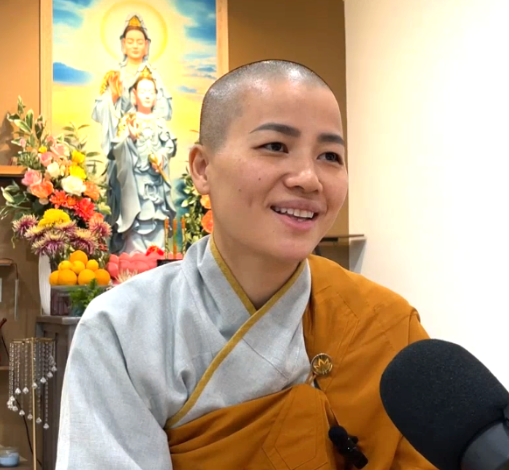
Sư Cô Janna Panna is a Vietnamese Buddhist nun serving at Tuệ Quang Temple in Fayetteville, Arkansas. She came to the United States from Vietnam, where she studied under her master, and she says she did not so much choose Fayetteville as arrive where the law of karma had already placed her.
In 2026 her community completed a hand-built statue of Avalokiteśvara Bodhisattva, called Quán Thế Âm in Vietnamese and Guan Yin in Chinese, the one who hears the cries of the world. It stands facing Crossover Road. Her teaching begins with faith and ends with wisdom, which she says does not wait somewhere up in the sky but lives in a person's action, heart, and speech. She practices compassion in small daily acts, picking up trash along the road and visiting people who have nowhere to go.
Sư Cô is a title of respect, something close to reverend sister, and she prefers to be called by it.
episode references.
- Avalokiteśvara Bodhisattva statue under construction at Tuệ Quang Temple, Northwest Arkansas Democrat-Gazette, 15 July 2026: https://nwamedia.photoshelter.com/image/I0000ddDNHv244ZQ
- Buddhists, Encyclopedia of Arkansas: https://encyclopediaofarkansas.net/entries/buddhists-4359/
- Southeast Asian Archive, Exodus, University of California Irvine Libraries: https://www.lib.uci.edu/sites/all/exhibits/seaexhibit/exodus.html
- Buddhark, directory of Buddhist centers and groups in Northwest Arkansas: https://buddhark.com/directory-of-centers-and-groups/
Teachings and figures named in the episode. These are traditional sources with no single canonical URL. Listed as named, not linked, per §4.
- Avalokiteśvara Bodhisattva, called Quán Thế Âm in Vietnamese and Guan Yin in Chinese, the Bodhisattva of Compassion. Named by Sư Cô.
- The law of karma, and its connection to rebirth across lifetimes. Named by Sư Cô as one of the teachings she recommends studying first.
- The life story of the Buddha. Named by Sư Cô as the first thing a newcomer should read.
- The Noble Eightfold Path. Named by Sư Cô at 46:11 and by Monica Kumar at 01:28.
- Right livelihood, sammā ajīva. Named by Monica Kumar at 01:28.
- Karuṇā, compassion. Named by Monica Kumar at 01:28.
- The debt of gratitude. Sư Cô's own framing at 31:20. In Vietnamese Buddhist teaching this is Tứ Ân, the four debts, owed to parents, teachers, country, and all sentient beings. Note. She names the debts without using the term. Cite as her framing, not as a term she used.D
episode outline.
- Episode preview, dream big and act small (00:01)
- Episode intro with Monica Kumar, the many pathways of Buddhism (01:28)
- Welcome, Sư Cô Janna Panna (05:01)
- Why Fayetteville, the law of karma, and becoming a nun (06:05)
- The core teachings of Buddhism for someone who has never walked in (10:47)
- The role of faith, and how it differs from mindfulness (13:35)
- The statue on Crossover Road, a year of work and two and a half months of hands (15:38)
- The people who stop to look (17:39)
- Faith in daily practice, fifteen to thirty minutes each morning (19:10)
- From faith to wisdom (21:55)
- The wisdom stays in your action, your heart, and your speech (22:54)
- A message of compassion to Fayetteville, and a vow that expects nothing back (28:24)
- Debt, and the debt of gratitude (31:20)
- Individual and communal, the non-ego concept (34:50)
- From living for myself to living for others (40:46)
- Religion, philosophy, or the knowledge of liberation (43:38)
- Is there a place here for someone from another tradition (45:12)
- Where to begin, the Buddha, the law of karma, and the Eightfold Path (46:11)
- From compassion to the practice of compassion, and the trash along the road (49:21)
- Faith and wisdom right here, compassion is not a noun (52:45)
- Fears, technology and the one thing machines cannot do (55:24)
- Wholeness, flourishing, and the will of God (57:50)
- Episode outro (59:40)
episode transcript.
episode content warning.
S03E29 the buddhist community with Sư Cô Janna Panna (restored).episode preview.
[00:00:01] Sư Cô: Every single person can think about compassion that the way they can connect each other no matter who you are, where you from, what language you speak, we still have the same thing to share. How we living, loving, all everybody love each other. Just make this place to become not just place of the growing up all thing to a thing and so growing all the spiritual thing of love. Give it a good energy for the whole city. But how we practice it? We go from very small action. We dream big. Compassion a big dream for everybody. But begin act small I said.
episode intro.
[00:01:28] monica kumar.: Off Crossover Road in Fayetteville, a new statue now rises above the traffic. The Bodhisattva of Compassion, known across Asia by many names, she's the one who hears the cries of the world. Built completely by hand, she stands facing the road and us with gentle, loving care. Today, we're sitting inside the temple behind that statue with Su Co Giana Panna, a Vietnamese Buddhist nun.
Su Co is a title of respect, something like sister or n- reverend nun, and she has given us permission to call her by that name. Before we begin, I wanna say something about the word and the pathways of Buddhism, because it can come across like one tradition when really it's so many. There are tr- the traditions of Sri Lanka, Thailand, Laos, and Myanmar, rooted in the early Pali teachings.
There's a Mahayana tradition that moved through China, Korea, Japan, and Vietnam, where devotion is rooted through meditation. And there are various practices in Tibet and the Himalayas, which all have their own rich ritual life. And of course, there's the Buddhism which many Americans and Europeans first meet.
Buddhist meditation apps, mindfulness workshops, sometimes a practice lifted right out of the temples and cultures that carried it for twenty-six hundred years without explaining that. Vietnamese Buddhism itself weaves through Zen meditation, Pure Land devotion, chanting, and ancestor gratitude. So what you'll hear today is not what Buddhists believe.
It's a deep perspective from one teacher, from one lineage, speaking from one temple, sharing how the beliefs of that community unfold in the place we call Northwest Arkansas. I've been drawn to Buddhism for a long time, and especially the Noble Eightfold Path, which includes something called right livelihood, sammā ajīva, the idea that our work shouldn't just avoid harm, but should actively be a way of caring for others.
And the heart of so much of the tradition is karuna, compassion, not as a warm feeling, but as a practice, a willingness to move towards suffering rather than away from it. I've spent so much of my time at different intervals in my life returning to those questions Who am I in my work? What is my work for?
Who am I doing it for? And can compassion be sustained not as something to rely on on easy days, but as a steady way of showing up, especially on the hard days? I came to Northwest Arkansas from outside a faith tradition that shapes so much of life here, and I've been curious about the communities that practice quietly in our midst.
Sitting in that temple, I really wasn't a host. I actually spent most of my time listening and learning from Su Co .
For Su Co , faith isn't the destination, it's the doorway. She says we start with faith, but we end with wisdom, and that wisdom isn't somewhere up in the sky. It lives in how we speak, how we act, how we care for the people who build our roads, check our water, clean our trash.
People we'll never meet, but to whom, according to Su Co , we owe a huge debt. She shared a teaching I haven't been able to shake. Compassion is not a noun, it's a verb. So in that vein, we invite you to join us at the table and actively participate in this conversation. This is The Underview, and we are delighted you're here with us
episode interview.
[00:05:01] mike rusch. (2): we have the privilege today of being able to share a table with Sư Cô Janna Panna here at one of the Buddhist temple in Fayetteville. Sư Cô, it is a tremendous honor to be able to sit and to share this table with you uh, and to hear the story of this community and the story of Buddhism here in Arkansas. I wanna say welcome to this conversation.
[00:05:23] Sư Cô: Thank you, Mike and Monica, for inviting me to this interview. This is usually my first time actually sitting down with some g- a professional like you and asking me question in a very, y- you know, structured way that I have to perform a way.
So my name is Janna Panna . You just call me Sư Cô.
[00:05:47] mike rusch.: Yes. We are honored to be here. We're humbled that you would invite us into this place. We're sitting inside the temple today. Maybe we could start with maybe explaining a little bit of how you came here to Fayetteville and how you became a nun. I would love to hear a little bit of that story, if you're willing to share that.
[00:06:05] Sư Cô: People ask me this question many time before. People I have met say, "Why you come to Fayetteville, and why you choose this place?" So to my understanding from learning from Buddha's teaching and learning about the karma law and all the connection with all the humans being, all the senses being, so I will choose nothing.
I say that everything I have done, it being arranged by the law of karmas. I'm here because maybe I have own people here, a small debt here, and I pay this way, and this has come back to pay my gratitude and me pay for my debt that I have not, like, finished from the past life, and continue to do good thing. So I don't choose nothing myself. I just come because this place is the place I'm meant to be, meant to stay here through life, and then I've seen many people here before. That's just my understanding .
And why I become a nun is a very long story. Because life in the Buddhist, Buddha teaching is say that life is suffering. So when you have to go through a lot of suffering and all the trouble of your life, and one of the moment that you re- that you realize that, you always have to chase after thing and things and never come and make you sacrifice and bring you happiness. And at the end of road, I feel like if you can have everything that your mind never cease.
The moment I catch all the teaching and learning, studying, dive deep into it, I really like this. This is a path for me. It's a profoundly beautiful path for me to follow. Yes. It's a moment I also realize that I have owe so much to all the people I have met, not just life also in the past and so in future.
Not just one place, at multiple place around the world. You know, we, like, come and gone, born and rebirth and reincarnation for many life. So we have met many people in this, in our lives before, and we owe them so much because they being so good to me. That moment, it's just- come to me and change my w- my life, and I decide this is time for me to come back to my path and continue doing it, and I can serve everybody. And then I can contribute to the community, not just for Buddhist community. To the all sentient beings. So become a nun, that give me a chance, the full-time job that I can just wake up, open my eyes, and see what I can do for others, not worry about my personal thing.
You know, become a woman is difficult too. You have to look good. You have to dress very nice. You have to work hard. You have to take care of the family. You have to know what to cook and doing all the thing. And the title of, you know, become a, a woman, it is... it make you run and run a zillion thing every day, you know, non-stop of, you know... It's a non-stop of the world that you have to ride it all the times and never stop. I feel like that. But become a nun, I'm, I never had to have moments that I have to worry about this anymore. I don't have to worry about
how I look and, I would have my time to continue and thinking about other skills.
So that's why i'm here.
Hold on. I say things go because I'm a nun now. Not because of the-- it's something special just about like when I became a nun, I can now do the real thing for the humans, for me, for the community.
[00:10:12] mike rusch.: Thank you. I, as you speak I can understand that in a different way because I have been a guest here before, and the kindness and the humility and the service and the peace, has been overwhelming, and so I'm an incredible ... I'm a recipient of the service that you have already given to so many, and so I wanna say thank you for that.
Maybe we could begin, I would love to understand how you would describe maybe the core teachings of Buddhism to someone who is in northwest Arkansas, maybe for someone who's never set foot in a place like this, in this temple, and maybe has never encountered this Buddhist tradition before.
[00:10:47] Sư Cô: Beginning, you gave me a very big question.
I will try my best to give the right answer because the coolness of the Buddhism is speak of a lot of thing that I can explain it very easy way that the coolness of the Buddhism is a cultivation of inner peace and to the moral living, compassion and wisdom. Buddhism teach that every action we do and take we create, it takes these consequences.
Whatever we do to other, it comes back to us. So we learn to live with kindness, with
the integrity and responsibility
When the mind is calm and guide by ethical living, ethical principle, the mind when it begin, we begin to understanding ourself easily and can see thing outside clear. Through the meditation and compassion practice every day and through the mindful of awareness, the Budd- Buddhism help people turn from suffering and build a harmonious, relationship and contribute to the community, and more peaceful and loving to community.
You meditate every day, meditate. The commitments of wisdom zap include, like, we have to live in the peace and moral life, and with compassion and gain the deep love through the meditation
To the people never step a foot into the Buddhist temple before, how do they understanding what they can know, what they seeking from us? So Buddhism offer a simple message. Living goodness and think with the wisdom. And so the compassion of loving kindness will guide our hearts everywhere. So very simple.
If you make a step in this, you understand this. If you walk into Buddhist temple in the future, you know that every temple will caring of compassion and work. And so really love this, care about you, want you to be good, and bring you some peace
[00:12:57] mike rusch.: This season's theme is the faith of Northwest Arkansas. And when I say this word faith, in many traditions that, that really is the central component of what it means to be an adherent or a follower, someone who's devoted to the way of the path that they find. Maybe as we think about this season's theme, the faith of Northwest Arkansas, I'm really curious, like, how or how you would explain what the role of faith plays in Buddhism, and maybe how does it differ from an understanding or from mindfulness?
Maybe you could help me understand how do you view when I say faith, how do you relate to that?
[00:13:35] Sư Cô: Yes. I remember when I s- began studying Buddhism, and I met my wise master, and I read his teaching, and the teaching in the Seba. Buddhism can be initial by the belief, but surely ending up with the wisdom So we don't say that Bud- we don't have, we don't believe in anything.
We say we believe because we need to have something to hope for the future. So when you have to face some problem in your life, the fate to guide you to find somewhere to seek for the keys and that what you start with. Yet- When you start to learn and focusing, cultivating the duality and meditating, med- do meditating deeply You will see thing the way it is and the real way it is.
Not like, just like, you can see through everything clearly and you know what cause of this. What's called suffering and how to get escape from suffering. Because from that view, from that knowledge, from that
understanding, your wisdom have come to. Because you give ... You have both answer for what giving shameful. So we start with faith, but we end with wisdom .
[00:14:52] mike rusch.: Su Ko, thank you so much. My my first time I came down here the s- the statue out on Crossover Road was almost ready to be completed.
The second time that I came, it was a dedication where the mayor of Fayetteville came, and you had a beautiful reception and dedication of the statue for this. And so this is a new statue that you have placed out here, and I'm sure that it's drawn attention of people that are driving by here on Crossover Road.
I'm curious maybe if you could give a little bit of background of the statue, and w- maybe if we can deviate just a moment to give some context to that. Maybe explain a little bit the, the meaning of the statue why it was built because I'm sure people stop here and maybe ask questions about what is it and what does it represent
[00:15:38] Sư Cô: Thank you, Mike, to introduce our statue tour with this interview. Cause like we know we have just finished this not long ago. It took us about a year to finish this project. It has to be. And to put our hands to start to build the statue, we take up two month and two, two and half month to build completely. To get this project done, and now you can see the beautiful statue in front of our temple.
The statue is made as a display of our Avolokiteshvara Bodhisattva. The statue represent about his compassion with the, yeah, with the, the unconditionable to all sentient being, listen to all sentient being suffering and understand the situation and so save them from being all the problem in life, especially when it in danger.
And you have to face some dangerous problem like you go middle of ocean and you get lost. Storm coming, you only recite the Bodhisattva name, and the magic boat it come, and without some worry, somehow you get saved from that moment. Or you had to face death. For example, you are in very big injuries, like accident or you are sick, very bad, and there nothing else you start to pray and just recite the name, and somehow things just change very quick, and you've been released from that bad problem. We build the statue because we want Her to represent the love to sentence game. And whoever stop by and see the statue have some peace and gain some blessing.
[00:17:31] mike rusch.: I'm cur- have you had many people that have stopped by to, to see it and to ask questions?
[00:17:37] Sư Cô: I have seen people, yes.
[00:17:38] mike rusch.: Yeah.
[00:17:39] Sư Cô: Yes, we do. We have people just drove by and stop for picture. Then people just stop by and reading and learning about what is this. And a lot of people actually been familiar and knows about the stone long kind of girl, and they just wanna try to come see.
'Cause it's a hand-built statue. It's look different from the other statue may- you have seen in my... And also, it's very thick, special. It,
[00:18:04] mike rusch.: it is. It's beautiful.
[00:18:06] Sư Cô: Yeah. Thank you. This is big and tall, so people will be amazed about how we built this statue with hand. So a lot of people curious about who could possessing that statue standing, and they come close and take a look and pay homage, respect to our statue.
[00:18:26] monica kumar.: Sukha, it's wonderful to be here. Thank you so much for having us in your space. So as I've been thinking about our season and then listening to people sharing, and y'all listening to you here you know, every tradition that we've talked with this season has put faith in the, the traditions of faith in the center. And I'm curious to hear from you, how does Buddhism understand the concept of faith and what role it plays in everyday practice? What does it look like to be a Buddhist as you're going about, about your day and your life? What traditions are you following and thinking about to be someone who who is a, a faithful follower?
[00:19:10] Sư Cô: Thank you, Monica. You also gave me a different question again. It's so kind of you. You're welcome. To go deeper into this explanation and a discussion that you have to raise this to me, so I don't need to say this.
There are many people in the world have no faith to nothing. We very thankful because we have faith to something. You might believe something, and I believe something, but the faith is here, not just because we, put our belief to something wrong. The faith only guide us to something right. So in Buddhism, I just mentioned about before that Buddhism also can be initiated by belief and faith. That's truly any methods existed .
So we start by faith. We believe in something, and we follow it, and we s- understand it, and we can see through it. That's a step.
When they first start to practicing visit, the Buddha figure shown. They say, "I believe there's a way to me to walk through and a way for me, path for me to liberate, to end up my suffering."
They start from there because they don't see it yet. That's because of the faith guide them, and they take a step, next step. We go deeper to practicing. In at the end of the road, they saw, "Here the way for me in the path forward."
So that how we can set up on daily activities. At the morning, I will spend about fifteen to thirty minutes in front of our Buddha statue, and I start to, bow, and recite, and pray. I pray because I believe, and I have suffered in the beginning. Because I know Buddha were here twenty, twenty-six hundred years ago, and he came to the world for real. There are real person for me to follow, and can guide us to escape from suffering. and also- I know this. I haven't saw Buddha yet, but my faith guide me to understand his teaching.
So we do that. I must say that, we'll say the Buddhism that is believe in the fate or believer he lived came, but we do. We take that first thing and go to the end. We have to understand and see all the truths that Buddha have given at the point at once before
[00:21:42] mike rusch.: I, I feel like I want you to just keep talking 'cause I hear as I listen to you, there's just a sense of peace that is really pronounced for sure
[00:21:50] Sư Cô: Thank you.
[00:21:51] monica kumar.: Yeah, it's really deeply intentional. Yeah.
[00:21:53] Sư Cô: I really appreciate that.
from faith to wisdome.
[00:21:55] mike rusch.: Suko, one of the things that I think as, as I'm listening to you talk about this difference between ... And maybe not difference, this continuation from faith to wisdom. I'm curious if maybe you would help me understand that a little bit more.
Because I think from my growing up and just maybe living here, and maybe my perspective, faith i- is in, in many ways is the destination. But what I hear from you is that faith is a beginning point, and that it moves us into this place of wisdom. And I think maybe from my ears or my understanding this idea of wisdom connected to a practice, a spiritual practice, is something that sometimes I don't really fully understand.
And I'm curious if I could ask you a little bit about, as you think about wisdom from the perspective of Buddhism, maybe just describe what wisdom really means to you because I have this deep feeling that it means something very different to you than it does to me
[00:22:54] Sư Cô: So let me explain this very, in a very easy way.
So we have many question in life, but you never get the answer. Everybody who does have a question that you want to know the answer. Like me, like I worry for, and when young I have many problem came to my life, and I tried to find the answer. But I never found the right answer until I practicing deeply into the energy
So your question about why this beautiful-- this person is beautiful and that person that not look beautiful. The person is going to say rich to that person not being rich, but that person is happy and body, but someone have to be born disability through in that part of the body.
That question arise and why? And in terms of you have the all the answers, but you have to figure it out what the answer. When you understand the law of karma, and you understand the permanence of life, and you understand about reincarnation and different realms in the... 'cause a senses being to fall into so when you happen something.
So the first thing I said, the law of karma. The law of karma is one of the three set we have to study from an- for the whole life to understand it fully. Law of karma not just talking about what you do and can suddenly come back to you. It also the law of karma also talking about the connection with reincarnation.
Because a lot of thing you had done this life, wait for you from the next life. And a lot of thing you have to receive from this life because of from the past life. So the law of karma arrange everything come in the right time for us.
So for example, I have someone i- they have lived in a life a good, to being so good for everybody. Never harm anyone, no lying, no hurting, no stealing, nothing. But why bad things still comes to them? They were still being tricked by the husband, one. And I say, " If you don't understand the karma law very well, you will then start to blame God.
' Hey, I'm doing so Good, and why bad things come to me?'" And you feel, like, unfair. You start to blame and ask the question. You don't satisfy. You're like, the more you know, feel like you said abandon God when you try to- he is sure to do something in that, like the pe- people, the person who hurt you. So that continue to make your bad karma can really come.
But when you understand the law of karma, you will stop doing bad thing. You say, "Is it because something come to me? I'm being so foolish. It's like me know I'm worth that dying in the past life, and I have to face what come to me now."
Accept it, take it, face it, let it go. I'm not gonna harm anyone. I'm not going back to that person that who hurt me. I continue doing good thing because I'm still doing good thing, even I had to face a lot of bad karma coming. That's a business Because you know, the, the wisdom is not something up to the sky and you will see it.
The wisdom stay in your action, your heart, and your speech.
Everything you do in daily activities, you careful, you be careful what you do. You know what you're gonna do, and you know the result gonna come back to you what you do. You are actually very smart, intelligent. So we've called that above all, that we call that wisdom, of knowing what gonna come to you for real.
So when you start to have faith, it mean you believe some good thing. There are good thing out there waiting for you. But so we have to act for. So you act for it because you know the law, how to create good thing, how to get what you want. That's a law. And you wanna be good, you wanna have something good, you have to act good, think good, and care good about others. So it's a connection with faith, wisdom like that. You not go alone by yourself. It's right here. Every daily activity, ensuring your life, every single moment of your heart. So you think good, you talk good, and you do good, right there is a wisdom.
The Manonidical way that you can find life, people always thinking something inside their mind you don't know, you know?
They can come to you and s-smile to you, be nice to you, but you know that something, they plan something inside themselves. Maybe they want to take advantage of you. They be good to you at first, but they wanna take advantage of you in the next world. If you have something they, they can get some benefit from you, something like that.
People lies and it's like I saw the problem that come, but to put this, this way in the Buddhism you understand the law of karma. You will not doing that bad thing to him. Because you know if you're bad thing to someone, bad thing come back to you. You don't want to face anyone else thing in the future.
So your only way to do, you do good thing. That's a wisdom. When you choose to do the good thing all the time, you are special.
message of compassion to Fayetteville.
[00:27:54] mike rusch.: Su co when you build the statue out on Crossover Road, it's this symbol of this vow of compassion and unconditional love to this community. And I'm curious, like, if you could share a little bit more about maybe the representation of this, and maybe to maybe share why do you feel like this message is the one that you wanted to share with this city, and let this message be the representation to the city from this community?
[00:28:24] Sư Cô: We build Guan Yin Avalokitesvara Bodhisattva statue because of her vow of the compassion at the core of our practices every day.
And like, I have now, a lot of people have told me every single moment I save life, you always think about what's compassion. Compassion is the worst thing going in this life every single day. What's it means the same to me when I start, studying and practicing Buddhism. The words of compassion just come to my mind and I ask, "How do you love people?"
It's so difficult. It's not easy to love anyone, especially the uncomfortable. Like, when we love somebody, because we ask them to love us too, right? When you s- for example, you have your husband and your wife, you send a message, "Hey, I love you," you are waiting for them to say, "I love you too." But in the concept of Buddhism, especially for the, for Avalokitesvara Bodhisattva, her vow is compassion towards sentient being without expecting something coming back to them.
That's what I also do and try to practice every day, and we are here doing that too. We try to give, to serve, to contribute to community, and never ask anything back to us. So represent statue of Avalokitesvara Bodhisattva and to show the community our vow, our commitment that we want to serve and listen and also give love to all people around here , especially to Fayetteville people . They are so welcome us, so kind to us, and we owe them so much. I always feel that I owe those people so much. I love them so much. I will try my best every single moment of my life to contribute and continue doing good thing for them
That's why we design to do statue up, because for a while, to follow vows just always being with us. Everybody go in single step by step to this place. How we think about how do I ca-- how do I work, how can I help people? Like Quan Yen, our bodhisattva, help all senses.
debt and compassion.
[00:30:38] mike rusch.: Su Ko, one of the things that you said when we were first telling a little bit about your story, was this idea that you had this debt to pay to people.
And I'm curious if maybe you would talk about that a little bit more because I know that doesn't come from yourself. It comes from following the teachings of Buddha. But help me understand that when you came to the United States from Vietnam, that this in many ways was because you felt like you had a debt to pay. Yet at the same time, you have this, a representation on Crossover of Road of compassion to the city. And I'm curious how you understand both this idea of this debt to pay, but also this idea of compassion to the city.
[00:31:20] Sư Cô: Yes. Thank you. That's a beautiful question. You gave me a chance so I can also share a bit more about, my life. So not just about being born, growing up, being raised, and we are here nowaday to stay in this place. Of course, I have to pay gratitude to a lot of thing in my life, a lot of people in my life. To my parents, to my family who raised me, to the people here in Vietnam, also US accept me. Of course, then Gnango Rurukinji has stopped my life from it.
And that owns everyone. But in Buddhism concept, when we say a debt, it mean the debt of gratitude. So we believe, we're understanding that everyone who support our life, our practicing or our ability to serve other become a part of our commitment to responsibility, commit responsibility So thank you and this town in the west of us have welcomed us so much.
And kindness, they welcome us with kindness. I feel so I have a duty to give. That I have to be more kind, doing better the much I can to continue to serve the people here.
It doesn't mean just the people living here, because when I pay my debt to people around here, it doesn't mean my people in my family, my country, that was receive anything. ' Cause in Buddhism, all the sentient being have connection to each other. That we do not walk alone, we walk with one. So when I pay my debt for people here, it means I pay my debt for all people who cannot own everyone in this world so much So we don't think about just small group of people. When we do something good for somebody, we also do a good thing for the whole world. ' Cause we never walk alone.
Everybody here have connection with other saints and it's making this world. We don't see it, we don't know it, but it actually, it is real. You know, my whole life, so I pay my debt. I owe people because I owe their love, their support, and so I owe them for my previous life, this life, and future life because I couldn't continue doing good things for many life.
individual vs. communal.
[00:33:46] mike rusch.: Su co, as I listen to you, this idea of living so intently for the community where you are and … But also holding this idea of this, this desire to serve the entire world in doing that is a really beautiful concept. And, you know, but I've grown up in in America, right? And we have this understanding of the individualism that, that I'm, I kinda orientate my whole life around what is best for me.
And I hear the exact opposite from you, and I hear you talk about wisdom and peace. And I'm curious if you could help maybe us, I say us, maybe me, may this very selfless question, maybe help me understand, how you or how the teachings of Buddha would be prioritize the community, others, over myself, and what we have to learn from that maybe as a place where we live. How can we be informed by these teachings and these traditions about what it means to live for other people and live, for the benefit of the community and not just myself?
[00:34:50] Sư Cô: This one's so a very big question again. You are so kind to me too. Again and again, you ask me a very nice question.
So In the Buddhism, I'm not saying just in Buddhism, all the traditional... I remember some American told me in the past, they were still living a life to underview, not to go to yourself. I had met some, lady, she about 80. She's talking about when she go out in her home, her-- and she can walk from this home to other home, from neighbor to her house, to neighbor house, and eating and playing and with no problem.
That nowadays it seem like we're difficult to have communicate good people like she, especially in live here, but when they go out there, something happened to them, we don't know them. We do not understand what happened to them. Because the concept, people like privacy, people like to have something for themselves, and thinking myself is important than anything else, happy The best is you tell me you were the same.
People living a life without questioning like, "It's me or you." It's all the we. We are the same. So in Buddhism, we are teaching about the non-ego concept. We're doing, practicing, meditating, doing good deeds, try to practice so hard just because we wanna reject the one self. Yes, it's go opposite way from the normal people thinking.
Why we knowing this? How can you live a life for others? How do you do that? Because taking care of yourself is so difficult already, and how can you care about others? That over the self wanna non-self. And that pushing is very difficult. That's why working on the enlightenment path is not easy like you think.
You can start with or to walk to it, you have to do a lot of good deeds, have a lot of passing. And meditate very hardly because you missing peace of mind to not thinking so much about yourself. 'Cause when you think about yourself, you start to create more problem. That's what the concept is. And
So happy people Understand why we should live for others. Because the moment we were born, we have so much support from our family, right? And we grow up, who feed us, who raise us, who teach us. We go out to school, we have teacher, we have classmate. We have all the coworker, we our boss. Like your brothers have connection with us.
And even the people, we don't see them at all, we don't talk to them at all. The people at the city that they drive every day and they check the water for us. The people actually mow all the way for us, so we can walk through anything. They build the road for us. We don't see them, don't talk to them, but we owe them. So our responsibility is continue to work, thinking about them. You can interviews, talk to them, go see them. We have the responsibility we have to care. Now think about-- not don't think about Buddhism, don't think about the Nanimozi, but think about us. That is easy. In like we start online, living the life like this.
There are many people who has been support us how many people you can count? I couldn't count because if I count, I don't have right number. I might miss somebody. I can, how would I count my whole family and my friend, my childhood,
from my childhood, and then my, all my coworker? Having to, from different job to jobs, I can remember all the people that you met in your life.
Can you remember all those?
And of course, every single day you driving on the roads who build that road for you. This country certainly, the people here give you so much good thing. And why you simply live for yourself? And you wanna die alone? We don't. We want to live a life that benefits others because it's never enough to making, working to pay our debt to others people.
Never. We work very hard to pay our debt to humanity because we have s- it's, we've
been s- people and all sentient beings been supported so much. And it's every single moment we got, it been supported by others
So that the concept. I hope people understand this because especially for young people nowadays, they're falling into love yourself, love oneself. We try to explain to them, this is wrong. Because if you should love yourself only, we don't get what you want Because when you love yourself, you want a lot.
Everyone love you. You are center of everything. Has everyone look at me, care about me. If you don't get, if you don't get what you want, you get mad. And mad, it bring you suffering.
Your mind is very suffering. And other
thing around you make you suffer. We get mad, who bear for it? You. Your mind get hurt first.
Another problem. And when you live for others, you do things for other, you try your best, you do your thing for other, you don't even want anything for you. So if you don't get nothing, you are fine because you accept it. You're willing to take that. So nothing can hurt you anymore. Nothing can hurt yourself anymore.
If you go don't care about you, you don't love this that much, you gonna be okay. You walk through it and it's faces and see it is fun. I exactly, I want it like that. I'm willing to do that
[00:40:17] mike rusch.: As I listen to you, I maybe realize how far I have to go to really understand what that wisdom really is. And so I'm thankful yeah, that you would, share that because I find myself, a- as I listen to you, I find myself asking questions of myself about what it means to live a life for others to not be focused on myself.
And, I don't know that I'm ever gonna get past that question. I feel like this is gonna be the perpe- this is the perpetual question probably of life for me for sure.
[00:40:46] Sư Cô: It's very difficult because this actually touched me a moment, like right now when I think about myself in the past
I never thought about myself. So because of that, I'm not shaming myself, but I'm thinking about how I change from being from the person I live for myself to the person living for others. So me in the past, I always thinking what I want to get what I want all the time. I want to everything. But I didn't do bad things to others, but I so only think about what I didn't have for myself first.
If I want something, I have to be, I have to get the best not the-- always get the, the second So when I read a book about the money open self at Buddhism, and I spoke to well, like, "This is all me, because why I'm doing this and yet it's you happy?" I got what I want, but I always want more and more because myself started asking me for more and more.
It never stop. I never had a moment in my life, and if I had a moment where I'm not gonna have a peace. When I stop wanting for myself and I change and the teaching about other, when I have anything I wanna give to others, it could be peace for real. And I start... this is actually the law or to have peace for your life.
If you continue get thing for yourself only, the suffering waiting for you. But if you continue to do good thing for other, the happiness will get to you. that's the moment changed me, so it take me back because of your question to myself in the past. And now I feel like if I don't get nothing, I'm fine. I'm fine because I don't want nothing. Nothing can hurt me
[00:42:36] mike rusch.: I can see how this is a lifetime pursuit.
[00:42:39] monica kumar.: I just really appreciate and admire your sharing with us. Yeah.
[00:42:45] Sư Cô: Thank you. Thank you. It's not difficult. It's not hard. The, the hardest enemy is at yourself if not everything right you. And you walk in the path, yourself is a problem . You have to bring yourself, not anything else, nobody, anyone else. This path to wake you,
As long as you do the right thing and you continue to walk, you will be-
[00:43:04] mike rusch.: Su Ko, as I listen to you, like th- those that have been listening for a while know that I come from a, a Christian faith tradition here in Arkansas. And as I listen to you I hear things that sound very similar to principles that I've grown up with I probably don't follow very well, if I'm honest, so I have much to learn there. But I, I'm curious maybe for those that are listening, that have been in Northwest Arkansas that are, maybe curious about the teachings of Buddha and Buddhism.
I know Buddhism is not a religion. You would not say it's a religion. It's a philosophy. Is that a fair characterization?
[00:43:38] Sư Cô: Yes. Let me explain a little bit about this. You're not the first one say this to us, to me. So to make it clear the explanation about if Buddhism is really a religions or not.
So based on the humans understanding and all the law of thing to continue to let Buddhism here in this world, we have to accept Buddhism be religions.
With that title of Buddhism, Buddhism can exist and continue to give message to humans. But Buddhism doesn't stop by religions. It's also- Have guide you to see the truth of everything in your life.
It's also philosophy, you can say that, but also the wisdom of the liberat- the... I say the knowledge of liberation. When you have liberance of knowledge, you understand everything clearly, and you call that awakening, enlightenment, because you see everything so clear The truth is right there reading to you.
So you can consider it is an the visions. But also you can understand things and also carrying a lot of philosophies and also bringing the wisdom to see everything
[00:45:00] mike rusch.: As someone who's grown up in, in here with the faith tradition that I have, is there a place for me within Buddhism to come and to seek and to try to understand, faith and wisdom?
[00:45:12] Sư Cô: Like I mentioned, as long as you understand that you continue to do goodness for people, you love all the sentient being, you try to keep your mind at peace and try to purify the life and the mind, you don't have to say I'm Buddhist or not.
You are practicing your waiting. And of course, the door always open for you, and the compassion and the love are always there waiting for you. Of course. And then no matter where you're from or what faith you follow- ... it's just the truth and the love and the wisdom is easy to get.
[00:45:54] mike rusch.: Yeah. Thank you. If I've, if I'm one who's maybe curious and want to learn more about Buddhism, do you have a, a recommendation on where I could start or how I could begin to learn or to read or, maybe to start to engage in understanding of what that looks like?
[00:46:11] Sư Cô: Yes. For begin to learn Buddhism, there are a few thing you need to know and understand. Yeah. Firstly, I recommend you should read about the Buddha, his life story. Once you understand the Buddha, you understand why he chose a path, and he also give the teaching to sons and spend. And what is his, give me the wisdom and the knowledge that he'd been given to since the day he was born.
you will need to understand this. Once, understand the Buddha, you will understand more about Buddhism, Buddha teaching, and the Dharma.
The second thing, we can start to study and learning about the law of karma. There are a lot of people out there, they don't have any understanding about law of karma. That's how some they think they do whatever they want, don't care about the result come back to them. But we are learning very carefully, deeply. And you learn how to-
S-take step and walk very careful. Everything you do, you think, you s-speak. It's now you into of path that you're not making any more mistake.
All the good thing that you are making. And so the supporting that you've start to know about what the path to living into the enlightenment. So there are eightfold path, but you have to work hard to do the right view, the right thought, the right speech, the right action. There's a right livelihood and the right right thoughts, right meditation, right concentration, right samadhi is a word of like you would say. Concentration, that your m-mind is peace and deeply in, in meditation. So all that the path you follow on daily life, we start to learn and study is take the step into it.
[00:48:13] mike rusch.: Su co, I think the, like, for me, like, where my mind is in listening to you, like y- obviously this community is here. M- the s- the statue of compassion and good you know, to, to the entire city, you know, is really, it's, to me it's, like, it's a big statement, all right, in many ways, like, of we're here. A- and these are my words, so correct me if you don't agree.
But it says, you know, to the city, "We're here." We want to bring compassion. We want to be a part of a message of compassion for this city. And so I think in many ways, you know, my, I think my question is this, like, as this community has has started to become rooted and grounded in this community, your first real statement to the community feels like it's, one of, of calling people into this way of compassion for the entire city.
And, I'm curious from your perspective, like, a- as you were to get maybe move from this idea of compassion to, like, the practicality or the practice of compassion, how you see or what you would hope for this city and how they would practice that compassion maybe for others? If that makes sense.
[00:49:21] Sư Cô: Yes. Living a city, the city is diverse city. There are many people come from different place, different cultures, differently. So because we are create a lot of we thinking humans always want to create something to make us different. So the compassion is the one thing that we can share, the new thing that we can share that connects all different cultural group and traditional together .
Every single person can think about compassion that the way they can connect each other no matter who you are, where you from, what language you speak, we still have the same thing to share. How we living, loving, all, all everybody love each other. Just make this place to become not just place of the growing up all thing to a thing and so growing all the spiritual thing of love. Give it a good energy for the whole city. But how we practice it? We go from very small action. We dream big. Compassion a big dream for everybody. But begin act small I said. When people come to me they have a wanna plan and say, "You can dream very big. Please act small." So how we compassion the city? We gonna do s- very small job.
Like I used to do. We used to do. We go out, pick up the trash for city, make city more clean. And we go walk through this road, they say, "Oh, this is a clean walk." They feel in luck, they feel in luck. They like to stay here because of this city is look clean and nice people. We care about each other. And we go and take care of people that they are lonely, they don't have no place to go.
We care about that. We got to look at the compassion. But compassion that's the worst we should put up there is actually have to act it.
But how we act it? Say every single moment apply, try to find something to do for others. It's a compassion. What you can do for others? First thing, take care of Bridge of Conway, right? Then look after your ranch town, metro town. Go out looking for everybody here in community. Take care of the city. Make it clean, make it nice, make it good. It's a compassion. How I practicing it? Not just sitting here and meditate. Meditate is keep your mind away from all problem. But also when you, your mind at peace, you have to share the peace with others.
That's a compassion. You have to show people, " hey, it's a way. You can have some peace." Where's the peace coming from? Where the happiness coming from? When you make other people satisfy and you bring happiness to others, that happiness right there. They bring it for you. That become energy. that's how I practicing and our people practicing compassion.
faith & wisdom here.
[00:52:10] mike rusch.: I think what I love as I listen to you is that, as you think about faith and wisdom, this is not a faraway concept. This is something that is, it feels like it's right in front of you. It's something that you're engaging in every moment as you move through this world, as you move through this place.
Is that fair to say that? That, it feels very real and very tangible and very close. I'm curious if that's something that you have learned or if that's maybe something that you've that carried with you your whole life.
[00:52:45] Sư Cô: So when I became a nun I had some moment of life And when I look at our Buddha and read our Buddha teaching, it's come to me naturally to understand the words so easily.
Not because I have learned it. Because we've been practicing very light before. It's just come back. The time for it to come back. We have the house. We'll be doing all the suffering, all the trouble. We walking outside the house. We don't spy the key. We won't find the key. We have everything inside waiting for us.
The food right there, the table right there. The chair we definitely lay down. Just like when you going in studying, you trying to work around all the, the teaching. You don't go deep into it. You, when you learn it and it catches one thing. So when you say that's right here, the wisdom and the compassion right here, it's because you don't ask for it.
When once you ask for it right here. When you just talk about it right there, up there. When you have to act it. Yes. So I tell one friend, I talk to my friend. She, her English better than me. I send her a message say, "I learned that compassion is not a noun, it a verb. Because a noun is just something you want to get, waiting for you. But a verb make you to act, to do, to act. "
she said, "Yes, you are right." I found out you had to act compassion. You not to talk about compassion."
fears.
[00:54:09] mike rusch.: So we've asked two questions to every guest that we've ever in, in all the conversations. One of them is what are your fears? And we do that really out of, like, this kind of to normalize that maybe all of us we've not reached the path that we need to, but we hold fears.
And we're always curious for those that are leading faith, you know, faith leaders such as yourself, I know you may not call yourself that, but people who like, what are your fears?
And then the second question is this idea of wholeness, is like when all things are as they should be, right?
fear and wholeness.
[00:54:42] monica kumar.: My two questions I think for you would be, what are some of the as we're thinking, as we're th- talking about wisdom and we're talking about the journey to wisdom, what are some of the things that you think can be could be barriers, that you see could be barriers to what- in that journey, and that you see surfacing that perhaps you want to- We want people to be aware of or that we, you worry about for our community or our planet for humanity.
And then the other question would be, you know, what does it look like when we are completely fulfilling our path of wisdom and compassion? What does it look like when the world is flourishing?
[00:55:24] Sư Cô: It's a beautiful question. Yes There's something I'm thinking because the worry about the human need and all the things happen around the world right is this, but I'm thinking about how people will deal with all the technology and the AIs that have been, taking over everything- especially our job that human have been giving so far. Now AI, they take care of it.
But in Buddhism, it had a chance for everybody to look back and they have karma, and they have classic and say, " Maybe because we have not done good thing, that much good thing enough, we have not done enough good thing. We have not worked enough . We have not loved people enough. That's why we have to be faced with this situation." But then so the chance for us to go deeper on practicing our spiritual practicing , especially to-- into meditation. When you can meditate deeply, daily, every day, every day, even see thing accepting change in the world, enough trust matter .
We're going to accept and see. But we also see this, the technology and AI can work on ground and other thing, robot can know but no, all of them cannot meditate, become enlightened. Humans can do it. But we are also, we have the brain spiritual that we can fit into meditation. We can practice meditation.
We not just have the body, we have the mind, and we can also work on the mind. So it's a challenging for the humans, but the community also on top of transforms to go deeper into med- to practicing accessible meditation. Meditation is the way to connect all the humans, yeah, all suffering and pain. Because the meditation will be working on the mind to mind.
So if we have nothing to do, if the AI took all the jobs, that's fine. We sitting down and take care of our need. With time for us. But never stop thinking about how we can serve this planet? And you say that, the question is-- second question you say, "If what if one day all the wisdom, all the love, compassion to appearance planet, what would happen?" I have come used to say maybe that is the will of God This place become heaven. Is that correct? I think that the will of God, that God want... I know you believe in God, and I think that God want we, all of us become a wisdom one, a kindness one, and that we need in this city to do the job that God given the order.
[00:58:17] mike rusch.: World of God. It's a beautiful sharing and ending for us.
Yes, it can't come soon enough.
[00:58:24] monica kumar.: Thank you so much.
[00:58:26] Sư Cô: You're welcome. My pleasure.
[00:58:28] mike rusch.: Su co, I just wanna say thank you for yeah, the ability to be able to share this table with you to be able to hear from your wisdom, which is clearly there.
It's so wonderful. It's been a gift to us, and so thank you so much for, yeah, just the chance to sit down, to meet you, to be welcomed. It's been a gift, so thank you so much.
[00:58:46] Sư Cô: Thank you. Thank you for at least let me, have conversation with you and seeing them, share all the information to you and your community and whole community here. And I have a faith that if whoever listen to this, audio, and they will start to change, not because following Buddhism, no. Change to love people, change to love each other more, and change to do good thing and living for other more instead of yourself. So that kind of message that I've been sent, it will... The people out there, once they read that, they listen to this,
that will help them to have a path to follow, the path that we will have lots of kindness and blessing and the peace that we bring for others.
episode outro.
[00:59:40] mike rusch.: Well, I want to say thank you to Suco for her time, for her patience, for her hospitality, , putting up with all of our questions, and for the wisdom that she shared with us at the table. She told us she starts with faith, and it ends with wisdom. She said that wisdom is not sitting up in the sky somewhere waiting to be found. She says it lives in our actions and in our heart and in our speech.
She walked us through the law of karma, not as a slogan, but as a way of reading our own life honestly. She talked about the permanence and the impermanence of things. She told us what it costs her to stop wanting things for herself, and she told us it is still the hardest work that she does.
She told us about the statue, more than a year of work standing out by the road so that anybody driving past might get a little peace from it. And she told us about debt. She owes her parents. She said she owes her family. She owes Vietnam, and she owes this country.
She owes people she has never met and never will. The ones who build the roads that she drives on and checks the water that she drinks. She says we do not walk alone, we walk with everyone. So paying a debt forward here is paying it everywhere.
I asked her a lot of questions today. And the thing that I keep coming back to also is what Monica mentioned in the intro. She said near the end, it was almost in passing about a message that she sent to a friend. Compassion is not a noun, it is a verb. A noun is a thing you wait for. A verb is a thing that you do. And then she told us how she does it. It's not complicated. Pick up the trash along the road. Go see the people who are alone and have nowhere to go. Feed whoever shows up hungry, and do not ask them what they believe first. Dream big and act small.
We've spent this whole season asking people what their faith makes them do on Monday. That is the question underneath all of it. Not necessarily what you believe, but what does that belief cost you, and who does it reach? She answered it with a statue of compassion and a trash bag for service.
This is the faith of Northwest Arkansas also. It has been here, and yet most of us have never driven up that road. I wanna say thank you for listening, and we would welcome your thoughts, what you're wrestling with and your questions.
And on the underview.com homepage, there is a send us a voice message button. We'd love to hear from you.
I wanna say thank you for listening, and thank you for being the most important part of what our community is becoming.
This is the underview, an exploration in the shaping of our place and our faith.