
the episcopal church with Rev. Evan D. Garner.
Rev. Evan Garner of St. Paul's Episcopal Church in Fayetteville explores what it means to belong before you believe, reckon with a history of enslavement, and build a parish where wholeness means all of the people. Not most. All.


episode notes.
Saint Paul's Episcopal Church in Fayetteville was organized on May 23, 1848, making it one of the oldest surviving church in the city. In this episode, Reverend Evan D. Garner, the church's rector, traces a tradition rooted in the Church of England's belief that a parish exists to serve everyone within its boundaries, not just its members. From the founding documents that carry the names of slave owners to a warming shelter that grew from six people to forty-seven in a single winter, Reverend Garner describes what it means for a 178-year-old institution to hold its history honestly while showing up for the most vulnerable people in a rapidly changing region.
The conversation explores the Episcopal tradition's parish model, the difference between opening doors and genuinely belonging to a community, and how institutions that have historically held power can do the work of justice without becoming political actors. Reverend Garner articulates a theology where love is not abstract, it should lead to human flourishing, and where wholeness means all of the people, not most of them. Monica Kumar joins for the talk-back, where the two process what it means to hear a pastor say there is no limit to how far his church will go to care for those who are vulnerable.
about our guest.
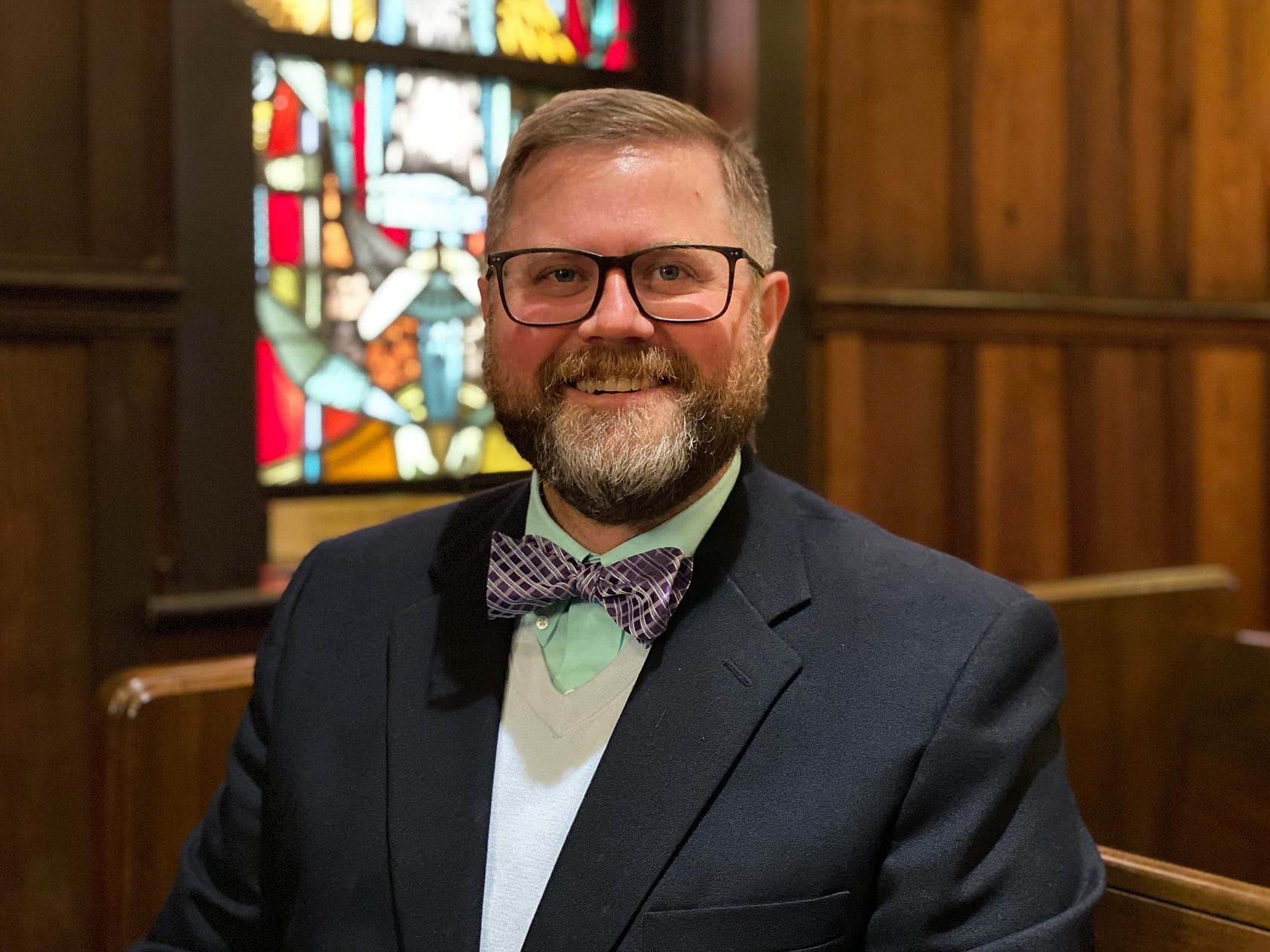
Rev. Evan D. Garner has served as the Rector of St. Paul's since July 2018. Before that, he served in two parishes in the Diocese of Alabama, where he was ordained in 2006. He trained for ordained ministry at Ridley Hall in Cambridge, England, and at Virginia Theological Seminary in Alexandria, Virginia.
As a follower of Jesus, Evan believes that God's love has no limits and that unconditional love has the power to transform this world. As Rector of St. Paul's, he works with the staff, Vestry, other lay leaders, and volunteers to share that love with this congregation, this community, and the whole world.
In addition to parish ministry, Evan has served the wider church as a deputy to General Convention, a member of two church-wide interim bodies, a stewardship consultant, and a member of several diocesan departments and committees.
Evan grew up in Fairhope, Alabama, and attended Birmingham-Southern College, where he studied Chemistry and Philosophy-Politics-Economics and, more importantly, met his wife, Elizabeth Graffeo. They have four children: Frances, Edison, Sam, and Emily. Committed to lifelong learning, Evan has received an MBA from Troy University and is working on an STM at Sewanee. In his free time, he enjoys playing with his children, birding, cooking, reading, and playing golf.
episode references.
- St. Paul's Episcopal Church, Fayetteville: https://www.stpaulsfay.org/
- Episcopal Diocese of Arkansas: https://www.episcopalarkansas.org/
- Evan D. Garner, The Christian Century: https://www.christiancentury.org/contributor/evan-d-garner
- Community Clinic, Northwest Arkansas: https://www.communityclinic.com/
- 7 Hills Homeless Center, Fayetteville: https://www.7hillscenter.org/
- Magdalene House Fayetteville: https://www.magdalenefayetteville.org/
episode outline.
- Welcome and Reverend Garner's path to ministry (00:00:00)
- From Alabama to the Ozarks — how NWA feels similar and different (00:04:17)
- What drew Garner to the Episcopal tradition (00:06:50)
- Describing the Episcopal tradition to an outsider (00:09:29)
- The parish model — serving everyone within the boundaries (00:12:37)
- The long story of St. Paul's — organized 1848, destroyed in the Civil War, rebuilt without a roof (00:17:47)
- History of enslavement — slave owners in the founding documents and the ongoing work of reckoning (00:21:17)
- A tradition of meeting community needs — Community Clinic, 7 Hills, Magdalene House (00:24:40)
- The warming shelter — from six to forty-seven, messier bathrooms and running out of bacon (00:27:39)
- How far do you go? — caring for the vulnerable without limit (00:33:01)
- How the mission of the church moves into the world — faith, politics, and power (00:37:53)
- Belong before you believe — what it means that there is no doctrinal litmus test (00:42:09)
- Navigating division — loud voices that don't sound like love (00:47:27)
- What St. Paul's would say to the broader community (00:51:52)
- "Anyone who seeks to divide people is working against God" — grace, division, and Bishop Budde (00:54:51)
- Fears — the vulnerability of the unhoused, undocumented, and underemployed as NWA grows (01:01:07)
- Wholeness — nobody is superfluous, nobody is disposable (01:04:46)
- Talk-back with Monica Kumar — belonging before believing, reckoning with enslavement, charity vs. justice, and wholeness as the measure (01:08:07)
episode transcript.
episode preview.
[00:00:02] rev. evan garner.: Some of the work that I recognize that I still have to do here at this church, some of the work that we all have to do is to remember that electing a particular person to any office is not how the reign of God comes to Fayetteville, Arkansas.
Should our relationship with God in Christ inform whom we vote for? Absolutely.
But getting the right person elected does not make Jesus come back. That's not how it works. The reign of God is not manifest in the political machinations of the American landscape. So because of that, we have to remember that no matter whom we vote for, our hope is always somewhere else, but there will always be a need to advocate for those who are vulnerable.
The more immersed we are in the distinct hope of the church, that is God's fulfillment of God's promises, the renewal of all things in Christ, the reconciliation of all people, of all creation to each other, and to God in Christ, the easier it is for us to keep those things into perspective.
episode intro.
[00:01:56] mike rusch.: You're are listening to the underview, an exploration in the shaping of our place. My name is Mike Rusch, and today we're continuing Season 3: The Faith of Northwest Arkansas. This season, we're asking a question that I think sits underneath everything else that we've explored on this show.
The church was the first institution in Northwest Arkansas. Before there were schools, before there were courthouses, before there were town charters, there was the congregation, and everything else grew up around it. So what did those faith traditions plant here? What did they resist? What did they accommodate? And how is all of that still playing out today?
So to help us understand these questions, today we're sitting in Fayetteville but stepping into a different tradition, the Episcopal Church. And if the Catholic story in Northwest Arkansas is one of persistence at the margins, the Episcopal story is something else entirely different.
This is a tradition that descends from the Church of England, the established church, the church of kings and presidents and Supreme Court justices, a tradition built on the idea that the parish doesn't just serve its members, it serves everyone who lives there within its boundaries, whether they ever walk through the door or not.
So what does it mean to carry that kind of institutional inheritance into a place like Northwest Arkansas? What does it mean to be the oldest surviving church in Fayetteville, organized in 1848, 10 years after statehood, 20 years after Indigenous removal, and to find the name of slave owners in your own founding documents?
What does it look like when a tradition rooted in the establishment power tries to do the work of justice? And is there a difference between a church that opens its doors, and a church that actually belongs to its community? Those are the questions that I'm carrying into this conversation, and I'd love to know what questions you're carrying as well.
And just as a reminder, at any point during this episode, you can pause it and head to theunderview.com, And there's a button there that says, "Send us a voice message."
Tell us what you're hearing. Tell us what you're wrestling with. What's landing for you this episode or this season? We wanna hear from you.
All right, we've got a whole lot to work through today. Let's get into it.
episode interview.
[00:04:01] mike rusch.: I have the privilege today of sharing a table with the Reverend Evan Garner, who's the rector at St. Paul's Episcopal Church here in Fayetteville. Reverend Garner, thank you for taking some time to sit down and share your story and the story of your faith community. I'm really excited to have this conversation, so thanks for being here. Thanks for being a part of it.
[00:04:17] rev. evan garner.: It's my privilege and pleasure. Thank you for inviting me.
[00:04:20] mike rusch.: Let's jump in. I'd love to start with your story and the story of this faith community and where those align. But how do you find yourself as the rector here at St. Paul's?
[00:04:29] rev. evan garner.: Thanks. I grew up in a small town in southern Alabama. I grew up in the church, not the Episcopal church, but the Methodist church. Church was important to our family. We went to church just about every time there was something going on at the church. And so I always grew up comfortable in church.
I never really, at the time, expected to be in professional ministry, whether ordained or otherwise, but knew that church was a place where I felt at home. And in the context of my own. Spiritual practice one lent when I was in college, got this sense, this overwhelming sense that didn't feel like it came from me. It felt like it came from God, though I know it was my own thoughts. But this sense that I was called to ministry as I explored that sense of call, what was hard for me was to figure out how to say yes to God and at the same time honor what I also knew to be my great desire. And I think at the time, my gifts to use, my gifts in teaching, academic research, academic teaching, I knew a lot about chemistry of all things. And I wanted to be a chemist. And I couldn't figure out how I could be a chemistry professor and take care of people at the end of their life and celebrate marriages and baptisms and, along the journey, finally heard a retiring clergy person say how much of their life and ministry had been as a teacher.
And it was not only a light went off I felt like I'd gotten hit over the head with a two by four all of a sudden. Of course being in ministry is about being a teacher and I was able to yield to that invitation and gave myself to it. And in our tradition, one doesn't decide one wants to be a minister.
One feels that call. And then the church also explores that sense of call. And only when church and individuals sense that's the case, are you able to pursue that? And was ordained and served. Two churches in Alabama, one in Montgomery, Alabama, and then was the rector or senior minister of a church in Decatur, Alabama.
And had been there for about seven years and got a phone call from someone who had heard that my predecessor, Lowell Grisham had retired and thought I might be a good fit for this place. Lowell was a friend of mine. We had overlapped in some other church settings and I had never, and probably still have never met someone who loved his job more than Lowell Grisham.
Every time I was with him, his whole countenance shown with his joy for what God was doing at St. Paul's in Fayetteville, Arkansas. And I thought, one of these days, I'm gonna go see what's going on there. Didn't realize it would be for an interview, but if Lowell. Someone I liked and someone with whom I could identify felt such joy here. It was worth me considering it. And the next thing I know, we were moving here. It's a little more complicated than that, but really as a married to woman named Elizabeth, as Elizabeth and I drove here to for interview, but also to see this place, there was a sadness to it because we both recognized that if St. Paul's called us that we would go. It was a good time for us to go somewhere. Everything we knew about this place, this church, this community was exciting and vibrant for ministry, but also it's a great place to raise a family. We have four children and we knew that we could be moving and neither of us has any ties to Arkansas.
But we've been here for eight years and really love it. I think it helps that we love our church and that our church loves us. But we love northwest Arkansas. We love the geographic and topographical diversity. We love the intellectual diversity. There's not a lot of racial diversity in northwest Arkansas. We do miss some of that from places that we lived in Alabama. But but we are delighted at the cultural, historical, outdoor resources educational resources that we're able to enjoy and that our family's able to enjoy. So that's kinda how I got here.
from alabama.
[00:08:15] mike rusch.: I'm really curious, your story of coming from Alabama, I guess by all intents and purposes, the deep South to a place like Fayetteville here in the Ozarks. What, how does this place feel similar or different?
[00:08:27] rev. evan garner.: A story that I like to tell is about our first season here. We, our family arrived in July or August. Our children started school not long after that, and within two weeks we needed to buy long pants and jackets. Because we had left most of our stuff in Alabama until our house sold, until we had moved into sort of some permanent housing here, or at least semi-permanent housing.
So we didn't bring winter clothes. 'cause who needs winter clothes in August. And what we discovered in that, not only in that experience but that winter, which it wasn't all that unusual, but we had several mornings where our kids needed to go to school and it was single digits outside. And my spouse looked at me and said, where have you brought us?
Knowing that she had a role in that as well. But we northwest Arkansas is not the same as southeast Arkansas. So there's enough statewide cultural familiarity that it doesn't feel like we moved very far away. That deep south culture which in some ways is tied to agriculture and history in some other ways is tied to slavery and racism and segregation.
And despite the complex story that represents, there's enough cultural overlap that it, it hasn't been all that unfamiliar. It's hard to find sweet tea in a restaurant. Yes ma'am. And yes sir is not as common for students in schools here, but for the most part it still feels pretty familiar. And otherwise though, of course it's not a lot of people think of where we live as being the Midwest. It's not really the Midwest, it's not really the Mid-South. It's not really like anywhere, but it is partly because of the corporations that are here. It's a place that has brought a lot of people to this area who maybe didn't grow up here, or a lot of people I meet went to college here. There are a lot of people who have moved to Northwest Arkansas from somewhere else, or people who went to college here who have come back ' cause they remember this place fondly for good reason.
So I wouldn't call it a melting pot by any means, but Northwest Arkansas is a community with connections throughout the country and throughout the world. So culturally, a more diverse place than the demographics might suggest. Yeah. But we've we have really enjoyed living here and in part for that reason it, but it wasn't as difficult a, an adjustment as maybe we would've expected, except for maybe the weather.
[00:10:47] mike rusch.: I'm also curious, not growing up in the Episcopal tradition, what drew you to this tradition?
[00:10:52] rev. evan garner.: At its core, what drew me to the Episcopal church is a desire to give more of myself to God. I found in the Episcopal Church, but particularly in Episcopal worship, an invitation to engage worship. What we are doing and a relationship with God, not just intellectually, but physically. There's a physicality to our worship of standing, sitting and kneeling, of bowing, of crossing ourselves. There's a tangible nature. There's communion is central which means almost every time that we gather for worship, we are physically moving up to the altar and returning to our seats. So there's so much of an invitation to bring more of ourselves to the act of worship also intellectually stimulating.
I mean that, that. In the Episcopal Church, I had to sit on the edge of my seat, or I might miss something. The, when I first came to the Episcopal Church, there are people, holding a bulletin, a prayer book, a hymnal, crossing themselves, kneeling, bowing, genuflecting, all at the same time. And that was just more that I could take in casually.
And the invitation to be my best was something that I found delightful. It's also one of the things that's really difficult about the way we do church. I'm sure we'll talk about that at some point in our conversation, but we do church in a way that that is often so formal, so regimented, so predictable that people who are new to the tradition either find it really inviting or often and off-putting.
And sometimes we're not good at bridging that gap. We're trying to find ways to do that. But but that's initially what drew me in. As I learned more about the Episcopal church, I learned that, the invitation to bring our best, to bring more of myself also included the breadth of understanding and theology.
I grew up with a particular way of hearing about God, hearing about Jesus, hearing about heaven, and to become a part of a tradition where there was much of what I had heard growing up, but an even more expansive. There are other ways sometimes contradictory ways to talk about who God is and how God meets us and how God loves us.
That not only the particular new insights and ways of talking about religion were attractive to me, but also the fact that there could be new, other diverse ways of talking about God itself was attractive. It invited me to bring my intellectual best and kinda a wholeness and an integrity of almost an organic sense in which my, the faith that is in my heart, the faith that is in my head, the faith that is in my body when all of those could be aligned, that was something that made this feel like home to me.
the episcopal tradition.
[00:13:26] mike rusch.: How would you describe the Episcopal tradition, maybe to someone who's not familiar with it or has never stepped foot in this place?
[00:13:33] rev. evan garner.: At our core, the Episcopal Church, the Anglican tradition is a reflection of the community that gathers so even though the words that we say in worship will be the same or very similar, wherever you show up in the country or even beyond the country how that gets expressed.
The culture, the context, it can be considerably different for the most part. Not always, but for the most part in the Episcopal Church. And it's true in most of our services at St. Paul's, there is a formality to worship. The people who are leading worship, whether they are the clergy or the choir, or the acolytes, or even the readers are gonna be wearing vestments particular clothing that kind of sets them apart marks them as distinct.
The words that we say in worship are prescribed for us. There's not a lot of ad-libbing that we do, and because of that, it feels very familiar, very regimented. So some would say stuffy some would say delightfully regular, familiar patterned. There's a lot of Bible. We typically read four different readings from scripture in one service, and people will notice pretty quickly that the sermon usually only has to do with one or maybe two of them, which is to say we value and encounter with the word of God beyond what the preacher wants to say this week.
There's something about the community gathering to hear, to read, to ponder, to think about what God is saying to us in scripture that transcends what the preacher might want to preach about this week. So that's another aspect of what we do. Also, music is really important to our tradition. We have a, an excellent choir, excellent organist, but it's what I think a lot of people would consider traditional music, traditional hymns, hymnity there are Episcopal churches where the music feels far more contemporary. That's not something we do very well here at St. Paul's. We don't have a lot of history with that. But it is certainly true that there are Episcopal churches where that's the case. But again, typically worship reflects the identity of the community that gathers.
And I know that's a, in some ways a self-limiting approach. But for the most part, a fairly traditional, fairly formal, fairly participatory fairly regular patterned. There is time for silence and contemplation. There's time for call and response or action and participation. A communion, as I said earlier, is almost always offered so that there's a chance to take part physically in the worship that's happening.
Yeah, also I think. No matter how fresh or contemporary an expression of worship is in the Episcopal Church, in our tradition our worship has grown out of a tradition that spans the centuries. And so there are very familiar, there's a familiar structure, there's a familiar element, there's familiar language.
We're not trying to do something new. We're trying to do something ancient. But we hope and pray relevant.
the parish model.
[00:16:34] mike rusch.: uh, you Mentioned it a couple times just that, the tradition the church is a reflection of the people that gather. And I guess one of the things that I think is curious to me is that it's my understanding within the Episcopal tradition that it carries this idea of of a parish model that really exists to serve the community here, maybe at large, even if it's not formally part of the church. I'm curious how you view that or how that works within St. Paul's.
[00:17:01] rev. evan garner.: A lot of that comes, I think, from our history as a missionary project of the Church of England. So the Episcopal church was the Church of England before the American Revolution and after we broke away from. The Great Britain. We couldn't be the Church of England anymore. We had to come up with our own way of doing that.
But the prayers and the patterns were almost the same. A couple of things changed. The way I joke about it is we stopped praying for George, our king and started praying for George, our president. There were other changes, but the model in England, of course is a parish model. It's very much a geographic model.
And that model is written into kind of the structure of the Episcopal church. There are in theory parish boundaries, but in a place like Arkansas especially where not every hamlet has a church in it, those boundaries become pretty fluid. Still. How we do church and whom we welcome through our doors is a reflection of a belief that whoever shows up belongs.
In the English Reformation, ultimately the Church of England, when Elizabeth, I was queen settled into a way of doing church, which is we will share these prayers. This way of worshiping the language of worship will be established, but we will not have doctrinal tests for individuals. We won't ask people what they think about this particular belief or that belief.
What happens to the bread and wine during communion, or what role the Pope might play? In order to hold a nation together after a series of pretty radical changes in their religious and political identity, Elizabeth and parliament figured out a way to trust that whoever walks through the door, whoever is physically resident in the boundaries of the parish for an established church, will be a part of the church community entitled to baptism, entitled to marriage, entitled to burial from the parish.
In some ways, although the strict geographic parish model doesn't apply in most situations in the Episcopal Church, we still are built around that belief that whoever shows up is welcome and we're not gonna have a doctrinal litmus test in order to see who's allowed to come, who's allowed to be there as a result.
Like how we pray. The wor words we use in worship are prescribed, but what the individual thinks happens to the bread and wine or what they think about even more perhaps divisive social issues. Like we don't have ways of saying if you're an Episcopalian, you're supposed to believe that. But we do have a way of saying that as Episcopalians, there's a way that we worship together, a way that we pray together.
Again, there's a lot of diversity within our expressions of worship, but we can't make it up as we go along. What holds us together is common prayer, the bumper sticker which I think actual physically, literally a bumper sticker, which the Episcopal church had for a while. During times of questioning about the role of women in the church, the role of of the traditional definition of marriage versus same-sex marriage.
The bumper sticker that got printed and used was, don't ask me where I stand. Ask me where I kneel. Which is to say we believe that what holds us together is not common opinion even about sacred things, but common worship. And that common worship praying together will form us, shape us, mold us into a people who do share a common faith.
Because of that, even though St. Paul's and Fayetteville doesn't think of every human being who lives within the city boundaries as being under the purview of our parish, we are a big tent that is designed, woven into the fabric. Our DNA we have been built, structured in a way that assumes that anyone is welcome to be a part of what we do.
And as a result with that woven into how we organize our church and whom we think of as a member that makes those boundaries. Fairly permeable and people come and go. People walk through the door and we just assume that they're here and that they belong with us. It helps that that the leadership of St. Paul's for a number of years, decades even, have had a heart of welcome and inclusion. But in addition to lay and ordained leaders who have that commitment, it's in some ways a commitment of who we are as a church. That's built upon a parochial model that is also a consequence of the English Reformation, which itself is different from other Protestants, different from Roman.
the long story of St. Paul's.
[00:21:45] mike rusch.: I love the rootedness that you bring to this conversation just in the own, in your church, in the church's history. I think St. Paul's is fascinating to me, organized in 18 48, 10 years after Arkansas statehood 20 years after indigenous removal that opened Washington County to white settlement.
I'm really curious, this long history of being here for such a long time within the history of this place and that rootedness I'm curious your reaction or your thoughts or what you draw from that long history of the church's presence here in Northwest Arkansas.
[00:22:21] rev. evan garner.: It's a privilege to have been a church in this community for so long. With that privilege comes a lot of sort of power and connection. I think the people of St. Paul's have long sought to use that privilege to be good stewards of those resources that we have either acquired or inherited or maintained control of for a long time.
We want to be stewards of those resources, not only our financial resources in our building, but also the relationships and our voice and the connections that we have through the community. We want to use those for good. And I'm grateful that it's a church that kind of recognizes that. Yeah we start from a place of history, a place of belonging here for a long time.
One of the other kind of curious things about our history is. When you said 1848, you're exactly right. That is when the Episcopal Church was organized, but then we fell apart and we've done a lot of digging. We don't, I, I don't know why historians don't know why Mr. Skull, I think was the name of the missionary the Cure.
The person who came and helped organize the Episcopal church here, but then. The numbers dwindled. There was some controversy, I think the word that the historical records uses the controversy, whatever it was, we don't know what it was. We can imagine, and in some ways it might be dangerous to try to put 21st century imaginations into a mid 19th century situation.
But for whatever reason it faded and only later on did did it come back? And then eventually that community became known as St. Paul's. But I love to remember that it wasn't an easy start and sometimes things aren't gonna have an easy start. And it's nice to remember that some things are worth persisting in and sometimes you gotta start over.
I think one of the benefits of being a church for this long here in this place is that we have the, we kinda give ourselves permission to try things and if it doesn't work to start over again. Another thing I like about the story of St. Paul's in the community is for a number of years, for over a decade after we built our current structure, which is largely still the structure that we use. It's been expanded twice but for the most part, our church is the church that was built on this site in the 1870s for 10 years or more. There was no roof on the building. And you think what do you mean? There was no roof. There was no roof on the building.
There were walls and doors, but there was no roof on the church at St. Paul's. And people say what did they do when it rained? I don't know what they did when it rained. But finally there was an appeal to not just the members of the parish, but to all citizens of goodwill in Fayetteville to try to raise money for a roof.
And physically the structure of our church is an expression of what we share in common with the wider community. We don't make a big deal about that. And thankfully nobody has come and asked me for the money back with interest. But I do think St. Paul's knows that we are a church that is both beholden to, but also responsible for the wellbeing and goodwill of the wider Fayetteville community.
history of enslavement.
[00:25:14] rev. evan garner.: You mentioned in, in the way you preface that question, you also mentioned, the removal of indigenous peoples. Of course, the first part of the 20th century slavery was the reality. Even in a place like Fayetteville, there wasn't a lot of row crop farming in this part of the world. So the number of the number of enslaved human beings that lived here was smaller than it was in some of the other parts of the state. But Washington County, as you, you probably know, has a record of of slave ownership. And several of the names on that list are people whose names are in the founding documents of this church. So we know that our history as a church, at least as a congregation, includes people who owned other human beings that, that fact, that historical fact and that reality have of course, shaped our identity in lots of ways and continue to shape our work as we seek to dismantle racism. We don't name we don't lean into the particular names of that in part because we recognize that even if your name's not on that list, people who look like me, a white man of privilege have benefited significantly from the enslavement of human beings and the stolen labor and and stolen wealth from them.
And so we recognize that's something that we all share. And maybe to a lesser extent has it been developed. We haven't developed as fully our intentional and institutional response to the forced removal of indigenous people from this part of the world. But, but we've just recently, just last week, our our governing body, which we call a vestry, adopted a land acknowledgement statement, which land acknowledgements were pretty fashionable about 10 years ago. And we missed the opportunity to do that. And we've adopted one, not I think as a way of saying, look who we are and look what we have done. But as a way of saying to ourselves, we still have work to do. And we've done a fair amount of work on dismantling racism as it has been manifest in black white relations.
But we still have a lot of work to do in in dismantling the history of of the oppression of indigenous people who lived here before we forced them off and took the land.
tradition of creating for needs of community.
[00:27:19] mike rusch.: Thank you for sharing that. I wasn't aware of some of those stories to watch you talk through this so you can see in your face. Others may not be able to see that. Just the wrestling with that duality of who St. Paul's is today and maybe some of those early years. And I just, I thankful to at least hear that voiced and and acknowledged.
I think one of the things that St. Paul's today you have spent, a lot of time in energy. This community, this faith tradition investing into the community. It's my understanding that community clinic, which now is serving about 90,000 people all over northwest Arkansas, began as a result of a partnership between St. Paul's and St. Thomas and Springdale. Seven Hills Homeless Center began probably in this office. I would assume that we're sitting in here today. Magdalene House grew within this place within this kind of same infrastructure.
I'm curious you talk about the wrestling of this history, yet at the same time, this place, this particular congregation. It keeps giving back and generating in many ways this care for the community that continues to make an incredible difference in the lives of people really at the margins of our community. I'm curious how that component and that part of this history here, how do you view that? How do you feel?
[00:28:38] rev. evan garner.: I think St. Paul's as a whole and almost everyone who calls St. Paul's home, would be quick to share credit for the institutions that you name with a lot of other people. Those are those are organizations and efforts that might have. Had a spark of an idea at St. Paul's, and certainly a lot of people at St. Paul's helped carry them out, but they are the work of a wider community effort. And I think that's maybe why we do it. Because the people of St. Paul's know and trust that our neighbors, even those who aren't a part of St. Paul's, want to be a part of something good for others, and good for those who are vulnerable in our community.
Whether it's caring for people who don't have healthcare, whether it's caring for women who have been trafficked and are the victims of of horrendous crimes that have resulted in their own incarceration whether it's those who live in under housed or unhoused conditions like Fan is a place full of people who care about their neighbors. And St. Paul's has the kinda the privilege of. Smiling and saying you wanna be a part of something. In some ways the organization of, or consolidation of resources that have led to some of those efforts has happened here.
But why I, I think it's how we understand the gospel. It's how we understand who God is.
I had a conversation with someone who's not an Episcopalian who asked me about evangelism and how we understand evangelism. And I said Episcopalians are usually so worried about offending someone that we're not very good at inviting anyone to church. But we are pretty good at doing important work in the community and inviting other people to be a part of that.
And and that's good news and that's good news to share. We are committed to that work. I think because we believe that God loves all people and that God, because God loves them, God, not only invites, but enables us to love them as well. And because of the Holy Spirit makes it possible for us, and not just us, but makes it possible for us to love other people the way God loves them, which is not just in an abstract, ethereal, sentimental way, but a way that genuinely cares about their wellbeing and their flourishing.
And the effort that we join in when it comes to caring for people who are in need feels very natural to the people of this church. It's just, it's not what, it's not just what God wants us to do. It's a part of who we are. It's how we understand who we are. It's how we understand what it means to be church.
It's how we understand what it means to be of faith, evangelism. This context, therefore has less to do with saving a soul and more to do is celebrating a love that has saved us, and that therefore invites all of us into a fuller flourishing, a participation in that love in a meaningful way, a practical way, a tangible way.
impact of warming shelter to congregation.
[00:31:36] mike rusch.: Thank you. One of the things that I believe that you shared was that you told your congregation that you were more proud of the warming shelter that. This church had participated in here in the community of Fayetteville this past winter than anything in the eight years of being there.
And you talked about messier bathrooms and running out of toilet paper or running out of bacon.
[00:31:56] rev. evan garner.: Yeah.
[00:31:56] mike rusch.: Which is a real problem.
[00:31:57] rev. evan garner.: Yeah. Yeah.
[00:31:57] mike rusch.: Ums very specific. I would dare say unglamorous picture of what this posture of welcome really costs a community. And I'm curious, what does that look like?
Why are those the moments that you say, these are the things I'm most proud of?
[00:32:12] rev. evan garner.: Yeah.
A little bit of background to that effort. In the fall, a couple of parishioners came up to me and said, we've noticed. That some of our friends who we see around St. Paul's every day, every night we've noticed that this is their home. This is where they live. Most of them we all knew by name because they're a part of our community.
They help in the kitchen, they come to church, but when we all go home, they go lie down to the sidewalk or under an awning or behind a bush. And the parishioners who approached me were worried that when the weather gets very cold, that our friends, our neighbors would not have a place to go. In the city of Fayetteville, at least currently emergency shelters open in additional places additional to the Salvation Army.
Those shelters open when it's 15 degrees outside. And these parishioners said, what are we do when it's 20 degrees outside? 20 degrees is too cold to have to sleep outside. They asked if it would be possible for us to welcome them into our church. And I said yes, but there's a lot we have to figure out.
So we had to call insurance company. We had to call the fire marshal. We had to recruit a bunch of volunteers. We had to think through what are we gonna do when it's a Sunday morning and we wake up and there are people spending the night in the church? What happens if the number of people who spend the night here at the church grows from the five or six we expected to the 47 we had not that long ago?
And we try to anticipate some of that and we did okay, but it was even messier than we expected it to be. The reason I think that I am more proud of that than anything else we've accomplished as a church in the eight years that I've been here is the fact that some members of our church recognized a need, devised a way to respond to that need.
Recruited over 60 volunteers who helped make that possible in order for a great need to be met in a way that invites other people into not only having their needs met, but being a part of that. And what grew from six to 47 what grew from three or four volunteers to, to 60 volunteers.
That's a that's another example of this church being faithful, recognizing a need, responding to a need in a way that grows beyond what we would've expected, which is where community clinic came from. It's where Magdalene House came from. It's where Seven Hills came from. One of the conversations that I had with some of the leaders of the church in my tenure here is I would often be asked and I would ask the question myself, what's the next big thing?
What are we gonna do next? What's the next Magdalene house? What's the next seven hills? And we would ask that question and people who had been here long enough would remind me, remind us. It will find you like you'll it will find you. The need will present itself. Don't invent the need. Be aware of the need and pray about it and be ready to say yes when that need presents itself.
We had one big response earlier. During in the beginning of 2016 when immigration cracked down became a serious issue. We were contacted by a local school district, not Fayetteville, but a different school district, about whether we would be willing to house children. Yeah, temporarily in our church, if their parents had been arrested in a mass I immigration enforcement effort and teachers and school officials did not know where they could go with these kids to figure out who's gonna be their guardian from now on.
And we said yes, we worked well with, we worked hard with them to make sure that was possible. Then an election in 2016 meant that wasn't an issue anymore. Immigration issues have come back. As a side note churches are no longer understood to be protected. And so our ability to even offer any shelter has been significantly compromised.
And we don't wanna offer something that we can't genuinely do that's still in the background. But that's another example of a momentary response that we had. But I don't know yet. It's still too early to know whether this warming shelter, the overnight shelter will be the next big thing, the next Magdalene house.
But I will tell you that we're having conversations not only with parishioners, but with city leaders and other religious communities, about what does it take for Fayetteville to have meaningful housing, permanent housing, and not just emergency shelters. I sense that housing is as big an issue as we will face in Fayetteville in the next 20 or 30 years.
I don't know if this warming shelter will lead to something more significant, but I do anticipate that it will continue. And I'm, I am, I'm proud of that. Not just because of the work that it's done, but because it represents the heart of this parish, which is a church that always wants to say yes.
When a need is identified and we have resources that can respond to it, we want to say yes in a way that invites other people to be a part of that. We don't wanna own the response, we wanna share the response. And this has been a, another good example of that.
how far do you go?
[00:36:58] mike rusch.: It's, it is a beautiful story. I'm really curious like how you view. St. Paul's role even more after listening to you talk about warming shelters or even, gosh, taking care of children whose families have been broken apart by immigration policies. How do you view the role of this church in the broader context of the community and meeting those community needs? It sounds like you're on the front line of those. I'm curious, like how far do you go?
[00:37:27] rev. evan garner.: I don't know that how far we go has a limit because. I don't feel like this effort is political in the partisan sense. I don't feel like this is a picking sides effort. This is an effort to care for those who are vulnerable and how far will we go to care for people who are vulnerable to advocate for those who are at risk.
There's no limit to that. If that gets confused with taking sides in political debate choosing choosing a particular candidate not only is that not true to our identity and not true to how we under, I understand and I think most of our community understands it's appropriate for the church to be involved in public life, but also that would confuse theologically where our hope is. Some of the work that I recognize that I still have to do here at this church, some of the work that we all have to do is to remember that electing a particular person to any office is not how the reign of God comes to Fayetteville, Arkansas. Should our relationship with God in Christ inform whom we vote for, absolutely.
But getting the right person elected does not make Jesus come back. That's not how it works. The reign of God is not manifest in the political machinations of the American landscape. So because of that, we have to remember that no matter whom we vote for, our hope is always somewhere else but. There will always be a need to advocate for those who are vulnerable.
The poor will always be with you. Jesus said. I don't think he said that in a fatalist or a defeatist way. I think he said that as an encouragement, as a reminder that we will always have work to do. And when it's our opportunity to do that work, were to take it up. Is that risky? Yes.
Does it touch on issues, public issues issues of the polis the city, the community that then overlap with political conversations? Absolutely. Is it always easy for us to tell where one party's platform ends and the work of the church begins? No. Sometimes that's a little messy, but I think we keep that balanced by, by setting our hope on Christ, on God's love. The more immersed we are in the distinct hope of the church, that is God's fulfillment of God's promises, the renewal of all things in Christ, the reconciliation of all people, of all creation to each other, and to God in Christ, the easier it is for us to keep those things into perspective.
But another response to your question about about how far, what we see our role in the wider community as I think St. Paul's over the last 20 years or so, maybe more, has continued to offer programs. That are beneficial to the end of interest to the wider community. We often have guest speakers come, and those speakers might be religious in their identity, but their topics are often not explicitly religious.
I'm always interested in where religious life, our life as a parish intersects the wider life, but we offer those because thoughtful, generous, kindhearted people have something important to say, and the people of Fayetteville are kindhearted, generous, and want to know more. So they show up they carry that torch, if you will.
As a result, like the work that we're doing for for emergency warming shelter, the work we're doing to end poverty, the work we're doing to dismantle racism, that work isn't just ours. We share it with a wider community. And I think the relationship that we've built with the wider community is part of what makes that possible.
So our role in the community is not is not any any more prominent or any more. Important and that of other groups, religious or otherwise. We want to use our resources, including the relationships that we've developed to be a part of God's good work in this community and thankfully the wider community, including those who do not identify as Christian or do not identify as having faith recognize the way in which we share that work and are happy to share it with us and allow us to share our efforts with their work.
how does the mission of the church move into the world?
[00:41:50] mike rusch.: Reverend Garner, thank you. I think my, as you talk through these maybe where the I love how you said the, where our, maybe the work of the church begins and ends and our politics maybe begin and end. That sometimes it's complicated and I'm curious as we look at where we are today culturally being in a place like northwest Arkansas, where.
Being an Episcopalian is not the dominant faith tradition here. I'm curious how you view your role or how you view this role of being at the Episcopal Church in a place where probably a lot of people maybe are gonna make assumptions about your ideas or your thoughts or your theology.
But as you enter the community, you're interacting with people who may come from very different faith traditions. And I'm curious your experience there or how you view that as this moves of this mission of the church moves out into the world around you.
[00:42:44] rev. evan garner.: I feel like God reminds us over and over again that the people who belong, the people who are loved, the people who are at the heart of what God is doing in the world, it's always a bigger community than we expect it to be. And that's true both for those who don't know the Episcopal Church, but it's also true for Episcopalians aliens.
One tiny image that might capture a little bit of that is I have heard a few times from individuals who have become a part of our college ministry. We have a ministry at a, the university called St. Martin's. I hear from a lot of people who become active that they did not know that you could be a Christian and be gay, because they've grown up in the church, but in a, likely a smaller community, or at least a more insular religious community where where there aren't a lot of mainline or certainly progressive Christians. I think one of the things that I enjoy doing most is being explicitly distinctly Christian and also being ways that are inviting and welcoming and inclusive and loving to the surprise of some.
I think the people with the loudest microphones are the, at least in the religious landscape, are often people who don't speak about the gospel as a truly grace filled, grace focused message. A message of unconditional love. God loves everybody as long as they agree with me. And I think the loudest religious voices. Who invoke the name of Jesus, who invoke scriptural passages, but do so in a way that feels judgmental and exclusive. And condemnatory, if not damning make it harder for either de-churched people, unchurched people, disinterested people to make any space in their heart, mind, or life for Christians, and I don't blame them, the church has done a lot of hurt, not only from those who currently have the microphone, but even from our church, the Episcopal Church.
Over the years, organized religion has done a lot of harm, and I don't blame people for wanting to tune out. So any chance I get to surprise someone by showing up. By by offering an invocation, by writing up something for the newspaper or sometimes it's even an sermon. Anytime I get to do that and surprise somebody that a Christian would talk like that is, is exciting for me.
My predecessor, Lowell was one of the first clergy people to march in the Pride Parade here at here in Fayetteville. What a joyful occasion. And I noticed that the crowd along the streets, along Dickson cheer really loudly when we start to walk down Dixon. Partly because I think St. Paul has long been an ally for the lgbtq plus community, but also because it matters when Christians who are explicitly identifying as Christian offer a different way of talking about love and God and marriage than the people with the loudest microphones typically would. So what a joy it is to to not just be a nice person, but to show a way of being Christian that is also inviting and inclusive and loving.
belong before you believe.
[00:46:06] mike rusch.: You said this before, earlier that and maybe I'll ask you to maybe tease this out Sure. Or we You use this term that if you are here, you belong. And I, that doesn't sound like to me if you believe this way.
[00:46:21] rev. evan garner.: Yeah.
[00:46:21] mike rusch.: You belong.
[00:46:22] rev. evan garner.: Agree.
[00:46:23] mike rusch.: Help me understand that.
[00:46:24] rev. evan garner.: Yeah. Yeah. Sometimes people who are a part of our church, especially those who are relatively new to the Episcopal church, will express frustration when they ask me what are, what am I supposed to believe about blank, about the virgin birth, about marriage about divorce. What am I supposed to believe about that?
And I say, I don't know. How do you read the Bible? What do you hear? What do you notice when you are praying? What do you notice when you are around people who have experienced divorce? What do you feel? And they look at me like, no, just tell me. Tell me what I'm supposed to think about that.
In a lot of not every church takes a stand on every issue, but for the most part, in order to belong to a particular religious tradition, it is assumed that you will agree or will work to agree on a particular list of doctrines and disciplines. Things that we believe. I do think that the Episcopal Church imagines in visions, unity of faith, that we all believe in God and the power of God's love as it's shown to us in Jesus.
And how we invite people into that is not if you want to come to our table, here's the list of things you're supposed to believe. We also, because of that, don't ever have to say to someone, here's the list of things you're supposed to believe. Just keep it to yourself if you don't we start with, you're invited to the table and sitting down at the table together, kneeling at the altar rail together, that act of worship, that act of communion with God and with each other helps us figure out who we are and who God is calling us to be because of that we trust that anybody who feels drawn into the community is welcome to participate as fully as they would like in the life of the community. And we don't seem to be, although sometimes individually and maybe even corporately, we aren't typically as threatened by disagreement as a community where the threshold for participation is unanimity. I think there's something really clear and good to be said about doing it the other way, the way that says, if you want to be a part of this, if you want to take communion, if you wanna be, you have to seek oneness, unity there so much so that if there's a brokenness that you have embodied in your relationship with the community, you have to go and seek repair before you can come back and sit at the table.
That means that when you gather at the table, there's a deep unity that is not just implicit but explicit, it's assumed. The problem is there are a lot of people who want to be a part of that, but even don't even know how to get over that threshold. And so the beauty of the Episcopal tradition, the Anglican tradition is we are a community of people, seekers who are seeking truth, capital T, truth, and we trust that the best way to figure out who God is and who God wants us to be is by being together, by praying together, by worshiping together, and that by praying and worshiping and being together, then truth, unity, oneness can come to us.
Which, we, we for the most part practice open communion. People wonder what open communion means. In, in our tradition we invite anybody who wants to come and receive communion to receive communion. I suppose there is a hypothetical limit to that. If someone said, I don't believe any of this stuff and I, I'm just doing this 'cause my spouse told me I have to come and receive communion, then I'd say you probably shouldn't receive. Let's, let me offer a prayer and we can talk about that later. So I, there are hypothetical limits to open communion, but but the language that, that we use, whoever you are and wherever you are on your journey of faith, you are welcome in this place. You are welcome that God's table. We mean that we seek for that to be true in not only the words that we say as an invitation to communion, but in the other ways that we, our church, including our overnight shelter.
Some other language that I've come to use is for visitors, people who are not members of our church, but have come to worship with us, we believe that they help us be a fuller manifestation of the body of Christ. That's a gift. They share a gift with us whenever they come and grace us with their presence. They help us be whom we think God is calling us to be more fuller, more diverse more inclusive. They've given us a gift and we hope that they'll share it with us again. That, and it's not just language. It, if you start from the belief that God wills for us to be together, which we do and we believe that.
Jesus is the means by which we can be one with one another and with God. Then when we gather in Jesus' name, we have to seek, we have to trust that spreading our arms a little more widely is the right thing for us to do.
national vs. community issues.
[00:51:24] mike rusch.: Thank you. I,
i'm curious though, like in, we, I know we both probably are exposed to the news and our national dialogue. That's not the dominant message that I sometimes hear from a I guess a someone saying, this is a Christian point of view and I think I'm trying to understand about. How do I reconcile or how do we as a community navigate through what appears sometimes in our own community or in a broader community, this idea of forming community. Yet there are some very loud voices that, that, if I'm honest, they don't sound sometimes like what you've just described.
[00:52:01] rev. evan garner.: I think human nature is I, for those who feel threatened, for those who feel uncomfortable, for those who feel that what is familiar to them is being taken from them, the response is to grab tighter to hold on, harder to put up walls, to start to check IDs and to evaluate. And in some cases, when there are communities that are under physical threat, you have to be careful there. There are, people are, Jewish siblings in faith are often the targets of violent persecution and and attacks. And so because of that, they have to keep their doors locked when they worship. Thank speed of God that, that I happen to be a part of a community that has the privilege of not worrying too much about that, though.
It does of course, cross our minds in today's world to, to double down on who's in and who's out. That instinct, I think, reflects. Just a, an a human response to threat. And I trust that the more fully we are aware of a love of God that doesn't promise to keep us physically safe, emotionally safe, but promises to save us in this world and into the life that is to come, that gives people of faith, confidence and freedom to become vulnerable.
To admit that I might not have the answers. I might be wrong about that. That it would be better for me to, it would be better for me to become foolish and, and fail than it would be for me to be exclusive and maintain the illusion of being right all the time. I think that's hard. That's hard to do. In a lot of ways it feels to me like not just American culture, but largely American culture. Like we live in a world in which people are artificially being pushed to the extremes. We are being motivated by by the fallacy of black or white thinking. If you're not for us, then you must be against us. That's, that, that becomes true in the political arena. And because of that, and because religion, faith is a closely held. Personal a part of our personal identity that also gets weaponized in the culture wars and the political wars.
And as a result we end up arguing with each other about really important things, but things that aren't foundational to the faith that we share with other Christians. And I think the I think the gift of being in a tradition that is not the majority Christian tradition is that I don't ever feel like I have to speak for all Christians.
I don't ever feel like I have to get it right or else the kingdom of God isn't gonna come fully in, in this area, in this community. And also gives me kinda the freedom to to take some risks and how we talk about God and Jesus risks that allow us to. Put down our walls and our barriers.
Not everybody likes that miss. The same with the overnight shelter. Attendance at breakfast on Sunday mornings is down because it's messy. Attendance on Wednesday nights is down ' cause attendance is messy. Figuring out how to be faithful not only to the people who have long called St.
Paul's home, but to some of our, the newest members of our community who are unhoused. Finding that balance is hard. We do not have it figured out. But I want I want to be on the side of of opening doors rather than locking them when we can.
what would St. Paul's say to the broader community?
[00:55:50] mike rusch.: As you look at this region that's growing and changing and people are coming here I'm curious what would you say to the broader community to help maybe us understand what can belonging look like? What can community become I'm curious your perspective of what from your position as a pastor of this faith community and what you may offer to the broader community.
[00:56:15] rev. evan garner.: The things that we hold in common with our neighbors are far more significant than the things that divide us. That's always true. Hearing that, remembering that, celebrating that. Is hard in a climate where there's this constant desire to to perform their loyalty checks. I think one of the benefits of Northwest Arkansas is that because of the corporate presence in northwest Arkansas, we continue to attract leaders, corporate leaders who come from lots of different places and lots of different backgrounds.
And because of that, I think a tolerance of diversity is some ways important to the flourishing of this community. So I think here more so than a lot of places in this country, people place considerable value on tolerance, on intellectual diversity. I think that makes it possible not only for churches who have to take bold stands in an otherwise narrow religious conversation but I think it's possible for other organizations, institutions, collections of individuals, neighborhoods little league teams, dance recitals birding enthusiasts, gardeners to build communities that are diverse politically, culturally, ideologically.
I do think the church in general and the Episcopal Church in particular have a distinct way of talking about. Inclusion and welcome. At our core, what motivates us, our rel detra is we believe that God loves, celebrates, rewards human beings, not because of who they are or what they do, but simply because they are to be loved by God.
That has the power to shape the way that we interact with our neighbors. So I do think the church has something particular to say about that, but I'm really thankful that I'm a part of a community where it's not hard to convince people that's true and that you don't have to be a follower of Jesus to believe that all human beings are worthy of dignity and respect.
You don't have to be a progressive Christian to know that someone who uses religious language to undermine the integrity of a human being's life and existence is not welcome in this community. It happens, of course. But for the most part, I think we live in a place where we want to celebrate what is good in each other and look for that which we hold in common.
[00:58:49] mike rusch.: I read something that you wrote. You said that "anyone who seeks to divide people is working against God and refusing to say that is sin."
And I think that's a really, it's a really strong claim. And you talked about this a little bit in a place where faith can often be weaponized to draw boundaries around this idea of who belongs and maybe and who doesn't. And I'm curious, like how do you hold that conviction in a place like northwest Arkansas in a way that continues to defend the people that you care deeply about and then at the same time, it feels like, does not compromise that prophetic voice that the church kind of holds.
[00:59:30] rev. evan garner.: Personally, I am the grateful and humble recipient of God's grace unmerited favor, unconditional love. Like I live it, I breathe it every day. That has transformed my life. I first experienced the magnitude of that love when I was a teenager. Having grown up in the church I tried really hard to be a Christian and what I discovered was I wasn't really trying to be a Christian.
I was trying to be good enough to be a Christian. And only when I really. Discovered that the harder I tried to be lovable by God, the harder it was for me to trust that God loved me. Was I able to discover that God had been loving me all along? It felt like a salvation moment and I wouldn't have been able to say it at the time but for me, it wasn't the moment I became saved.
It was the moment I discovered that I had already been saved. And it was a powerful moment. But that, not that moment, but that reality, the reality that I am loved by a God who loves all, is a something that I experience in prayer and study every day and have to, otherwise I'd lose track because of that.
It's not on the surface, it's not hard to remind this community, church or the wider community at all, that those who seek to divide us are working against what God wants for us. A God who loves all people the same, all people, the same is a God who envisions unity among all people. And the easiest way to undermine that is to get people all up in their fields about what is theirs and what is not theirs and what's trying to be taken from them. And because of that, I, we, I don't usually, and in the Episcopal church, we don't usually use language about where the devil shows up or where Satan shows up. But whether it is a personification of evil itself in a mythical figure like Satan, or whether it's just the human condition and greed and self-interest manifest those who sow division, those who sow disagreement, those who sow, hatred among us are absolutely undermining God's will in our lives. And when we won't say it and name it, when we pretend that it's okay, then we give in to that effort. And that's what's sin, that's what evil is. I think to bear prophetic witness in my, in this current context at St. Paul's Church, the hardest thing for us to do is to love Christians who don't talk about God or Jesus or other people the way that we do. It is easier for us to embrace people of other faiths than it is for us to embrace Christians who talk about. Those who are going to hell because they don't agree with us because it's they're using the same structure, the same faith that we clinging to, to do the opposite of what we do.
Bishop Budde
[01:02:32] rev. evan garner.: And it's really hard. And yet God loves them. God loves those people who represent everything we stand against and God loves them just as much as we do. And that's really hard to hear especially in a community that is as committed to love as St. Paul's is. But for that commitment to be more than just, we love the people who we agree with. We have to be willing to ask for that. And I don't know if this is something you envision speaking about, but Maryanne buddy the Bishop of Washington was here as one of our tippy speakers, one of our guest lecturers. And she was an individual who I think became non Episcopal famous. She's been famous in the Episcopal church for a while as the Bishop of Washington, but she became famous outside of Episcopal circles because of a sermon she preached at the National Cathedral after Donald Trump's latest inauguration. His second inauguration when she asked him to have mercy. And in a confrontational way.
And a lot of people here at St. Paul's, and I think a lot of, not just progressive Christians, but a lot of humanists in general. Really appreciated someone in a religious context calling for Mercy. When she came to visit us a couple of weeks ago, what I heard her say was was in order for us to continue to believe in a God whose love has no limits, we have to ask for God's help to hold with pity, empathy, mercy, those whom we find hardest to love. And I think what made her presentation beautiful is that she was able to call us, call me, call this community to be about love having. Having experienced a lot of blowback, not only from the sermon, but before she was the bishop of Washington, she was the rector of an Episcopal church in Minneapolis.
And a lot of her friends are at risk, have been at risk. And so when she tells us to pray for our enemies, she does that not as someone who has not experienced the hardship personally and in relationships, she holds dear with those who are in danger. And so for her to pray for her enemies, our enemies anyone's enemies is costly.
Costly for her. And because of that I think that invitation makes it real. It's a lot easier for someone who doesn't have any skin in the game to say, you should love your enemies. But I think that her message isn't new. It's the gospel. And yet when we hear it from someone who has, as she has demonstrated that deep commitment, then it helps me, I think helps us hear it even more fully.
fear.
[01:05:04] mike rusch.: R everend Garner I'm just, I'm. Very thankful just for your words and for the posture that you bring into this conversation. And I think one of the things that I always try to ask every guest that I sit with is around their fears for what this community may be experiencing or may be what may be ahead. And I do that out of the, maybe the conviction that if, as we name our fears it allows us to kinda put those on the table. And and maybe there's a connection piece with people who are maybe, I don't know, have the same fears in some ways. And I'm curious within your context and your role as rector here, I'm curious, what are your fears for this place in this community?
[01:05:43] rev. evan garner.: Fears, fear is such a, an importantly strong word. And I appreciate the way that you ask that question. I don't. I don't have a lot of fears in the sense that ultimately I don't worry that God will forsake us, that God will abandon us. I have deep concerns probably bordering on fears and if I sat with those concerns long enough they would probably keep me up at night and maybe they should keep me up at night in that fearful kind of way.
But I worry that as this community continues to grow and develop. That those who are most vulnerable among us will not be included in our conversation, will not have their most basic needs considered, much less addressed by those who are continuing to grow and develop our community in good ways, but ways that by virtue of who is growing and who is developing, are inclined to leave behind those who aren't typically at the table.
I think particularly of those who are unhoused those who are unemployed or underemployed, I think also of those undocumented immigrants who are among us as long as it is convenient for those individuals to serve the needs of the economic drivers in our community, then they'll continue to be thrown some scraps from the table.
But I worry that as this place continues to grow, as housing becomes more precious, as employment becomes more specialized, that those among us who aren't already at the table, aren't already inside the boardroom, that they'll become less and less important until they even become a nuisance, an abstraction of the problems that they represent.
And sometimes it's easier to sweep problems under the rug or move them down the road than it is for us to recognize that we are a better community because of the people who live here. Because of the needs that they have, because of the humanity that they remind us of. And I worry that the incredible economic and population growth that we are experiencing makes it harder and harder, not just for people to buy a house, which it does, but harder for us to pay attention to the most vulnerable among us.
And I, I. Maybe that's the most important voice that the church can have in this next part of our community's life, because our driver is different. What motivates us is different. And I think largely it, it does become a prophetic voice that when the people who come and sit in our pews are also the people who are sitting in the boardrooms, they need a place where they identify deeply and personally, that is reminding them to consider the humanity of those that they don't have to consider at their jobs, but that we are called to consider as human beings. And in this case, in particularly as, as Christians.
wholeness.
[01:08:44] mike rusch.: The other side of that question is this question of wholeness. Really trying to understand what does community wholeness look like? And that's the thread that we tried to draw through every conversation. Is to ask what does wholeness look like to you?
[01:08:58] rev. evan garner.: One of the images that the Christian Church uses for the church the body of Christ is the image of a body. And Paul uses that image and I think preachers will often turn to it. But that no part of the body is unnecessary. No part of the body is less important than the others. If one part of the body suffers, the whole body suffers.
I think. Wholeness for the wider community, just northwest Arkansas, not the religious community only, but the whole northwest Arkansas is for us to recognize that we are a body, we are interconnected wholeness for our wider community. Is to remember that nobody is superfluous to the life that we share.
Nobody is disposable. It is a flourishing of everyone in the community. I have great hope and expectation that economic flourishing in this community will ultimately be good for everybody who lives here. As long as we can remember everyone who lives here the resources are amazing. There are, there's a lot of wealth in northwest Arkansas, and it's only growing.
I also think there are a lot of really creative, thoughtful, smart, compassionate people who live here. I think wholeness is when we measure the welfare the wellbeing of this area with regard to all of those who live in this area. I think we are disposed to care about people in lots of ways, culturally, intellectually, physically. The creation of a new medical school in northwest Arkansas there, there are lots of amazing resources that are coming, have come to this area. So on the one hand, I think I. I think flourishing is not just a, a pipe dream, it's a reality. The hard work though, is to remember that, that wholeness doesn't just mean most of the people, it doesn't even just mean almost all of the people, but it doesn't, all of the people and I trust that there are people in this community, in churches and beyond churches who will continue to remind us of that and hold us to it.
[01:11:17] mike rusch.: I, yeah, I will subscribe to that definition of wholeness with you then.
[01:11:22] rev. evan garner.: Yeah.
[01:11:22] mike rusch.: Reverend Garner, thank you for sitting with me and for sharing your story and the story of your tradition. And for the work that you are doing in this community to be tangibly present and meeting the needs of our community and caring for our community, it's really beautiful to learn more about and to see that that, that work at hand.
So thank you for that. And thanks for yeah, this time to sit with you.
[01:11:46] rev. evan garner.: You are welcome. It's a joy and it's a joy to be a part of the wider community, but it's a joy to be a part of a church that, that really does care. It's the great privilege that I have of serving among them, and I'm really glad to share that with you.
[01:11:58] mike rusch.: I'm deeply humbled and eternally grateful, so thank you so much.
[01:12:02] rev. evan garner.: Thank you, Mike.
transition.
[01:12:06] mike rusch.: Well, a big thank you to Reverend Garner for the generosity of that conversation, for the honesty, the warmth, and the willingness to sit in the hard parts of his church's story right alongside some of the most beautiful ones.
Monica and I are back with our short talkback. If you've been with us this season, you know this is where we sit down after the interview and process what we heard together, what landed, what surprised us, and what we're still carrying. It's about 15 minutes. I'd encourage you to stay with us and then share with us your reactions to this episode.
talk back.
[01:12:37] mike rusch.: We just had a chance to sit with Reverend Garner of St. Paul's Episcopal Church. So Monica, I know you've had a chance to listen to this, and really would love to know just outta the gate, how that landed for you, your takeaways. What's maybe the first thing that comes to mind?
[01:12:52] monica kumar.: I think the kind of first thing that I think about immediately from that conversation is this kind of... It's almost like an organizing principle in that you are invited into our space, to our table, into... you belong before you need to believe.
And I thought that was just really really powerful for me. I heard that, especially as someone who often wonders, like, how much you have to believe something or how conditional something might be before I can walk into it.
To hear him just be very honest and inclusive, like radically inclusive in that way, that was really powerful for me. And then that foundationally sat for me very deeply as I am hearing him reckon with with inequity and the imbalance of power in in their history. I felt like it wasn't performative.
I think that there's a deep thinking and a deep introspection that came across from that.
He named slavery as acknowledging that there have been people in that congregation that have perhaps benefited or been slave-owning in the past. He held that really strongly and also didn't didn't waver in, us being able to see and him believing truly and deeply that is at odds with the way we think about God and the way we think about this faith that we practice. That is at odds with that, and we're holding that, and we are not pretending it didn't exist, but we are also moving on from that.
And then what I heard from that, or the way I saw that being illustrated I was so moved by , their church and their space and their congregation's movement into supporting people who are unhoused or unsure about, what their status looks like in our community, and that those are the people that they, that is their community and that they do support.
And I think that just hearing that right now in what I consider, a challenge and a crisis that we have with our immigration and people who are experiencing that. I don't know. That, that just really moved me, and I love that is the key and the lens through which they see God.
[01:15:18] mike rusch.: I resonate with each one of those, it was really interesting, I think, that one of the first things that kind of caught my attention was just Reverend Garner's just, gosh, he had this excitement and curiosity about faith, right? Which was infectious to me. This has been part of his story and his family, from the very beginning.
And to your point when you mentioned about the belonging and believing aspect, his quote was if I remember correctly, " We just assume you belong with us," right? And I think that to that point, that starting posture feels really authentic because I didn't have to do anything to be able to be welcome or to sit in those tables, right? And I think your mention of, like, how that worked itself out or how it is working itself out of their care for marginalized people there's this assumption and posture that isn't just like a parishioner going, right? It's, it carries itself into that community. And I loved I, I loved how he carried that forward. So I, I resonate with all of those things deeply as well too.
I'm curious let's talk about... I also picked up- and was really taken back around this aspect of just how they dealt early on with enslavement as well too, because that was part of their story. And you called this out, but he, he acknowledged that there were enslavers that were members of this church.
Yes. And then he went and did something that I wasn't necessarily prepared for, but he held everyone responsible for the benefit that they received of that reality, and then also said, "We're still working to reckon that." he said "we still have work to do."
So you're looking at this 200-year arc of both acknowledgment and reckoning, and still a desire. The work that he mentioned they're doing within racism is still work that faith community is still working because they recognize the need and , that was part of their foundational story.
We heard that in the last episode with Father Tyler that these are still artifacts and memories that they are still working to, to reconcile within the community.
And so I loved hearing that.
Yeah, I'm curious as you listened maybe what else popped out specifically that was maybe different or similar to what we heard from last week's episode.
[01:17:21] monica kumar.: You know what I heard, and I would say there is a thread of similarity, but I want... I felt like Reverend Garner really solidified it 'cause he called it out in his in his narrative where I don't know if you remember, he said that he wanted to be a his- a chemistry professor,
and immediately what I thought was you're a man of God and faith and you were called. He said he's called to serve God and throughout the conversation with him, that is what I heard, this incredible balance that he was holding between science, fact. It was a fact that there were members of congregation who were slave-owning. That was a fact, and he called it out and he wasn't performative about it. And also, it's a fact for him that there- This faith and his service to God and the calling that he has it's higher than anything worldly, and it's about love and radical inclusion and hospitality before setting any conditions around that love.
And I think that balance of science and faith, it... I felt that thread through the conversation, and I thought he held it so beautifully.
[01:18:31] mike rusch.: Yeah, they definitely were not in in conflict with each other- ... which was really encouraging to hear as well, too. And, and, you know, he talked about bringing sometimes an academic discipline to it, which obviously is necessary and needed.
... but he also went beyond that, too, and we talked about this a little bit, but he went into this conversation about how kind of faith then transcends into politics and power as well, too. And the way he articulated it was really good. I think you've got maybe the exact quote on what he said. W- would you read that if you have that in front of you real quick?
[01:19:02] monica kumar.: Yeah, for sure. And I might be paraphrasing a tiny bit, but basically, he was saying electing a person to public office is not how we make Jesus return. The reign of God does not show up in political leadership. And also, like you said, he's not moving away from or trying to hide from the fact that sometimes politics, and he brings this up, sometimes politics do show up in the work that they do and the work and the way that they need their faith to show up in the world.
[01:19:32] mike rusch.: That to me is, And I don't know if this is a Southern Bible Belt thing, but this kind of divide that I've always wrestled with between this idea of charity and justice, and that, the church should be charitable towards the poor because, they'll always be with us.
And Reverend Garner talked about this. That's a, kind of a mischaracterization of what that looks like. But the idea that, we can build just systems, and that sometimes political power is the way to do that, but they're not the same thing, right? And we talked about this in our terms of faith as we were defining these, and we should have just used Reverend Garner's de- definition of that.
Sure. Because he was like while those two can sometimes work together, they are not the same thing." And so that separation of ideology, I think in many ways, or holding faith separate from an ideology, a political ideology, gosh, he just articulated that so well, and it was so helpful for me in many ways.
[01:20:26] monica kumar.: I heard something so similar, Mike, and it struck me as well. On the one hand, Reverend Garner talked about God loving every single person without condition, and then he also said, "And our work is to pray to God and turn to our faith and ask God for mercy, for empathy for love for those who don't, we don't agree with."
And at the same time like you've just shared, he talked about his fears for our community, from a very, from, from an institutional and society perspective and how is God showing up. And he shared about his concerns that, we're growing, we're developing, we're enriching, and then what effect and impact does that have on our most vulnerable in our community.
How will they be included? How are we considering their basic needs? And these are all social conversations about... And I think he called out those who are unhoused, those who are undocumented, those who have low socioeconomic demographics. And so that holding together of love and faith and empathy and mercy for all, because that is what God calls us to do , alongside we live in this world, and the way the world shows up and the way we build the systems in the world, how do we bring in our faith and our love and our radical commitment to inclusion and belonging?
And how do we how do we create systems and social structures that reflect those pieces of our faith?
[01:21:58] mike rusch.: It reminds me of his quote. I asked him, I said "How far will you go?" Yeah. And his response was- " I don't know how far we go has a limit." And then he went on to describe the criteria of what, and the criteria was, like, being vulnerable, right?
And I, I just was and I was It was such a beautiful thing to think about the reality of that we don't have a limit. If you're vulnerable, if you're outside this care for the outsider, this care for someone who's vulnerable, to see the church be a part of helping protect or helping care for or helping to bring justice to these spaces, to hear a pastor say There's not a limit to how far we will go."
Like, and, And I literally believe him when he says that, and as evidenced by their story and the work that they've been doing. Gosh was something that was very centering for me, very affirming. And yeah, it was incredibly hopeful to, to hear that.
[01:22:54] monica kumar.: Mike, I'm curious. I heard I heard Reverend Garner talk about those who sh- sow division or those who are working towards building a culture of hate as working against God.
So it sounded like, some of the ways our faith shows up, it's not just social and it's not just cultural, but we have to think about it as a theological complex issue. And I found that really powerful. Yeah. And I would love to hear what you heard or if there was anything that stuck out there for you.
[01:23:24] mike rusch.: Yeah. It's, I think it's, that's such a great call-out. And for me the evidence is in the practice of what that church is doing. And this from the starting place of belonging, we just assume that people belong with us, to a statement he said. He said that "love is not abstract. It should lead to human flourishing." That leading with that love and that theology, like, how do you make an enemy in the world- if that is your posture, right? How do you not look out for everyone's wellbeing, Christian or not. If that is your posture? That beginning posture in many ways is the preventative solution from that fear or that anger or it getting sideways in the world.
And so I think... that is a position from me that, yes, it originates in faith, but it's a theological practice of the institution on how that shows up in the world, which is what we were so curious about, of understanding how does, how does your faith and your theology and your institution, how does that show up in the world on Monday?
And I think Reverend Garner explains that really clearly, that we're gonna have a theology of love for all that should lead to flourishing, and it's gonna show up in the world on Monday as caring for victims of human trafficking, for the unhoused, for working in racial equity work. And I'm like, to me it's just a clear evidence that this is how it works itself out in the world. So it was very, yeah, very encouraging to me.
[01:24:48] monica kumar.: I am so with you on that, Mike. I love that you called that out, because it reminded me of something, that I heard from him, or a theme that I had, which is that the measure is wholeness.
Reverend Garner talked about community health. It's not when most people are doing well. That's not enough. That is not, that is not God in practice . It's when everyone is doing well, all people are doing well. And it just felt so it that just felt like a measure that he put out there that just felt so strong. It felt like a political measure, a spiritual measure, a social measure.
And it, yeah, wholeness is the measure, and that just really sat with me, so thank you for reminding me about that .
[01:25:30] mike rusch.: I'm never gonna argue about that kinda definition of wholeness, that's for sure.
So, All right, Monica this was such a gift to be able to sit down with Reverend Garner, and, like- Yes
And I can't wait for the next conversations ahead of us. I'm learning so much. It is messing with my brain and my soul and all of it at the same time, and just thankful to be able to sit with you and to process that together.
So, Monica, thanks for being such a foundational part of all of this. And yeah, I guess we'll talk next week.
[01:25:56] monica kumar.: Thank you so much for inviting me into this these conversations and this space, Mike. It's really changing me, and I look forward to continuing to observe and feel those changes.
[01:26:07] mike rusch.: All right, Monica. Well, Thank you. Until next week.
episode outro.
[01:26:11] mike rusch.: Well, thank you again to Reverend Garner. I-I'm grateful for the way that he sat with the full weight of this congregation's story, a tradition that says you belong before you believe, A church where everyone is welcome to the communion table, and a history that includes the names of enslaved people's owners in the founding documents, a congregation that isn't pretending otherwise. What stays with me is something that Reverend Garner said about fear. He doesn't worry that God will forsake us, but he worries that as northwest Arkansas keeps growing, the people who are most vulnerable will stop being people to us, that they'll become abstractions of the problems that they represent, and that maybe the most important voice the church can have in this next chapter for our community's life Is to remind people who sit in boardrooms during the week that the humanity of the unhoused, the undocumented, the underemployed, that's not optional. That's the whole point.
Monica and I sat with this one for a while in our talkback, and the thing we keep returning to was this: Reverend Garner said that love is not abstract and should lead to human flourishing, That the measure of wholeness isn't whether most of the people are okay. It's not even whether almost all of the people are okay.
It's whether all of the people are okay, every one of them. Every one of them. No one is disposable. And I asked him how far this church would go, and he said, "I don't know how far we go has a limit," and I believe him. The history in this story of the community clinic, Seven Hills, Magdalene House, a warming shelter that started with six and grew to 47.
It's a church that keeps saying yes. If this conversation stirred something in you, a question, a memory, something you're wrestling with, we wanna hear it. Head to theunderview.com and hit the Send Us a Voice Message button.
Your voice matters to what we're building here.
All right, I wanna say thank you for listening, and thank you for being the most important part of what our community is becoming. This is the U=underview, an exploration of the shaping of our place and our faith.