
the faith of Northwest Arkansas with Mike Rusch.
Season 3 explores how faith has shaped Northwest Arkansas. From circuit riders to megachurches, hush harbors to City Councils. This opening episode gives a beginning point of to view religion as both a system of meaning and power.


episode notes.
In the opening episode of Season 3, the underview begins its most ambitious exploration yet: the faith of Northwest Arkansas. From the seat of a gravel bike on a quiet Sunday morning in Benton County, the episode traces the religious history of the Ozarks from the earliest circuit riders and Cumberland Presbyterians at Cane Hill to the founding of Methodist, Baptist, Catholic, and Episcopal congregations, all of which arrived before the towns they would come to define. Drawing on the work of sociologist Émile Durkheim, the episode frames the church as the first institution in the Ozarks, one that built both a structure of meaning and a structure of power.
The episode then turns inward, as the host wrestles with his own evangelical upbringing and the growing distance between the faith he was raised in and the faith he sees today. Asking hard questions about how personal belief becomes institutional power, and how Sunday's message shapes Monday's actions, the episode arrives at the central question of the season: how has faith shaped belonging in this place, and whose belonging has it excluded? The episode closes with a phone call to seek perspective that will help guide the season's conversations across traditions, from pastors and historians to scholars and seekers, as the underview explores how what we believe about God shapes what we believe about each other.
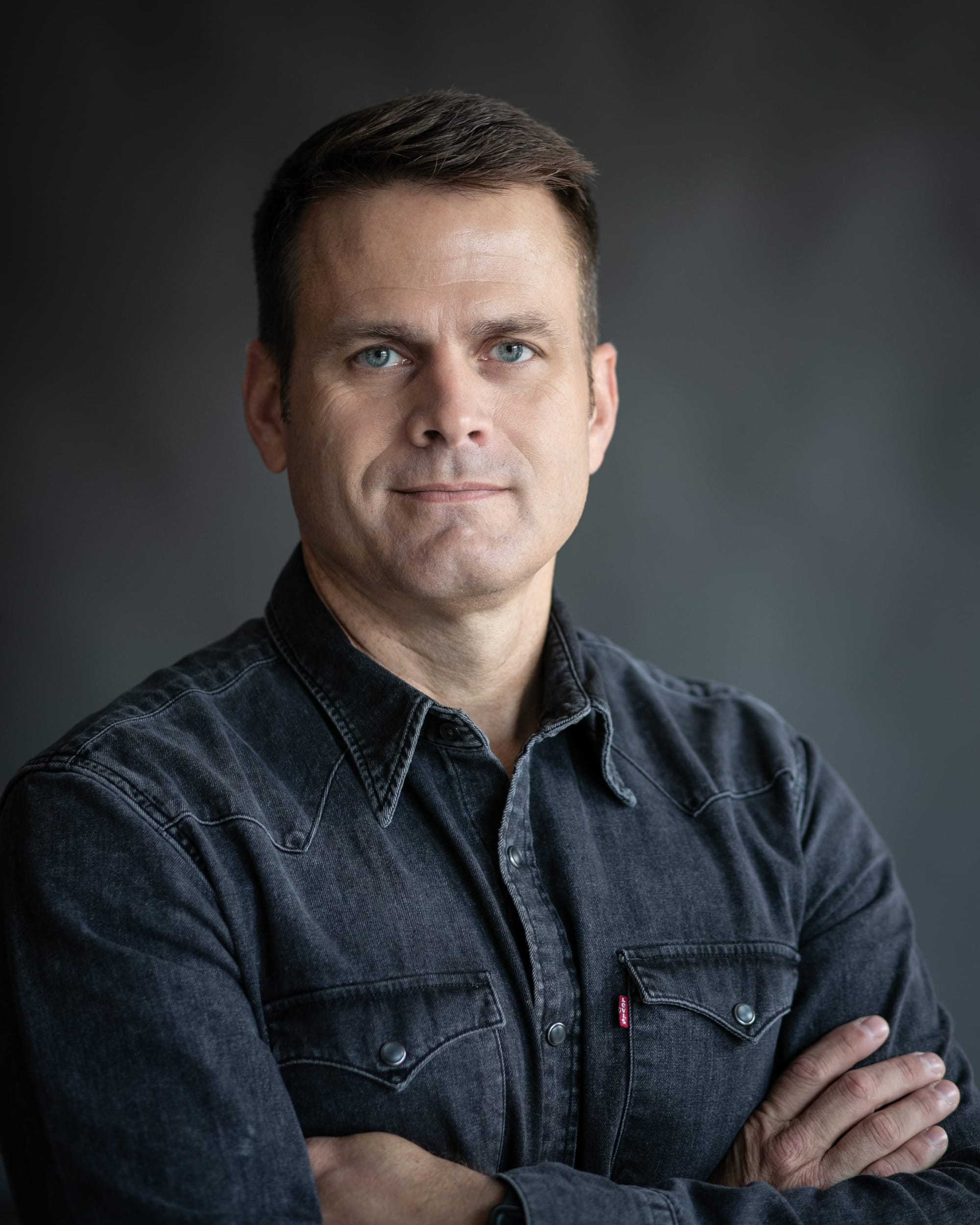
about the host.
Mike has called Bentonville, Arkansas home since 1986. He graduated from Bentonville High School and attended the University of Arkansas, earning a degree in Computer Science and Computer Engineering. He is currently pursing his M.A. in Applied Anthropology.
Mike is a Veteran of the United States Marine Corps and began his career at Walmart, before moving on to iconic companies such as Hershey Foods, The Walt Disney Company, and Nickelodeon/Viacom.
Mike Rusch joined the startup team at Pure Charity, an organization developing fundraising technology for nonprofit organizations striving to address some of the world's most difficult problems. Mike serves as one of the Managing Directors of Pure Charity today where they have helped over 1,250+ nonprofits raise over $250MM.
Mike currently serves on the Board of Directors for several nonprofits, including Equity Impact Fund, 99 Balloons, Laundry Love, Mercy House Global, and New Beginnings Northwest Arkansas. Additionally, he served as a founding Board member of Canopy Northwest Arkansas, helping to create the first Refugee Settlement site in the State of Arkansas.
In addition to his professional and nonprofit engagements, Mike has been a part of the Northwest Arkansas cycling community. As an avid Gravel Cyclist, he has participated in endurance events such as Unbound Gravel XL, MidSouth, Big Sugar Classic, Rule of Three, Telluride Gravel, Birdeye Gravel Fest, and attempted Leadville MTB 100 but failed at mile 79 (that story is not over). He has also completed other endurance events like the Ironman Triathlon and numerous Marathons and long-distance cycling events including the Arkansas Traverse & Arkansas Graveler.
Mike was a part of the first graduating class of the Northwest Arkansas Community College Bicycle Assembly & Repair Technician accredited certification program and is currently a member of the Northwest Arkansas Community College teaching staff as an Instructor for the Continuing Education Program for Bicycle Maintenance Fundamentals.
He was a part of starting Bentonville Ride Club as a place of deepening local community around the thrill of riding in our community and helped organize events like the Arkansas Traverse (Documentary Link) and rides across Missouri and Oklahoma.
Mike married the most incredible woman in the world, Corrie, and together they have four children. His love for a great story, whether told through nonprofit endeavors, professional achievements, or cycling adventures, reflects his appreciation for the diverse and interconnected narratives that shape our lives.
episode outline.
- Opening: Sunday morning gravel ride through Benton County (00:00)
- The role of the church in America and the Bible Belt (04:14)
- Religious history of the Ozarks: Spanish Catholics, circuit riders, Cumberland Presbyterians, Methodists, Baptists (04:14)
- Durkheim and the church as first institution: meaning and power (06:30)
- Removal of indigenous nations and the Trail of Tears (07:30)
- Slavery, the Methodist split, founding of St. Joseph Catholic Church (08:00)
- St. Paul's Episcopal and the Civil War (08:57)
- The invisible institution: hush harbors, Squire Jehagen, and the Black church as cathedral of resistance (09:18)
- Church of God in Christ and the Assemblies of God: Arkansas as birthplace of Pentecostalism (11:08)
- The KKK and the church: accommodation and resistance (11:32)
- Faith as both force of good and force of harm (13:28)
- Personal story: evangelical Christianity and questions of faith (15:08)
- The central question: faith, belonging, and the communal theology of place (16:22)
- Sunday to Monday: faith in public life, city councils, Christian nationalism (17:22)
- Religious pluralism as the oldest story in the Ozarks (19:00)
- Introduction of Monica Kumar as co-host (21:24)
- Closing: welcome to Season 3 (25:57)
episode references.
- Émile Durkheim, The Elementary Forms of Religious Life (1912/1995)
- Albert J. Raboteau, Slave Religion: The "Invisible Institution" in the Antebellum South (1978)
- Clifford Geertz, The Interpretation of Cultures (1973)
- Guy Lancaster, Racial Cleansing in Arkansas, 1883–1924 (2014): https://rowman.com/ISBN/9780739192375/Racial-Cleansing-in-Arkansas-1883-1924
- Spout Spring Historic Context Statement (2025): https://www.fayetteville-ar.gov/DocumentCenter/View/36089
- Cumberland Presbyterians in Arkansas — Encyclopedia of Arkansas: https://encyclopediaofarkansas.net/entries/cumberland-presbyterians-2655/
- Methodists in Arkansas — Encyclopedia of Arkansas: https://encyclopediaofarkansas.net/entries/methodists-310/
- Southern Baptist Convention founding — https://www.britannica.com/topic/Southern-Baptist-Convention
- Church of God in Christ — Encyclopedia of Arkansas: https://encyclopediaofarkansas.net/entries/church-of-god-in-christ-2296/
- Assemblies of God — Encyclopedia of Arkansas: https://encyclopediaofarkansas.net/entries/assemblies-of-god-5121/
- Ku Klux Klan in Arkansas — Encyclopedia of Arkansas: https://encyclopediaofarkansas.net/entries/ku-klux-klan-2755/
- St. Joseph Catholic Church, Fayetteville — Parish History: https://www.sjfay.com/our-history
- Andrew L. Whitehead and Samuel L. Perry, Taking America Back for God (2020)
- the underview Season 1 & 2: https://www.theunderview.com
- Music Courtesy of https://brianhirschy.com/
episode transcript.
S03E02 the faith of Northwest Arkansas with Mike Rusch.
[00:00:44] mike rusch.: The wheels of my bike, they weave through the earth made soft by the spring rains, their rhythm on the pack. Gravel is a calming voice as I head southwest outta my hometown here in Bentonville, Arkansas. Towards the Great Plains.
It's the second Sunday of April here in the Ozarks of northwest Arkansas. And predictably I find myself out on the gravel road seeking to clear my mind. The southern air is warm and heavy as spring returns, and the sky is that particular kind of blues scrubbed, clean by last night's wind. The dark storm clouds linger on the far horizon, even as the daffodils have burst forth yellow from the ground. In defiance, the big flowers of the rosebuds have bloomed and the dogwoods have broken from their sleep, and just a beautiful array of white. It's a beautiful pattern to witness a reminder that the days ahead still remember who they are. They're revealing the hope that they have held for us over these winter months.
And on the church calendar, we've just celebrated Easter. However, in the earth the Spring Equinox arrived first as this complexity of religious tradition is once again entangled with the liturgy of the earth. I think both calling out to be reunited.
This is a season of revelation of light breaking through the cold and the dark, and maybe that's fitting for where I find myself this morning because the questions I carry, I think they need some light also.
The gravel roads in this part of Benton County are quiet on Sunday mornings. They are quiet because the cars and the farm trucks have already reached their morning destination. And as I ride, I pass a few churches. They're parking lots full of cars lined up along dirt roads with people inside doing what people have always done in this region for nearly 200 years. Worshiping, singing, and listening to a preacher explain the promise of salvation and so together maybe we're all seeking something of another understanding.
And as I remember, everything we've explored over the last two seasons, the voices start to speak to me again about the land inviting me into the stories that are held here. The buffalo traces and the trading routes, the path of the trail of tears and the layered histories beneath the gravel roads that I ride. All of these pathways seem to lead to different kinds of destinations, and here are the borders and the blood in the ground, and the forgotten headstones and the people displaced, the mythologies we've created and the ones that we've forgotten. All of the voices that have shaped this place and all of the voices that have been silenced, their ringing is something I can't ignore.
But here outside this church, I can almost hear the voices coming from inside the building. The voices that sing and pray that aren't silent today, and I know they won't be silent in the shaping of this place as Sunday turns to Monday. Here where the sky holds a particular kind of honesty that neither leans towards darkness nor towards light, but holds in a perfect union, a trembling balance. This is where the liturgy of the earth and humankind runs through all of it. Like those inside the building. I come here seeking something more. A presence I've felt before, but lately can only be found in the quiet rhythm of my breathing that is exaggerated as my legs push me through these rolling Ozark hills.
So this morning, passing these churches with their full parking lots and steeples breaking the balance of the sky. I guess we both make a vertical claim that eventually returns against a horizontal reckoning.
I wonder what is happening inside of those walls? What faith questions are they finding answers to? And when they leave this church, how do those answers shape the way that they see their home and their neighbors, and the work to form this community that we all share?
the role of the Church.
[00:04:14] mike rusch.: The role of the church in America, especially here in the American South, it has always both fascinated and troubled me. I grew up in what people call the Bible Belt, the sun hammered arc of the American South from Texas to the Carolinas, where steeples outnumber stoplights. And the question is never whether someone believes, but where they practice that belief today, it is a place where Protestant Christianity is shaped not just Sunday mornings, but politics and culture, education and economics, the very fabric of daily life.
Arkansas seems to be where the Bible belt was driven into the hills, like a fence post driven deep into the Ozark rock until the stone bled. And the people who swung that hammer, they called the blood that followed holy, because before anything was built in these hills, the church was here creating a foundation.
The Spanish Catholics came first with De Soto's expedition driving across into the red ground of the Mississippi River Valley and held what many may believe is the first Christian worship service on this land, but the colonizer's faith didn't take root then, but the seed was in the ground, pressed into the earth as a claim upon the place that already belonged to someone else.
About 130 years later, the French Jesuits arrived, and this was The religious order that first encountered the Quapaw people and somehow mangled the name Arkansas from it. And at the time, French and Spanish Colonial law had prohibited Protestant worship in these territories. But after the Louisiana purchase, American Protestants began flowing into Arkansas. This is when the circuit riders came and the second great awakening swept the Arkansas landscape like a storm. Camp meetings and the clearings, brush arbors and the hollows, men on horseback riding 200, sometimes 600 miles to preach their gospel to people who had nothing but land and hunger for meaning.
The theology that they carried was radical for its time, free will, personal transformation, and the idea that any person could walk directly into the presence of God.
That slowly became the spiritual DNA of the Ozarks.
In 1826, the Cumberland Presbyterians arrived at Cane Hill two years before Washington County existed, 10 years before Arkansas was a state. The church never followed what they called civilization into these hills. It arrived first and everything grew up around it.
In the early 1840, the Methodist Society organized in Bentonville before they were proper streets, before the square was platted. And they met where they could, argued about God, and they built something together. And Springdale didn't begin as a town that later got a church. It began as a settlement gathered around a congregation called Shiloh.
Once again, the church came and the town was built around it. The church, well, it always came first.
"The French Jewish sociologist, Emile Durkheim, seeking a framework for understanding the religious nature of humanity, wrote that religion reveals something essential and permanent about what it means to be human. Not a phase of civilization, but its foundation." (citation)
And the Ozarks proved that framework in its raw form. In this lawless, unincorporated place here. The church was the first institution and the first structure that it built was one of, meaning.
The first claim it made is that something here was worth gathering around. Before the courthouses, before the schools and the banks, there was the congregation and these religious congregations put to work, creating the first two structures of this place, structure of meaning and the structure of power.
Because we cannot talk about religion without naming it as such. A system of both meaning and power.
The history of that power was first exercised in the removal of indigenous people. The Osage, Quapaw, and the Caddo, they had hunted in these hills for millennia. The Cherokee had been pushed here and then pushed again. And while the settlers were raising their first sanctuaries on the banks of the Ozark Creeks, the United States government was marching thousands of Cherokee people west on the Trail of Tears through Fayetteville, through Bentonville, and past the very ground where these congregations stood. And then on Sunday they held services again.
The church didn't just arrive on someone else's land. It arrived thanking God for the land it believed it was given, and that was the first wound, and everything that follows after that was its echo.
And then after removal, the institution of slavery came to these hills, and with it power was asserted and meaning was called into question. And in 1844, the question of slavery within the First United Methodist congregation became a question that it could not answer together, and it tore them in two. That same year, seven Irish immigrant families founded what would become St. Joseph's Catholic Church in Fayetteville, small log cabin, east of town. The oldest continuous Catholic community in northwest Arkansas built on land that they would never leave, their first sacrament of Baptism was given to enslaved people brought here against their will.
st. pauls espiscopal.
[00:08:57] mike rusch.: And in 1848, St. Paul's Episcopal organized just down the road. The congregation eventually rising, one of the oldest surviving church congregations in the city. These institutions were present at the founding. They watched Arkansas become a state. They buried the dead of the Civil War, and they held the contradictions of this place inside their walls, and they called it worship.
black churches.
[00:09:18] mike rusch.: The circuit riders who preached free will and transformation rode through a society built on forced labor, and enslaved people heard sermons about obedience, but what they did in response was build something else entirely. In the hollows in the woods and the spaces beyond the site of enslavers, they gathered in what historians called the "invisible institution," hush harbors, Secret meetings where iron pots were pressed against cabin doors to muffle prayer.
There a different kind of gospel was preached, not obedience, but exodus, not acceptance, but deliverance. The same bible held by hands that had every reason to find something different in it.
In 1845, the Southern Baptist Convention formed explicitly to defend the institution of slavery. And when the Arkansas Baptist State Convention organized in 1848, they did so as a southern denomination. The Baptist would eventually become dominant here, and the church they built was on that foundation. Then the war came and ended in the invisible institution it stepped into the light.
In 1865, a man named Squire Jahagen, freed from bondage, organized a Baptist congregation on South Willow Avenue in Fayetteville, and by eighteen eighty-four , black residents had built a brick Methodist church with their own hands that still stands today. These churches became the infrastructure for everything else, sustaining schools when white opposition nearly killed them. Housing fraternal organizations anchoring a civic life that was barely acknowledged.
A nursery in the Methodist church became the first Head Start program, and when the University of Arkansas admitted black students but refused to house them, these churches took them in. And in 1954, when Fayetteville desegregated its school districts, all seven students who had integrated in the high school came from this community, from these churches, from this stretch of Willow Avenue. The hush harbor had become a cathedral of resistance.
church of christ.
[00:11:08] mike rusch.: And in 1878, a yellow fever epidemic drove a family from Tennessee to Conway County, Arkansas.
Their son, Charles Mason, he was baptized in Arkansas, but the Baptist expelled him for his Holiness preaching. And then in 1897, walking a street in Little Rock Mason received a vision. The name, the Church of God in Christ. Today, the fourth largest Christian denomination in America.
assembly of god.
[00:11:32] mike rusch.: And in April of 19 14, 300 Pentecostal ministers gathered at the Grand Opera House in Hot Springs. Mason preached, and from that gathering emerged to the Assemblies of God. Now the largest Pentecostal fellowship in the world.
Arkansas was the birthplace of two of the most consequential religious movements in American Christianity.
But the church that could birth liberation could also baptize hatred. The church has always seemed to be on both sides of history.
In the 1920s, the KKK established more than 150 chapters across Arkansas. Little Rock, a seat of power, second only to Atlanta.
Here in this state, the Klan made Sunday visits to Protestant churches, praising ministers, offering gifts of money. Their moral agenda was to sell respectability, wrapping its violence in the language of Protestant moral reform, sobriety, ,purity, order, and the protection of the Christian home, which aligns seamlessly with dominant Protestant culture.
The church just didn't exist within the Klan in too many places it welcomed it through the front door, and the Klan's primary target in Arkansas wasn't only black Arkansans, it was also Catholics, which means that the Irish immigrants families who founded St. Joseph in 1844 who had built their log cabin church in the Ozark Kills as an act of faith and survival. Found themselves a century later, the named enemies of Protestant White nationalism operating inside the walls of the very churches these neighbors attended.
The same soil, the same faith, opposite sides of the same wound. Accommodation and resistance. Always in the same building, always reading the same text, always arriving at different conclusions about what it meant and who it was for. That same faith that sent, missionaries to these Ozark hills also sent defenders of the Confederacy to Pea Ridge. The same camp meetings that welcomed all souls also enforced the color line. The same churches that preach the equal dignity of every person before God built separate sanctuaries for black and white believers.
a force of good and evil.
[00:13:28] mike rusch.: This faith in the South has sometimes been used for a negative influence. It's sometimes been used to justify violence and force hierarchy. And it's blessed injustice, and I have to sit with that. I can't pretend that my tradition is innocent, but faith has also been a source of good. It built schools where there was none. It created hospitals and orphanages, mutual aid networks. It sustained people through slavery, through war, through poverty, through grief. And the black church born in the invisible churches of enslaved people became the institutions that made the civil rights movement possible.
Both things are true and holding both is hard.
The church was the first institution to call the Ozarks home. it shaped everything. The beauty, the courage, the violence, and the grace. Durkheim was right. Religion reveals something permanent about humanity. Here in these unsettled Ozarks. It revealed all of it all, at once with nowhere left to hide.
And this is what this season is about. The churches here are the institutions that stretch all the way to the beginning, and yet are still speaking into what this place is and what it is becoming.
not the whole story.
[00:14:33] mike rusch.: But this is not the whole story because that story is still being written and over the centuries. I wanna understand how this history still shapes us today.
Faith has shaped our mythologies, the stories we tell ourselves about who we are and why we're here. Faith has shaped our state and our region from the founding of the earliest institutions to the debates that are happening right now in city council chambers, school boards, and their state legislature.
This same story of faith that holds both unthinkable tragedy. Also proclaims the power of healing and repair and reconciliation.
my story.
[00:15:08] mike rusch.: And that same faith has shaped me also. I would consider myself a person of faith. And I also understand why others, may question that I grew up in evangelical Christianity and churches that taught me how to love God and love my neighbor, to seek justice, to walk humbly. And yet all of the duality of that church can be found in me as well as I have both pursued and failed greatly in doing all of the things that I profess to believe.
But I have to be honest, the Christian landscape that I see today, I don't recognize it. One of us has changed, maybe both of us. It's become entangled with things that I don't recognize and I find myself asking questions I never thought I'd ask.
How did we get here? How did a faith rooted in love become in some expressions, a faith rooted in fear? I've asked these questions in faith communities before, and I have to be honest, that hasn't always gone well. I've been told that I'm asking the wrong questions. I've been made to feel like my curiosity was a threat. I've watched friends and family walk away from faith entirely because the questions weren't welcome.
But I've also found faith communities now that hold space for these questions. A community that believes faith and doubt can coexist. A community that trusts our ideas of God are big enough to handle our hardest wondering.
And so this season is that collective journey to keep asking these questions.
the faith of Northwest Arkansas.
[00:16:22] mike rusch.: As I continue over the gravel roads and pass another small country church, white clapboard, cemetery beside it, families buried there going back generations. I find myself arriving at what feels like the central question of this season.
How has Faith worked to shape the foundations of this place? How is it shaping, welcoming, belonging, and inclusion in our community today?
I wonder if I walked in those doors, would I be welcome? What if I didn't believe everything that they believed? Could I belong even if I didn't believe? Or is my belief the condition of my belonging.
That question matters to me personally, but it matters beyond me because what we believe about God shapes what we believe about each other.
This isn't a question about whether faith is true or false. We can free ourselves of that question because the reality is, is that this expression of faith in our community, it has an impact and that impact is real. So we could begin this season with the posture that this faith is real because we experience the evidence of its impact every day.
today.
[00:17:22] mike rusch.: This is the communal theology of place that I've been seeking. The place where we understand how what we believe are about ourselves, each other, and our place converge. Because the faith practice in these churches, it doesn't stay inside these walls. It goes out into school board meetings and city councils. It shapes hiring decisions and housing policies. It determines who gets helped and who gets overlooked.
We saw it in our election miniseries before in conversations with elected officials about how others are wrestling with what it means to be a person of faith in public life.
We've seen it in our city council chambers when faith was front and center in debates about public art and public values. At some point in these council meetings, I realized we weren't debating the colors of paint that were being used. We are debating whose version of God should direct the affairs of our city.
We see it every time someone invokes God to justify a policy or condemn a neighbor. We see it today in Arkansas as it was reported to be the state at the top of the list of Christian nationalism syncretism, and that didn't emerge outta nowhere.
How does a personal faith turn into an institutional faith? That's what I wanna understand. Where does the process of enculturation inform how we act, what we believe, and how do faith communities influence these spaces? How does the power of faith in religious institutions create the rhythms of our community and the posture of welcome in ways that we do not recognize?
And I'm coming to understand that the most dangerous liturgy is the one that you don't know that you're practicing.
And so over the past two seasons, the role of faith has been an undercurrent in almost every conversation, our guests have mentioned it, referenced it, and sometimes wrestled with it openly.
Dr. Perla Guerrero talked about how religious institutions have shaped immigrant communities. Interviews with descendants of the Trail of Tears, spoke of spiritual traditions that survived forced removal. Black Arkansans shared how the church was one of the institutions that they could call their own during segregation.
Faith has been here all along beneath the surface, shaping everything, but I've also learned that no one person can represent it. The faith of Northwest Arkansas is not monolithic. Yes, evangelical Christianity has the largest influence here, but that's not the whole story. And even within evangelical Christianity, there's diversities that outsiders don't always see.
But before we begin, I have to be honest about my own limitations. I'm not a theologian. My exposure to faith traditions outside my own has been limited. I grew up in one stream of Christianity, and while I've asked questions and wondered some, I have to be honest with myself and try to see how my perspective is still shaped by where I started.
So I've been thinking about something that Dr. Jared Phillips told me about the unique history of religion in the American South. From the very beginning, the Ozarks have never been one faith.
The Osage and the Quapaw had their own spiritual traditions. Long before White settlers arrived, circuit writers built Methodism and living rooms. Baptists followed and then they split and they split again, formerly enslaved people built their own churches as a refuge of safety. Pentecostalism was born in a hot springs opera house, and today a mosque sits within driving distance of the megachurch, a Spanish mass parish, and a Hindu temple. Religious pluralism it isn't new to these Ozarks. It's the oldest story that we have.
These are the questions that I'm carrying this season, but I wanna be honest about my own posture. Based on my own story, I don't know that I can be objective enough to ask the right questions alone. I'm too shaped by my own tradition, my own blind spots, my own assumptions, my own social position. I have to admit that I've been so deeply influenced by evangelical Christianity that I'm not sure I can see it clearly.
I need someone to help see what I cannot, someone who might on the surface be very different from me, someone from a different faith tradition or a different background, a different set of experiences, but someone who shares a hope, that faith can be a renewing force in our community rather than dividing one. So I'm gonna take a step forward this season. I'm going to invite someone in to help us all work through this.
introduction of Monica, phone call.
[00:21:24] monica kumar.: hey, Mike.
[00:21:26] mike rusch.: Hey, Monica. How you doing today?
[00:21:28] monica kumar.: I am. Great.
[00:21:30] mike rusch.: Hey, I want to have a conversation with you about this idea of faith in Northwest Arkansas that you and I have been talking about for a while, and I know this may, uh, be a longer conversation, but I would really like to ask for your help.
As we've talked through this season. I think I've just come to this point where I'm just not sure that I fully trust myself to navigate through this alone. And you know, aware, I mean like I'm too far inside my own tradition and I know what I think. I know, and I think that's also can be good and problematic. And I think I just wanna ask if you'd be willing to help be someone who can help push back on those assumptions and bring perspectives that I don't have and tell me when I'm asking the wrong questions and someone who can lead this conversation when I don't know how to.
And I know you and I share, as we've talked many times, we share a common hope that faith can be something that unites rather than divides. And I just really think that I need your help and your voice to help understand this story better.
And so I'm calling just to kind of ask if you would be willing to step into this conversation and help co-host this season with me.
[00:22:41] monica kumar.: Wow. I, yeah, I mean, I need a moment with that Mike, uh, because I wasn't expecting to be so moved by your invitation. Um, so thank you for that. Yeah, I mean, I think yes, of course.
Yes. Um, and I think it's really important for me to also maybe try and articulate why I'm saying yes. And of course, you know, you're a dear friend and I respect you and the work you do so much. But that's probably not my main reason for saying yes. It's not just because you asked, I think it's because of the specific way you asked.
You didn't say like, I need to translate or I need a different perspective. I heard you say that you don't trust yourself to navigate this alone. And that felt really honest and vulnerable and compelling to me. And so I wanna be honest with you, you know, faith is complicated territory for me in ways that I'm still working out, especially in this space.
I've sat outside of spaces. When it comes to faith and specifically in our region, you know, for a long time. And so I'm always looking for spaces where, where I can step inside if I'm invited. So I'm hearing you in invite me in, and it feels like that's what you're asking. So I'm gonna say yes because I feel like we have faith that we can do this together with grace and love.
[00:23:55] mike rusch.: Well, I, I would be humbled, Monica, I know from all of our conversations that this idea of faith being a bridge and not a wall, and that people from different faith traditions and experiences and worlds even and can work together to build a community where everyone belongs. And I know this has been at your heart, and I know this is the work that you've been doing for so long.
As I think through this season, I just, I, I don't wanna walk through this by myself and I can't think of anybody better to help guide and lead all of us, uh, through these conversations. And so I would be humbled and grateful for us to walk down this road together.
[00:24:31] monica kumar.: I really appreciate you naming that.
And that feels like that's really the question, right? Can faith be a bridge and like not a barrier? And my, and I think my answer is yes, it can. And I also hear a question underneath that, which is for me, the question of are we willing to get proximate to be next to and walk alongside people who pray differently from us or who might believe differently from us.
You know, I feel like the question is, will we lean towards encounters that might cost us something if, you know, there's a potential promise of a possible greater reward of community and connection. And I think this region all places with everything it carries historically and everything that's becoming, this is exactly what we need to ask those questions out loud.
So my answer is yes. And thank you so much for asking and inviting.
[00:25:20] mike rusch.: Well, I am humbled and grateful. And, let's set up a time where we can dig into where we even begin this conversation and how we start and our backgrounds. And maybe we need a moment just for the two of us to have a kind of a centering moment.
We can figure out where are we starting from this conversation. But maybe until we have that chance, I just wanna say thank you and I'm looking forward to this and I can't wait to kind of work through this season with you. So thanks for saying yes. I'm humbled and grateful that you would do that.
[00:25:48] monica kumar.: Thank you for the invitation, Mike. I'm humbled and grateful that you invited me.
[00:25:52] mike rusch.: Thanks, Monica. All right, we'll talk soon. Mm-hmm.
[00:25:55] monica kumar.: Bye-Bye.
closing.
[00:25:57] mike rusch.: So on this gravel road from a warm April morning. I wanna welcome you to season three of the underview, the faith of Northwest Arkansas. This season we'll explore the traditions that have shaped this place.
We'll trace the history from frontier revivals to megachurches and the growing religious diversity of today
We'll ask hard questions about how faith has been used to include and exclude, to build and to break. And we'll do it together. Monica and I, along with the guests that we'll bring into these conversations, pastors and historians, scholars and seekers, peoples whose faith has sustained them, and people who have walked away.
In the spirit of our communal theology of place. This act of faith in honest conversation is my hope that we can lead to a deeper understanding of each other. I believe that faith can hold our convictions while making room for others. Faith that the God worshiped in a hundred different ways across this region might be enough for all of our questions.
For in the end, the question of what we believe. It is inseparable from the question of who we are becoming. And that question belongs to all of us.
My name is Mike Rusch, and today we begin the exploration of the faith of Northwest Arkansas.
You're listening to the underview, an exploration and the shaping of our place.