
the free will baptist church with Ben Gibson.
A Springdale pastor who is working for a Christian nation from his own pulpit lays out the vision with rare candor. Ben Gibson of Phillips Chapel Free Will Baptist on free grace, family discipleship, and what a nation brought back to Christ would ask of Northwest Arkansas.
⚠️ Content Warning: This episode contains adult subject matter and other content that may be disturbing to listeners, including grief and personal loss. Listener discretion is advised.


episode notes.
Pastor Ben Gibson did not grow up in a Christian home. His earliest memories are the police at the house, and then a kitchen in Colorado where his father, newly and radically saved, poured every ounce of alcohol down the drain. The whole family was baptized together in 1984. Fifteen years later, on the Saturday night before Easter, a patch of ice took his father's life, and a calling arrived that he can only describe as a compulsion. Since 2011 he has pastored Phillips Chapel Free Will Baptist Church in Springdale, the most diverse city in the Ozarks. He teaches his tradition with real care. Free grace for everybody. Congregations that answer to no hierarchy. A church that rewrote its own bylaws to match what it actually believes, traded the youth group for rooms where seventy-year-olds and toddlers pray out loud together, and scattered itself into neighborhoods, schools, and workplaces. Since the lockdown lifted it has grown by roughly a quarter every year.
And this is the conversation Season 3 has been circling without a guest willing to represent it until now. Gibson has preached on Christian nationalism by name from his own pulpit and claimed the term. At this table he lays the vision out with unusual candor. A nation brought back to Christ, not by force but by conversion, by discipleship, by generations of believers stepping onto school boards and city councils until the laws change and the culture changes. He also says the church was never meant to wield political power, that top-down political rescue is a pipe dream, and that he is not sure America can even be called a Christian nation. Both of those are his words, and the space between them is where this episode lives.
about our guest.
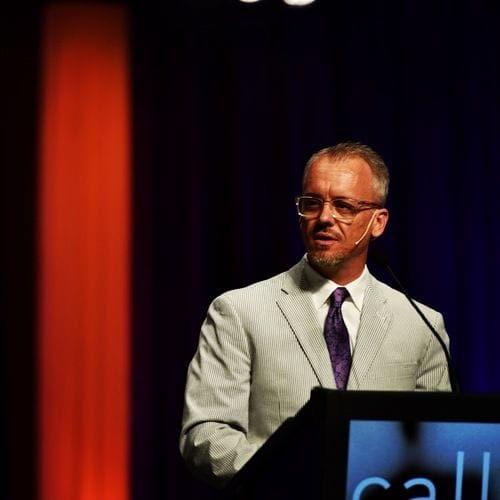
Ben Gibson was born and raised in Colorado and was a member of Highland Hills Free Will Baptist Church in Greeley. He worked as a carpenter with his father for 13 years in northern Colorado. He graduated from Southeastern FWB College in 2006. He has pastored Charity FWB in Wendell, North Carolina and Immanuel FWB in Winterville, North Carolina. He started his pastorate at Phillips Chapel in 2011.
During his tenure at Phillips Chapel, he has been instrumental in forming the Shiloh Association, starting small groups, and leading his people through the Fanning the Flame church revitalization. He currently serves on the Executive Board of the Arkansas State Association of Free Will Baptists. He is an avid cyclist, an activity he also enjoys with his family. He has been married to his wife Fawn for 23 years and they have 3 children: Ellie, Owen and Ethan. He also has two golden retrievers.
Ben takes preaching the Word very seriously and is a skilled expositor. His desire is to make disciples and to do all things with excellence.
episode references.
- Phillips Chapel Free Will Baptist Church: https://phillipschapel.org/
- National Association of Free Will Baptists: https://nafwb.org/
- Promise Keepers: https://promisekeepers.org/
- LifeWise Academy, released-time Bible education: https://lifewise.org/
- Thom Rainer, Church Answers: https://churchanswers.com/
- C.S. Lewis, The Problem of Pain (1940).
- Dallas Willard, quoted by Ben Gibson, a person becomes a saint "by doing the next right thing": https://dwillard.org/
- Douglas Wilson, quoted by Ben Gibson, "your theology comes out your fingertips."
- R.C. Sproul, cited by Ben Gibson for the line about betting 60 percent of his theology is right. "In essentials unity, in non-essentials liberty, in all things charity."
- Jeremiah 29, the letter to the exiles, and Titus 2, referenced throughout.
episode outline.
- Content warning (00:00)
- Episode preview, disciples before politics (00:17)
- Episode intro with Monica Kumar (02:22)
- Welcome, Ben Gibson and Phillips Chapel (05:33)
- A kitchen in Colorado, addiction, transformation, and a patch of ice (05:51)
- Faith as a process, God shouts in our pains (11:07)
- Becoming a pastor, Promise Keepers and a seven-minute sermon (13:05)
- Tradition shift, Arminian free grace, and rewriting the bylaws (16:19)
- The move to Northwest Arkansas in a snowstorm (23:35)
- Transparency from the pulpit, 60 percent of my theology (27:29)
- Your theology comes out your fingertips (34:09)
- Family discipleship, no youth group, every generation in one room (41:00)
- Salt of the earth, faith at work and at school (44:27)
- What it means to belong to Phillips Chapel, you can attend forever (49:18)
- Church security (52:44)
- Hope for the church, VBS honesty, and LifeWise (54:22)
- Our political moment, the two things you didn't talk about at Thanksgiving (01:01:17)
- Everything under the lordship of Jesus Christ, the March 1 sermon (01:02:23)
- Douglas Wilson, a controversial figure, and the Christian nation question (01:08:06)
- Not top down, disciples on school boards, local elections first (01:12:42)
- Immigration rhetoric, incitement, and the nations God brought here (01:16:38)
- One gospel culture in a multiethnic church (01:21:34)
- A call to action, voting, prayer, and Jeremiah in Babylon (01:24:51)
- A revival, and coming back to a biblical nation (01:27:27)
- In essentials unity, gentleness and humility (01:31:43)
- Fears for this place (01:34:34)
- Wholeness, reconciling the past with the present (01:37:38)
- Episode outro (01:42:25)
episode transcript.
episode content warning.
[00:00:00] mike rusch.: Before we begin, this episode contains adult subject matter and other content that may be disturbing to the listeners. The underview is committed to honest storytelling about our place, and sometimes that means sitting with hard things. Please take care of yourself as you listen.
episode preview.
[00:00:17] ben gibson.: the responsibility then comes back to the church. And I mentioned voting earlier. I think the most important thing for us to do is to face reality as the church and make disciples.
Because if we make disciples, then we have every expectation that somebody who is a follower of Jesus is gonna get on the school board and that if that happens enough over time, it's gonna change the education system. And if somebody's gonna be voted into the state senate or whatever, and you just you can follow it up.
A lot of times we think it works from the top down politically, that if we just get the right person in the Oval Office then everything's gonna be fixed. And I think that's a pipe dream, honestly, because obviously there's a limited amount of change one person can do in a four-year term, but I don't think that's the way God has designed the world to work.
And that's especially not how the influence of the church works, that we're not supposed to wield authority politically. We influence politics by making disciples, and then those disciples go, and they're voted into office. Laws change. Culture begins to change,
epidsode intro.
[00:02:22] mike rusch.: Well you're listening to The Underview, an exploration in the shaping of our place. My name is Mike Rusch, and today Monica and I are gonna share a table with Pastor Ben Gibson. He's the lead pastor of Phillips Chapel Free Will Baptist Church in Springdale, Arkansas. This season, we've been tracing the faith of Northwest Arkansas. What was planted here, what holds power, what is breaking apart, and what is trying to be born.
Today's table, it sits with this aspect of power, and it sits closer to many of the conversations that we've had off the record this season. What I mean by that is that this is a conversation that we've not had someone who was willing to represent it until now.
A little history before we begin. Free Will Baptists were born saying no. They are Armenians preaching free grace in a world where the established church preached to a chosen few. They believe the gospel was for everyone. They believe nothing should stand between the free soul and God. Not a bishop, not a king, and not a state church. Baptists in this country went to jail rather than to bow to one. This is the family line that Ben Gibson stands in.
Every conversation this season keeps arriving at the same question. How does a church see its role in the community, in the place where it sits? What does Sunday send out the door on Monday into the school, the workplace, the neighborhood, even our civil government?
Every congregation that we have visited carries something across that threshold, a casserole, a protest, a prayer, a policy choice. Phillips Chapel carries something worth understanding. This is a church that has thought hard about what its place in this community is, and its pastor has been more direct about it than most.
Part of what he hopes Sunday sends into the world is a nation brought back to Christ. That phrase belongs to an argument much bigger than these hills, an argument about what America and what it should become, carried into places like Springdale by books and podcasts and pulpits from far outside the Ozarks.
However, this is part of the message and the mission at Phillips Chapel. The words "Christian nation" or "Christian nationalism," they've been claimed within this congregation, and so we wanted to get below the surface with Pastor Ben to understand how he thinks about it and how it works.
The underview has always said that place is shaped by movement. People move, ideas move, too. Today we listen to what one of those ideas sounds like when a church preaches it down the road in the most diverse city in the Ozarks.
So you will hear us ask questions today, and you're not gonna hear us respond. That is on purpose. The work of this season has been letting our neighbors tell us what they believe in their own words, at their own table, in their own time. But Monica and I are walking away with questions. I'm sure you will too, and we will work through those in episodes to come.
Here is what to hold as you listen. What kind of community is being described? Who belongs to it? What does Sunday ask of Monday? And how does it direct the path of a church when the mission is about the soul and the nation?
As always, we wanna hear what you're thinking and what you're wrestling with.
Hit the Send us a voice message button on the underview.com homepage. We listen to every message.
All right, we've got a whole lot to work through today. Let's get into it
episode interview.
[00:05:33] mike rusch.: well, Monica and I have the privilege of sharing a table with Pastor Ben Gibson, who is the lead pastor at Phillips Chapel Free Will Baptist Church in Springdale. And so-
[00:05:44] ben gibson.: Thank you for having me ... yeah, Pastor Ben, thanks for being here, and welcome to the conversation. We're glad to have you here, thank you.
[00:05:49] monica kumar.: Welcome to the table, y'all.
[00:05:51] mike rusch.: We'd love to just hear your story, and maybe tell us a little bit about you and your background. Okay. And then we'd love to know when, like, faith became real to you.
[00:05:58] ben gibson.: Sure. Yeah. It's, How far back do you want me to go?
[00:06:01] mike rusch.: You can go back as far as- You
stop wherever it's significant to you
[00:06:04] ben gibson.: I did not grow up in a Christian home. My dad was a drug addict and an alcoholic, abusive to me and my sister and my mother. Some of my earliest memories are the police at our house. It just it was v- very traumatic. As a matter of fact, not to digress, but, and I've been in counseling for years for some PTSD, but the good news is he was radically saved and transformed when I was in third grade.
And I remember standing in the kitchen, watching my mom bawl, and him pour every ounce of alcohol we had in the house down the drain. And to the best of my knowledge, the rest of his life he did not touch it again, but like all transformation stories, not everything was immediate, so there were some things that took time to, to sanctify out of him. And shortly after he was converted, my mother and my sister and I were, and we were all baptized together in 1984.
And then- To make a long story short, we kind of lived nominally for a while. I was a typical rebellious teenager, and kind of tried to go off into the far country, so to speak. But God used a series of pretty intense trials and suffering in my own life to bring me to ministry, and it started in '
- My mother was diagnosed with cancer, and that really shook my dad up. That's when he got super serious. '
98, I had a blood disorder that put me out, out, out of work for three months and in the hospital and almost took my life, and that-that's when faith became real to me.
To keep things succinct, I felt God calling me to something different than what I was doing at that time. My dad was a general contractor, so I was kind of his foreman at the time and just was responsible for all of the physical on the job sites. And his company had grown to the point where he was just doing all the administrative stuff.
And then, it was actually the Saturday night before Easter in '99, he died in a car accident. And that's really-- And forgive me if I tear up. I don't talk about it much, but, I was driving the car. We hit a patch of ice that was really no bigger than this room flipped multiple times. He was thrown. His seatbelt failed, mine held. It was just one of those things. You could call it random or chance, but with looking back on it now, I see God's sovereign hand in all of it.
Um, but anyway, that was obviously life-shattering for me. And so I spent the next year trying to wrap up his business and prepare to go off to Bible college. Met my wife during that time. We started dating and then were married shortly thereafter. And I ended up in North Carolina from Colorado, of all places, going to Bible college. And those first two years were quite a struggle for us. I'm still trying to process my dad's death and all that God has done in my life over the last... in a very short amount of time. We're married, we're in Bible college, we're a thousand, twelve hundred miles away from the nearest family that we have, and, it just, it kind of came crashing down on us. So we ended up going back to Colorado for a few years. I'd like to say that time helped us.
Maybe it did. I'm not quite sure. We were there for the death of her-- my wife's grandfather. And, so that, there's some meaningful experiences there. But then we went back to North Carolina in 2004 to finish up our education, and that's when I started pastoring. Just again, t- another Band-Aid ripped off, and to make a long story short, I pastored two churches in North Carolina, both for three years. The first one while I was in school finishing my degree, and then I pastored another one in Greenville, North Carolina for three years. My first two children were born there, and then we moved here in 2011 in the midst of that huge snowstorm.
I don't know if you guys remember that.
[00:09:47] mike rusch.: That's when I moved here. Yeah.
[00:09:48] ben gibson.: Really? Yeah. All of our furniture was under snow in Nashville, and we spent the first almost month here without any furniture 'cause it was stranded in Nashville. But, yeah, so that's kinda my story and how, how I came to faith. And then, we got here and It, I haven't always been a Free Will Baptist either.
So the, the church we were, saved in Fort Collins, Colorado was a, was an American Baptist church. And then w- and when I was in high school, one of the reasons I think I rebelled is 'cause the timing of our move. We moved to Greeley and we started going to a, it was a mission plant. There were 12 people there our first Sunday.
And my dad just fell in love with the pastor and fell in love with the building and decided we were gonna go there. So we attended there, and that's kinda how I became familiar with Free Will Baptists. So when I felt God calling me into ministry and under the direction of my pastor, after my dad died, he'd...
And like that was present- it was presented to me to go to one place for education. I didn't have options. You go here. So I went there, and it seemed like a very direct path, but um, not straight one, but that's kinda my story about how I got into the ministry, so I don't know if you need any more from me than that.
But...
[00:10:58] mike rusch.: I would just say thank you for sharing- Yeah ... that story. That's yeah, to say the least, that sounds like a very difficult story.
[00:11:04] ben gibson.: Yeah. I'm hard-headed, I think.
faith as a process.
[00:11:07] mike rusch.: As you think about that time of when faith became real to you- was that a new experience for you? Was it kind of an aha moment, or was it... i'm curious. Yeah. Gosh, it sounds like there was so much really hard things going on. Yeah. Kind of, or was that more of a response maybe to what was happening in life?
[00:11:26] ben gibson.: It could ... It, I th- I would say all of the above, it, 'cause it, it wasn't all at once, and I look back on it and I see God's fingerprints through all of it. And then it became this compulsion where, 'Cause, i, I loved carpentry. I was pretty good at it. I liked the lifestyle it afforded me. My dad and I were best friends, and we fished on the weekends and snow skied and did all kinds of things, you know. and so, and, and that was forcibly taken away from me.
And then this just became a compulsion, like I have to do this. And every so often we're kind of reminded of that too, where it becomes a compulsion again. Like it's that there's no other reason for me to be alive than to do this. And I really think that was just God's grace in shaking all of that out because had my dad been around, I would have always been attached, if that makes sense.
And I'm not diminishing his death at all 'cause it was torturous for our family But I see now what God did through it. And, it's-- I see now how my own struggles with my own mental health and my own spiritual formation have really brought me to a place where I can ha- I can help people. Not in a lo-- I'm not doing a lot. I'm not helping a lot of people all at once. Some, some pastors are gifted that way, but it-- my goal is just to help one person at a time, and that's kinda where we're at. But back-- to circle back around to your question, it's-- I think at first it was a response. C.S. Lewis said in The Problem of Pain that God shouts at us through our pains, and I c- I could hear, "Hey, wake up."
And so I was responding to that, and then through the process of time, it became a compulsion
becoming a pastor.
[00:13:05] mike rusch.: Thank you. I'm curious maybe the moment that you started to say, "Hey, this is real in my life- ... and this is something I'm going to pursue- ... from a pastoral perspective."
[00:13:15] ben gibson.: Yeah.
[00:13:16] mike rusch.: How you remember that time or those decisions- ... around, yeah, this is- That's- ... gonna be what I pursue for the rest of my life.
[00:13:22] ben gibson.: That's a great question. It interestingly, and it's part of the story I left out 'cause I was trying to be succinct, but a-along the same time my mother was diagnosed with cancer, I had a... One of my high school friends that we were rebellious together, he went to a Promise Keepers event, and he came to know the Lord.
And so within a f- a few months, he-- I drug me to one, and here I am growing up in a Christian home, but we lived rebelliously together and, he's the one who was influencing me. And that, that was the thing, and I look back on it, they sent me home with a Bible. I had Bibles at home, but this was my own Bible.
And it was just the New Testament, and it wasn't the King James version. And I'm not diminishing translation or anything like that. I don't even remember what it was. I think it was New International Version. But I started reading it, and I r- I read Matthew maybe for the first time with understanding.
And I remember thinking how important Jesus was, not just to history, but to me. And I began to see how he interacted with people, the things that he said, how he behaved himself in certain situations, just... And not just to treat him as an example. He is that, but so much more than that. It b- he became real to me.
In that, I think that was more f- important to my own formation than I realize. And then I was healing up from my blood disorder. It had been almost a year And people started to say things to me. " Is God..." He just asking me if, "Is God calling you into the ministry?" And I was like, "No." I thought I was gonna chase a nail gun for the rest of my life.
But, and then I remember my dad asking me that. And then finally I just went and talked to my pastor, and this was shortly after his death. Now this, we're talking about two or three years have elapsed and he just said, " I'm gonna be gone over Memorial Day on vacation. You're gonna preach. If you feel called, we're gonna s- go to it." And it was like seven minutes long, and I almost threw up. It was awful, and funny story, if you'll allow me to tell it.
Please.
I ran for student council when I was in the ninth grade, and had to, had to give a speech and all that kind of stuff in front of the student body, and I had carefully written one out. My mom helped me write it. They-- She actually came to watch, and I couldn't get two words out of my mouth. I froze, locked up, couldn't swallow. I just sat there for a few minutes, crumbled up my paper, threw it over my shoulder, and went and sat down. And so when I told my mom what I felt like God was doing in my life, my dad's God at this point, she said, "Are, are you sure?
Do you remember the last time? You remember what happened to you when you spoke publicly last time?" So it was ki- it's kind of a funny story. And that's, that's also I think evidence that this is something that only God could produce, not something I'm pursuing because I wanted the microphone.
I tend to kind of skew the spotlight and the microphone. I don't wanna be the one always doing the talking, but, yeah, so maybe that'll-
tradition shift.
[00:16:19] mike rusch.: As you went to seminary and really began down this path of becoming a pastor you said you grew up in an American Baptist. Yeah. What was the context of the shift as you either went through seminary or after seminary- ... or why, maybe why that change of tradition?
[00:16:34] ben gibson.: Yeah. Really the move, and we just, we kinda just landed where we landed and during the move. We were not close enough to the inner workings. We didn't serve at our church in Fort Collins. We attended, and I went to youth group sporadically. But honestly, other than some slight differences in maybe the doctrine of security of the believer, I couldn't tell you with any kind of authority what they believe.
And then when we got to our Free Will Baptist Church, whatever it was that differentiated the theological position, 'cause Free Will Baptists are Arminian, and then American Baptist, I believe, is Calvinist. My dad would not join. He would not become a member because of that one doctrinal difference.
Served in the church, was a tremendous support to our pastor, but he just wouldn't submit to membership. He maybe would have over time, but he didn't. And so none of that even really hit me until we got to Bible college. And then it was on- it was very one-dimensional because I didn't have any other experience.
W- in the first year, one of the reasons that made it difficult for us is because we were kinda told what to think rather than, and then, taught how to think. And um, there was a denominational perspective that was kind of, I hate the word forced, but I don't know a better one, forced upon us.
And I tried, honestly. I tried to walk the walk and talk the talk And it became pretty apparent pretty quickly that we-- I, because of where I was from, was not going to be accepted simply because we were from out West. We were always gonna be met with suspicion. Interestingly, once we got out of school, that was not the case. Both churches that I pastored there loved us well. We had a great ministry there, made lifelong friends there. But there was some, some pretty intense suspicion at school because we just didn't think like them. And that's not just unique to that school. I think that's pretty common in the Bible college seminary culture throughout America, and to, to circle back around to your questions, like the, the denominational distinctives between Free Will Baptists, d- going back to like the 1700s in Europe, there was a distinction made between general Baptists and, you know, Calvinists about security of the believer and in particular, who the gospel is for, is Calvinism is very specific that Jesus died for the elect.
And while we all know that's practically true, his cr- sacrifice on the cross is only effective for those who believe, Armenians believe he died for the whole world, m- and that therefore the gospel is open to everybody. And so that's the main reason I hang on to our movement, because I believe it, and I've searched the scriptures and in the convictions of my own conscience, I believe the gospel is for everybody.
Faith comes by hearing and hearing through the Word of Christ, and so I believe through the work of the Holy Spirit and the power of God's Word, anybody who hears the gospel can call upon the name of Jesus and be saved. And so we hang onto that. There are some other denominational s- distinctives that I may get in trouble for this depending on who listens, but that we have forsaken and we have s- we have set aside.
And in 2018, we actually rewrote our constitution and bylaws at our church to reflect what we actually believe and teach, because we don't necessarily adhere to every part of our treatise that the national has for our faith and practice. And one of those things has to do with whether a person can lose their salvation.
If a person is truly born again into the Kingdom of God, not every Armenian believes this. We don't, but some do. They believe that you can fall from grace and be lost, and we don't teach that. That we teach that because of the sufficiency of Christ's sacrifice on the cross and his eternal intercession for us at the right hand of the Father, he had made a promise in John 10 that he would lose none that the Father has given to him.
And so those that are truly born again will continue in the faith. And if somebody doesn't continue in the faith, then we have a Judas situation in that they were never part of the congregation to begin with. There are others that, that are maybe peripheral issues, but more faith and more, more about just the general way we conduct church. I'm not throwing shade, so please don't think that I am. But a l- not every Free Will Baptist church, but a lot of them are very rural and kinda localized to the Bible Belt, and so that comes with its own culture And just as a matter of philosophy, we've tried to do things excellently.
So my wife leads worship for us. We've got a tremendous associate who actually hired him from J.B. Hunt, so he's on board, and all of our church leadership is on board, where we just, I don't do things spontaneously, or haphazardly, so to give you an example, before I came here today, I was studying for Sunday sermon.
That's not a Saturday night special for me. You know what I mean? It's a week-long, I'll spend 30 hours probably preparing for one sermon. And I treat those teaching opportunities with the highest respect because I believe I'm gonna be judged with stricter judgment because of what I say.
So it needs to be accurate, and I think I need to try to meet people where they are. And then we've chosen to sing doctrinally correct songs, so the music that we sing, our movement is very sentimental about music. And we kind of, along the same lines, same timeframe where we rewrote our bylaws, we just decided that we were gonna sing music regardless of where it came from, regardless of who wrote it, and regardless of its style, that w- had, it had to be biblically accurate if we were gonna sing it.
One of the keys of the Reformation was that, they preached the Word, they prayed the Word, and they sang the Word, and so it began to saturate the congregation. And so we just, we started doing that, and it took a while to become germane to our environment and really to begin to bear fruit. But, it's changed the way we do church. And then we also kind of, to make another distinction, we pulled away from the three services a week - modality, where you had Sunday school, then Sunday morning worship, and then Sunday night, and then Wednesday night prayer meeting. And so we n- we have small groups that meet throughout the week.
We don't have Sunday night services or Wednesday night services. And then we have discipleship groups that meet on Sunday morning, so before worship, and that has a little bit different feel than the small group. But we started focusing on family ministry through our small groups, and that took a little while too to germinate and really begin to bear fruit. But once it did, it's been incredible post-COVID to see what has happened at our church. And we've-- It's like we just we just had a deacons meeting last night, and I'm trying to remember the exact number, but it's like 24 to 26% growth per year once, once everybody kind of recovered in '22 from the lockdown, we've just-- we've been climbing, and it's been such a blessing to be a part of it. It's so much fun.
the move to NW Arkansas.
[00:23:35] mike rusch.: Thank you As you came to Northwest Arkansas, I'm curious, what was the impetus to come here?
Was it to- ... start this church, or how did you find yourself here?
[00:23:44] ben gibson.: Yeah, that's an in-- that's a good question. It took a long time. So my wife actually has distant relation from this area. Her grandfather was born in Madison County, and then he has some cousins and then their children that were in our church here, and they had contacted her dad and asked if he knew anybody. They were without a pastor at the time and had been for a while, almost a year at that time. Had asked if he knew anybody that would be interested, and he gave them my number. And I was mad at him at first, honestly, because we were in a great place in North Carolina, and the church was growing there, and we were happy. I knew I wasn't gonna be there forever. That's probably another conversation for another time because there were some cultural things going on there too that just didn't jive with my spirit.
But like I say, my, I two of my best friends are still there, so we love the people there. And so he called, and I was like, "Yeah, I'll pray about it, whatever," and that was, like, in May. And then I didn't think about it again. And then in, in July, he contact-- the guy contacted me again, and I was like, "I don't even, I don't even know what I'm praying for. I've never been to Northwest Arkansas. I've been to Little Rock, and if that's what Northwest Arkansas is like, I don't wanna, I don't wanna come," and so we hung up the phone, and then he called me back in September, and I said I don't have an answer for you. I don't know what you're looking for. I need to see it. I need to see the church. I need to see... I need to meet you guys." 'Cause all this is still blind. And I talked to him a couple of times on the phone, and that was it.
So they brought us out for a weekend, and I spoke a couple of times, and we spent some time socially with people, and my wife was actually the one that fell in love with it first. I hope she would say that if she was here. But and it just began, it began to be one of those things where the door opened for us. And it goes back to that compulsion again, 'cause I didn't wanna leave North Carolina. I didn't wanna leave our ministry or our friends, but I just felt compelled to go. And so by, by November, we were back out here again, and they voted to call us, and we accepted, but we had to wait until the end of January 'cause my wife was pregnant with our son.
And so we just felt like it was better to keep all of our insurance in place and everything like that, and they were agreeable to that. And so he was two weeks old when we moved here, and in the middle of that snowstorm. But- ... so a roundabout answer to tell you that it was a family connection that brought us here.
[00:26:12] monica kumar.: You know, I'm still sitting with you started so incredibly personally. So as you're talking, and we're having this conversation, I'm still threading back- ... to where you started. Whether you're okay with that or not, I don't know. Yeah. But it's moved me, so-
[00:26:25] ben gibson.: Sure
[00:26:26] monica kumar.: it is what it is.
[00:26:26] ben gibson.: Yeah.
[00:26:27] monica kumar.: And, you shared some very personal things. You shared about sort of unraveling and working through PTSD. And I'm hearing you speak, and then I'm hearing about your journey as we're starting to talk about that, and I'm really curious, like, for somebody who maybe isn't familiar with what how your church and how your conviction shows up in the world- can can you just share a little bit about that? I know that's a big question, but I feel like through points I've heard you sort of talk about even when you just talked about North Carolina- ... that was a, a, a movement towards something that maybe didn't sit with you culturally. And so I feel you in these conversations- ... and I don't mean you in a self-centered way.
[00:27:14] ben gibson.: Sure.
[00:27:14] monica kumar.: I mean you in a bigger way. Can you share what does it look, what does it mean to be a part of the church that you're growing here and developing- ... and clearly growing as it's growing every day. You shared that. And then just what does that look like in the world? Yeah.
[00:27:29] ben gibson.: That's a great question, one that I think I'm wrestling with continually. And to be very direct, one of the things that didn't sit culturally well with me in North Carolina, I was trying to be transparent, and it was not well received.
Some of our older congregants didn't think I ought to be so forthcoming about my own struggles from the pulpit. They were worried that people wouldn't respect me or wouldn't, whatever. And I was like, "I don't know another way to be. I'm sorry." And and that was just one, one small thing.
So when we got here, the same thing was true at Phillips Chapel. It was a very traditional church, and it was a shock to people and I just And I'm working through stuff too, 'cause I'm a flawed... I'm pretty flawed. And I kn- I know I'm not getting up in the pulpit on Sunday mornings.
I'm confident in what I'm saying because I put the time in. But I know, to quote like R.C. Sproul, I don't know if you're familiar with him, I'd s- I'd say I bet 60% of my theology's right ' cause I'm s- I'm a student, I'm learning, and when I'm confronted with the truth, and it's supported biblically and experientially, then I'd like to think that I'm humble enough to change my mind.
And so I kinda preach that way too. And it, at first, weirdly, it was too forceful for people. They thought I was heavy-handed, and I was just passionate about what I was saying. And I don't know what they were used to. I just, that's what I brought to the table. And those first couple years were pretty hard when we got here, because, I didn't wanna play around, and I just I wanted to do things well and
I'm not bragging, and I hope this doesn't come across as arrogance, but I just, I don't have time for that. And they don't have time for that either, and that's the weird irony in all of this. Peop- people who are comfortable always become complacent, and they think there's always gonna be another Sunday, and we'll just, we'll do this again next week.
And that's not the way life works, i've I shared my story with you because that's, I ha- I came to that knowledge in real time. How that shows up for me on a week in and week out basis, to answer your question, is I try to be an open book. There's obvious boundaries of propriety, but I've been open about my mistakes, past, present, and future.
I've been open about my struggle with my children, just being a good parent, and my struggle with marriage, 'cause those early years were hard and they're hard for almost everybody. But for some reason, when you come into a church environment, everybody puts a smile on, and they paint the fence, and they act like everything's glorious, and it's not.
[00:30:07] mike rusch.: Well, what do you mean it's not?
[00:30:08] ben gibson.: Yeah. It's just, ' Cause you have two sinners trying to build a life together. Yeah. And, and they've have got- they've got their scars and their baggage, and they've got their scars and their baggage and, it's... And it doesn't matter how honest you were it- during your dating or engagement, there's always something that you didn't tell, you know? And that's always gonna be a surprise to somebody.
[00:30:28] monica kumar.: And you might not even know. You might not, yeah. Yeah. You don't know what, what's gonna show up and how it's gonna show up-
[00:30:33] ben gibson.: That's so true ... sometimes.
[00:30:34] monica kumar.: I'm n- I'm not saying that's true for, you know- Yeah ... but it can be.
[00:30:37] ben gibson.: Yeah, absolutely. And along those same lines too, I've been honest. I talked about some of the distinctions that we've made between us and other, our environment, really. I've been pretty open about that too.
[00:30:48] mike rusch.: Could you explain what you mean by that?
[00:30:49] ben gibson.: Yeah. Yeah. So a couple years ago in particular, we were going verse by verse through the Book of Hebrews on Sunday mornings, and there are some verses that have been lifted out of context from that book by, some people in the Armenian camp. They've been turned into... They've been weaponized, I'll just say that, and I'm being overly blunt. Forgive me.
And it's been turned into a threat s- that... So we just... And I remember, we actually, we had some people leave over it. I called it tabula rasa, which in Latin means clean slate. And we're gonna approach this subject with a clean slate.
We're gonna set aside our theological bias, our traditional bias, and sentimental bias, because come... Some of it's very sentimental. "This is what Granddaddy believed, or, "This is what Papaw said," and I'm being facetious, and I apologize. But, so we're gonna set all of those things aside, and we're gonna let God be true. We're gonna let God speak from His Word, and whatever God says, that's where we're gonna hang our hats. And so w- we just, we began to work through some of those things, and I was just honest about I used to think this way- And now after studying, now I think this way. And, most of the church was like, "Yes, thank you."
But there were some people that couldn't abide that kind of... And I don't think it was the honesty that they couldn't abide. It was the questioning of tradition that they couldn't abide. And so they decided to go to another church and, we wish them well, no hard feelings. But, this is who we're gonna be. Is-- And so-- And that's another thing I love about our church is that the way we're structured, I'm the, the main teacher, and so we have a plurality of leadership. I'm, I'm-- It's-- The buck doesn't stop with me, but I do kind of have the final say, and especially when it comes to biblical interpretation. And it and I need to be careful 'cause I don't want anybody to think that it's like an echo chamber or cultic. I'm working all this out with our deacons too. One of my deacons is my, one of my best friends in this world. And, during the course of that year we were going through that, we were praying together and talking things through, and I was bouncing things off some friends of mine, and we had rewritten our bylaws to reflect that at the time too, so everybody understood maybe on black and white, in black and white what I was saying, but now it became a matter of consequence.
And, w- we're gonna actually start practicing our faith this way. And, and then there's, there are other issues that we're wrestling with and grappling with right now too, but would you like to hear about those?
[00:33:21] mike rusch.: Well, yeah. Yeah. Well,
[00:33:22] monica kumar.: I'm curious- yeah ... and maybe- If that's where you're going. Yeah. Well, I don't know if that's where I'm going- Okay ... but I do know that something stood out for a couple of times for me. And it was where you said "that." And I'm curious how much you would share what "that" is. If at all
[00:33:38] mike rusch.: Could, can I ask my question?
[00:33:39] ben gibson.: Yeah.
[00:33:40] mike rusch.: To make sure, just to see if you would interpret it the same way.
[00:33:42] monica kumar.: Maybe, may- yeah. Maybe you'll be b- maybe you'll ask a better question. No. I think I...
[00:33:45] mike rusch.: Well, I think, Pastor Ben, I mean, y- I think your comment, like, to me, which is really interesting, and I'm curious about is this, we practice this way, and then we were practicing that way. Right? And I'm curious, just as someone outside of y- your church who's not a part of that- ... if maybe there's an example of that- Yes ... or if that was a specific, thing, I guess, if you will. Sure. Yes. Maybe an example of what that could be.
[00:34:06] ben gibson.: Yeah. Is that what you meant as well? Yes. Okay.
[00:34:08] monica kumar.: That's exactly what I meant.
Thank you, Mike.
[00:34:09] ben gibson.: Yeah. So- I hope this was helpful I'm gonna take the security of the believer thing because that's a, that was a big one for us to work through. And there's so much of the intangibles about the gospel that are affected by that. So we say the gospel is for everybody, but if somebody can be saved and then lost, then as a matter of consequence, we don't believe that.
And so we say we say we want a church that is for the world, but then we present the gospel in such a way that you can never really know that you're forgiven and accepted and welcomed into the kingdom of God. That seems to me an ingla- a glaring inconsistency. And so then when I say that, I was talking about that, that kind of inconsistency that we had to just-- and I keep saying this, but just practically speaking consequentially working it out in the way that we respond to new people, the way that we treat one another.
The chief command given in the New Testament is for believers to love one another. I think we've kinda flipped that, and we kinda make that loving the world, and we should love the world for the sake of the gospel, but, the, the chief testimony that we have that the gospel means something to us is the way that we love one another.
And if I'm gathering with my brothers and sisters on the Lord's day in, in what we claim to be the Lord's house, and we claim that the Holy Spirit of God is there, and we're not loving each other, and by that, I mean, from the heart kind of love, not just in word but in deed, it's another inconsistency that we've g- we've gotta rectify that.
That can't stand. There's ... We have reason to say that we're not even following Jesus if we're not doing that well. You know what I mean? So that's another i- issue that we've really focused on. And I will say this, though working through those things was very tough, but I have never been around a more loving group of people than we have right now.
I had COVID in '21 and was hospitalized and almost intubated. It was terrible. It was it was pretty bad. And the church just rallied around us and I, and I-- they didn't just do that because I was their pastor. They do that for everybody. And that was, that was something that we had to champion.
We knew that up here, but like this is gonna get me in trouble too to quote Douglas Wilson, but he says, "Your theology comes out your fingertips." And meaning what you believe should be also what you do. And so just as a matter of consequence, we've just tried to take that approach And I think, d- and I-- maybe big picture as far as the whole conversation goes, I think m-my experience coming to faith and all of the things that happened to me, and with me, and through me, it ha- it, it has to be real or it's not worth it.
You know what I mean? And if we're gonna pay lip service to it, I'll go pound nails again, that's-- it-- I hope that makes sense. I'm not trying to be negative, but it has to be real
[00:37:07] mike rusch.: Pastor Ben, one of the things just in listening to you and just... I know people who are listening may not be able to see just kind of the I don't know, maybe the i- intensity, and I say that in a good way, right? I've been called worse. No I mean that as really as a compliment. Maybe intensity is the wrong word.
[00:37:23] monica kumar.: Conviction?
[00:37:24] mike rusch.: Conviction the seriousness in many ways.
[00:37:26] monica kumar.: Clarity.
[00:37:27] mike rusch.: The clarity that you carry with you as you- Those are kind words. Thank you. Yes. See, this is why Monica is here, 'cause I'm- she's the kind one. That's not-
[00:37:36] monica kumar.: absolutely not true.
[00:37:37] mike rusch.: No, but I mean that in a way of that, like, this is the, this is your whole life.
Yeah. This, there, there are consequences, it sounds like, what you're saying, like, "Hey, i- if this is real, there are consequences to how this works itself out in the world." Ha- do you feel like faith for you has always been that way, or has this been something that has emerged over time, or s- maybe a lesson that you've learned, or?
[00:38:02] ben gibson.: That's a great question. And the answer is no, for a lot of years, I think we were Christian in the sense that we went to church. I, I know my parents read the Bible, but we didn't, me and my sister didn't. And it really, I mean, had minimal impact on our lives, and I think that's one of the reasons why I take it so seriously is because I know the pain that causes, it's just- My dad talked about this after his battle with alcoholism and everything. He just said, "There is a tremendous amount of blessing in just living right." And that I'm not presenting some kind of moralism or anything like that. I'm just-- there's a l- there's a great blessing to be had if we take Jesus at his word and take up our crosses and deny ourselves in order to follow him.
If we lose our lives, he said we keep them, but if we try to hang on to them, if we grasp at them, we end up losing them. And so when-- once that clicked, it's this is my life, and I'm-- I have no plans to ever do anything else. You know what I mean? It's cost me too much, and I know that's very subjective when I say that. If somebody's listening, they're probably like, "Well, that's just your experience." It's not mine, though. There's so much in the Bible about this. How things can be forcibly taken away. Apostle Paul talked about that in Philippians chapter three, how he suffered the loss of all things for the sake of Christ, and then he willingly gave up whatever was left over.
He counted them dung. They're trash compared to the excellency of the knowledge of Jesus Christ. And that's been a very formative line of thinking for me coming to this conclusion. Yeah, it's been a for- a process for sure
[00:39:38] monica kumar.: i'm curious, has it cost you? And if it has, what has that looked like?
[00:39:45] ben gibson.: I think the obvious low-hanging fruit would be the death of both of my parents and I didn't share this as part of my story earlier, but the month we moved to Arkansas, my mom found out that her cancer had returned and it had-- it was stage four metastatic endometrial cancer. It was in her lung, next to her heart, in her liver, it was everywhere. So she starts that journey, and we're here, and she's in Colorado. And so the cost there is I've made a commitment that I cannot forsake to go and take care of my mother. And my sister was a gem. She stepped in, my aunt stepped in. My mom was very well taken care of. But I was unfortunately not there. The-- and then to-- the similar thing would be after my dad passed, within a year, I was at seminary, at Bible College.
And so I left my grieving mother, to go pursue ministry and that, that's a certain kind of cost. The other probably more recent and perpetually ongoing is, I have a pretty clear idea of what I want our church to produce and I mentioned family discipleship earlier. And that comes at a cost because people have a lot of different ideas about what church should do.
family discipleship.
[00:41:00] monica kumar.: If you would be willing to explain to me what family discip- discipleship means. Yes. And maybe-- I mean, Mike is probably more familiar. As-- and I should. But I know for listeners that would be helpful too.
[00:41:09] ben gibson.: Yeah, absolutely. And I should, instead of being vague, I should. So when I say family discipleship, there are-- Our associate just preached about it Sunday morning in Titus chapter two. The older men are supposed to teach the younger men. The older women are supposed to teach the younger women. And it do- that, that doesn't just happen at church, it starts in the home. It happens at church, but also happens in the home. And therefore, a father has spiritual authority over his children as long as he's alive. That the grandfather has spiritual authority over his children and his grandchildren as long as he's alive because he's supposed to teach them. The assumption is he's got something to teach.
Same thing is true for women. And then so as, as what that looks like practically in our church is that we don't have a youth group. We've abandoned a traditional youth ministry model where we separate families all the time. Now, during our discipleship classes, we have age-appropriate classes for children.
But during the week when we're in small groups, we expect everybody to come together. We, we really work on it trying to form our groups around every age group being represented from seventy-year-olds to toddlers. And the expectation is that everybody participate to the degree that they're able. You know, Obviously, a five-year-old who can't read isn't gonna be able to participate in discussion like somebody who's an adult.
However, I watched this with my own children. They still remember those moments when they were five and seven, and we were sitting in a room about this size with about twelve people, and they were sitting on the floor, and they were listening to other adults besides their parents pray, and other adults besides their parents talk about the Bible.
And I remember them all of a sudden wanting to partici- That, that was a draw for them to participate, and they started praying out loud. And when I say family discipleship, that's the expectation. And every so often, there's an attempt to kinda-- There's some... and I say attempt, I should say mission creep instead. The-- There's some slide back toward a more youth-centric model. We need to separate the kids over here. We need to do this. People want, naturally wanna be around their cohort, and I think there's opportunities for that at our church. And I lead a, a men's group on Sunday mornings where we're Everybody gets in there and it's a men's group, so you're around your buddies and there's a, there's an appropriate time for that.
But I, we feel like, and I have a biblical conviction that discipleship happens best when every generation is participating in it at the same time. And by discipleship, I simply mean people following Jesus, like, like the 12, his disciples. And so we've developed some deep convictions about that, and that's come at a cost too.
Some people who want a youth group for their children because they're convinced that's better for them,
[00:43:59] monica kumar.: So as you're speaking, I'm kind of thinking, well, this family disciple... And thank you so much for defi- helping me understand that because now I feel like I have more context.
[00:44:07] ben gibson.: I hope it was, I hope it was clear.
[00:44:09] monica kumar.: Oh, it was per- it was very clear. Th- it feels to me that then it does not stop in the church. If-
[00:44:15] ben gibson.: Yeah ...
[00:44:15] monica kumar.: if you're if you're in family pr- prayer and family tradition in the church space, then it can't possibly stop there.
[00:44:25] ben gibson.: Yes. That's the aim.
[00:44:26] monica kumar.: Okay.
[00:44:27] ben gibson.: Yeah. That we're aiming at the community when we do that. And it, the term a few years ago was decentralization. F- 'cause for a lot of years, and our movement is still kind of yoked up to this, where everything happens at the church. And it's kind of a nuanced thing, but somewhere around the Second Great Awakening, depending on the date, we kind of inverted the church, and I say we as a whole, the church holistically in America, inverted the Great Commission, where we're supposed to go. As we do life, as we go, we are supposed to make disciples. So that means I'm supposed to be living my faith in such a way that it can be seen. We're s- the salt of the earth, the light of the world, so that when people see the way that I live, they glorify God by what they see. And so instead of cloistering up at the church and expecting the world to come to us, we decided that we were gonna spread out.
And that way, there's a gospel presence in neighborhoods and at elementary schools and at businesses and grocery stores and things like that. It's just, And the irony is that's exactly what we're told to do in the scriptures. We just forgot it for a long time, but add to-- back to your first question, trying to get to that place here, , there was quite a cost to get there.
We lost a lot of people. I have a lot of personal hurt. I think I probably wounded some people along the way 'cause I know I didn't handle every situation well. If I had it to do over again today, I would say different things and with a different tone.
you...
[00:45:58] mike rusch.: from your perspective, like, do you... is that a difference of culture? Is it a difference of theology? Is it a difference of tradition that you may... I don't know if it's fair to ask you to say, like, a- as you went through that and people made decisions about, this or that, about how the church was moving forward- ... was there a theme on, on- why people either said yes or maybe they said no?
[00:46:21] monica kumar.: Well, some, some emerging themes. Right. Maybe not just one, but a couple. Yeah.
[00:46:24] ben gibson.: Yeah. Yeah, I think they-- I think there's some subtle ones and some more on the nose ones. The, the more obvious ones is there were people who were comfortable didn't want their stuff messed with and I don't know of a better way to put it, but this is like our space. And if you're-- it's we don't wanna learn new things. We wanna do what we've always done because we're comfortable with that. And they began to measure success by comfort level. The church can be very guilty of that. And so we're, we-- we're not gonna measure success by comfort level. We're gonna measure success, like, by fruit. What are we producing? And, so that's a little... That was probably a more obvious one.
The others are probably, as I said earlier, traditional, where it's what they've always known and comfort doesn't really enter into it. It's more of a familiarity at that point. This is how we know how to do it. And we realize it's going to take quite an investment to learn how to do it differently. And then the other would be sentimental.
We had some sentimental problems in our church too, because somebody's grandfather used to be the pastor and this is the way he did it. And you don't do it like he did it. And why don't you do it like he did it and that kind of thing. And that was a problem. And then to be honest with you mentioned my intensity. Some of it is personality. I'm not naive about that, that I c- I can rub people the wrong way, and I can be, I'm-- I've tried to temper it, but, -- growing up on a construction site, leadership was very straightforward. You did what your boss said or you found another job.
Ministry doesn't work that way. You know what I mean? And so it took me a minute to kinda unlearn that and learn how to relate to people, to be patient with people, where they were. And I do have some regrets about how I handled some things. I know my personality caused some conflict during those early years and I've done my best to try to reconcile with those particular folks and, yeah. I
[00:48:18] mike rusch.: number one, I just I really appreciate the transparency and the re- the reflection on that. Yeah. And not that's a, question we're necessarily trying to unpack, but I think it, for me it's like I hear as I listen to you, like the, just the change, right- that's happening. And so I think part of my question comes to, like, a- as the church forms, what is your church like? What does it mean to belong to your church? Yeah. How does... What's the view of the faith tradition the community and how it interacts with the world?
[00:48:47] ben gibson.: Yeah.
[00:48:48] mike rusch.: This is, I think to me, like, that internal cultural formation becomes really interesting because I think it, I would assume w- we'll go down maybe the- these roads here now around, how does that work itself out into the world, right? And so I think as you talk through what that process of cultural change looks like, I think my, I guess what's in my mind is, you know- ... is this a, "Hey, we're gonna have some change because we're moving in this, this direction or that direction, and so we have to prepare for that."
[00:49:18] ben gibson.: Mm-hmm. "
[00:49:18] mike rusch.: Or we have to understand who's kind of with us or, who's not." It's probably a, I, I would assume a conversation that e- every pastor probably goes through- Yeah ... at some point, right? And I think as I listen to you, I think one of the questions that I have is, like, from your perspective today, maybe where you're at, like, what does it mean to belong to Phillips Chapel?
[00:49:37] ben gibson.: Yeah.
[00:49:37] mike rusch.: What does it mean to belong to the Free Will Baptist tradition? And how, maybe how has that evolved over time-
[00:49:42] ben gibson.: Right ...
[00:49:42] mike rusch.: that you've been there?
[00:49:43] ben gibson.: Yeah. So we've tried to focus the last few years on what it actually means to be a member. Because for a long time in Evangelicalism, and our tradition got kind of sloppy with it, I think that's a good word, where it was approached haphazardly.
And, m- membership's kind of a formality, but we don't wanna treat it like a country club- you know, where you're paying to receive services. We're, our ultimate membership in the body of Christ comes through faith in the head, who is Jesus. He puts us in the body where he wants us. We try to take that seriously. And therefore, because he's sovereign over it, you know, not everybody's the same. Not everybody has the same gifts. So we don't want a cookie cutter approach to membership either. And then i- through that whole process, we've tried to refine what it means to become a member at our church.
They have to affirm our statement of faith, and that was through the advice of the lawyer that helped us rewrite our bylaws. Just from a legal standpoint, we have to have a hundred percent agreement on our statement of faith. And there are some, some primary issues where they're just non-negotiable. And if you don't, if you don't line up, you can attend forever. You're welcome here all the time. But we just-- you can't pursue membership at our church.
And then beyond that, we read through two books by Thom Rainer that, that pertain to church membership that intend to divorce us from this country club kind of come and be served mentality to put us in a framework where we're gonna become a member of your church to serve one another, to serve the community, to-- for the sake of the world.
God left the church and the world as a city who is set on a hill that cannot be hidden. We're supposed to light the world with the presence of the gospel. And, we can't do that if we're all together in the-- behind the same four walls all the time. So we-- Back to the small group thing, one of the reasons we're so insistent upon that is because it gets us out into the world.
And so everybody new to our church over the last few years has really come through that avenue. And it's just because there's space, and it's a whole lot less intimidating, I think. If your friend's inviting you over for a meal and a, Bible study to go to something like that with twelve people than it is to come to a church for the first time with two hundred. Some people prefer the anonymity of the big crowd, but I think it's just generally speaking, it's more, agreeable to people. And that's coming from an introvert too, by the way.
But then as far as meaningful membership goes, we've tried to make that whole entire process less businesslike Because it doesn't-- A, a lot of times traditionally being a member of a church just means you vote at business meetings, or you vote on personnel changes or whatever. We really have one business meeting a year where we have a vote, and our-- the main vote is on, who's gonna sit on what board and, the budget for the year. And then other than that our members' meetings are fellowship-oriented. We eat together, we play games, we talk, we t- we tell the story of our church because not everybody knows what's going on all the time.
church security.
[00:52:44] ben gibson.: And since we only have one worship service a week, it's probably not the time to deal with some of that. We've been doing so-- doing a lot with our church security over the last year and a half. And so we took our last members' meeting, and we kind of informed the congregation about what was going on with our security team, why certain things are the way they are, and we're taking certain precautions because there's been a lot of violence against churches over the last couple of years.
And so we want people to feel safe, like, that we're not taking that for granted. We talk about the, the wins, our associate who is over Discipleship Ministries, he's-- we call him our community pastor. He also shared the growth because it's not necessarily obvious if you're sitting in the same seat every Sunday how much the church has grown and if you're always around the same group of people. Not that our church is cliquey, but, people tend to, cordon themselves off. So we d- we just talked about the growth that it in-- it's something that we try to celebrate in those kinds of environments, and that's brought people together. And then other than that, to be a member of our church means we're gonna be accountable to one another too. And so if you need help, my door is always open And I go where I'm invited. That's one thing I love about my men's group, is that, you've got 12 other guys who are gonna look you in the eye and tell you're being an idiot if you're being an idiot, they're like, "Stop doing that. Do different things." Or they're gonna give you advice if you need some some positive encouragement in another direction. And so that's been a unique thing to watch develop, is that kind of level of accountability. I think that scared people at first, if I'm honest.
People are afraid about what that looks like. It's gonna turn into judgmentalism, and it doesn't, because we're loving each other, and I think that's part of loving each other well.
hope for the church.
[00:54:22] mike rusch.: As you talked earlier about kind of the church's purpose and what the church would produce, and how the church would really move a- and be a part of the community. I'm curious what that looks like today- yeah ... as you think about from your position, and maybe your hope, maybe, if that's fair,
W- we use this term, like, what, how do you go from Sunday to Monday, right? How does this become a part of the world, community in Springdale? Right. And I'm curious just kind of a starting position of when I say that what is your starting position of what you would hope that Phillips Chapel would start to become in the world, or is in the world?
[00:54:59] ben gibson.: Right. Yeah. So I think it starts with the family, and I don't mean to be redundant, but, th- that's where the first breakdown begins. We take what we learn Sunday, and it always begins to break down first at home. And we just, we're constantly trying to encourage parents to disciple their children, to make faith real at home, and what- whatever that looks like. We don't prescribe anything. We have some resources that we make available to people, but, we just const- we're constantly beating that drum. Because then- we have great confidence that mom and dad are gonna go to work and do the same thing at work, and kids are gonna go to school and do the same thing at school.
And so that's really the first line of ministry is at home. And then we are constantly looking for ways to plug into our community, and that's been a struggle for us. Because for a long time, I think we were just kind of there. If you've got 60, 70 years of expecting the world to come to you, then you really don't have a presence in the community unless people know where you are.
And that was kind of a, a, a sore spot for me. And we tried different things. We tried doing some community outreach with limited success. Vacation Bible school in the summer is always very possible-- or popular. But, our experience with that too, was by the time kids were at our church, they had been to the same VBS three times, and most of them were already church kids. So we're not actually ministering to anybody. We're providing daycare. And I'm saying that on purpose the way that it just feels like... That's what it felt like.
To-- just to, to-- back to your question, it's been a struggle for us to get to a place where we are recognizable in the community because we provide some benefit to the community. And one of the struggles has been because we put some parameters around that. We wanna participate in things that allow us to be who we are. I don't just wanna go serve at the animal shelter. Good works are important, don't get me wrong, but I wanna go there because we can be a church while we're there, and that doesn't necessarily add up this year we actually found something called LifeWise.
I don't know if you're familiar with that. I don't know all the details with it, but our associate is is on the board there. And it's actually for students in public school, they can elect to go off campus for an hour every day and be taught the Bible. And of course they have to have parental permission and everything like that, but it's where it's kids work through the school board and the, the superintendent and every individual principal has to sign off on it.
But we're starting to get heavily involved in that. So probably this time next year, our church will be hosting a group of school kids from a school in immediate proximity to our church. And so we'll be teaching Bible classes to students who don't know, that are not familiar with the faith or they're not going to church or whatever.
So that's ex- that's an exciting, possibility for us, there. I think we've actually finally found something to where we can make a difference in the community that way. But other than that then, like I mentioned family earlier there's a, a part of this that transpires in your neighborhood and to where, for the sake of the gospel we're, we also serve our neighbors, those who are in immediate proximity to where we live or at work, you know.
And my wife is brilliant at this. She just immediately senses a need and it's just, so she's always praying with somebody at work, and they don't attend our church. I don't know where they stand with the Lord, but she's just... they're going through something and so she's just there praying with them, for them. And then t- we've got a couple of deacons too that, they... If I was stuck in a snow drift in the mountains of Colorado, he would come get me out. I wouldn't have to call roadside. I could call Doug and he would come get me. He's that kind guy, and he serves his neighbors that way.
And to a really cool story, one of, one of his neighbors is actually getting baptized in our church on Sunday because he's just a good neighbor, and just brought him into his life, and come and see what we believe and how we live, and you're welcome here and come... and eventually it's come and do what we do and that's, that was Jesus' model.
That's good. That was helpful for me because, I heard you say earlier that, w- we talked about family discipleship, which you very kindly defined for me a little bit, and then you talked about how it should, how it shows up in business and in schools, and I was gonna ask you to kind of share- Yeah a little bit about that. Yeah. And so those examples were helpful and, ... yeah.
Yeah. And there are, there are opportunities for people that they may not know that they have at work. There's employee resource groups and things like that. And my daughter's a senior at Harvard this year, and she's a part of the, the Fellowship of Christian Students and has, has-- leads worship for their meetings. It's really kind of cool to see my kids get involved in that too. But,
[00:59:40] monica kumar.: So I guess I do have a question. Yeah. How-- In what ways do you and your church feel that is additive in a school or in a business or in the workspace?
[00:59:52] ben gibson.: By additive, do you mean beneficial?
[00:59:54] monica kumar.: Yeah. How do you feel like this is purposeful and- ... and supportive and helpful?
[00:59:58] ben gibson.: Right. I think big picture I quoted Jesus in Matthew five earlier that we are the salt of the earth. And so I think that's just one way that we can effectively bear witness. It's another way of how we can be who we are when we go out into the world.
That we don't wanna be duplicitous, and we certainly don't wanna compartmentalize. And so those avenues provide ways for us to be who we are. And if we can go be who we are at work and at school and in our neighborhood, then I feel like there's a whole lot more grace for the church, because the, the church has stumbled a lot.
I mean, we-- everybody's familiar with that. And we're all familiar with the hypocrite and that kind of thing. But if we're s- if we're transparent and we're just being who we are, we're loving each other well, it's a whole lot more, appealing, I think, to people who are watching from a distance when they see reality in us, not perfection, ' cause... And by the way, I say this all the time at our church, perfection is not the standard. Faithfulness is the standard. And people living faithfully and doing their best to follow the Lord with a-- from a pure heart, just trying to love the Lord and do what He's commanded us to do then we can put up with a lot.
You know what I mean?
our political moment.
[01:01:17] mike rusch.: The, one of the things that's really I think interesting to me listening to you, like, being a part of community and the work that you're doing. I mean, I think, we look at the church's involvement in, in our communities, in schools, in family. And no surprise to anybody, we've had many conversations with pastors this season about, gosh, this political moment we're into, right?
And I- I'm curious, , from your perspective, - ... how do you see the church's role, your role, or people that are a part of the church, , what does this look like- Yeah ... from your perspective? Because, it, I think it's, for me anyway, I think it's been really hard to navigate between-
[01:01:58] ben gibson.: Me too, honestly.
[01:01:59] mike rusch.: Well, good. Then maybe we can work this out together. Yeah. Because I think it's like, it's been really hard to navigate between, like, many times the rhetoric that we hear. The controversy, real or inflamed sometimes. Yeah. So to be able to sit down, and have a conversation about how, like, how does... as we move from this idea of Sunday to Monday- Right ... in one of your sermons we've listened to a lot. Oh. We try to do our homework. Oh.
[01:02:21] ben gibson.: Thank you for not holding that against me.
[01:02:23] mike rusch.: No, not at all. It's, I think it's, this is what we're curious about. I mean, you talk about how, this, there's this desire to have everything, whether it be the church, the market, the family, civil government- brought under the worship of Jesus Christ, right?
[01:02:37] ben gibson.: Yeah.
[01:02:37] mike rusch.: And so I think it's been really hard for most people to navigate through this and because I think the, the-
[01:02:43] monica kumar.: And understand maybe what that looks like. Yeah. Like, what does that mean? Yeah. What does that mean?
our political moment.
[01:02:47] mike rusch.: Yeah, because I think our tendency as humanity is I need to know who you are and what label to put on you so I can put you in a bucket so that I can assign whatever thing that I need to do, right? Yeah. And so- We label labels. Yeah ... I think part of these conversations are trying... We're trying to hold back on those kinds of things- Yes
right? Yes. And open those things up. And yeah, so maybe give me a s- a starting point- Yeah ... if you can about a- as you think about these different parts of our culture, the church's role in these spaces- Yeah ... given kind of where we are today in these political times.
[01:03:16] ben gibson.: Yeah. And boy, it has been a struggle for me, too. But a lot of anger, a lot of emotion. And I think for, a- and I'm speaking generally about Christian people that I know When they get to a place where it becomes emotional for them, it's either off the cliff or retreat. And I feel like we're in a position now, we're probably on the downside of the bell curve, I think we're late to the party, where we have got to engage-
[01:03:41] mike rusch.: what does that mean? ...
[01:03:41] ben gibson.: in a meaningful way. Yeah. Where we, like, we have to at least be willing to talk. And I feel like most of my life we haven't talked. Right. Those were the, the two things you didn't talk about at Thanksgiving dinner- ... were politics and religion. Right. And it's, that stereotype didn't invent itself.
It's, like, that's a legitimate thing. And, but we- what we're seeing now, I think, is probably several generations worth of an unwillingness to have some very hard conversations about what we want. And then there's external pressures and, people wanna be well received and liked, and so they're... and I'm guilty of this, too, of conforming to external pressures. I don't wanna say something that's gonna get me in trouble. And I don't intentionally wanna make somebody angry with what I say or that kind of thing. And so we g- then we just be quiet. And I think that's a dangerous place. So by engaging, I just wanna have... I want people to start talking about it again in an honest way, and not in a political way, the, the church has been co-opted in a lot of ways By politics. And I think that goes both ways, where the church can be quick to put all of their hopes and dreams into a particular candidate, and I think that's a mistake too.
I think we need to have honest conversations about the kind of world we wanna live in. And honestly, that's probably the-- been the biggest motivator for me to start paying attention, as I start watching my children try to navigate the same problems that I'm experiencing, and face the same pressures.
And they're probably facing it to a different degree even than I am while they're in school. We started having these conversations at home, and they started... they were beneficial. I don't wanna just teach my kids what to think about the world they live in. I wanna teach them how to discern the world that they live in, how to think about it, not just what to think. I don't want them to know just what to say, and so often we're guilty of that. And that's really how the conversation began with us at the church. , What kind of world do we wanna live in? I wanna live in a world where I can practice my faith freely. I believe that's the kind of world that our Founding Fathers had in mind, and it feels like we're edging toward a world where that's not gonna exist anymore, and that's deeply concerning to me. And so I feel like I have one recourse right now, politically speaking, and that is to vote, it's amazing how many Christian people don't vote every year. The sta-statistics are staggering. And I don't even-- I'm not even concerned necessarily about how you vote, just that you do it.
Let's start there, and let's get involved in the process. And I don't wanna run for office. I know some pastors start getting involved in politics, and they end up running for office.
I'm not interested in that, because I feel like the lane God has given me is eternally important, and not to diminish what's going on in the civil sphere, but, 'Cause then you end up having all of these other... I think they're peripheral issues that end up-- they're the tail that ends up wagging the dog, that you can have-- You can start to have honest conversations about that are not so inflammatory.
We can talk about our ideas. Why do you feel this way about that particular issue? As a Christian especially, can you communicate why you feel the way that you do or why you think s- And, a-because you used the word rhetoric, it's... and there are so many other things going on in this argument. But, I'm just-- My, my, my motivation in even talking about that at church is because I'm deeply concerned about the world my kids are gonna live in- and my grandchildren. And the other part of this conversation too is I think especially evangelical Christians have been guilty of not thinking generationally for a long time. I don't know where it began. I'm not a social scientist, but I've just observed enough behavior to know that people are only concerned about what's right in front of them. And back to that comfort thing, if they're comfortable right now, they're complacent about what the world's gonna be like when they're not around, and I think that bears fruit in what's going on in our world right now, now honestly, one, one of the fringe benefits I think of family discipleship is that we start naturally thinking that way..
Grandparents are involved, and the expectation is that grandparents are involved in their grandchildren's spiritual formation. And if your grandkids don't go to church with you, then you're gonna be involved in somebody else's kids' spiritual formation, and that includes conversations like these. And then without getting really specific about particular issues, I think... have I answered your question there? Is that-
[01:08:06] mike rusch.: Yeah. I would love- Yeah ... for you to keep going just 'cause- ... I think I don't know. I feel like, number one, there's a lot of pastors who don't wanna s- step into these spaces- Right. Sure ... right? And so I don't get the chance to- Yeah ... to talk with many that are like- Yeah
"Hey let's have a conversation- Yeah ... about it." And not out of- Yeah ... like trying to win over anything. It's more like I'm generally trying to understand. Sure. And so I think one of the things that, you know, that I've appreciated is as I've listened to, some of your teaching, is that you seem to hold, this idea that Christianity sits outside of this realm, outside of this domain, if maybe that's a better word- ... of kind of outside of politics, over politics. Correct me if I'm wrong. Yeah. But at the same time, there's also, I feel like y- you are, you're compelling people- Yeah in many ways to be involved- Yeah ... in those spaces also. Yeah. And I think I'm... i'm trying to understand in this world where it would be real easy to just say, "Okay, well, I think this is what that is." Yeah. How do we think through it? And the re- and the reason I say- Yeah ... you mentioned Douglas Wilson he's controversial-
[01:09:07] ben gibson.: Controversial figure.
Yeah ... person
[01:09:08] mike rusch.: I think, based on what I see- Yeah ... in the news. I think there's conversations right now in, in the media about whether this is a Christian nation or not. Right. And I know there's people that kind of fall onto all sides of those conversations. Right. But this has been a, a, a conversation within your church.
Yeah. And I'm really kind of curious about the motivation of, like, why, how? How do you feel- ... like that's working itself out? Yeah. What are the implications of that? Because I think for so long, the world that I grew up in is that these two worlds, as I'm told- Yeah ... these two worlds never shall- Yeah
[01:09:38] ben gibson.: never shall ...
[01:09:38] mike rusch.: never shall meet. And- Yeah ... I find myself now Yes ... in a space where there's a lot of people that I would not have assumed would be saying, "No, these two worlds should be pretty well integrated." Yeah. And so I think I just... If I'm honest, it's hard to navigate- Right ... through that. And so from your perspective and the time that you've spent- Yeah
[01:09:57] ben gibson.: Great question ...
[01:09:57] mike rusch.: yeah. Is that fair enough- It is ... of a rambling to maybe- no, it's great.
[01:10:00] monica kumar.: And then I have a question. Okay. Do you wanna- You can answer that very long question. Okay. Yeah.
[01:10:05] ben gibson.: So it goes back to the idea of people going out, w- decentralizing from the church. That if... I feel like if the church w- is doing its job- then by way of presence, we should end up with Christian lawmakers. And then that will affect the way that the civil government fulfills their responsibility. We can argue about Christian nation and stuff all the time. People have a lot of different opinions on that. I don't necessarily have fully conformed convictions about whether or not you can call the United States a Christian nation right now I think it was f- it was founded by men who were Christian.
They, at the very least, had a Christian worldview, and they were arguing about things that we're not arguing about. I mean, that's pretty clear. They were trying to figure out if-- they were trying to prevent, like, Presbyterianism from becoming the state-sponsored religion over Baptists or Methodism, not, all the different religions that have come here. So we have a different problem than they had, that one that we have to figure out how to navigate.
And so I think it-- then that be- that f- the responsibility then comes back to the church. And I mentioned voting earlier. I think - the most important thing for us to do is to face reality as the church and make disciples.
Because if we make disciples, then we have every expectation that somebody who is a follower of Jesus is gonna get on the school board and that if that happens enough over time, it's gonna change the education system. And if somebody's gonna be voted into the state senate or whatever, and you just-- you can follow it up. A lot of times we think it works from the top down politically, that if we just get the right person in the Oval Office- ... then everything's gonna be fixed. And I think that's a pipe dream, honestly, because obviously there's a limited amount of change one person can do in a four-year term, but I don't think that's the way God has designed the world to work.
That-- and that's especially not how the influence of the church works, that we're not supposed to wield authority politically. We influence politics by making disciples, and then those disciples go, and they're voted into office. Laws change. Culture begins to change, that kind of thing.
So I don't know if that makes sense to you or not. It does. And it's part-- it's-- So that's a kind of a twofold miss on the part of the church. We've been quiet, and we've been told to go over to our corner and just not participate, and we-- people were willing to do that for a long time.
And then we haven't been making disciples like we should have been either, with the expectation that they go into the political space and be salt and light,
how does this faith tradition work itself out.
[01:12:42] mike rusch.: Thank you. Yeah. I think that's s- super helpful from clarity perspective. Like, do you feel as you obviously continue to lead the church, I mean, is this... Like, how does that work itself out in Springdale, Arkansas? Right. Yeah. I mean, I think... and I ask that specifically because obviously the conversation we're have is around how we think about- ... what that looks like in our own community.
And if I'm honest, like, at a national level, many times it becomes... it's hard to n- It's very polarized. The dialogue is hard. It's a little ambiguous, right?
[01:13:10] ben gibson.: It's huge, too. I don't think people understand the scope how big it is, and I didn't mean to cut in on you-
[01:13:16] mike rusch.: No, please ... there, but- Just take it away ...
[01:13:17] ben gibson.: like I... I've started to change my philosophy on that because of this too, where I think local elections are actually more important than big ones. As, as far as my quality of life goes, and the kind of world my s- children live in and go to school in, who's on the school board is more important than who's president, if that makes sense.
Right. From a practical standpoint, right? And that, that becomes part of the conversation, too. We need to pay attention to those because people focus on the big things that really b- have less impact on your daily life than the little things. Right. And then the size and the scope of what's required, W- we have to face reality, ' cause you're asking how this would impact. I think if... ideally for this to truly change, it's gonna take more time than we're willing to give it. Two, three generations maybe. And you're talking about millions of people. It's much easier to just vote one person into office, and they put all of our hopes and dreams upon them and expect them to turn around, and if they don't, we're disappointed, but we're right back in the boat we started in.
But, if my philosophy is gonna work itself out, then millions of the kingdom, millions of people are gonna have to come into the kingdom And their worldview is gonna have to change, and they're gonna have to start voting differently and then engaging in the civil sphere differently for there to be any meaningful, lasting change, I think.
And, I might be out of bounds here, but it seems like The, the Christian presence in the United States is the only one who's willing not to do that I feel like every other people group is willing to, religious or not, is willing to engage in the civil sphere in order to get what they want, to produce the world that they wanna live in. And for some reason, Christians have yet to really realize that we're the only people who don't. If that makes sense.
[01:15:11] monica kumar.: What curious- Well, yeah, I mean, it's just an extension of the conversation that we're having. I go back to when we, when w- some of the conversations that we had and some of the things that you brought into the room around transparency. And I just wanna say, like, we've had conversations in this season with different pastors, and I feel like the, th- there's been skirting around this piece of the conversation. And so I... First I just wanna say I really appreciate just having a transparent conversation, and it... And I think it does thread back to some of the things that you said about yourself- Yeah
In this conversation. So I just wanna appreciate that.
[01:15:45] ben gibson.: Thank you.
[01:15:46] monica kumar.: And then I suppose my next question, it maybe is pulling on some of the threads that we've already talked about. Because what I'm, what... The words that are going through my mind is, like, Christian citizenry. And being civi- being a civically engaged citizen with a Christian lens. Yeah. Or from, for not just a lens, but a Christian, like, purpose and belief and sense of self.
[01:16:05] ben gibson.: Right.
[01:16:06] monica kumar.: And so my question to you is, 'cause I wanna keep it small because I like Mike, like, we're very high... I just believe in local act- Yeah ... action. I believe in, like, thinking of it globally, but I believe in acting locally. Sure. Yeah. And so I love to hear from you from that if we're sticking, pulling on that thread a little bit, what does it look like when those millions of people are voting or we're building up, you're- ... building up a coalition of people who are just ordinary people in smaller roles that have power and impact-
[01:16:38] ben gibson.: That would be a dream, wouldn't it? I mean, in a lot of ways. If I was clairvoyant and I could see the end from the beginning I think we would live in the ideal that our founding fathers had envisioned. And I know a lot of the rhetoric in Christian circles right now has to do with immigration and deportation and that kind of thing, I think that's a way to keep people incited and fearful and angry, and I don't necessarily know that it's that helpful because if we make millions of disciples... jesus told us to make disciples of all nations, and God has brought the nations to us, and so we don't have to go overseas anymore to to meet people and win people.
We can do it right here, and so if we do it right here, the change that we long for will happen The other part of this conversation is that little part of our heart that is always spasming when we start talking about this, and, we start thinking about the world that we wanna live in, and we want...
Really, everybody wants justice. All the conversation about equity and equality, we really want justice. And the Christian worldview says that we can build that here and now, but ultimately it will not be fulfilled until the kingdom comes, until Christ returns. And so to, to give you a pastoral church answer to your question , I think big picture, my heart's cry is for the kingdom.
I know that's when that's gonna happen. And until that happens, this is fractionally going to fulfill that. But when Christ returns, we will have it in all of its glory. And then s- then the civil sphere will be ruled by Him. And there will be total justice. And I'm not saying judgment, I'm saying justice.
Everybody will be treated lawfully. And, and whether you're Republican or Democrat or in between or no matter where you fall in the spectrum politically right now I think that's really what In our heart of hearts, that's really what everybody wants. They want a system that is actually just, and I know the only way it's gonna actually be just is for Jesus to return.
So I think we can have it in part, but Until we see him, it's gonna be futile to some degree, just because of the world we live in
[01:18:52] mike rusch.: as I listen to you, I, like, I hear the critics in the back of my head, right? Like, I'm sure you've heard them too.
[01:18:59] monica kumar.: Maybe not just in the back of your head.
[01:19:00] ben gibson.: Yeah.
[01:19:01] mike rusch.: Yeah. Yeah, I can rephrase that too. I, I've-- They're not in the back of my head either, right?
[01:19:04] ben gibson.: Yeah. I hear emails too.
[01:19:06] mike rusch.: Yeah. Like maybe without even going what those critiques are, I'm like, how do you respond to sometimes that... and I generally ask this out of an understanding point of view, right? ... That, the This idea of justice, which, I mean, now you're talking
my, my love language-
[01:19:20] ben gibson.: Mm-hmm
[01:19:20] mike rusch.: right? Like, .. and I think part of this question is really w- when, in our world today, and it's a broken world, right? So I'm like I have to- ... like, I have to fil- filter these ideas and thoughts through that, right? It, because it's not what you're saying. It's not the kingdom at this point-
[01:19:35] ben gibson.: Right right?
[01:19:36] mike rusch.: And yet, like I, I can hear the critics saying, right, that, this idea of the church and our history and, like, where... Like, sometimes the church has been on the wrong side of things-
[01:19:48] ben gibson.: They have ...
[01:19:49] mike rusch.: We've talked about this with some other people before- where it's like, you look at, I always use, like, the 10 years before Civil War, right? Or something like that. And you, like, you look at this thing from this side of the world, of that, this side of history- Right ... and we're like, "Look at all of that happened, and that happened." "And we did these things, and oh my gosh, how could that have ever happened," right? But I think the reality is, like, something happens, then we go home and we have dinner with our family.
[01:20:11] ben gibson.: Yeah.
[01:20:11] mike rusch.: And we go to soccer practice, and we, like, live our life, and we do, we have- Right ... our men's group. Does it, like... And like, I think I'm trying to understand, like, does that framing, does it give us pause? Does it give you pause to say- ... how do we look at this moment that we're in, and that, yes, this is a moment where the church should be involved, or should stand up, or, or is the church in a position of being threatened-
[01:20:35] ben gibson.: Yeah
[01:20:35] mike rusch.: for lack of better words. I guess I've got a... I don't know that I have a coherent question. Well, that's the question. Yeah. Yeah. Well, I'm just... You can hear me. Like, I'm trying to process- Yeah. Yeah ... and throw around my mind, so maybe- I'm listening and feeling the same way. I know. I'm just like- i'm trying to formulate, like, because as I listen to you, you've kind of opened this up in a way that allows me to say, "Well, okay, I may think this or may think that," but from your perspective and the work that you're doing with Phillips Chapel, like, and the people that are there- ... like, how do you respond to the critics, I guess, would be my question.
[01:21:03] ben gibson.: Yeah.
[01:21:04] monica kumar.: And they might not even be critics. Yeah. They might just be curious. Curio-
[01:21:07] mike rusch.: that's a better word. Right? That's a better word. Questions, yeah.
[01:21:09] monica kumar.: They might just be curious and say, "Well- Yeah ... where is the space for me?" Or, "Where is the space for my group?" Or, you know- ... "how do you see us fitting in?"
[01:21:17] ben gibson.: Right.
Yeah. Yeah.
[01:21:18] monica kumar.: Maybe it's just a curiosity.
[01:21:20] ben gibson.: Could be.
[01:21:20] mike rusch.: That's a better word- Yeah ... I think. I feel like any time we step into these conversations, , you just better be ready 'cause the axes are gonna be thrown. Yes. No, I'm not saying that's not there. Yeah. I'm just saying maybe- Right. And that's not, yeah, the point I would want to bring along- Yeah ... is that I ask out of curiosity. Yes. I don't have no axes to throw. I know you do.
[01:21:34] ben gibson.: Yeah and honestly, I wrestle with the same things too. In, theologically, I think there are huge implications. If, if-- Our understanding of who God is and how he works in time, this is the generation that he chose us to live in. It's dangerous for us to look back on past generations and say, " Why didn't they handle that the way we would handle it?" Well, they handled it the way that they did because that was the generation they lived in, and knowledge is gained and lost between generations. Not everything is kept, and so they... some of the men i-in, during the Reformation could read and write four or five different languages. They did not know how to work a computer because they didn't have one. That doesn't mean that they were Neanderthals, and sometimes I think we treat people in history because of their mistakes like they were just Neanderthals, and they weren't.
So I kind of... I would encourage people-- I have these conversations with people who are curious, critics even, to be cautious about trying to interpret history based upon our present context. We can't interpret the Bible that way. We have to look at it. It's an original context, and I think we need to look at history in the same way.
And then my first question is always, " Let's talk," "do you want to talk about it?" And if the answer is no, then I don't entertain it. I'm just being honest. Like, I'm not gonna give it my time if you don't want to have a conversation. You just wanna... Like, it's real common on social media for people to just blast you, and then they're not even there for a retort or they don't want to have a conversation. They just want to unburden themselves. So I just, I try not to involve, and it's hard because I take things personally- Sure ... because I'm very invested in it. And I've got some friends, and my wife help me, a lot of times they tell me to suck it up.
But as far as your question about curiosity, and I'm not sure if you're talking about curiosity politically or culturally or maybe all things together. Curious where they could fit into our church, and it's-- that's a tough thing because for years we were told that ministry needs to be multicultural, and I've come to the place where I disagree. That you can have people from all different... You can have multiethnic churches, but there has to be one gospel culture in the church where people have a shared set of values.
In particular, we're talking about the same, like the same kind of worldview, the same biblical lens in which we're reading the paper and watching the news and engaging with people. We have-- we share a same sense of priority about the way we live life, but we may not live the same way because we're from different cultures.
We're starting to experience that at our church some, and I actually love it. And it's been so neat to watch because nobody's grappling for space. Nobody's trying to hang on to their territory, and nobody's got an agenda either. It's just been very pleasant to see that the... and when people come together in the church, they can be from all over the world, and if there is a gospel culture, then that's what reigns in the church. Grace would reign in the church, and there's room for people of all different walks of life. Really, as long as they're bringing themselves under the lordship of Jesus Christ, then anybody can be there, the church kind of gets a bad rap for that sometimes because we have, we start talking in these kinds of terms, and people immediately think the fences go up, and that's-- I don't want, I don't want to leave people with that impression at all.
what could be a call to action?
[01:24:51] monica kumar.: Sort of leading on from my other question, Ben, I certainly would love to hear, if you're willing to share, like, what would, what does a call to action then sound like?
[01:25:01] ben gibson.: That's a good question too, 'cause it doesn't... It's one thing to, theorize, it's another to go and do, right? Right. So during this last election cycle It was m- my main concern was just trying to get people to go vote because, and we haven't even talked about the frustration part of it.
So a lot of people don't feel like it even matters, and so they don't participate. And I don't feel like we have any right to complain if we don't have any skin in the game. And so if it's too much for you to go and vote, then you-- your opinion about the way things sh- should be is irrelevant. You've marginalized yourself in doing that.
So and then beyond that, I think we minimize the role of praying for leaders, civic leaders. It's interesting, Paul in Romans and in First and Second Timothy advocates for prayers to be offered for civic leaders. And one of the calls to action is I think, and I'm deeply convicted about this, I complain before I pray, and I should be praying first. If I believe God is sovereign over all things, then I should be committing that to Him first. And then there, there are some passages in the Old Testament, in Jeremiah in particular, where that prayer becomes... And I actually preached a message about this last election cycle, where we are supposed to pray for the prosperity of our nation because when the nation prospers, we prosper.
And that message was given to people who were taken as prisoners of war to another land and they were forced to reassimilate into a culture that was not their own. And Jeremiah tells them to pray for the prosperity of the land that they're in because when the land prospers, they prosper. And big picture, I think in, in looking at a call to action, I think we I want to experience that kind of blessing. Pray for the nation, pray for the people that are in it, pray for our civic leaders. It's because when the when our community succeeds, we succeed. When our community flourishes, we flourish.
And and then going back to the discipleship thing, we can't for the sake of politics neglect that. I think that's where our first line of ministry goes. And I know that if I miss with my kids, -- it really minimizes my impact on the rest of the world. Personally, my go do would be I gotta focus on my children. My children and my wife, and then we can go out from there.
[01:27:27] mike rusch.: I think maybe to close this section out one of the things that you said from the pulpit this summer was that you _"pray for a revival in this country- Yeah that we will come back to fully being a biblical nation." _And I'm curious if you could maybe help me understand maybe the depth of that- Right ... statement.
A- and I say that because you made a comment earlier in this conversation. You said "This is really about the kind of world that we want to live in."
And so kind of based on that posture I'm curious how you may- Yeah ... communicate that to those in Northwest Arkansas who are saying, " What is, what does that look like for us practically?"
[01:28:03] ben gibson.: And the, the thing about revival too, we use that term, and sometimes I don't know if it means the same thing in different conversations. So what I meant when I said that was I wanna see a movement of God, not just reformation. And I think sometimes we're looking for another reformation kind of thing. I think we need the spirit of God to move and we need restoration or even rebirth at some point. But as far as what that looks like tangibly, I mentioned millions of people coming into the kingdom. That would be one. If there's a movement of God, if you look at the, the First and Second Great Awakening, there's just-- it's got God's fingerprints all over it. People are just spontaneously almost calling upon the name of the Lord. And the-- there are other things that go along with that kind of help facilitate that. I would long to see those kinds of numbers of people coming into the kingdom because I know that long term generationally that would be the most effective way to produce the change that we're looking for.
I think everybody's always concerned about somehow there being another tyrannical situation like we had in England where, there's a battle between the Catholic Church and the Church of England and people are being burned at the stake and if Christians get in power that's gonna happen again. I don't think so because in, in neither one of those, either one of those circumstances they weren't dealing with what we're dealing with today
The, the problem was top-down, and we're trying to do things from the bottom up. So And I think if revival happens where the, where churches
like become what they were in the first century. I think that there would be a lot less division amongst the churches. That's another problem that I see right now that we haven't even really broached that subject. And then I think that would bring a lot of healing to the community too, because the, the division in the church has kinda given the church a bad reputation. And then the way the church has responded to people in the community has kinda given the church a bad reputation. Not everywhere, but in a lot of places. And then you mentioned church hurt at the beginning of our conversation. There, a lot of people are dealing with that. And one of the byproducts I would long to see out of a movement of God was that, the church would be restored to its original purpose and place of prominence in the community. And then the, the perception of the church would be one like we read about in the Book of Acts, where people were in awe about what was going on.
And in, in reverence, there would be a reverential respect for what was going on because it was legitimate and genuine, and it was truly transforming people's lives, not just in name, but in reality Does that answer your question?
[01:30:44] mike rusch.: Yeah, sort of. Now you've piqued another question. Yeah. Well, y- you brought it up at the beginning of, like, this, and again, we're, we're talking from within this conversation about what does it look like for faith to work itself out in the world- Yeah ... right? Specifically here in Northwest Arkansas. And at the beginning, you talked about how maybe sometimes when they talked about the role of the church as it relates to the nation, dealing more with kind of interdenominational-
Mm-hmm ......
differences, really. And so this idea, though, of a bi- of a biblical nation, for me, we've talked with a lot of pastors. And I would love to think we could find some consensus on-
Mm-hmm ......
what that would be defined as. Right. Is this a question of what the, the Church, I guess, as they used to say, with a capital C- ... believes? Is that possible to do that- ... still in this day? Or do you feel like, man, that kind of ship has sailed and- Yeah
and really this idea of what it looks like to kind of, if you will to be in that position again, is it possible?
[01:31:43] ben gibson.: Yeah. Left up to us, no. That's one of the reasons why I think it's gonna take a movement of God, where people are willing to come together and agree on the priorities. And, I think it was Augustine who said in, in, in matters of e- es- essentials, that there has to be unity and that in preferential matters there's liberty, and then in all other matters there's, charity, which is, his old word for love. If we could, if we can agree on the priorities and, we can let some other things go.
For the sake of the gospel and the world, I think that would take a movement of God at this point. If we're looking at reformation instead of revival, then it's gonna, it's gonna take a lot of time and an enormous amount of work, more work than I think people are willing to put into it, and I say that even maybe about myself.
Because that's not the only thing at this point that God has given me to do. It would take a lot of effort, and that would come at a, at, at an opportunity cost toward other things, and plus, I... Please don't take this wrong. I think there are some people who just don't want to. You know, And I'm not trying to oversimplify that. They're products of their environment, and they don't want to, on both sides of the aisle. It's just easier to continue to treat people who believe differently th- than you, who practice their faith differently than you... Oh, even though you both call Jesus, Lord, you're just go we're gonna treat each other like enemies." And I think that's- That's a problem that's gonna take generations to fix
[01:33:08] mike rusch.: I would be curious from your tradition, maybe from your church, if, maybe you had a word of wisdom, if you will- ... to, to our community- ... on how to maybe fix that or how to think about that if that change begins with us. And I don't know if it does or not, but I'm, I'll take some personal responsibility- Right to say that I think it does. What does that look like from your tradition?
[01:33:29] ben gibson.: From our tradition or from me personally? 'Cause I think the two, they're two, they might be different.
[01:33:33] mike rusch.: Then I'd love to hear them both. Okay.
[01:33:34] monica kumar.: Yes, both.
[01:33:35] ben gibson.: I don't know that I can speak because of everything that I've described today with authority about what our tradition would do.
I think they would fall back on the proclamation of the gospel and for... and with good intentions. I think that's obviously part of this conversation. But me personally, I-- there's a verse, and I forget the reference, but Paul says to Timothy, " The time is at hand. Let your gentleness be known to all." And I think taking that, a little humility would go a long way. To quote the Proverbs, a s- a soft answer turns away wrath. And just some, some gentleness, some respect, some humility, I think that would go a long way toward maybe bridging some of those gaps. Maybe to inject some humor, to quote my son, " I'm not the main character," "Jesus is."
When, I think when we treat our context like we're the most important person in it that's another recipe for disaster, so
fear.
[01:34:34] mike rusch.: We have two questions that we ask everybody- Okay ... that we sit with and have from episode number one. And the first question is around your fears. We ask that question out of really the hope to normalize- Yeah ... that, this world it is a mighty thing, right? And so I'm curious from your perspective, from your viewpoint, And you think, when I say that word fears, I'm curious, like, what d- what comes to mind? And- ... what are, what would be your fears for this place or this time?
[01:35:02] ben gibson.: For Northwest Arkansas? That's a really good question. I think some selfishly and materially that our way of life will be lost at some point. I mean, I grew up in Colorado, and I saw that happen on the Front Range, where just over time it was eroded. And it-- there were many reasons for that, but it's just when we go back and visit family now, it's not the same place that it was. It doesn't even hold the same beauty that it once did because the landscape has been so scarred, and it's it's heartbreaking.
And w-- I've come to love the way of life here in Northwest Arkansas, and I think
as I'm just... That would be a fear ' cause I'd like to be buried here, honestly. I'd like to spend my life serving here and, that would be a f- a fear of mine. And then spiritually speaking, I think there's some like I'm, I worry about missed opportunities, risks I should have taken or not taken, that kind of thing. But that's always hindsight woulda, coulda, shoulda kind of thing, and I think that might just be me trying to work that out in my own mind. I do think we are kind of protected maybe From a lot of what goes on nationally, economically, politically, we're sheltered a little bit here. Kind of plays into that way of life conversation, and I love that about that, and I fear that would be lost at some point too, where, we become another metropolis and that all brings with it its own issues. Benefits to some degree, but a host of other issues. If you're in the people business, it's a lot of opportunity, so there's a tremendous opportunity here. One that really rather excites me, just to think of the tremendous opportunity to impact a lot of people And that then that would go back into that fear of missed opportunities, like cause honestly, I just-- this is gonna sound pious, and so I hope it, I hope it's received well. But all I really want is to hear, "Well done" at the end of my life. That's it. And I know-- I don't know if you guys know who Dallas Willard is, but he he was asked, and I'm not sure the context in which he was asked, "How does a person become a saint?" And he said, "By doing the next right thing." And so that's all I try to occupy myself with at present. And if I could circle back around and say one thing about humility too, if I can. By humility, I don't mean being passive. I don't necessarily mean that we let go of our convictions or that we stop being passionate about things, but that we place others above ourselves in the sense that we're gonna give them space and room and time and show them respect rather than trample on people all the time.
[01:37:37] mike rusch.: Thank you.
[01:37:38] ben gibson.: Yeah.
wholeness.
[01:37:38] monica kumar.: Yeah. Thank you. And then our final question- ... which I feel like it might even be one of our biggest questions. . Okay. What does wholeness mean to you?
[01:37:48] ben gibson.: Wholeness?
[01:37:49] monica kumar.: Wholeness.
[01:37:50] ben gibson.: Hmm.
[01:37:50] monica kumar.: And what does that look like for our community, maybe for yourself and for your church?
[01:37:55] ben gibson.: Yeah that is a big question. So wholeness for me personally has been reconciling my past with my present. Trying to understand all the trauma and the abuse and the tragedy and the suffering in light of what is going on now without it tearing me-- continuing to tear me down. 'Cause there was a lot of years that happened, and I'm thankful for some good counseling and some good treatment and some good friends that helped me work through a lot of stuff.
So but a lot of times that's the issue, right? We're divided people. Our brains become divided, and then that we're not processing information in the right way. And so that, that's a big, that's a big thing for me. And then the same thing would be true spiritually is understanding why God would allow certain things to happen biblically to serve His greater purpose for my good. I know that because He says that in the Word But we still-- I still have trouble reconciling that in my mind because we don't-- we're not intrinsically thinking that pain is good and, we don't wanna become sadistic either where we treat it like it's good 'cause it's, it's not, but God uses it for good. So trying to reconcile that, my sins with-- and my sin nature with Present blessings. Future ones too. I think that applies to our home too, because I'm not the parent now that I was when I was... My, when my kids were 30, I think when I was- I was 30 when my kids were born. 33. Sorry, took me a minute to do the math. You know, And we had, we had a little COVID surprise sneak in the back door in, in, in 2020 too. And so I'm parenting him differently than I did my first two because I know more now, and I don't wanna cause my older kids grief because of that. I don't want them to think that dad's inconsistent. I want them to understand that dad's changed. Dad's not the same person he was when he was 30 and I think when you talk about wholeness, I think maybe understanding that Transition is so critically important spiritually, emotionally, relationally. We're not the same people, and so much of our problem comes from we either think we're the same people and we're not, or we expect to be the same people and we're not. And I hope that doesn't sound like I'm just spewing psycho babble, but this is-- I'm just talking about my own process here, I guess.
And then as far as our church goes, that's a big problem too, is helping people reconcile their past with their present and their future. And then t-t-trying to help them. So much of discipleship in this particular generation is trying to teach people how to cope and to live with all of that. We we've got a lot of young people in our church, and a lot of them are first generation Christians, and they're-- they struggle with that sense of identity in a lot of ways. But again, scripture is clear. If any man is in Christ, he's a new creature, and old things have passed away and all things have become new. And so we spend our lives trying to come to terms with that transaction that took place in the heavenly places, and then trying to live like it. And then another pastoral pious answer I know that we will be our truest self, wholeness will be achieved when God makes all things new. That I think that's one of the beauties of the resurrection. I think that's one of the things that we often miss in the Easter story. When Jesus rose from the grave, he was still a human, but he was maybe the most human being that he ever lived, and he was his truest self. And then when-- and so I just, I long for that. I think that's one of the blessed promises of God making all things new is that there will be wholeness one day, full and complete, and all of the things that break us will be gone, and I long for that. Um.
[01:41:45] mike rusch.: Well, Pastor Ben, thank you for, yeah,
sharing a table with us and for a conversation that allowed us to just, yeah, dive right in- Yeah ... and get get our head wet, for sure. Thank you for your transparency. Thank you for your honesty. Yeah. Thanks for sitting with us. We really appreciate it.
[01:42:01] ben gibson.: Thank you for having me. It's been a pleasure. I really appreciate it. Thank you. Thank you.
[01:42:05] monica kumar.: Yeah. I wanna echo what Mike said. It's just been really it's been really refreshing and I feel like, yeah, just, yeah, the transparency and the ability to just be open and have a conversation, I've really appreciated that.
[01:42:18] ben gibson.: Thank you for giving me the opportunity. I really do appreciate it a lot
episode outro.
[01:42:25] mike rusch.: Well, a big thank you to Ben Gibson, who gave us his whole story today. A kitchen in Colorado where a father poured every bottle down the drain. A patch of ice no bigger than the room we were probably sitting in. A calling that arrived as a compulsion. He taught us his tradition with real care, free grace for everyone.
A church that pulled down its own walls and scattered itself into neighborhoods and schools and workplaces. A congregation where 70-year-olds and toddlers can sit in the same room and pray out loud together. And he closed with gentleness. A soft answer turns away wrath. He said his son may have the best line of the whole season. " I'm not the main character. Jesus is." So I wanna say thank you, Ben, for your honesty and for your time. You didn't skirt any single question that we asked, and that doesn't happen in every interview, and so we're grateful.
Now, we wanna be honest with everyone listening about what we heard because Ben was honest with us. This is a pastor who prays for America to become a biblical nation, not by force. He was clear about that. By conversion, by discipleship, by generations of believers stepping into school boards and city councils and state houses until the laws change and eventually the culture.
He said it plainly, and he said it kindly, and we believe that he meant every word. Very few people holding that vision will describe it at a table with that much candor.
And after the interview, because of what we talked about, we realized we probably had a lot more questions that we weren't gonna be able to answer today.
But we're gonna say them out loud and let them ride with us for a while. From his pulpit, Ben said he wants everything, the church, the market, the family, and every form of civil government brought under the lordship of Jesus Christ. At our table, he told us he's not sure you can even call America a Christian nation, and that the church was never meant to wield political power.
Both of those are his words. So our question is, which one is the vision? Ben told us his prayer is for restoration, even rebirth, a movement of God like the Great Awakenings we heard about in the earlier episodes.
But we wanna ask, restored to what, and who is in the picture?
Ben told us a church needs one gospel culture, but what does that ask of a city that speaks dozens of languages in its schools? And what does the community that Ben is praying for owe the neighbor who never joins it?
And one more thing that will not let us go. Pastor Ben told us about preaching Jeremiah in an election year. Pray for the prosperity of the city where you live.
But those words were written to exiles in Babylon, not to the powerful in a promised land
And from that same pulpit came a prayer to become a biblical nation. Exiles or the chosen, Babylon or Israel? Those are two very different stories about what America is, and today we heard both.
Which story are we living in? That may be one of the bigger questions of our entire season.
But we're not done yet with these questions. Before this season closes, you'll hear Monica and me, just the two of us at a table, with the history of this place and everything this season has taught us and opened up in front of us.
That episode is coming. And we would love to hear your voice or any questions that you may hold.
There's a send us a voice message button on the homepage at theunderview.com. Well, we wanna say thank you for listening and thank you for being the most important part of what our community is becoming. This is The Underview, an exploration in the shaping of our place and our faith