
the muslim community with Shahid Sheikh, part 2.
Part 2, Shahid Sheikh, president of the Bentonville Islamic Center, shares the story of NWA's Muslim community, from garage prayers to a food pantry serving all, and what Islam actually teaches about belonging, economics, and mercy.


episode notes.
In part two, Shahid Sheikh, President of Bentonville Islamic Center, refuses the label of victim and names the resilience of a faith that has survived 1,400 years in every political climate. The conversation turns to what Islam actually teaches about economics, power, and human dignity, and how much of it overlaps with values Christianity already holds.
Sheikh challenges listeners to ask who profits from the fear of Islam: the industries built on debt, addiction, exploitation, and war that Islam explicitly forbids. He tells the story of structuring an interest-free deal with a Baptist car wash owner who paused and said, "That's in my Bible too."
He describes visiting an elderly Christian couple he loves, strong in faith, struggling with rising costs, and gently asking why they're focused on headlines about Iran when their own economic security is being eroded by the systems they defend. Sheikh names Miss Jean, a retired Christian teacher from his childhood in Dalton, Georgia, who baked cookies and taught his siblings English when his father was working two jobs, a woman he prays for to this day.
He introduces the concept of ummah, the global Muslim community that crosses every boundary, and the M4C food pantry that serves anyone in Bentonville without questions, theology, or gatekeepers. Asked about his fears, Sheikh worries that Northwest Arkansas will profit from diversity without investing in it. Asked about wholeness, he answers with the opening words of every chapter of the Quran: compassion and mercy. "Any society without compassion and mercy, I don't want to be a part of."
about our guest.
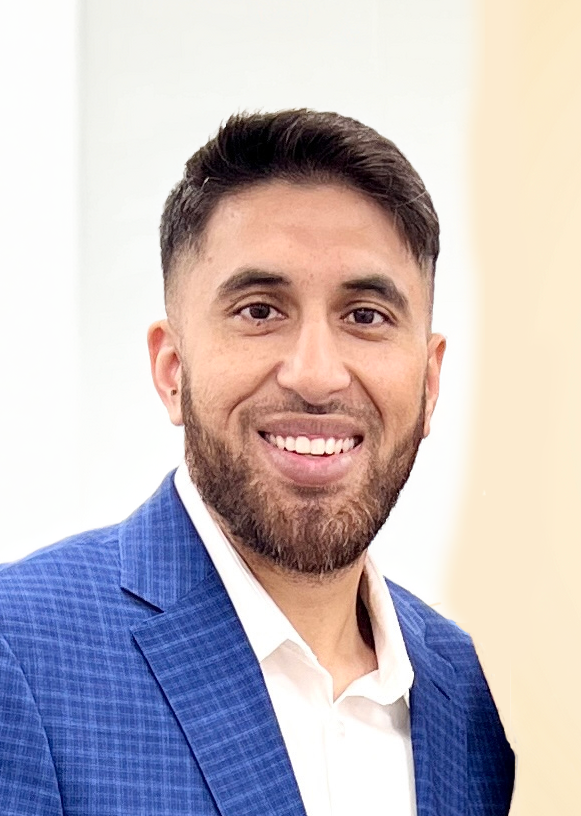
Shahid Sheikh is a values-driven executive and entrepreneur who has built a remarkable portfolio of successful ventures across Northwest Arkansas. A practicing Muslim American and the son of an immigrant, he embodies the American dream, having created hundreds of local jobs while maintaining a profound commitment to community impact.
Following a distinguished 17-year corporate career with Walmart and Sam's Club, Shahid transitioned to entrepreneurship in 2017. Through hard work and divine blessing, he has demonstrated exceptional skill in scaling diverse businesses, growing his portfolio to exceed $30 million in value across childcare, commercial real estate, hospitality, and land development.
Shahid's deepest impact resonates through his work in childcare, where he has served thousands of families for nearly a decade. His leadership reflects an unwavering commitment to both the families he serves and the teams he leads. This dedication was powerfully demonstrated during the COVID-19 pandemic when he maintained full employment for all teachers before federal assistance became available. He takes particular pride in his record of internal development, having promoted 100% of his center directors from within the organization.
Beyond his business achievements, Shahid serves as President of the Bentonville Islamic Center, where he facilitates interfaith dialogues and oversees food pantry initiatives supporting low-income families. He is currently leading a significant development project for a new masjid and community center in Benton County, further expanding his commitment to community building.
His leadership philosophy centers on creating opportunities for others while championing diversity, transparency, and organizational excellence. As a devoted husband, father of four, son, and brother, Shahid remains grounded in his faith and family while continuing to build a lasting legacy of prosperity and opportunity throughout Northwest Arkansas, guided by his faith in God Almighty.
episode references.
- Bentonville Islamic Center: https://bic-ar.org/
- Muslims for Community (M4C) Food Pantry: https://m4c.bic-ar.org/
- NWA Food Bank: https://nwafoodbank.org/
- District 3 Podcast — Interview with Shahid Sheikh (KUAF): https://www.kuaf.com/show/ozarks-at-large/2024-04-12/district-3-explores-local-muslim-community
episode outline.
- Episode preview — ummah: "Who is my neighbor? Everyone." (00:00)
- Episode intro — Monica Kumar frames part two (01:54)
- Mike's reflection — the double standard, the deeply unjust critique (03:43)
- "We are not victims" — 1,400 years of resilience (04:24)
- What Islam actually teaches versus media propaganda (05:30)
- Islamic economics: riba, interest-free lending, human dignity over profit (07:00)
- The car wash deal — a Muslim and a Baptist discover shared scripture (10:05)
- Faith-based success — from laid off to a $30 million portfolio (14:00)
- Reexamining economic systems — power, labor, and the conflation of capitalism with Christianity (18:07)
- The elderly couple story — Fox News, Iran, and the cost of distraction (20:04)
- Systems of power — Musk, Bezos, and the 2.5% wealth tax (24:00)
- Monica — "It's not the people, it's the power and the politics and the profit" (30:11)
- Miss Jean — a Christian neighbor who changed a Muslim child's life (30:32)
- The concept of ummah — "Who is my neighbor? Everyone." (34:15)
- M4C food pantry — "We welcome all humans. We do not ask questions." (35:29)
- Fears — will NWA profit from diversity without investing in it? (37:49)
- Wholeness — compassion and mercy, the opening words of every chapter of the Quran (39:51)
- Monica's closing — "I have felt God in the room through this conversation" (41:35)
- Shahid's closing — "Peace and blessings be upon you" (42:24)
- Episode outro — religious liberty, the double standard, and what Shahid illuminated (43:49)
episode transcript, part 2.
episode preview.
[00:00:01] shahid sheikh.: My responsibility to my non-Muslim neighbors in Bentonville is as real and as sacred as my solidarity with my Muslim brothers in Palestine, Cairo, Pakistan, wherever. Islam doesn't ask me to choose and prioritize between people. Like when I say: Who is my neighbor? Who am I in community with? It's everyone. And I've been on the receiving end of some of the most beautiful Christian human beings that have impacted me in-- at a young age that there is no aspect of my life where I don't wanna give back.
As a Muslim in this community, as part of BIC, as part of our mosque, like I want to offer support, and I want to offer help to all non-Muslims and Muslims alike equally, and if not more. Because truly as society, we benefit when we take care of each other, when we see each other all equally in that sense.
episode intro..
[00:01:54] monica kumar.: You're listening to The Underview, an exploration of the shaping of our place. My name is Monica Kumar. This is part two of our conversation with Shahid Sheikh, president of the Bentonville Islamic Center. If you haven't heard part one, I really recommend you go back and start there. This'll be here when you're done.
In part one, Shahid took us through his own journey, and we concluded that at the door of the Bentonville Islamic Center with an open invitation to the community from Shahid. Today, we walk further into the space. Shahid walks us right out to the corridors of power, to profit, to the systems that decide which fears get amplified and which values get ignored in every tradition.
He tells the story of an elderly Jewish couple he loves deeply, and the unexpected outcomes when he gently asks them to look past misleading clickbait headlines. He talks about Zakat, offers a unique perspective on the universal acceptances of traditional lending, about a Muslim community that centers its food pantry every weekend on feeding everyone and anyone in our community who needs a meal and some loving care.
This season has asked again and again what a community organized around its faith looks like in practice, not in theory, not in Sunday language, but in the parking lot, in the food pantry, in our community spaces, in business practices, even in conversations with a neighbor who sees the world differently than maybe we do.
Shahid answers that question about as fully as anyone has this season. He closes with a gift for all of us, a way to think about wholeness and belonging that has left Mike and I in conversation and consideration ever since. This is where I'll invite you in.
Let's get into it
episode interview, part 2 .
[00:03:43] mike rusch.: I come from a Christian faith tradition, As I hear you, maybe take on the critique sometimes or often that comes from our culture about about your faith tradition. It feels so deeply unjust because all of the things that you've mentioned are all critiques of a Christian faith tradition as well. They're not unique to, to one faith tradition, and yet it feels like a deeply unjust double standard that's been applied from a position of power. And and I just, I listen to your words, and I think I'm challenged to not just listen to them, but I'm just deeply challenged to to make them reality in our world today.
[00:04:24] shahid sheikh.: I, I appreciate you sharing that perspective. And I would tell you that, the one thing is that I don't want people to walk away with thinking that, there's a sense of victimhood in this. We are not victims. We will never allow anyone to define us as victims. We are a resilient people. 1,400 years of surviving in every kind of political climate has taught us. Islam has, spread from a cave in Saudi Arabia where the first visit from Angel Gabriel took place. And that connection with God was established. And for 1,400 years in almost every in every nation, in every political environment, in every climate, we've survived. And we didn't just survive. We've thrived. ... I think one of the things that really scares The media and the people, the powers that be of the idea that Islam is, is still the fastest growing faith in the world. And I think some of the studies have, are showing right now that by 2050 it will be the number one religion, and people are reverting to Islam and seeing that.
One thing that, Mike, I try to... I was having this conversation with a fellow businessman, and we were talking about, what scares people about Islam? The violence on the news, the extremism, the men with guns claiming to speak for over a billion people? But that's not Islam. That's propaganda. It's a curated fear designed to sell a narrative. So instead of judging Islam by what the media chooses to propagandize, let's look at what it actually teaches, and you'll find much of it overlaps with values Christianity already holds, like take, take the exploitation of women, the adult industry, the way marketing, sexualizing young girls to sell products. Islam rejects this completely because it holds human dignity as sacred. That's not a foreign idea. It's the same conviction behind Christian teachings in modesty.
Take debt, for example. Islam prohibits, uh, riba, which is interest, because it traps people rather than helping them build wealth. I bought my first home for $200,000 on a standard 30-year mortgage. By the time, um, it was going to be paid off, I, I would have paid over $450,000 for that house. Think about that. Christianity carries the same thread. Scripture warns against profiting off a neighbor's hardship.
Alcohol, drugs tied to the preventable deaths and broken families are forbidden, right? So is unjust killing. Honesty in business, caring for the poor commanded, the same values you'd hear from any pulpit on a Sunday. And let's be honest about why that threatens people. Lending, alcohol, adult entertainment, weaponization, some of the most profitable industries on earth built on harm that Islam explicitly forbids. An industry that profits from debt doesn't want a faith telling a billion people that debt should be interest-free. An industry that profits from addiction doesn't want a faith telling people sobriety is sacred, and an industry that profits from war doesn't want a faith telling the world that unjust killing is forbidden, that peace is commanded, that human life outweighs any weapons contracts.
Look at where the money actually goes. Trillions poured into weapons and wars while healthcare, childcare, and education go underfunded. That's not an accident That's a system that has decided which things are profitable and which things aren't, and it has nothing to do with what actually keeps people alive and thriving. Islam draws a hard line here. It asks what protects human dignity, not what maximizes revenue.
So the next time, a headline is built to scare you, pause and ask yourself, "Is this the faith or is this a profit model defending itself?" Because a lot of what Islam actually teaches, you may already believe, and you may be wishing and desiring for it. But this is the, this is the world that we're in right now. So as a fellow Christian, um, or any believing human being, I would think these principles are all the same and founded in human dignity.
islam and christianity shared values.
[00:09:06] mike rusch. (2): As I listen to you I think this, a key element that you've brought into this conversation that I, maybe I hadn't thought about it in the way that you have described it, is this economic... the these systems of power, right?
And as I listen to you describe the things that would change I don't find that in- inconsistent with Christianity, or at least the Christianity that I know.
Yes. Yeah.
And the way that if it was practiced, in a way that its teachings would ask you to teach it would change. I think if someone sits back and listens to that and finds a problem with that, maybe the question that I'm asking myself is, show me where that would be inconsistent with the Christianity a- as I've learned and I've been taught. And so you've brought into this conversation this i- this economic and the systems of power, and I... maybe it's colonialism, that I would maybe use these terms. Am I thinking about this maybe in the way that you are? Or am... I don't know. Would you steer my thoughts maybe in another direction?
[00:10:05] shahid sheikh.: Yeah. No, No, you... I think you've got it, Mike. I think you have it. So I'm gonna... I'll share a little story with you. I had the opportunity I was looking... I am an investor. I'm an entrepreneur. I'm always looking for expanding my portfolio. And in one particular case there's There was a car wash for sale here in Northwest Arkansas, and I got ahold of the owner, and I spoke with him and I said, "Hey, I'm interested in buying this, but I wanna do an owner finance deal with you. I don't wanna go to the bank and borrow money from the bank on interest. You and I both know that the margins, for example, with this location that you're trying to sell are limited for where it's at. But in order-- But I'm still willing to invest, and I'm still willing to pay you the price that you want, but you've gotta help offset my cost by financing it yourself, so I'm not paying a enormous interest rate. And the way that we would do that is, come to an agreement on you carrying the loan for an X period of time, and then you can charge me a fee for you to own that loan and go through the effort, 'cause there is an effort for you to take payments and deposit. So you can tell me what that fee is, one percent, two percent twenty dollars, thirty dollars, a hundred dollars a month, whatever that is, and I'll happily pay that fee.
But we're not going to have this idea of compounding interest," which compounding interest is haram. Haram is forbidden. It just translates to something that's forbidden by God in our faith. And he paused, and he goes, that... that sounds like..." And he was a Baptist Christian. And he goes, "That sounds like... Yeah, that's in my Bible too." Interest and paying interest and usury, like this is in my Bible. Yeah, you're right. Like I wonder why we don't follow that principle, right? And so he had this aha moment, and so we were like, "Yeah let's come to an agreement." So anyway we structured it. We got this deal done. And in about two years, I was able to pay him back his money and I was able to transact this whole thing without involving the banks and without involving interest. And I was speaking to a- another fellow Muslim of mine and he was saying, "Man, like, like trying to practice our faith in the US, like you just can't avoid interest." I said, "Why can't you avoid interest?" Like why? Like we have to make an effort. Think about it. Think about the economic freedom. Think about the economic power that the everyday American will unlock when they're not enslaved in this system, where maybe Maximizing profit shouldn't be the goal.
Why did we accept at a default that maximizing profit is the thing that we should all go for? Why are we not like, " Here's what I need to be comfortable and to live comfortable, and beyond this, you should be able to live comfortable." So why are we not making these ... and when he said that, like that's in our Bible too, like it resonated with him. And then we went on this whole conversation, and we pulled up the passages, and you're right. And so when I said at the beginning of our conversation that we have more in common than in than not, it's absolutely true. When you look at the principles of how we live and how we transact with each other, Christianity teaches many of the same things that Islam teaches and practices today.
But unfortunately, I think the powers that be, the industries the institutions that have gotten a foothold into our society have made it such that either people remain ignorant to their teachings and their values, or that they don't prioritize them ever. And this is the difference between a Muslim who's practicing submission to the will of Allah. We say no, and we reject the institutions and the power, and we prioritize God. So we say, for example, in the Quran, God says "Leave all worldly profits and come to the masjid and pray." He didn't say leave your job, leave your home. He said leave worldly profit. So everything, you leave it for the sake of God, and you come and pray. And that's a shock to a capitalist society that's hell-bent on maximizing profit at the expense of human beings, and we reject that notion. We want success. We want economic success, and I would tell you as a as a Muslim business owner, I am so blessed, and I thank God. I could never thank him enough for the blessings in my life.
I would say by all accounts I'm a very financially successful individual with the blessings from God. My resume's out there for someone to look at it, but I went from having a corporate job with Walmart for almost 17 years to being laid off to having no savings to having no 401 'cause I cashed it all in. I started a building business, and I trusted God in that and being able to take that business from zero to 13 years later to having a portfolio that's worth well over $30 million. And I attribute to that to say that I didn't accept capitalism and the powers that be at the expense of my faith to accomplish that worldly success. In fact, I leaned in on my faith and my values to go and get that. So success can be attained in both ways. We believe as Muslims that God has already written the provisions for you. When you were in the womb of your mother, your provisions were written, and so it's going to come to you. It's like someone who's hungry and decides, "I'm going to steal a burger, and I'm going to eat it," and he chooses to steal a burger, and he eats it. And then at the same time, the guy n- sitting next to him, someone walks by and gives him a burger, and he eats that burger. And then a third person sitting next to them says, "Hey, let me wash your, wash the windshield on your car for five bucks, so I can go buy a burger." All three of them ate. All three of them had the provision from God. Which one did you choose to exercise to get that?
And for Muslims, We absolutely feel we belong in America. We are Americans here, but we're Muslims first, and w- we wanna submit to the will of God 'cause God has told us how we should live our life. And as we try to live according to God, we find success in the worldly. Many people think, like, you know, if you look at the studies right now, In neighborhoods where Muslims families move into, crime drops, level of education increases, income level increases. The average Muslim family in Northwest Arkansas today in our community is earning a high to mid middle class income exceeding six figures. They own their own home. Their kids are going to college. They're not taking, they're not collecting resources from the government and asking for help. So there is some correlation between our faith and the success that we're seeing when we're living by that faith. I hope I hope that kinda helps connect the dot, Mike. I don't know if I diverged from your original question.
[00:18:07] mike rusch.: No I'm just, I'm deeply thankful because I think, the question of ... and I come f- I- obviously I want to be aware of my own social position as I say this, but we come from this idea of these stories and mythologies of what it means to b- be American how this country was be- begun. And all that carries with that, and I think sometimes we have ... That's why these conversations are so important, because it allows us to step back and reexamine these components of our own faith of what do we believe and why do we believe it, and how does that become real in the world today?
And I think it reveals in many times our own ability sometimes to be able to see those things clearly, if I were to speak for myself. And so I think that's why these conversations are so important that we do have much to learn from each other, and I hear people talk about maybe there are problems with these economic systems, but what do we r- re- you know, what do we replace them with?
And and so power historically has been used to divide people for economic reasons and for labor, and that and maybe there is a reason why there is a stereotyping and a typecasting, and that I listen to you and I'm like, "We why are we not working together to understand and to learn and to be faithful to the things that we believe and to practice those in the world?" And that, gosh, to listen to you talk that you can work with maybe a a person from a Baptist tradition to reform and to think differently about economic systems, gosh, I think these are the lessons and the things that you're right, I think they do become threatened. You know, Power does become threatened by those elements. And at the same time to hear you speak of them, I'm like, gosh, there really is some beauty and some hope- and stepping back and having these conversations. So anyway I would ramble on, but I'm just deeply grateful for your willingness to share that story, these stories, and to remind us all that it's through sitting down and having these conversations that that I would like to think that good change comes to this world.
And so-
elderly couple story.
[00:20:04] shahid sheikh.: Yeah I, so I, I'll share one more story with you. Please. I have I, I have a elderly couple that moved in into one of my p- my rental homes. And last year and they stayed with me for a year. Beautiful couple. Th- they lived a very successful life strong in their Christian faith. They-- We had a beautiful relationship. I visited with them. We spent... Every time I went over, I felt like I was at my grandma's home, and we would talk. And they would ask questions about what's happening on the world stage and this. And after a year their health started getting affected, and so they were like, "Hey, I don't think we can live on our own. I think we're going to move to a community." So I felt, I worked with them, and w- they we helped them transition, and we worked together in the, in, in that period. And once they got, once they moved to a retirement community, I visited with them. And this was, I think, less than two months ago, and this was my first visit over there.
And in our conversation, they brought up the fact that the whole topic of Iran had hit the news and that. And and the wife, oh, my God, I love her. She's such an amazing human being. And she was like, the Iranians are-- their leaders are just really awful, and they're doing bad things," and this, and, "America's gotta do this, and President Trump is doing that." And so anyway she shared some things, common talking points on what we would hear on Fox News, for example. And I realized that she was a MAGA supporter and voter, and I'd spent a year engaging in dialogue, and I loved her. She was such a kind human being, and her husband. They are amazing human beings, right? And but that was the political view and that they held. And so when I started talking and I was like, " If you don't mind, can I have, like, five to ten minutes to kinda help dissect maybe the context behind some of these talking points for no other reason than just to help give you some more data to process?"
Think about the way that we demonize these nations and these leaders across the world. If you go back in history, not too much, less than eighty years in most cases, if you look in those countries, they didn't have chaos. They didn't have all of this mess that existed. It-- Most of this chaos and mess started when we started interfering in their political environment, in their political systems because we needed the resources that they wanted.
And so majority of the, majority of the chaos that's being sowed came out of human greed. It came out of a need to take resources and to take capital and by any means. Divide and conquer. The British did this for hundreds of years as... and to, to-- And I know most folks who follow President Trump, for example will take offense to this.
But for the better part of America, like, we've done this. We've exploited societies and nations for our own benefit and right wrong or indifference, and that has consequences, and then those consequences create an impact. And so our own policies are the reason that we have this chaos in the world. And they've, they have you convinced that you need to have a boogeyman to blame and to focus on. And I purposely am telling this story in this way because in that same conversation before we got here, she had shared with me that the cost of living is going up They can't afford insurance, right? Their savings that they had for retirement are depleting faster, and they're truly worried about it. A doctor visit, a procedure she was worried about was going to possibly cost them a year's worth of their savings, things of this nature, right? And then I realized, and as I was talking to her, I said, for someone who's facing such economic hardship in, at this point in your life," for example, I didn't quite say it this way, but in my mind I thought like, "Why are you focused on Iran? Why are you focused on things outside of this country and these things that affect the multi-billionaire?" I mean, Elon Musk just broke the news about being the first trillionaire, supposedly. And, and if you look at his wealth, it was built on handouts from taxpayers. Majority of everything that he built, taxpayers funded it.
If anything, the taxpayers have a right to every penny that he has amassed the fortune. Government contracts were handed out to him from the beginning, and he was subsidized in every business venture that he had. So today, he wants to stand at the top and say, "I'm a self-made capitalist trillionaire. Look at my success. Everybody should be like me." Like, come on, dude. You, like, you took advantage of this system and taxpayer dollars, and you took every handout. But yet when we want to help a single mom and a single dad pay for childcare, that's an issue. When we want to provide lower cost food for elderly couple that are retiring, that's an issue. When we wanna provide insurance so that a family of three doesn't go bankrupt with one ER visit, well, that's an issue. But you taking billions in subsidized loans from taxpayers was never an issue? Come on. What kind of society are we living in? And so I feel like, and in this particular example, what I walked away with was amazing, beautiful human beings, strong in faith, but unfortunately, the institutional powers have them focused on the wrong thing, and they have them distracted because when they're distracted on that, they can't question my cost of living. Why can't my kids afford higher education? Why can't I afford to own a home? Why can't I pay for my grocery bills? Why can't I have a nice new, car for my family? ' cause they're taking that wealth. But that's ... Islam challenges that. My faith challenges absolute greed. The 2.5% wealth tax, I mean, when Bezos and Musk and all these guys say, "Oh, we're being taxed, and these taxes that we're paying," like you're not taxed on the stocks you own or on the mansions that you own or on the wealth that you have.
You're being taxed on the profit that you generate and you have so many loopholes that more often than not you zero all of that out, so your contribution to society really is not there at all. But Islam comes in and says, "Hey, 2.5% of your entire wealth," so somebody who has $100 billion in Islam would be required to pay 2.5% of that wealth. A, someone who has $100 billion, after they give 2.5% of their wealth away in a year, well, guess what they still are? A billionaire. And over the course of that year, they're going to earn so much more, and then the next year comes in and Islam says, "Hey, 2.5% of your wealth you need to give to others." Like, so what Islam's teaching and what God has ordained for us in the Quran and in the practice is not unreasonable. It is actually a small amount of contribution, but it, the greed that, that has a hold in our capitalist society of the powers that be in the institutions, it won't let them. We want to make sure, like institutionally, this system is rigged so no one can ever get their head above water. It feels that way, and Islam challenges that
[00:28:34] mike rusch.: I, you're gonna get me in trouble, aren't you?
[00:28:36] shahid sheikh.: I don't know if I was supposed to talk about economics
[00:28:39] mike rusch.: and politics in the best of ways. No, I mean, like- Yes ... I mean,
[00:28:42] monica kumar.: No, I mean that connection to, between, and it's not faith, it's re- it's a false sharing of faith but it is not faith. But that connection of that and power and e- economic interest is so entwined, and we have been bamboozled to believe that is about God, and it is not about God. Yeah. It is about money and power
[00:29:03] mike rusch.: you're challenging the very framework, I think, that Monica and I are trying to, like, operate in and which makes me se- stand back and say, "Well, then we've got the wrong framework," right? Yeah. Like, maybe it's a sys- And so I'm gonna have to- Maybe
[00:29:13] monica kumar.: it's a system of power we need to
[00:29:15] mike rusch.: face.
Well, it is. It is a system of power, right? I think your comments reveal in its rawest form that even these conversations we're having operate within that system- Yeah ... of power, right? Yeah. And so- Yeah ... I think that's the challenge is that we've so... Like, over time too, like, we've so conflated these ideas of what it means to be an American and what it means to be a capitalist and what it means to be a person of faith, i.e. A dominant faith tradition of Christianity, right? We've so brought these things together that it becomes it becomes very hard to, to... And dare you pull them apart, right? And examine them for what that looks like. And so I think these are the... This is the chall- this is why these conversations are so important and why it matters so much to listen listen to you talk about how does this faith work itself out in the world?
And I think the clarity you bring is undeniable. And so- ... i'm thankful for that clarity in so many ways. Monica, I don't know how we're gonna frame all that
[00:30:11] monica kumar.: But I do- Yeah. Yeah, I think that- ... that you're repositioning the lens from maybe it's not the people, and maybe it's the power and the politics and the profit.
[00:30:23] mike rusch.: Yeah.
[00:30:23] shahid sheikh.: Yeah.
[00:30:23] monica kumar.: It's not a person practicing their faith or not a person in the mosque. So if I- Maybe there's something else here. Yeah. But the lens is being placed here for a reason.
[00:30:32] shahid sheikh.: Yeah. And if I may add, like, in my own background, so I grew up in the early part of my life and the first almost 20 years of my life were spent in Dalton, Georgia. That's in the Bible Belt. I went to a high school where I was one of three Muslims in a, in a class that was majority Christian, and I had an amazing experience. In that school, there were incidents that I wish had not taken place. But majority of my experience growing up in Dalton was beautiful.
I had a neighbor. We had a neighbor, Miss Jean. I- wherever she is now, I pray that God gives her health, happiness, joy, the best of what this world has to offer, and I pray that that she be guided on the path of Islam and she gets the best of the hereafter. We moved here. I didn't-- I was not fluent in English. I was still learning English. My mother was not fluent in English. She was learning English. My father was working two jobs, overnight included. And I was struggling in school. And Miss Jean was a retired teacher, and she, in just talking and engaging with her, my siblings and I, she would tell us, "Hey, when you get home from school, come over to my house."
She would make us-- she would bake us cookies, and She would have milk, and she would sit down with us, and she would help us with our homework. And she would teach us, like, here's how you do math. Here's, sentence structures and that. And Miss Jean was a Christian woman- ... who truly, I believe, lived the Christian faith in how she supported my family and in my childhood in that environment.
I had a store manager at Walmart who hired me. His name is Stacy. I'll put him on the spot. Very strong faith Christian faith. Typical papa bear personality, protects all those under him. Was a role model for me, taught me what it meant to be a business person, a business leader. Absolutely amazing human being, right? And so my life, even growing up, even though today at I think... what am I? Am I 40? 41. At 41 today I think back, and, like, some of the most influential and impactful individuals in my childhood were non-Muslims Think about that. And so these are Americans, and I felt like, like these individuals, which is why I have hope.
When I reflect, I feel like I have hope because America is more than one political party. America is more than what the talking heads on, on, on the news media are saying. Everyday Americans, I genuinely believe and my faith teaches me, are good, honest, hardworking people who want to do right by each other, and I trust that, and I believe in that.
I would say I'm such an optimist because of my experiences that I would say that 99.9% of the people in this nation truly want the right thing for themselves and for others. In Islam, one of the concepts that we have is, And I think I-- you had it in yours. I think it's a good time for me to maybe interject, but the the concept of Ummah, the global Muslim community, it crosses every boundary.
The Prophet, peace be upon him, Muhammad Sallallahu Alaihi Wasallam said that he was asked, "Who is my neighbor?" And the scholars tell us that the answer that he gave was, "Everyone in my vicinity is my neighbor, Muslim or not." My responsibility to my non-Muslim neighbors in Bentonville is as real and as sacred as my solidarity with my Muslim brothers in Palestine, Cairo, Pakistan, wherever. Islam doesn't ask me to choose and prioritize between people. Like when I say: Who is my neighbor? Who am I in community with? It's everyone. And I've been on the receiving end of some of the most beautiful Christian human beings that have impacted me in-- at a young age that there is no aspect of my life where I don't wanna give back.
As a Muslim in this community, as part of BIC, as part of our mosque, like I want to offer support, and I want to offer help to all non-Muslims and Muslims alike equally, and if not more. Because truly as society, we benefit when we take care of each other, when we see each other all equally in that sense.
mercy for the community program.
[00:35:29] shahid sheikh.: You know, One thing I do wanna m- I want to recognize and I wanna take a moment to recognize our Muslim community members, especially our youth and that are engaged in our M4C program. And so the it's Mercy for the Community is what that stands for, and essentially it's a food pantry that we operate here in Bentonville. And we work with the Northwest Arkansas Food Bank, and we have done it for years now. And it's one of the most meaningful ways for us to be able to, give back to the community. I- it's open to everyone in the community. We don't ask any questions. We have a lot of engineers and and IT people in the Muslim community in Northwest Arkansas, and some of them got together and created a store on Facebook that people can go to and link with, and they can directly place orders of what they need, of canned foods and of grocery items and even protein, so chicken and things of that nature. And and they place orders and our youth especially, they come in on the weekend, and they fill those orders, and we'll box them up. And basically, on Saturday, people can just drive through our parking lot and pick up the food and take at no cost. We ask no questions. It's open to all. That is that is an example of we welcome all humans, Muslims and non-Muslims alike. It's open to everyone. For us, that is a zakat, that is a sadaqah. It's mandated that we give to the poor and that we take care of those that are that, that are i- in a difficult time in their life. We don't ask questions. There's no discussions of theology. There's no gatekeepers to God in Islam. There's nothing. It's hunger, and it's real, and Northwest Arkansas is impacted by it, and we wanna do our part to help contribute and support and uplift the community. So I don't think I, I talked about that, but I do wanna give that out to your listeners that is a program that we are proud to drive and we invite people to come.
And there's no requirement of you gotta come and attend a khutbah or you gotta come to the masjid or that. There's nothing. Just go on, you place your order. Even if you don't know and you don't place an order, it's okay. Just show up, and we'll make you a box on the spot, and we'll get you taken care of.
fears.
[00:37:49] monica kumar.: Shahid, thank you so much.
And, I'd love to close with a couple of questions that we ask everyone that gives us the pleasure and the privilege of their voices. And the first question is what are your fears for our community? And then the qu- second question would be what does wholeness mean to you from your faith perspective, or however you choose to answer it
[00:38:10] shahid sheikh.: Yeah, I, i, I think I hinted on a little bit of this earlier. My, my fear is not for the Muslim community specifically. We're resilient. A- as I mentioned earlier, we've survived for 1,400 years in different political climates and different situations, and and that m- my fear is for the overall Northwest Arkansas, and will Northwest Arkansas become a place that that profits from diversity without investing in it? Acceptance. Or will it become a place that genuinely lives the vision of its own rhetoric inclusive, connected whole?
There's a lot of things being pushed at a national level that are, permeating the smaller communities, and I worry that Northwest Arkansas... I hope, and I'm going to do my best to make sure that we maintain our sense of community in Northwest Arkansas, that we don't allow for this this this rhetoric to come in and divide us. We want to be united with all of our brothers and sisters in humanity, the Christians, the Jews, the folks who don't believe in God, the folks who believe in multiple gods, the folks w- whatever, whoever it is, we want to make Northwest Arkansas remain united and a safe place for all of us to thrive. Surviving is, like, a basic thing. We're- we gotta move beyond that. We need it to thrive. We don't need to survive.
wholeness.
[00:39:51] monica kumar.: What does wholeness mean to you from your faith perspective or just personally?
[00:39:56] shahid sheikh.: So the Quran opens with the phrase . In the name of God, the most compassionate, the most merciful. Every chapter begins this way. And the structure of the entire revelation through the Quran is held in those names of God, which is compassion and mercy.
Wholeness for me is a community organized around those two attributes of compassion and mercy. Not perfection, but intention, right? A community that's always trying to be more compassionate, more merciful than it was the day before. That's the Northwest Arkansas I want to build. That's the Islam I try to live. And, when we talked earlier about the different aspects of what it means to be a Muslim, and when I hear you ask me about the wholeness in, for me in this area, that... compassion and mercy is what it comes down to. Any society without compassion and mercy, I don't wanna be a part of. I don't. It's painful. We've seen, history has, history's filled with chapters and, of what happens when compassion and mercy disappears, and I don't want that. I want that to be out in front.
If I could somehow change the tagline, it would be Northwest Arkansas, home of compassion and mercy. That's what it means to me.
[00:41:35] monica kumar.: Well, Shahid, I mean, I know, we have spent some time together, and so I had a sense of you and, your spirit, and but I just... A- and I had such hopes for our conversation and I c- a- and I am just so overwhelmingly, like, you have exceeded m- like, everything that I hoped for. This has just been such an honor and a... it has felt like a, it has felt like a calling and a timely and purposeful and intentional conversation. I have felt God in the room through this conversation very deeply. That's how, that's obviously a very personal sharing from me about my faith. And I'm just so feel so honored and privileged to have sat with you during this time, and I feel changed from it, and I will not stop thinking about it. Thank you so very much.
[00:42:24] shahid sheikh.: My gosh. Your words mean the world to me, and I I we always end, e- end our interactions from a, from an Islamic perspective of saying peace and blessings be upon you, and I seek forgiveness if I said something that, unintentionally hurt anyone of your listeners or viewers in any aspect. I'm human. Please have mercy in, in, in how you hear me and my words, and if there was something that I said that came out the wrong way, it was unintentional, and so I seek forgiveness for that.
And at the same time, I'm humbled by this platform and by the time that Monica and Mike, both of you have given me and the opportunity to share. And I welcome anyone to reach out and connect with us at the Bentonville Islamic Center to ask questions, to build community with us. I welcome it and I truly mean that. So if you if you just look up Bentonville Islamic Center on Google, our phone number our WhatsApp our email, everything is there, and you can just reach out, and we would love to hear from you because we're better when we're together and we're united.
So thank you, Monica.
[00:43:42] monica kumar.: Thank you.
[00:43:43] mike rusch.: Shahid, thank you so much. What a privilege and an honor to be able to hear your voice, so thank you so much.
episode outro.
[00:43:49] mike rusch.: Well, I think I needed this conversation. I came into this interview knowing very little about Islam, and I'll be honest about that. Most of what I thought I knew came from headlines from a distance, from a culture that has spent twenty-five years telling me to be afraid of something that I'd actually never sat with. And then after Monica and I had the privilege of being able to spend an hour and a half with Shahid, It reaffirmed what I believe, that everything that I heard, it wasn't foreign. It was familiar, incredibly familiar.
Shahid described a faith that forbids charging interest on a loan. That's in my Bible. He described a faith that commands caring for the poor, not as an option, not as a nice idea, but as an obligation. It's in my Bible, too. He described a faith that holds human dignity as sacred, that rejects the exploitation of people for profit, That's in my Bible, too. It's also a faith that asks its followers to stop five times a day and remember that they belong to God before they belong to any system or any market. And I listened to that, and I thought, "How much of what I've been told about this faith was designed to keep me from hearing exactly this?"
And here's what I'm asking myself, and maybe what I'll ask everyone, not as a host, but as a neighbor. Have we had a chance to know our Muslim neighbors? Someone whose name you know, whose kids go to school with your kids, who lives on your street or works in your office.
Have you ever sat across the table from them and asked them what they believe and what they value? This is the work of this season, and for me, what I heard sounded a whole lot like the faith that I was raised in. I'm not saying they're the same. They're not. Shahid was clear about that, and he was generous in naming the difference. But the overlap, the shared prophets, the shared scriptures, the shared conviction that human beings belong to each other, it's not a talking point. That's the theological bedrock.
And if, like me, you may not have known all of that, I'd ask us to all sit with why not? Who benefits from you not knowing? Shahid told us that belonging is not something you find, it's something that you build, and he and twelve hundred Muslim neighbors here in Northwest Arkansas have chosen to build it here. They've pooled their money and bought a building and turned it into a house of worship. They run a food pantry that feeds anyone who shows up. No questions, no theology, no gatekeepers. They have been, and they are, and they will be putting down roots.
Something interesting happened this past week. Arkansas was named the number one state in the country for religious liberty. Number one. And I want to ask, who is that for? I know it's for those practicing Christianity here, But is it also for the 1,200 Muslim neighbors who live here in our community? Is that for the families at Bentonville Islamic Center who drive across town five times a day to pray? Is it for the man who just sat in front of me and told me that compassion and mercy are the foundation of everything that he believes?
Because if religious liberty doesn't include them, if it doesn't protect the faith of the people serving their neighbors out of a parking lot on Saturdays, then it isn't liberty, it's preference, and we should call it what it is.
And so we'll end here for this week. Talking to Shahid was an incredibly refreshing conversation, Not because he told me what I wanted to hear, but because he reminded me of something that I already believe. His story, his father's sacrifice, his own journey through doubt and study and return, His refusal to participate in systems that exploit people, even when those systems are the only ones that may be offered. His story reminded me of something beautiful within my own faith, something I don't always live up to, something I don't always see clearly. And his conviction, the clarity, the directness, and the gentleness of it, it invites me to come closer to my own faith, my own soul, and my own neighbor. Maybe he's asking all of us to look more carefully at the places where our culture has taken the lead and where our faith has quietly followed.
To ask whether the things we've accepted as normal are the things that our own traditions actually ask of us. Shahid's words weren't a challenge to my faith. He didn't challenge me in my own beliefs. He actually helped me see them more clearly. And I think if you listen to this conversation with an open heart, my hope would be that it would be the same for you.
Shahid, thank you for your generosity, for your honesty, for your love of this place and its people. It's an honor to share this table with you, and I'm deeply thankful to live in this place together as neighbors and now as friends. Our community is better because you and this Muslim community are a part of it.
For everybody that's followed along, I wanna say thank you for listening, and thank you for being the most important part of what our community is becoming.
This is The Underview, an exploration in the shaping of our place and our faith.