
the permission with Darrel Harvey.
Retired pastor Darrel Harvey on forty years in ministry, a life that fell apart, and the permission to doubt. A Northwest Arkansas conversation about faith, belonging, certainty, and wholeness, and why it's hard to follow Jesus inside a superpower's civic religion.


episode notes.
Darrel Harvey is the Chief Formation Officer at Workmatters. Darrel spent more than forty years in ministry, raised in a small Holiness church an hour north of Detroit, ordained young, a planter of churches, a pastor of congregations. When his life changed. What he found on the other side wasn't certainty. It was permission. Permission to doubt, to ask, to loosen his grip and lean into the mystery of a faith he no longer needed to defend. In this conversation, recorded around a single table, he takes us back further than expected, before the New Testament, to a mixed multitude walking out of Egypt, to argue that if we start the story in the wrong place, we end up drawing lines around who belongs and who doesn't.
This is a conversation about wholeness and reckoning. Harvey names the hard things plainly: that doubt is not the absence of faith, certainty is; that an obsession with being right keeps us anxious, grasping, and forever sorting people into who's in and who's out; that it is difficult to follow Jesus in a superpower whose civic religion has its own sacred sites, its own hymns, its own devotion. Alongside co-hosts who push and wonder with him, he opens the door to a different posture, hospitality without an agenda, freedom extended to the neighbor, the image of God stamped on every person. The result is less a set of answers than an invitation: to let the frame crack, to admit it failed us, and to begin again.
about our guest.
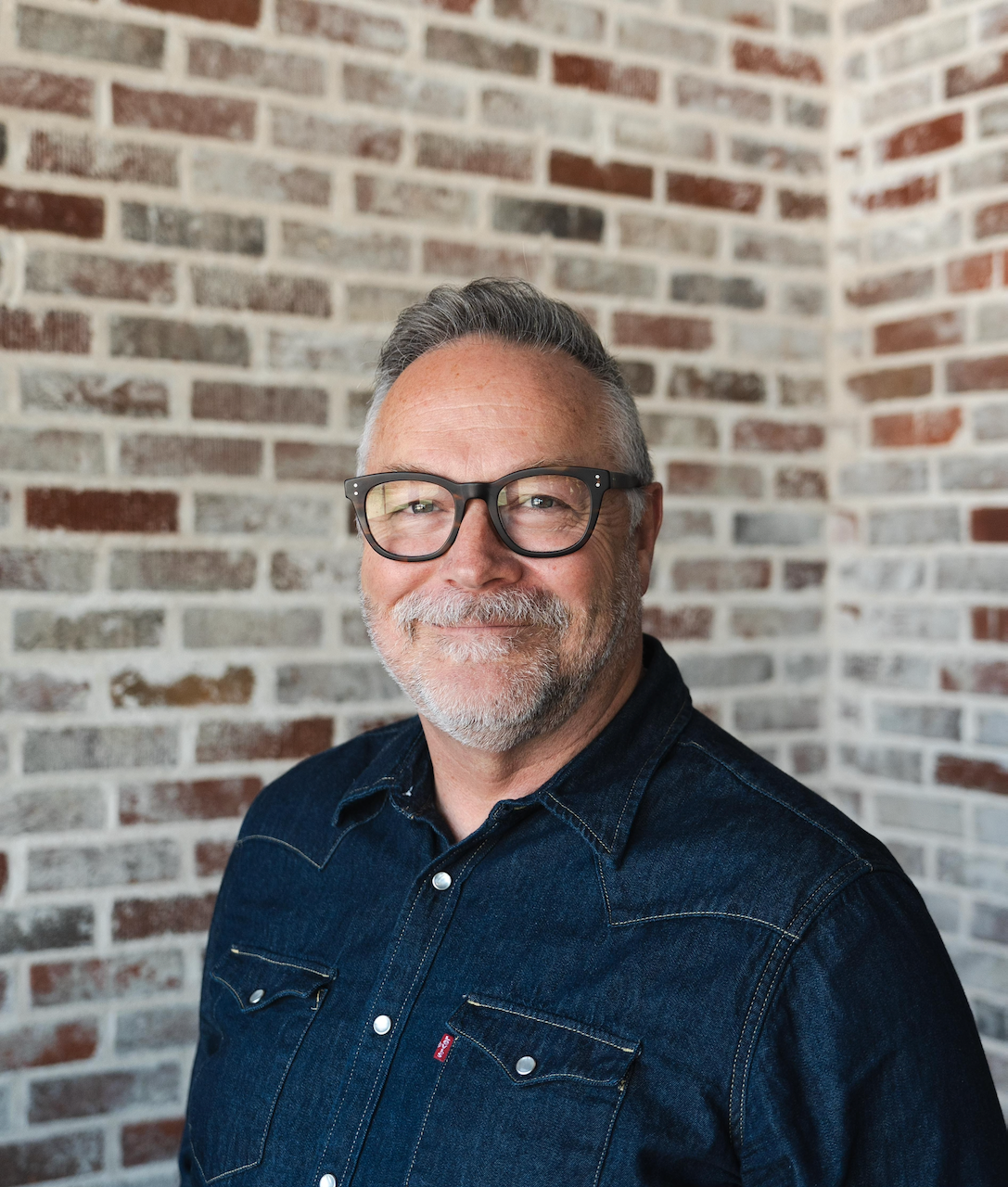
Darrel Harvey served in pastoral ministry for forty years before retiring in 2024. Beginning his career as an associate pastor, he became a church planter and lead pastor in 1997. He helped plant three churches. For over a decade, he also served bivocationally — years he considers among the greatest gifts of his ministry journey.
His work has been marked by a deep love for people, the local church, and the integration of faith into everyday life and work.
Darrel is the grateful husband to Krista Harvey, father to five grown children, and grandpa of four. You will most likely find Darrel and Krista biking or hiking on our awesome trail system or listening to live music on one of the wonderful patios around NWA.
episode references
- The Message (Eugene Peterson), Matthew 11 — "unforced rhythms of grace": https://www.biblegateway.com/passage/?search=Matthew+11%3A28-30&version=MSG
- Scott Erickson, artist: https://www.scottericksonart.com/
- Genesis 18 (the three visitors at Abraham's table): https://www.biblegateway.com/passage/?search=Genesis+18&version=NIV
- 1 Peter 3:15 ("give an answer for the hope that is in you"): https://www.biblegateway.com/passage/?search=1+Peter+3%3A15&version=NIV
episode outline
- Episode preview: reading scripture as citizens of a superpower (00:00)
- Episode intro with co-host Monica Kumar (01:47)
- Meet Darrel Harvey: a friend, a pastor of forty-plus years (03:29)
- Background — a Holiness church in Michigan, God and country, into ministry (03:50)
- How Darrel came to Northwest Arkansas: the falling apart and the rebuilding (06:06)
- "Where do you go to church?" — the orthodoxy question and belonging (06:56)
- Where the story of faith begins — the exodus and the mixed multitude (11:42)
- Unpacking the mixed multitude: gratitude as a welcoming agent (14:34)
- The Pharisees, disgust triggers, and the urge to legislate who's in and out (17:25)
- Guardrails, control, and power — where is the space for God? (20:25)
- Freedom within Christianity: "for people marked by freedom, we are some of the least free" (21:26)
- Freedom to worship — extending faith's freedom to the neighbor (25:02)
- The price of not loving: measuring relationship in material terms (28:56)
- It can't be love without choice — the table, the Trinity, the dance (32:02)
- Evangelism vs. God already finding you (37:16)
- Hospitality in its truest form — the most hospitable person who ever lived (39:47)
- Motivation matters: welcome with an agenda vs. welcome as presence (42:05)
- Imago Dei — the image of God stamped on every person (43:23)
- The missing third space between the sermon and the comedy club (48:29)
- Our obsession with certainty in faith communities (50:33)
- Americanism as a rival religion: sacred sites, hymns, and the National Mall (52:21)
- Fears about having these conversations (58:09)
- Wholeness: refusing to need the other to be wrong so we can be right (01:03:41)
- Thank you and send-off (01:04:53)
episode transcript
episode preview.
[00:00:00] darrel harvey.: The problem is the challenges that are hermeneutic, our way of reading and interpreting scripture is challenging because we are citizens of a superpower.
One of the beautiful things about scripture is it was written by the oppressed and the downtrodden and the defeated and minority, and so for us to read scripture, we have to consciously remind ourselves when we read about the rich man at Lazarus, we're the rich man. What am I doing with the lazarus's that I come across when we read the story of the Good Samaritan? We're the priest in the Levite.
This enemy cultural and religious enemy. He's the hero. And so I think as we tell the story to ourselves and to our children, and to our friends, and remind each other of this faith story, it has to start in the right place. And we have to view that story through the lens of Jesus.
episode intro.
[00:01:47] monica kumar: You're listening to The Underview, an exploration in the shaping of our place. My name is Monica Kumar, and this season, Mike and I are sitting down with faith leaders across Northwest Arkansas, pastors, priests, and teachers from traditions that have shaped this region for generations, to ask the hard questions about faith, belonging, and what it means to build a community together.
Today, Mike and I have the privilege of sitting down with Darrel' Harvey. Darrell grew up in a small church in Michigan and was raised inside that faithful tradition. He pastored for a long time, built churches, planted communities, but then his life fell apart, the kind of falling apart that doesn't leave much standing.
And in the years that followed, he built relationships that cracked something open in him that never closed back up. He'll take you back further than you expect in this conversation, before Jesus, before the New Testament. In this conversation, Darrell opens the door to permission, the permission to hold doubt as something sacred and to sit with possibility.
It's a conversation about wholeness and about reckoning. And as a reminder, we wanna invite you to add your voice to this season. If you go to theunderview.com homepage, we've set up a way for you to record an anonymous voice message to us. Just click the Send a Voice Message button, tell us what you're hearing, what you're carrying, and what you're still wrestling with.
This is not a debate, this is an invitation, and we would be honored to include your voice. We started this season asking what the church was built on and what it's becoming. Darrel Harvey has spent a lifetime inside that question.
We're so glad you're here. Let's get into it.
episode interview.
[00:03:29] mike rusch.: Monica and I have the privilege of sharing a table with Darrel Harvey. Darrel has been a close friend of mine for a very long time. You have come out of a Christian faith perspective as a pastor for over 40 years. You're retired now, and yeah. Darrel, welcome to this conversation. We're really happy to have you here.
[00:03:47] darrel harvey.: Thanks. It's, it really is an honor to be here with both of you.
[00:03:49] mike rusch.: Monica, you ready?
[00:03:51] monica kumar: I'm ready. just feel so honored and grateful that Darrel has agreed so thank you, Darrel.
[00:03:58] darrel harvey.: Thank you.
background.
[00:03:59] mike rusch.: All right, Darryl, let's jump in. You ready? I'm ready. Give us a little understanding of maybe who you are, your background, a little bit of your story. Yeah. Maybe the faith tradition that you come out of. I'll defer to you where you wanna start,
[00:04:08] darrel harvey.: I grew up originally in Michigan, about an hour north of Detroit. My grandparents immigrated to the United States through Port Huron and into Michigan. After World War I my grandpa came to work in the automotive industry after his tour for the Canadian Army in World War I that's where my, my dad and his siblings were born in Michigan, first generation Americans. So I'm not too far removed from being from somewhere else.
My dad was a World War II veteran. I have three siblings. My oldest brother's a Vietnam veteran. So this whole idea of God and country and responsibility was just fused with our Christian faith which started with my grandmother.
We attended a small Holiness church, so that's even different than evangelicals or Catholics or any of the other types of Christianity, but it's even a more narrow slice of maybe even who's in and who's out and how we live it out. But it was the nearest church to my grandparents' farm. There was not a lot of deep reflection that went into which church my grandma would go to, but it was just the nearest one. And of course when she met Jesus there, then my dad did after he got outta the service. And then we were all there. We were all in. And so I grew up in that tradition and I wouldn't be who I am without it, even though I've become very different than, than my roots.
Went into ministry right after college. And so somebody in 1984 thought it was a good idea for me to be responsible for a group of people. I'm not sure who they were or what they were thinking, but it turned out okay and pastored for a long time in that tradition, that holiness tradition. And then about 2000 early two thousands started to find my way out of that into a different expression of Christian faith.
[00:05:49] monica kumar: Darrel a I uh, I'm just sitting with. When you shared, that's where she met Jesus. Because I feel like you brought relationship into the room really fast and Mike and I had such a dream of this being all about relationship and people and humanity. So thank you for that. Oh, thanks. And I, yeah, I just, yeah, you just really shifted something in me. I love that. Thank you. Can you share how you ended up here in this region?
movement to NW Arkansas.
[00:06:15] darrel harvey.: It's a long story, but I'll give you the short version.
My life fell apart. It was just a perfect storm of personal, professional, spiritual crisis, and my marriage didn't survive it. And I walked away from pastoral ministry at the time and owned a small business. And in the years that followed. As I rested and went to therapy and healed got reconnected with someone that I'd known years before who had relocated here. And we did one of those long distance relationship things And in May of 13 I moved here and got married not knowing what I was gonna do for a job or anything like that.
So I don't know if it was dumb luck or blind love because my wife doesn't operate without a plan. But that's how I got here. And that's when I met you when we were both working different versions of the city life.
[00:07:02] monica kumar: Yeah. Maybe it was blind love and deep faith
where do you go to Church?
[00:07:05] darrel harvey.: maybe. When I got to Bentonville and was working for Visit Bentonville I would find myself in meetings with people and they would always ask, where are you from? Which wasn't that unusual, the question, and what church do you go to?
And here I was a pastor for a long time. I'm saying, should we be talking about this in a meeting like this? And I and yet I understood that was part of the culture here. That was an okay question. But I also did pick up that wasn't just a get to know you question, that could also be an orthodoxy question. Like, where do you attend church? Gave people an instant idea on where you fell theologically. And so that was a realization that, that kind of came along slowly. I still answered. But there was an awareness there that this was really important and I didn't feel dishonored by it, but I did feel like people wanted to know where to place me in their circle.
[00:07:56] mike rusch.: Yeah, you said an idea of orthodoxy, but I think what I hear, I and I growing up here too, I feel like that was a very normal question, but maybe the intent of, do you belong here? Do you fit, what do you believe? This idea of believing and belonging,
[00:08:11] darrel harvey.: right? Yeah. All that's was wrapped up in the word orthodoxy that I used. Do you believe what we believe or do you believe what they believe? Or do you believe something we're not even sure as Christian. So it is wrapped up in, in belonging and my place here.
[00:08:27] monica kumar: It's so interesting because both of you feel, at least have a sense of comfort with that question. And I, we got that question a lot. I had never heard that question in my life. So when we moved here and we got that question, I was like, gobsmacked, to be quite honest to even. Yeah, I was just straight. It was like, oh, someone asking me like, what planet do you come from? That's how unusual it was to me and unexpected. So I just, I think it's, I think I'm sitting here with this feeling of, oh, but you felt some, at least orientation around that question and I found it disorientating.
[00:09:06] mike rusch.: I think within that though, I mean, it reveals something about this place and faith. What does that reveal to you? Because you're talking about like how I feel and what it, what, when someone asks that question, but what does that reveal about the person asking it?
[00:09:20] darrel harvey.: I guess the upside would be that they seem very comfortable with their spiritual location. But then it also has, it brings with it the assumptions They also bring that we must certainly go somewhere. I think that's revealed in that question too. And thinking back to the people who asked me that I don't sense any malicious intent. And maybe it was just a, and an assumed posture that they could take on because probably because I looked like them and I was a white man and I moved in from out of town. So I, I can see how disorienting a question that would be for people other than people like me.
[00:10:00] monica kumar: Yeah. And I think now that I think back on it, and I'm really trying to like, like I'm really trying to remember the moments and the question, and I think it wasn't even a question about Christianity. I think it was a question about Jesus. To me. Oh, do you believe in Jesus? So maybe even the marker of where the question started for me, as opposed to you or Mike, maybe even that marker is different from the get go, just based on how we look, maybe. Yeah.
[00:10:27] darrel harvey.: Yeah. That makes sense. I would
[00:10:28] monica kumar: Or how we present.
[00:10:30] mike rusch.: There's a whole lot what the two of you just said real quick. Yeah. Of maybe assumption of origin of where you're from, judgments based on maybe what we look like trying to understand your belief systems all about how that informs Yeah. Your ability or your sense of belonging in this place. And so I think, this conversation as we get into it, is this idea that, hey, faith does inform our belonging. Faith informs how others view us as if we belong or not. And I think this is the heart of the, maybe where we're starting this conversation is to try to start to get our head around what does it look like?
And we're talking from a dominant Christian perspective. That's why we're starting here. That's not the only faith tradition here in northwest Arkansas. But when we start from that perspective, I think this idea around living alongside people who really may believe very differently from me, even within the Christian faith tradition.
Like where do we start? I'm curious, Darryl, you kind of encountered that within a quote unquote Christian faith tradition. Monica, you're encountering that from a maybe Christian versus not, if you will. I dunno if that's a fair designation, so how do we start to think about really living alongside people who may think very differently than us?
our beginning point of story of faith.
[00:11:50] darrel harvey.: Yeah. I think the beginning point, like we're storied creatures.
We organize information in story form in a matter of seconds to make sense of the world around us. And so if we start with the wrong story or start the story in the wrong place, or perhaps three chapters into the real story it can take us in a very skewed direction. And so I would even back up from before Jesus.
The major event in the story of God's people was the exodus. And how God freed them. He heard their cries and set them free. But if you get nerdy and look into that story, the word that's used in the people that came out was the word for mixed multitude. That it was a mixed multitude that left Egypt together.
It wasn't like the Hebrews said, wait a minute. This is our God. He answered our prayer. So he is, he's gonna free us. So good luck with the rest of you. So from the very beginning of the story, pre and into the story Jesus would point to in the foundation of his faith, it was this mixed multitude of people that God was willing to walk with and guide through, through history on their journey with him.
So if we don't include that in our beginning point, we're already off in the wrong direction. We already are ready to draw those lines that it's us and not them. And then Jesus continued to un unfold that story in the same way with the stories we've grown up hearing about him. The problem is the challenges that are hermeneutic, our way of reading and interpreting scripture is challenging because we are citizens of a superpower.
One of the beautiful things about scripture is it was written by the oppressed and the downtrodden and the defeated and minority, and so for us to read scripture, we have to consciously remind ourselves when we read about the rich man at Lazarus, we're the rich man. What am I doing with the lazarus's that I come across when we read the story of the Good Samaritan?
We're the priest in the Levite. This enemy cultural and religious enemy. He's the hero. And so I think as we tell the story to ourselves and to our children, and to our friends, and remind each other of this faith story, it has to start in the right place. And we have to view that story through the lens of Jesus.
We look back through Jesus to interpret the confusing stories of the Hebrew scriptures. We don't just add him to another story. He is not, Hebrews says that he is the radiance of God's glory and the exact representation of God's being. So we are to read all these things through who Jesus, he's the clearest picture of who God is in our tradition. And so we have to read those stories through him.
mixed multitude.
[00:14:42] monica kumar: Darrel, that was so interesting that's sitting with me. Can you talk a little bit about that mixed multitude and maybe share a little bit more about that because Yeah that's a hook I wanna understand.
[00:14:52] darrel harvey.: Okay. Yeah, I'll try. I, and again, if we're talking about stories, we think about Charlton Heston leading the people of Israel out of Egypt, and they're all this monolith of people. And that's just not the case. And I don't know how long I'd been in the faith before I had learned that. So I'm not trying to belittle people who that might've been new to because it's so new to so many of us that God's desire was for humanity to walk with him and respond with him.
We're the Hebrews a select group of people? We believe they were they were blessed to be a blessing to the world. They weren't to hoard things up. They were to be a conduit of God's love. And I think when we, we look at these ragtag former slaves whose lives have been measured by what they could produce, and their bosses kept making it harder and harder, who were finally liberated, the gratitude they must have sensed was a welcoming agent to those who weren't quite like them, who joined them in this exodus.
And maybe that's a key for us. Maybe we lose track of the gratitude that would enable us to welcome others into their pursuit of God and who they're understanding him to be.
[00:16:06] monica kumar: It also feels like this is an opportunity for a gift before us, and we can choose to take it or not. And so alongside gratitude, I feel like here's a gift. Do you want to open it and explore it?
[00:16:19] mike rusch.: Okay, so I'm coming from with inside this tradition Darryl? Yeah. So like, I would assume for some you know, the, some, there's some alarm bells that go off there for a moment
Yeah.
Of this idea of maybe exclusivity, of this idea of who is in and who is out. And so I hear this message, this like a mix of this mixed multitude, which I think is, frankly, that's not something you hear about very often. And I think like it's a challenging perspective of this idea of God and what God who he calls, however you want, let, we can go down all these roads. But I think from some of the lights, like I grew up in this tradition saying, but wait a second. Somebody's gotta be in and somebody's gotta be out.
Yeah.
And that feels like that's just baked into maybe, I don't know. I would blame the Southern Bible Belt in some ways, but help me, I don't know.
Yeah. Gimme some wisdom here because I don't want to just stop the conversation and say, yeah, but if we wanna talk about this expansive idea within the Christian faith tradition of inclusivity. Which I think is what you're trying to say.
[00:17:25] darrel harvey.: It is.
inclusivity in Christianity.
[00:17:25] mike rusch.: There's a whole lot of people within the Christian faith tradition who would say inclusivity also includes in a very overt exclusivity at times. And I don't know what to do with that.
[00:17:34] darrel harvey.: Yeah. I would point us back further than the Bible belt. I think the Pharisees were a great example of that. The Pharisees were a group of people who I wanna believes hearts, their hearts were in the right place when they started. That if there were this many commands to be right with God, they added more commands to those commands so they wouldn't get close to the original commands.
Like they, they wanted guardrails and then guardrails inside the guardrails. And so that's, they tried to legislate this relationship that God longed for and. And so what do you do when you're the good ones? Obeying all the rules that you came up with to show how good you were. You start pointing at all the people who don't.
So it, it becomes in and out at that point. I believe that we start to, to evaluate people's standing with God based on laws that we've come up with, that measure morality, orthodoxy,
spiritual devotion, and and the Pharisees had a really hard time with Jesus who blurred those lines all the time. In human development, as humanity develops, we're given basically disgust triggers, things that we smell and see, for our ancestors to not touch that rotting carcass or not eat that, that would poison us.
And as, as we continue to be developed in society, we started placing that, discuss trigger on people groups as if contamination could be transferred by you and I having a meal, because you were definitely out. I just know because I've created this rule and I'm well within the rule, and you're not, so that must mean you're out.
And so the heart of Jesus was to remove those roadblocks. The woman at the well, the, the people that he ate with. The questions that the Pharisees asked his disciples, why does your teacher eat with sinners? And so I think I would point us back that far that this idea that good hearted people still fall into the idea that we can legislate spirituality and morality and evidence for our good behavior in standing with God.
Because it gives us some sense of control. And we've talked about this before, that the world can be a scary place. So how do you mitigate your fear? You grab for more control so that you can tell yourself it's not that scary. And so we see it throughout human history. We see it today.
[00:20:03] mike rusch.: Monica, we're, i'm, I'm watching you respond. I am too, maybe to some of these questions because. I, what I hear from Darrel, I think to me, like I, I've had the opportunity to sit with Darrel for many years, right? Yeah. And so what I hear from Darrel, I'm like, yes, okay. I understand how we're processing through that. I'm curious, what do you hear when that as we talk through this?
guard rails, control, power.
[00:20:25] monica kumar: It's fascinating to hear you share that. And I also, my immediate sort of sense of, and I would say sense of faith and spirit when you talk about guardrails and you talk about control, which could also be synonymous with power.
That feels so ungodly to me. Like that suddenly makes me say, oh, okay, so people are gonna, so that's a people position. It's not expansive and interconnected and of the spiritual. And so even as you're talking, I feel my spirit going one way and then the other when, you know, when you were talking about being open and the multitudes that felt like vast and expansive and in inclusive for want of a better word. And then when you start talking about guardrails within guardrails and power and control, I was just like, where's the space for God there?
[00:21:17] mike rusch.: That's the a hundred dollars question.
[00:21:18] monica kumar: That's what I felt.
[00:21:20] mike rusch.: If y'all could answer that, we could end the season right now. If so, go for it. Darryl what's the answer to that, Darryl,
freedom within Christianity.
[00:21:26] darrel harvey.: For people who are supposed to be marked by freedom, we are some of the least free people I've ever met, and I wish I knew where all of that came from. I don't know why there is so much angst about pleasing God when he already loves us. One of the most profound things that I think I've learned in my relationship with Jesus was when he talks about our father and us as parents. If a child asks for bread, you're not gonna give him a stone.
If you ask for fish, you're not gonna give him a snake. How much more does our God want to give you? Like that is the great. I wouldn't if I'm at least a halfway good dad, and yet I portray things on God that he's not that good. Like I, it's just this twisted reality because I'm afraid I'm not doing enough.
We talk so much about grace, this wonderful free gift. And yet I'm not sure we always believe it. Eugene Peterson translates Matthew 11, just in a very beautiful and poetic way. And he talks about watching him. Jesus says, watch me work with me. Watch how I do it. Learn the unforced rhythms of grace.
And I think that resonates with so many people because we all long for that, that we can set down our striving because we are already loved with guardrails are not, we are period. We are loved. Period. So it is constrictive. It is angsty. It is not the way. And when Jesus made that invitation, I think he was saying, if those are the things you're feeling, you're not doing it right.
There should be this graceful ease in this relationship that is not afraid, that is not grabbing for power that is not. Wring hands, oh, Christians that wr their hands and worry just drive me crazy. And it's not because I just write it off and say God's in control. It's, it is, are we gonna trust in God's goodness or is he a good father or is he not? And again, there's so many stories that Jesus told. The lost son was welcomed home. He did everything wrong, and yet his father welcomed him home, wouldn't even let him apologize, wouldn't even let him make his rehearsed confession. He just went him and embraced him.
And I think why do we not believe that for ourselves as hundreds and thousands and millions of Christians why don't we just, how is that not our guiding narrative?
We talked about this too, Mike. We, in our system there, there's a lot of legal imagery that we use, that we have this savior who stands in our behalf who dies for us. That there is, there are lots of courtroom scenes that we've been played out in our sermons and when you search the pages of scripture, there are only a handful of courtroom scenes that Jesus even alludes to. And yet our major picture is me guilty, condemned, but God does the work where I can be set free. But there are so many more banquet and party scenes in scripture. So many more so many more. And somehow this, and maybe I'm getting back to where the angst and worry and heaviness and constriction comes from.
It is that narrative of the courtroom. Is it, is he really coming through for us? Am I really gonna suffer? Is he really gonna be good on his promise? Is this stuff I believe really true? Versus he's running out inviting everybody to the party? Everybody going to the hills and hedges and invite those who didn't get invited.
I don't know if that fits at all, but that was free.
freedom to worship.
[00:25:02] mike rusch.: I think Darryll, you talk about this idea of. Freedom, which I understand and living in the place that we do we have this idea of freedom of a Christian faith tradition, being able to practice that faith the way that we should be able to practice that.
But I think the balance of that is that freedom also should extend to our neighbor to practice faith the way that they feel called to or from the tradition that they come from. Yet at the same time, there seems to be, I don't know if it's culturally, maybe it is baked within our religious understanding that's in some way not okay or a compromise.
If that happens, it's a compromise to a belief system that I'm trying to uphold and to spread and to practice, and that someone else's practice of faith is probably going to become a barrier in some way for mine.
So I'll just say it out like how do, how from a Christian faith tradition how should we think about that?
[00:26:03] darrel harvey.: I hear your question and relate to your question, and I wrestled with that throughout the years, but I think the premise of the question is based in this false idea that we can control anything else. My neighbor's gonna practice their faith or not practice it based on my approval or not.
So why not be their friend and learn why they're practicing and how, what's your story? How did you grow up? Those are beautiful questions that anybody can ask anyone. Because all, we all believed something, whether we don't believe it anymore or not, or, and we all grew up a certain way. So I think there is this false premise that.
By me taking a stand somehow that's gonna draw someone else to my faith. And you play that out, it, I've heard people wrestle over my nephew's gay and I don't think I can go to the wedding. And that's theirs to decide. But what will that stand do for their relationship? And for some relationships, maybe the young man understands and knows Uncle Joe's not gonna come and he's not gonna change, but I'm gonna let him anyway. But it certainly isn't gonna move him any further toward the God that Uncle Joe claims. But there is a lot of guilt that I think probably in the last. 30, 40 years that, that we have taken on with that question.
What if I endorse, what if I don't hold a hard line? What if, it's all an illusion that we, by doing those things is gonna make any difference Anyway I think I, I grew up in the era of apologetics that you needed to know how to defend your faith.
It's already in the war posture, right? You're gonna defend this that is under attack from somebody. And I know that there are people who, that is their spiritual path, that they enjoy intellectual wrestling and that is the way they engage important things. So I'm not diminishing that at all.
But the assumption that love is not the primary, a apologetic that we work from when we look at Jesus. That's a bad assumption. That a Christian faith disconnected from the life and model of Jesus becomes a very dangerous and damaging thing. And I think when we play out questions like that, with the hard line leaving room for people to discern and know who they're talking about and the parties involved the love of Jesus is the apologetic that we clinging to,
In first Peter, he talks about being ready to give an answer for your hope.
So he puts us in a response position, not an attack position. Think about the phrases we used to use around this topic. We would win souls and defend our faith. They were all very combative. And yet, here's Peter, hundreds of years ago. It's live in such a way that people are gonna be curious about you.
And when I mean they're curious about you, step that through that door and tell 'em why your, who your hope is in, and why you hope.
[00:28:52] mike rusch.: Okay. Whew. It's a lot it to walk through here real quick. It is. How are, where are you at?
model of evaluation.
[00:28:56] monica kumar: No, it's, this is so good.
I just wonder if this what's the model of evaluation for for deciding or thinking to take your example, what is going to be. The what is going to be the win or the prize that you get for not engaging and loving and connecting with your nephew who happens to be gay and is getting married.
And I think there is a question here of what's the price and how are we measuring or evaluating the price of things? And then the other thing that this brings up for me is just, is God supposed to make us just feel anxious and terrible and scared and fearful? Because that just feels so not of God to me and not of love.
You know, I only believe in two emotions. I believe in love and fear. And I think you're either, moving toward love or you're moving away because of fear. And and for me, love is God. And so I just, I wonder at that, if your relationship to God. Is causing anxiety and your allegiance makes you not celebrate the love of your nephew's wedding, regardless of who they're marrying or how they're, you never ask us.
If it was a woman, would you ask yourself, oh, she's a terrible person. I shouldn't go to the wedding. I don't know, I don't know what that evaluation looks like, but it just, I just wonder where the feeling of your relationship with God comes into it. Because my relationship with my, with God feels so good.
[00:30:31] mike rusch.: Yeah.
[00:30:31] monica kumar: Well, I would just, I mean, I, you know, I, I want, I,
I mean, I wonder how you mes like that measurement. Yeah. And then what do you lose? What do you know? I think, we do put, there is a western analysis of relationship here, because for me, and Mike and I talk about this all the time.
What do you lose when you are only in relationship with people who believe in the same things you do and look like you and worship in the same ways? People don't ask that question. The, you analyze it as this makes me feel safe and good, and I know what food to bring to this table and I know what to expect when I walk in there.
I don't have to take my shoes off because you're not entering my house. I don't wash shoes, as you can tell. Like all those questions. But the flip side of that is what do you lose? And for me, I can sincerely say before I moved here, the idea of being in relationship and in love in the broadest sense with people who are Christian and practice Christianity and are conservative would've it wouldn't have been like you.
I wouldn't have been a part of my life story, and now I can't imagine my life without it because I have gained so much from it. And so I do think there's a meter that we use to analyze that is so fundamentally like material and it doesn't feel spiritual. I,
[00:31:51] darrel harvey.: i'm still stuck with the what's the price of not pursuing that relationship with your nephew? The price is this hollow feeling, I did what was right, but I sure am lonely, at least in their mind, which seems like a too high of a price to pay.
[00:32:06] monica kumar: And I also wonder when did God tell you to be an island?
[00:32:10] darrel harvey.: Yeah.
Yeah.
freedom to choose faith.
[00:32:10] mike rusch.: Maybe within this, Daryl, there's a question that I'm thinking about as and maybe this is true of all faiths. I don't know. I can only speak to from what my background is, but it feels like there is this idea of this I, we go back to this idea of freedom and so I think there's this permission in that freedom to, to choose a faith tradition.
I think Why is it important, maybe from a Christian faith tradition, to be able to have that freedom to choose that tradition or to not choose that tradition?
[00:32:40] darrel harvey.: It can't be love without choice.
Now, within Christianity you have Arminianism, which values free will. Calvinism, that is this neat system of God's activity, almost to the point of determinism. So there might be some issues that we get into as far as can you resist grace? And some would say no. But I think we would all agree that we are not the only agent in making that choice.
That we believe that God is stirring and drawing. And we do make that choice. But I think it would be the same that we would say about any of our spouses or even our children to us if we mandate choice. It is not love. And I believe this is a love story. We started talking about the starting point of the story and it is a loving God who in love created others to love.
I have this tattoo on my arm of the father, son, and the spirit sitting at a table together. It's an image drawn from Genesis 18 when these three visitors came to Abraham. And they're very clearly three, and yet he only referred to them in the singular Lord. It is this foreshadowing, this illustration of , of Trinity of three being one, and to imagine that god is forever in the beginning, existed in a loving relationship of Father, son, and spirit and will forever exist in the future, in a loving relationship that he has invited us to that table and into this loving relationship. It is a dance at the words paraparesis. It is many moving as one and that can't happen if it's mandated.
It is. It is a We do come we do say yes. We do opt in, we do accept the invitation. We do pull the seat up to the table, whatever image it is, but. It's not love without choice.
[00:34:29] mike rusch.: Maybe I take that one step farther. Maybe within the Christian faith tradition, do I have an obligation to make sure that freedom is extended to others who may choose or not choose that faith tradition? Like where is that, I don't know, help me process where that balance is between this idea of freedom for self and yet extending that idea of freedom for the other. Without tying a condition to what that freedom will ultimately produce.
You are gonna sound like a universalist, but go ahead.
[00:35:00] darrel harvey.: We should all pray to be universalists. What would I lose out on if I was a universalist? Nothing.
[00:35:06] mike rusch.: You might be out. I don't know if you're gonna be in, but you're definitely out according to some traditions. Right?
[00:35:12] darrel harvey.: So when I look back on my journey of a multitude of yeses and a multitude of missteps those choices to pull the chair back to the table, those choices to get up out of the pigpen and head towards home are some of the most powerful experiences of my life. And so when I think about freedom for others to make why wouldn't I want them to make that choice and have that experience too?
Why wouldn't I want them to have memories like that that when they thought they were at a dead end, they were able to respond to a nudge of God. I feel like I would be robbing people of that. We talked about being asked, what church you go to. And my experience with that, but I also was evangelized on the square one day. Oh. I was having an ice cream cone on the fountain with a friend.
And and of course being around the system a long time, you know what's happening. You know that the engagement question, what's coming about your eternal destiny, now that was a very different experience. I felt. Being led to something that I wasn't asking for, even though I already possessed it.
And so that, that kind of memory just popped into my head when you were asking about the freedom for someone to have a choice in that. And sometimes we assume because of our tradition, because of pressure that was put on us in gen different generations because of the emphasis on conversion, not formation.
We feel like we, we just assume we're the ones to present that. Because if we don't, we're gonna feel guilty.
[00:36:42] monica kumar: I just think it's just a really interesting form of relationship with God if it's. If it's everything to you, which I think is how that would be manifested, that you want to, convert people or bring people to it.
I to, for me, it feels counterintuitive because I feel like if it's wonderful and enclosing and loving, this person will find it.
[00:37:06] darrel harvey.: Yeah.
[00:37:07] monica kumar: Because they can't not
[00:37:08] darrel harvey.: Yeah.
[00:37:09] monica kumar: Because it's so incredible. Yeah. And I can just share my experience of it, and then I just know that they'll find it because it's good.
[00:37:18] darrel harvey.: Yeah. Yeah. Mike's heard more of my Easter messages than he's probably wanted to.
[00:37:23] mike rusch.: Nonsense.
evangelism vs. God finding you.
[00:37:24] darrel harvey.: But that's exactly what happened. You know, when you read the account the first Easter morning, the women go to the tomb. Why? Because they believe Jesus is still there.
And they, and the men come to the tomb because they didn't get it all along. And so their theology was bad. They were all going to the tomb for the wrong reason. And what had happened what happened was the risen Christ found them. It and all their going, and all they're seeking, Jesus found them.
Which in my faith tradition, that is exactly what I was picturing when you were talking about that. That, that, my wife and I have five kids and three in-law kids and three grandkids, and not all of them have, who have not all of them have embraced the faith that I have. But my faith in God's love for them and per pursuing of them is what helps me.
Because we look for God in all sorts of places, and yet ultimately he's the one that finds us. And then we have that choice. Do I wanna acknowledge that? Do I wanna step into that? There seems to be a flow that God has provided. Do I wanna step into that stream and see where it takes me so that, yeah, I, I draw great comfort from what you said and how you said it as a parent.
[00:38:37] mike rusch.: I can sit with anybody and have these questions and these conversations to really try to understand who you are and the perspective that you bring to the table.
I maybe to go back to, you said the, those moments when you were asked what church you go to and where do you all these things that have this, I would say, have this inherent, do you belong? Do you believe what I believe? If you believe what I believe, then you belong in this space. Which to me is seemed a fairly traditional paradigm for most people of faith in many ways of a way of determining who's in and maybe who's out.
Does that faith tradition have a responsibility to extend that idea of welcome and inclusion to help people belong to a place? Yeah.
[00:39:19] darrel harvey.: What I hear you asking about is hospitality in the truest,
[00:39:22] mike rusch.: we can use that term
[00:39:23] darrel harvey.: in the truest form, which in modern Christian culture means. We're gonna go out to lunch after church, or we're gonna have somebody over because we signed up to list on a list to host some people. And again I'm sorry I keep going back to Jesus, but the most hospitable person to ever live was Jesus. And he didn't own a home and really wasn't in a financial position to throw big parties. He just assumed a role in gatherings that were happening. And he would eat with anyone. He ate with Pharisees as much as, as, as well as those who were being excluded and pushed to the margins and who were already on the outs.
So yes we have absolutely have a responsibility to extend welcome and hospitality to the neighbors that God brings to us. It's funny to me that, some Christians can draw such comfort from God moving all these pieces, and yet we look at the people who might have moved next door and somehow that doesn't count as God, God bringing them that we could eat together on the back porch or so.
Yes. And again, it's the humanity that we celebrate. It's this we fished with a young man, Colin, who we spent a whole day in the boat talking about aligning with people on the values they have when their belief system is very different than ours. We all want good for our kids. We all want, good schools and a safe environment. And we all we, why do we get so hung up with the belief system when, what sits beneath those things? We can share there's so much more. Black on the domino than white, and we should be celebrating the black part of the domino that there's so much we have in common. And I don't know how we've excused ourselves from that. And I'm guilty. I'm not having a block party on my cul-de-sac. I'm not good at knowing my neighbors.
Sometimes. I'm guilty. It's not easy. And yet at least I should feel some conviction over that, that is not what God intends. If we are each outposts of this kingdom to come, if we're all little glimmers of the fullness that is coming someday, I, how can I not welcome the people that I come in contact with?
[00:41:37] monica kumar: I think that when you share that, I think that there is a motivation piece that I wonder about. I think when we open our homes or when we talk with our neighbors, I think what are we bringing to that conversation? Or that interaction or that gathering. Are we bringing the conviction that I am going to, I'm going to invite you to this gathering to bring you to God.
Or am I inviting you to, to this gathering to understand how God is in your life. Or what relationship do you have with God? Or, what makes you a person that I can connect to?
[00:42:12] darrel harvey.: Yeah.
[00:42:13] monica kumar: On a deeply human level.
[00:42:14] darrel harvey.: Yeah. What keeps you up at night?
[00:42:16] monica kumar: Yeah. And I think that in, I think historically, like something that triggered for me was just, there's a lot of work done in other countries and a lot of my sort of ancestors have been have been subject to that work that is good work and that the chimes of hospitality and speaks of inclusion and speaks of gathering and welcoming with a motivation to help the person, or not even help the person, make the person come to God. Or make the person see the relationship in a certain way. Or religion in a certain way. And I, so I do think motivation matters.
[00:42:51] darrel harvey.: It does. Totally. And we can, we're good at disguising that.
[00:42:55] monica kumar: Yeah.
[00:42:55] darrel harvey.: And telling ourselves that's not really what we're doing, but we know it is. I think that the thing that I experienced that maybe changed me in that I've planted three different churches, one by accident, but the first one was the first time I'd ever intentionally spent time with people who didn't go to church.
I just because when you grow up in staff ministry and pastoral ministry you get paid to take care of the flock and that's not a bad job. But to spend two years intentionally not going to church, but spending time with people on the ball field or in the community or the gift I think that God gave me was, you're not going anywhere.
Just get to know people, love people. There's no rush. I have no timetable for you to push them somewhere. And I'm not expecting you to push them somewhere. Relax into the privilege of being a neighbor with that first Peter comment in your back pocket of if they ask, just be ready. You don't need to maneuver things.
But you're exactly right that there is. There is a lot of coercion that happens under the guise of hospitality and being nice. And I'm glad you pointed that out 'cause it's definitely true.
[00:44:05] monica kumar: Yeah. For me light is in every light.
[00:44:08] darrel harvey.: Yeah.
[00:44:08] monica kumar: And I don't need to bring anyone to God because God has already, they would not exist.
I don't believe trees would exist. I don't believe plants would exist without God.
[00:44:18] mike rusch.: Yeah.
[00:44:18] monica kumar: Having given life
[00:44:20] mike rusch.: Yeah.
[00:44:20] monica kumar: And love and nurturing.
[00:44:22] mike rusch.: Yeah.
[00:44:22] monica kumar: So I don't need to bring you anywhere. Yeah. Because you are already there. Yeah.
[00:44:25] darrel harvey.: Yeah. And I think also in that church planning experience, it was the first time our lingo would call that the imago day, that the image of God is stamped on every person.
And so when I'm spending two years with people who would not identify themselves as a Christian, and yet seeing their giftedness, their generosity, their kindness. Their love, joy, peace, patience, kindness, goodness, self gentleness and self-control, the fruit. It was a revelation to me that yes, the image of God, we all bear the image of God.
[00:44:56] monica kumar: I wonder what it would look like instead of saying, I'm going to show you God whenever you meet someone, to think, oh, I'm going to meet a different part of God today.
And just what does that do to, to a person's self? You're like, okay, like this is a part of God I have not yet met.
[00:45:13] darrel harvey.: Yeah.
[00:45:13] monica kumar: And here they are.
[00:45:14] darrel harvey.: Yeah.
[00:45:15] monica kumar: Instead of I'm bringing God to meet you.
[00:45:17] darrel harvey.: Yeah.
[00:45:17] monica kumar: So meet them.
[00:45:19] darrel harvey.: Yeah. That taking God into places is that language and that mentality and runs deep and it's hard to, it's hard to think differently. It takes sometimes some. Loving direct reminders from God to say I'm already there.
I'm already having conversations that you may, you could join in. And that's even how I prefer to talk about evangelism. That, rather than having the strategy like the guy on the square head for me the acknowledgement that yeah, God, you're already having conversations with everybody around me. Some are paying attention, some aren't some, but I don't need to insert myself, but I can listen on how to join that conversation.
[00:45:59] monica kumar: And then I think slowly the, those circles open up and widen your understanding of who is God. How does God show up? How do people worship God? What does it look like?
[00:46:11] darrel harvey.: Yeah.
[00:46:11] monica kumar: And the same grace that you want for the way you want to worship. I just wonder how it. How it will enhance and grow and nurture, extending that that grace. Fully.
[00:46:22] darrel harvey.: Yeah. This is so good.
[00:46:24] mike rusch.: Yeah I do think, first of all, like what I hear from the two of you. I just wanna let you to continue to talk because I think there's a modeling of a conversation that is the starting point is humility and empathy to try to understand from both of you from all, hopefully from me too, a little bit. I'm the least empathetic of all of us here, but that is fine. But modeling a conversation in many ways that we can't have or we've not been able to have very well in our public dialogue in our public square.
Yeah. So I think for me, like why is that? Are the, is this an okay conversation to have? Is it not an okay conversation to have?
I dare say there are probably faith traditions that would say this is not an okay conversation to have. That there's inherently a compromise somewhere here. Yeah. And I think that's the conditioning of the world that I grew up in, that I don't know where that comes from.
I don't read that anywhere. But I see it modeled everywhere, whether that be in a country grounded in this Judeo-Christian space of chosenness and election and all of these words that, exceptionalism, all of these things, you're scratching at that. You're tearing, it feels like you're tearing those things apart and that makes a lot of people nervous and I won't, where does that come from? Yeah. Y'all answer that question.
[00:47:40] monica kumar: Just hearing you say, relationship with compromise is radical is just incr it's crazy to me. How can you have a relationship without compromise? That's not a relationship. Yeah. How is that being in relationship with each other? If there's not space for compromise, how is there space for love? What kind of, there's no love if there's no compromise.
[00:48:03] mike rusch.: Yeah.
[00:48:03] darrel harvey.: There's no faith there either.
[00:48:05] monica kumar: No, there's no space.
[00:48:07] darrel harvey.: Uh, Scott Erickson was with us a couple years ago. He is an artist a prophetic agitator with art in the Christian community.
[00:48:14] mike rusch.: He's definitely ones that stands at the gates, shall we say?
[00:48:16] darrel harvey.: He does. He does. But he and I were talking in that weekend that he was here and he posed an idea that maybe this will, we'll put this out there and maybe somebody will run with it.
Or you two will, Mike will,
yeah.
There's, there needs to be something between the sanctuary and sermon and the comedy club, like those two places are pretty defined, but the conversations you two are talking about there, there needs to be a third space in the middle there. It's not sermon, it's not all jokes, but there is an exchange that happens, and so we don't even have a structure for that or a location for that. So you guys can fix that problem. But I think that does add to the complexity of it. Because the churches I know aren't set up to have conversations like this.
[00:49:05] mike rusch.: Yeah. So what does that do to our sense of community and belonging and seeing the other, like if those spaces don't exist or we're, I think I love the language that you use because I think probably for many, including myself, there's awareness like, oh my gosh I walk through this world not even understanding that I'm missing a space that this space doesn't, so I, I'm not seeking it out. I would venture to say most are comfortable staying within the, the orbits that they inhabit most of the time. Yeah. So what is missing? What do I miss out in my life or in the ability to build a community without spaces like that?
Yeah.
Do I, am I missing the fullness of who God is? I,
obession with certainity.
[00:49:44] darrel harvey.: oh, I would think so. I think we all are.
I think our obsession with certainty in faith communities has really sewn a lot of complication with where we are. Doubt is not the absence of faith certainty is, and if we grow up in systems that perpetuate this idea, that marks of maturity are how much you know and how certain you become, we're always gonna be afraid, we're always gonna be anxious, we're always gonna look to control. We're always gonna be looking to prove something. We're always gonna be looking to point out who's wrong and who's right specifically that we're right.
[00:50:23] monica kumar: I also think and I'm not sure why, but I'm just thinking about power here. I think that there's also an accountability that if we are in spaces of faith and we are in relationship with God, I think that is an obligation to talk about power in those rooms.
Because because I think one of the reasons why these conversations can't happen or don't happen as often is a fear of losing power. So not having the conversation about power means that you'll never have these conversations. And so I do think that whenever there's gathering, whenever there's any purpose of of gathering that is motivated by an individual or an organization or some sense of power, drawing people together, whatever that power looks like, I think power needs to be named.
So that, that is transparent in the room and people, because it, there's a lot to lose otherwise. And I think that's one of the reasons why people skirt around these hard conversations.
[00:51:23] darrel harvey.: Yeah.
[00:51:24] monica kumar: Because of fear of losing power.
[00:51:25] darrel harvey.: Or being on the outside of power
[00:51:27] monica kumar: or being on the outside of power
[00:51:28] darrel harvey.: that you may still keep it, but I'm even further outside now.
[00:51:32] monica kumar: Exactly.
[00:51:33] darrel harvey.: I just want to say what I said before we started taping was it's hard to make disciples in America because most people have already been fully discipled in a rival religion, which is Americanism. And it's an uphill battle when you think about Christianity in the United States. It's baked in this. Religion of Americanism is in competition with the message of Jesus.
Am I glad I'm American? You bet. Are there some beautiful things that are here, that are about us? That Yes, I'm, yes, definitely. But it's set up for our worship and devotion. I had a seminary professor that used to talk about the mall in DC and this parallel story with Christianity, that this national religion is set up alongside that.
At one end of the mall, what do you have? This giant phallic symbol of our, the father of our nation. And you go to the other end of the mall, and there you have the country's favorite son, Abraham Lincoln seated on a throne and just a short drive from there. Arlington Cemetery. There's John F. Kennedy, the spirit of America, and what marks his grave, an eternal flame.
So there you have father, son, and spirit all baked into this national orientation about what Americanism is. We have sacred sites and sacred hymns and sacred documents and it's just set up that way. And there's nothing wrong with being proud of being American, but it always has to take a back seat to our devotion to God.
And so it is an uphill battle when you start talking about the things that are going on in the world that even carry into our local community. Those run very deep. And to question capitalism or power or, anything like that, you can not only feel like a heretic, you feel like a, that you're not patriotic, that you don't belong here. And so it's very risky to, to have these conversations in places and so we tend not to have them, I think.
[00:53:33] monica kumar: And I think, again, this is an example of what is, what do you miss out on when you don't? Because I'm British and I'm incredibly proud of being British in spite of all the challenges that comes with.
I'm Indian and I love being Indian. And that has its own challenges and celebrations. And I'm American and I love being American. And also it's complex and complicated and I would say I am, God is present in each of my relationships with each of those countries. And I would challenge you to say, just like building a bigger room, a bigger table, a bigger community for ourselves. The more global, the more open we are to other perspectives, the more space God has to shine in our lives.
[00:54:21] darrel harvey.: I'd agree with that.
[00:54:22] monica kumar: And so again, you miss out.
[00:54:24] darrel harvey.: Yeah. Yeah. Because of our fear. Our tribalism. Yeah. Our desire for control.
[00:54:29] mike rusch.: I think in response to this conversation, Darrel, what you just laid out for a switch. I think it's hard for anybody to say that's not a, an accurate picture of maybe a, a power structure and a religious structure that while we have done so much to try to maybe blend them what we, what I would sense sometimes is also the tension between them.
And that maybe we, I would say in our current culture, we're not doing a really good job of navigating between that combination and tension and I think it leads to a lot of what we talk about of this really sometimes hard ability to include and almost this defensive feeling that there's an exclusion at some level for they are not like us. Therefore we have to do something about that.
And so I think, I don't know, that's my rambling on that as our process through this conversation, but I think as we head down this path for this season about exploring the faith of our community, the faith of Northwest Arkansas what wisdom or what maybe advice would you offer for someone who's coming from a Christian faith tradition where these kinds of conversations create some level of tension or anxiety?
[00:55:46] darrel harvey.: I think the first thing I'd say is that the anxiety's real. I would not dismiss that at all. We, in the Christian faith have enjoyed many years of a favored position. I've benefited from that position. So yes, it, the unknown is frightening. And to acknowledge that and to those serious about their faith, to be honest with God about that, I'm, I've never gone into anything like this. I've al we've always been, had this position forgive me when I've trusted in that more than I've trusted in you.
But acknowledge, acknowledge what's going on inside us to the God who loves us and whose image exists in everyone we meet. And then I think we can always draw strength and hope from the story that we began talking about that if God is a good father and faithful to his children we need not fear.
And for those of us in the Christian tradition, we all know that the phrase fear not as mentioned, 365 times in the Bible, one for every day of the year. That's just so to, to fear not. And maybe it will stir some more empathy in us with our neighbors who haven't enjoyed this kind of position.
Who have been on the outside their entire time, within our neighborhood, within our city, within our country. That's what, that's where I would start.
[00:57:11] monica kumar: That was incredibly powerful and moving for me,
[00:57:14] darrel harvey.: darl. Oh, thank you.
[00:57:15] monica kumar: Yeah. I love that. It's, it was stirring.
[00:57:18] darrel harvey.: Thank you.
fears.
[00:57:19] mike rusch.: Maybe, I'll pose a question to both of you before we head down this road that we have no idea where it's going to lead. What are our fears? What are your fears for having these kinds of conversations or for challenging maybe the paradigm sometimes that we just live in without really having to think about it very often. What are your fears?
[00:57:39] monica kumar: I can share my, my deeply honest held fear is that our conversations and then particularly me specifically, will add to polarization and toxicity, when that is the exact opposite of my intention. Both from a faith perspective and from a human perspective. And yeah I worry that people will assume intentions about that these conversations and about my being in this conversation with you, Mike, and us being in conversation with various people like this, that we have an agenda or that I have an agenda and I'm trying to make people like check the boxes on my agenda, which is just absolutely not true. I have a genuinely curious desire to learn and to listen and to open my heart to to different perspective and different belief systems and people who have a different framing of and lens into God.
That is my genuine like intention, but my fear is that will not be seen or felt and that saddens me deeply.
[00:58:49] darrel harvey.: My fear has to do with our faith tradition. A divided family who does not point people to a Jesus who loved his enemies, who is the incarnation of a God who would rather die for his enemies than destroy his enemies. And i'm often more concerned about the polarization that makes me fear, am I the right kind of Christian, not just am I a Christian? Does that make sense?
That there is. Something that, that unity could do for the good of our community, the good of our world, the mutual admiration and respect to what these different faith traditions and Christianity bring, whether it's a contemplative stream or a biblical stream, or even evangelical stream. We all contribute.
But, some of the church this year is celebrating the 1700th anniversary of the Nician Creed the creed that was developed on the foundational major proclamations of the church.
And yet we've made everything a major doctrinal issue, which has splintered us and caused us to be so repulsive to the people who observe our behavior. So my fear is in a continued divided Christian family, because that is something that affects local, state, region, country, world. It's just, it's that's heartbreaking to me.
[01:00:20] monica kumar: Mike, can I ask you the same question?
[01:00:22] mike rusch. (2): Oh, I don't get, I don't, it's not, no, you can't. Next question. I'm in Control of the questions. Fear makes control, right? Is that, what, is that what you said? Monica's like you're hopeless and that's probably true too.
Yeah. I,
I think fear, I think it is. Yeah. My continued fear is that people continue to move, into more entrenched positions that my way is of course the right way. And I do, I think I would echo what was said earlier in that I do think that is a place of fear and we don't know how to reckon with so many things in our culture and in our space and our history. And and we don't wanna reckon it 'cause we don't have good tools and we don't have good leaders who are helping us to reckon.
And I think what I find on the other side of that reckoning is maybe that there is not the fear that we assume that is supposed to be there. And that if we can move through the reckoning of this conversation around faith that I just don't think fear exists on the other side of it. But until we're willing to risk that, we we hesitate and we stay in that perpetual space of fear. So that's my fear, is that we're not willing to do the work. And I think I found, this is my own, I'll probably cut this out, but, and that's my own experience of moving through last season, which is the story of northwest Arkansas, to deal with indigenous removal, to deal with slavery, to deal with Jim Crow, to deal with civil rights, to deal with power in this place.
And that the reckoning on the other side of that is the ability to now move forward with allowing things to be true and also allowing things to, to still have hope. And I, my, my hope would be, maybe we'll move this into the wholeness question. My hope would be that if we can do this from a position of faith, that will still be true, and that the other side of that fear will be hope.
[01:02:24] darrel harvey.: Yeah.
[01:02:24] mike rusch.: And so I guess I'll ask you all, maybe I'll answer it for wholeness, for myself. Wholeness is the reckoning. Wholeness is the ability to step in these spaces and not have to be right, and not have to be on the inside because someone else is on the outside.
My hope is that wholeness will be a reckoned with faith that allows us to live within that peace and unity. That I believe is the tenant of the faith that I would hold for myself.
wholeness.
[01:02:52] mike rusch.: How would you, and we can have a conversation about wholeness, what does wholeness look like to you within that space?
[01:02:57] darrel harvey.: Wholeness for me is. Is the ongoing journey to acknowledge my resistance, to have those conversations, my desire for my enemies to defeat it, or embarrassed or, you know,
othered. Wholeness is what Martin Luther King said I refuse to hate. And some days I do okay with that. What's the old phrase you make the way by walking it, and I think it's wholeness would be us and your listeners and people locking arms and walking the way,
[01:03:30] monica kumar: God, gosh. That's so inspiring, both of you and pieces of everything that I feel. Wholeness. I think it, it feels like a completely fearless love that is boundless and interconnected and that we don't need to manipulate or maneuver and it just lives within us and then extends to the people around us, our neighbors, our community, the way we see each other, with the way we relate to each other.
I think. I think it is, yeah. Wholeness is a, it's letting love live without the fear of having to control it or make it grow in any one way or direction.
[01:04:12] mike rusch.: I'll take that definition. Mm-hmm.
[01:04:14] darrel harvey.: Beautiful.
[01:04:15] mike rusch. (2): Darrel, thank you for
your voice. Thank you for the work that you've been doing , thank you for being a part of this community and one who's willing to step in and be a part of that reckoning. I think it's something that I know I need that modeling. And so Darrel, thank you so much for being a part of that.
[01:04:30] darrel harvey.: Thank you both.
[01:04:31] monica kumar: Yeah. Darrel, I'm so grateful to you. I feel like I just learned a semester's worth of, yeah, of faith and God and relationship and connection. Thank you so much. And I just, yeah. This has just warmed my day. Thank you.
[01:04:46] darrel harvey.: Thank you.
episode outro.
[01:04:49] mike rusch.: Well, I wanna thank Darrel for his words and his wisdom. 40 years of ministry, churches planted, and a life that has had interruptions and pain and has been rebuilt. And I'm 100% biased. Darrel is my friend, and he was my pastor. And what he gave us today wasn't a set of answers. It was permission, permission to doubt, to ask, to loosen our grip and lean into this mystery of faith. He named some hard things, like how doubt is not the absence of faith and that certainty is. He said our obsession with being right is what often keeps us anxious and grasping and looking at those who are on the outside.
And so I wanna carry a few of his questions out of that room and put them with us, not to him, to us. And I think some of those questions are this: Where does our ultimate sense of belonging actually come from? Is it this land, the region, our history, our idea of growth or prosperity? Or is belonging something underneath all of that? And it makes us ask a question of how firm that foundation is and what happens when we lose the path, when those frameworks of belonging maybe potentially crack.
Because I think as we've seen and in the stories we've heard, they seem to eventually crack. At some point, maybe our theology, it fails us. Our religion doesn't live up to the expectations that we have set for it. The ideologies that we were handed, whether that be civic or regional or something inherited, they can also fail us as well.
I think the stories that Darrel shared with us are the witness to that, the falling apart, the rebuilding, Because what he found on the other side was not certainty, it was faith, a place to begin again, doubt and all.
So maybe the real permission we came here looking for is this, the permission to let those frames crack, to admit that sometimes they can fail us, and a reset is not about being right. A reset may be just returning to the foundations of that faith. We can let it all fall away and be left with nothing, because in these stories, we hear that sometimes if we let it all fall away and we're left with nothing, faith can remain to allow us to begin again.
Darrel also talked about things that make it harder for us to see and understand this faith that we hold, especially in the land of a superpower, In a place where our civic religion grows up alongside of our faith. A civic religion that has its own sacred sites, its own hymns, and its own devotion. That holds its mythologies, those stories that we tell about ourselves and about our place. The mythologies of the Ozark and Northwest Arkansas about who we are, who we've always been, and where we come from.
Look, I love this place. It is my home, And within that sense of belonging, it gives us permission to look closely, to look for maybe where the cracks are. We started this season asking what the church was built on and what it's becoming.
We've sat with four pastors now, each of them carrying the same story of faith and belonging and reckoning. And I know it's a lot to work through. Monica and I are still wrestling with what this looks like. But we wanted to stop here, maybe use this conversation with Darrel to catch our breath with someone who has spent forty years inside the question of what faith is and why sometimes it's so hard to hold.
And Darrel, he didn't hand us answers. I knew he wouldn't. But he did hand us permission, And as he talked about this idea of wholeness, he was very clear that wholeness is not the idea of having it all figured out. He talked about how wholeness sometimes is simply the ability to sit at a table with someone who believes differently and not needing them to be wrong so that we can be right.
That sometimes that wholeness of belonging to a place Means we don't draw a line around it to figure out who's in and who's out. But it's a harder kind of belonging and one that we have to ask here for those who live in this region, are we willing to make room for that?
And so I think that's the work of this season. That's the work of this place. Because if you're carrying something after this episode, a question, a doubt, something you're still wrestling with, we do wanna hear it. There is room for your voice in this series. I would invite you to go to theunderview.com and click on the Send Us a Voice Message button.
This isn't a debate, it's an invitation, and we would be honored to include your voice. Okay, that's it for today. I wanna say thank you for listening, and thank you for being the most important part of what our community is becoming.
This is The Underview, an exploration in the shaping of our place and our faith