
the primitive baptist church with Tom Griffin and Paul Lindsey.
A small Arkansas church, planted in 1843, belongs to one of the oldest and least-known traditions of American Protestantism. Elder Tom Griffin and Deacon Paul Lindsey on Primitive Baptist faith, and a church built to endure rather than grow.


episode notes.
Drive the back roads between Rogers and Pea Ridge and you'll pass a small white church that gave its town a name. Little Flock Primitive Baptist Church was constituted in 1843, planted out of the older Shiloh congregation whose building is now a museum in downtown Springdale. It belongs to one of the oldest and least understood strands of American Protestantismm a people who broke from the wider Baptist world in the 1830s by refusing the machinery of organized religion: the mission boards, the seminaries, the Sunday schools, the paid clergy. They kept the name "Primitive" not because it meant backward, but because it meant original, a return to the apostolic pattern. Family worship, congregational singing with no band and no production, and a conviction that salvation is God's finished work, not a transaction to be earned.
In this conversation, Elder Tom Griffin and Deacon Paul Lindsey open the church's original minute books and tell its story: a sanctuary Union troops turned into a hospital during the Battle of Pea Ridge, a town that later incorporated to keep a landfill out, hand-hewn oak beams older than the building they hold up. But the history is only the frame. What these two are really describing is a way of belonging that runs against the grain of a region that measures nearly everything by growth, a church that has never once asked how to get bigger, only how to stay faithful, and that believes it blossoms under burden rather than under plenty. The episode closes with a recording of the congregation's singing, shared as a gift. What can a people who choose to endure teach a place that has staked everything on expansion?
about our guests.
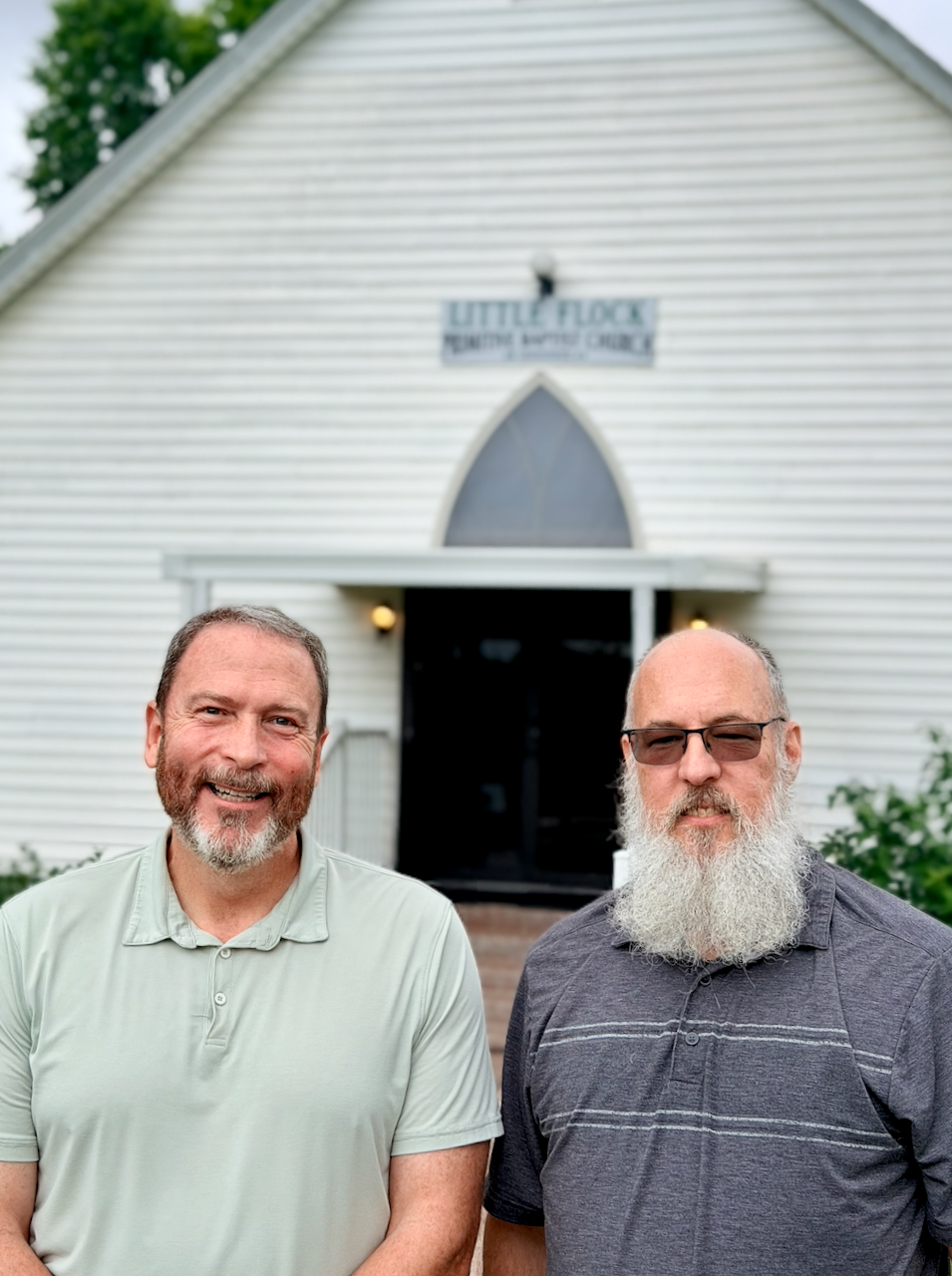
Elder Tom Griffin
Elder Tom Griffin is the pastor of Little Flock Primitive Baptist Church. Raised in another faith tradition, he came to the Primitive Baptists in his twenties, first drawn in through a young woman he fell in love with, then, by his own account, "arguing his way into the faith" under the patient mentorship of a pastor who kept sending him back to the text. He was baptized and joined in 1995, began introducing services in 1998, and was ordained in 2002. He pastored a church in Mississippi for 25 years before accepting the pastoral care of Little Flock in November 2025 and moving to Northwest Arkansas full-time in April 2026. He and Paul Lindsey, as he likes to note, are "the same year model."
Deacon Paul Lindsey
Deacon Paul Lindsey has been a Primitive Baptist his entire life, with generations of the faith in his family, including a great-great-grandfather who was a Primitive Baptist minister, buried in Mississippi. His family roots in Arkansas reach back to at least 1901. Raised in the river valley north of Russellville, he first came to Little Flock in 1989 as a seventeen-year-old student at the University of Arkansas, keeping his membership at Point Remove Primitive Baptist Church in Russellville through college. After an internship near St. Louis, where he met his wife, the two settled at Little Flock in the mid-1990s. He was ordained a deacon around 2001, a servant of the church, in his words, called "to hold the faith in a pure conscience."
episode references.
- Little Flock Primitive Baptist Church: https://www.littleflockpbc.com/
- Little Flock (Benton County), Encyclopedia of Arkansas: https://encyclopediaofarkansas.net/entries/little-flock-benton-county-833/
- Shiloh Museum of Ozark History (Springdale): https://shilohmuseum.org/
- Battle of Pea Ridge, Encyclopedia of Arkansas: https://encyclopediaofarkansas.net/entries/battle-of-pea-ridge-2306/
- Pea Ridge National Military Park (National Park Service): https://www.nps.gov/peri/
- Point Remove Primitive Baptist Church (Russellville): https://www.pointremovepbc.org/
- The Black Rock Address (1832), foundational Primitive Baptist document: https://www.pb.org/the-black-rock-address/
episode outline
- Cold open: the simplicity of Christ, and a faith that won't shy from any text (00:00)
- Episode intro: a church named from Luke 12:32, and a tradition built to resist becoming an institution (01:27)
- Meet the guests: Elder Tom Griffin and Deacon Paul Lindsey (05:56)
- Tom's story: from another order into the Primitive Baptists, and "arguing his way into the faith" (07:01)
- Paul's story: generations of Arkansas Primitive Baptists, and coming to Little Flock in 1989 (07:59)
- When faith became real: a childhood storm, and the sermon on God's silence (10:35)
- Tom's very different road in: love, baptism, and ordination (13:34)
- What the church believes: salvation as God's finished work, not ours to earn
- Religion versus a person: the distinction at the center of how they understand themselves
- The founding: Shiloh as mother church, and Little Flock constituted in 1843 (30:15)
- Why "Primitive": the 1830s split over mission boards, seminaries, and Sunday schools (30:15)
- From "Regular" to "Primitive": the name change hidden in the minutes (37:36)
- The Civil War: Union troops, a church turned hospital, and minutes that record only "national difficulties" (38:09)
- Still here: what it means to persist through national difficulty (41:46)
- Faith and the political world: what Paul learned, and walked away from, after 2010 (43:11)
- Change in Northwest Arkansas: growth, prosperity, and a faith that speaks to the burdened (49:42)
- Serving the community: the tornado, the chainsaws, and a generosity extended to all (55:50)
- Wisdom for this cultural moment: "come and see" (59:14)
- Fears and hope for Little Flock and the place (01:05:05)
- Talkback with co-host Monica Kumar (01:19:00)
- Episode outro: the ledgers, the book, and the singing (01:23:30)
episode transcript.
episode preview.
[00:00:00] tom griffin.: For me, it's the simplicity. There's nothing really here to attract the carnal man. And that to me, the simplicity of Christ, the simplicity of the church, the simplicity of the worship, and the way that the Lord expects us to honor him is what drew me to the faith.
Primitive Baptists will tell you that the things that most religious orders will tell you are the causes of eternal salvation, the primitive Baptists understand to be evidences of a state of already being saved. We understand that salvation is solely by the work of God, and then everything we do is... flows forth from that. Even belief flows forth from a state of already being saved.
episode intro.
[00:01:27] mike rusch.: Well, you're listening to The Underview, an exploration in the shaping of our place. My name is Mike Rusch, and today's story starts with a sentence, "Fear not, little flock, for it is your Father's good pleasure to give you the kingdom." A church took its name from those words in 1843. A town later took its name from the church.
There's a small white church in Little Flock, Arkansas, and if you've taken the back roads between Rogers and Pea Ridge, you've seen it. You've passed by it. Maybe you've wondered about it. The town is named after the church, not the other way around. A small flock, a given kingdom. There's a whole theology folded into that name, and a whole way of being in a place.
This is Little Flock Primitive Baptist Church. It was constituted in 1843, in the earliest years of Arkansas becoming a state. Planted out of one of the oldest congregations here, Shiloh, whose building is now the Shiloh Museum in downtown Springdale.
The original minute books are still in the next room. There are hand-hewn oak beams under the floor the b- that are older than the building on top of them. This is one of the oldest continuous strands of faith in Northwest Arkansas, and I'd guess most of us, including myself, could say that we don't really know anything about it. So this episode is all of us learning at the same time. I told our guests that when I sat down with them, and I'll tell you the same thing, I came in unfamiliar. I came in to be taught. Here's a little bit of what I've learned, , just enough to frame what you're about to hear.
Primitive Baptists got their name in the 1830s, when the Baptist world was splitting over a question that sounds procedural and turns out to be everything. What does a church have the authority to build? Mission boards, seminaries, Sunday schools, paid clergy, organizations that raised money and made decisions from outside the local congregation.
One group said, "We'll build all of that," and another group, the ones who'd come to be called primitives, said no. Not because they were against the work, but because they believed that the church itself, gathered in one place, was the only body that God had authorized to do it. Primitive was meant to be an insult, backward, behind the times, but they kept it because to them it meant something else, original, close to the source. I want you to hold onto that because it's the thread that runs under everything in this conversation. This is a tradition built to resist something becoming an institution. It has survived here on this ground for 180 years, through a civil war that turned its meeting house into a hospital, through the decades when families came by on horse and buggy, into a Northwest Arkansas that now adds something like 30 new residents a day and measures nearly everything by how fast it can grow.
That's the tension I'd ask you to sit with. This whole season, we've been asking what faith looks like in this place, and how faith and place shape each other. And almost every story we tell in Northwest Arkansas is a story of growth. More people, more building, more prosperity.
And here is a church that has never once asked how to get bigger. It asks how to stay faithful. It believes it blossoms under burden, not under plenty, which is a strange and difficult thing to say out loud in the most prosperous corner of the state. So the question underneath this episode isn't really about one small congregation, it's about the rest of us.
What does it mean to belong to a place? What are we actually here to build? And what might we be missing in a region optimized for expansion from the people who chose to endure instead? I would ask you to listen for the difference that my guests draw between a religion and a person. It's the center of how they understand themselves, and it may not be what you'd expect. And I want you to listen for the silences. This is a tradition that won't advertise, won't perform, won't take out an ad and tell you to come. Its whole invitation is two words: come and see. Even the historical record keeps that tone. When the Civil War came, the minutes recorded only that the church could not meet due to "national difficulties," and then it went quiet for years. In the interview, we've said it before, sometimes the silence is the evidence.
Unfortunately, Monica wasn't able to sit in the room with me for this interview, but you'll hear her in our talkback after the interview, so stick around for that.
And if something here stirs a question in you or a memory or disagreement, we wanna hear it. There's a Send us a voice message button on the underview.com homepage. Tell us what you're wrestling with. This whole thing works better when it's a conversation. All right, a whole lot to work through today. Let's get into it
episode interview.
[00:05:56] mike rusch.: Well, I have the privilege today of sharing a table with the Deacon Paul Lindsey and Elder Tom Griffin, who are both here at Little Flock Primitive Baptist Church, and have been a part of this community for a very long time. Gentlemen, thank you for coming and being a part of this conversation and speaking into it. I'm honored to have you as a, yeah as people who we get to talk to and explore this concept of faith in northwest Arkansas. So welcome.
[00:06:19] paul lindsay.: Yeah, thank you. Thank you. Thank you for inviting us. .
background.
[00:06:22] mike rusch.: Well, it's it's a privilege, and the conversations we've been having have been r- really phenomenal, and I'm really excited to be able to sit down with you both because Cards on the Table, this is a tradition that I'm not familiar with, and so I am learning, and I'm probably not alone in that. And I live in Bentonville. We're here in Little Flock inside the sanctuary. A beautiful building that holds a lot of stories. And so I'm sure there's a lot of people like myself who have driven past this church and have been curious. And so today I hope we get to share your story and hear what this place means to you.
We'll start with the lead pastor here, who is Elder Tom Griffin. Tom, I'd love to hear your story, your background yeah, how you ended up here.
[00:07:01] tom griffin.: Thank you. So, I've been a member of the Primitive Baptist Church since I was about 24 years old. I spent the first 23 years of my life in another order of people, and I pastored a church there in Mississippi for 25 years. Through a series of just life events, became acquainted with the Little Flock Primitive Baptist Church as they were searching for a pastor, and just fell in love with them, honestly. And not that I ha- didn't have any affection any lack of affection for the church I was pastoring, but just fell in love with these folks and I feel like, I hope that's reciprocated anyway.
And, Yeah ... they've called us as pastor, and so we've been here only for a couple of months now full-time. Accepted the - pastoral care of the church back in November, but couldn't move right away, and so mid-April. We've been here ever since, and looking forward to many years here with them.
[00:07:53] mike rusch.: Well, welcome to northwest Arkansas. Thank you. It's a privilege to have you here. Deacon Paul, I'd love to hear you, a little bit of your story too.
[00:07:59] paul lindsay.: Sure, you bet. So I'm a longtime Arkansas resident. Every branch of my family was in Arkansas back as early as 1901, and some probably 60 years prior to that. But raised in a river valley north of Russellville, around the Russellville area. Been a Primitive Baptist my entire life, have literally generations of Primitive Baptists in my background. I have a, like a great-great-grandfather buried in Mississippi who was a Primitive Baptist minister.
But moved up here in Northwest Arkansas to go to the U- University of Arkansas. Started attending here at that time in 1989 as just a 17-year-old young man, and was really impressed with the congregation here. The pastor was, at the time Elder Don Ferris, and Attended here, but kept my membership back at Point Remove Primitive Baptist Church in Russellville while I was in college.
Point Remove actually precedes Little Flock a little bit. They were founded in 1833, so 10 years prior to our church here. And the state was founded in 1836. So there's a, Anyway, I was a m- I was a member here as a college student. Went up to St. Louis area to intern for a couple years, and then met my wife up there. She was a member of another Little Flock Primitive Baptist Church up there in Edwardsville, Illinois. A very young church really by comparison. Met her, fell in love with her, and brought her back here to Arkansas in 1994. And her and I've been here since.
As soon as I graduated in 1995 we moved our membership, hers down from Illinois, mine from up from the Russellville area, and we've been here ever since. We were just members during that period from the late '90s. Elder Don resigned his pastorship in like '98, I wanna say. And then as our first child, Hannah, was being born, we called a new pastor Brother Carl Staton, who's now moved back to the Russellville area and r- and is retired from being a pastor here. And he was our pastor for 25 years. And during that period in the early 2000s, about 2001 or so the church here ordained me as a deacon to serve and that's literally, a deacon means, is a minister- ... or a servant of the church. So I'm just a servant of the church ex- and expected to hold the faith in a pure conscience. And I s- I strive to do that albeit imperfectly. So that's kinda my background.
[00:10:22] mike rusch.: Well, thank you. This is home for you.
[00:10:24] paul lindsay.: It is.
[00:10:25] mike rusch.: Yeah.
[00:10:25] paul lindsay.: Yeah, it truly is.
[00:10:26] mike rusch.: I'm really curious about the moment or the time that you felt your faith maybe within this tradition or maybe outside this tradition became tangible, became real for you.
[00:10:35] paul lindsay.: There's never been a time in my life that I didn't feel like God was involved. I, even as young as oh, I was probably five or six years old, and storms here in Arkansas can be pretty pretty hairy. Extreme downpours and lightning storms, like pure electrical storms with no rain in them.
This is one personal story of a storm coming through the area, and I was here, and of course my dad was a, very technically minded, and I knew how to calculate how far away the lightning was striking, and I felt it coming closer and closer. I could hear the lightning strike getting closer, and I first prayed to God to give me some relief from the fear and He did so. The, I heard the lightning and thunder move it, move away, and I was like, " God heard my prayer." And that was just as a very young child. It wasn't till I was 16 that we were going through some m- family and church challenges.
My extended family all the branches of my family were up north of Conway in the Bee Branch, Quitman area. And there was a little church there called Old Salem Church in the Gravesville community. And we were there at the time with my grandparents and great-grandparents, and they were going through some troubles of family members who were not living a life they thought was appropriate, and they were having to deal with it. And it was a pretty big turmoil at the time. But I remember the sermon our pastor at Russelle had taught about sometimes there, God's not... He's silent. He, there's no need for Him to speak or step in. And everyone was really troubled, and there was a situation where exactly what I'd heard preached on was bearing out in this trial.
And I was completely comforted throughout it. I was never worried or troubled by, even though trouble was all around, and it was, to me it was not natural. I'm a worrier by nature. It totally wasn't natural to me to be calm. Even the pastor's wife at the time, who, as a 15-year-old, 16-year-old sitting next to the pastor's wife, she was trying to comfort me, and I was fine.
This was my own family that was going through families and church struggles. And I realized that God was involved in my life. And I needed to make a, I needed to make a call to to show that. And so the next Sunday I went to church and in Russellville and spoke to my pastor and told him I'm ready to make a public declaration and a public commitment to follow the Lord Jesus.
And so, my dad had to go off on business for he worked for the Corps of Engineers on the Arkansas River as a crane operator. He had to be gone for three weeks so we agreed to hold off until he could get back- ... and and have the baptism at that time. But there's just too many stories to tell of God's goodness throughout the years.
But that's kind of the, my origin story.
[00:13:22] mike rusch.: Oh, well, thank you. That's a long origin story in a good way. Like-
[00:13:25] paul lindsay.: Yeah. I lo- Lots and lots of stories ...
[00:13:26] mike rusch.: I love the sentiment of like- ... this idea of like, like almost don't remember a time when- Sure ... it's really beautiful.
[00:13:32] paul lindsay.: Elder Tom?
So my story's very different.
[00:13:34] tom griffin.: Okay. I have not always been a Primitive Baptist. I was raised in another order of people. We were not the most devoted family, but, we went to church regularly. Got a good foundation. And then I became the victim, if you will, of the Primitive Baptist recruiting plan. Which is to send, which is to send these beautiful young ladies and young men out into the world to entice spouses.
And so I fell in love with a young lady that was- ... a Primitive Baptist and started going to church with her, and almost immediately set my entire energies towards proving them wrong, and just argued my way right into the faith. Ultimately, I had a pastor that was... I happened to work with as well in my secular job, and was very gentle with me, but he would, i'd go to him and I'd say, "What about this text?" And he would say, " Okay, well, if you take that view of that text, what do you do with this one, and this one?" And I'd go away and study those and go, " Well, he must be right." Yeah. And so anyway that that's what really drew me to the Primitive Baptists.
I did not join right away. It took about two years before I joined, because the Primitive Baptists will not accept a baptism of another order, and I just, I was stiff in my neck about that. I just, "No, I'm ba- I've been baptized. I'm not doing that again." And then having observed communion service and watched the saints there in Mississippi wash one another's feet and commune with the Lord, I decided that it really didn't matter what they wanted me to do.
I didn't understand why I had to be baptized, but at that point I wanted the fellowship so badly that it wouldn't have mattered what they told me. But anyway, so I did submit to baptism then and joined. That would've been 1995. And then in 1998 they started asking me to introduce services. It's kind of the pattern in Primitive Baptist Churches. You have a young man that studies and you'll call him to introduce services and then if that bears fruit, you'll set him at liberty as, like, Paul described Timothy. And then if the churches are edified, ultimately you'll ordain him. And so I was ordained in 2002.
Right. And the rest is a, an ever being written history.
[00:15:39] mike rusch.: Yeah, thank you for that story. I will say I resonate with both of your stories because I feel like growing up in the Bible Belt, it's like I don't remember a time not, like, being aware of faith.
And at the same time Elder Tom, like I, I feel that internal like, yeah, pushing back sometimes. But at the same time finding the beauty of what faith can mean.
origin of the tradition.
[00:15:59] mike rusch.: Maybe help me understand when we talk about Primitive Baptist Church and faith tradition, how would you describe that to someone who may not be familiar with this faith tradition maybe in a sea of faith traditions here in the South, if that's fair? But what do you feel like is the thing that has really drawn you and held you into this faith tradition?
[00:16:20] tom griffin.: For me, it's the simplicity. It's there's really, I wanna say no fluff, if you will, but if there is, there's very little. It's, there's nothing really here to attract the carnal man. Or very little, let me say it that way, just to be fair. And that to me, the simplicity of Christ, the simplicity of the church, the simplicity of the worship, and the way that the Lord expects us to honor him is what drew me to the faith. And the other thing is, was the thing that really... so if you get, if you ask me for a word, I'd say the simplicity. But it also the way that the Primitive Baptists did not shy away from any verse from Genesis 1:1 to Revelation 22:21, they were willing to say they didn't know but they would study it with me instead of just saying, don't look at that text," or, "We don't understand that text," or whatever. They would acknowledge they don't understand it, but they were willing to study it with me, and so that also was very impressive to me.
[00:17:13] mike rusch.: I love hearing that. I think simplicity is something in this world we all would long for.
[00:17:18] paul lindsay.: Yeah.
[00:17:18] mike rusch.: Deacon Paul, I'm curious. You've been a part of this faith tradition and faith community for a very long time.
[00:17:23] paul lindsay.: Sure.
[00:17:24] mike rusch.: You know the story of this place. What has held you here for so long?
[00:17:27] paul lindsay.: Well, part of it is just the family I was raised in. There was a time when not all the biblical questions could I answer. I could say the words and kinda repeat 'em back to you. Well, this is what we believe, but at one point that guilt of conscience of not being sure, And doubt's fine. There's no problem with doubt. God can use that to purge away things that are unnecessary. But at some point, God put it on my heart to just answer, find all the answers, and I just studied. I couldn't read enough material. I couldn't study enough, and dug in. And until I was like, "Yep, this... I've absolutely got it. This is what's true." There's uh, some aspects of it I've always known true. Primitive Baptists, they're different from other denominations and, primitive Baptists are different from other religions. It may s- you may hear common words or things that sound familiar with other denominations.
Some would call us Calvinists because we do have a, we do have a firm belief in election of God choosing his people. We are not Calvinists because we have a lot- Amen ... of differences between us and John Calvin and his doctrine. He just happened to come across some of the biblical topics when he was learning about faith himself.
But one of the things is foundational to Primitive Baptists is human nature, and that there is nothing good about us at all by birth. We sin came into the world by a man, and it passed on to my children through me. They're sinners because of me. And that awareness or that sense of realizing that the world's a bad place, it's actually miraculous that there's any good at all, is because I can see in myself a tendency to want to do all manner of things that would be even of myself I'd I find despicable.
That human nature aspect resonates with who I've seen in myself when I get caught as a young child, doing the wrong thing and caught in a lie and feeling guilty about it. Where did that come from? It was just natural. It came out.
The Primitive Baptists uh, I we heard it last weekend at a meeting over in Oklahoma we went to where the minister says, "Primitive Baptists are one of the few pl- people that when you go to them and tell them, 'Well, you're a s- you're a real sinner,' and they would thank you and say, 'Amen.'" we don't shy away from that.
[00:19:47] tom griffin.: We- And they usually feed you when you're done.
[00:19:49] paul lindsay.: Th- they us- they usually will
But because we know we're sinners I even had a young man who's not from the printer best tradition joined here recently. He-- That was his commentary was mo- most Christians will tell you that we're sinners saved by grace. They've been taught that. But y'all know it, y'all believe it and don't shy away from it. And because we know we're sinners, it's all the more that we need a savior. And when we see what Jesus did for us and what through no-- through truly no merit of our own he's given me life, and I can feel that.
The fact I have a guilty conscience, even that doesn't-- is not natural. Most people go through the world, and they-- things don't even bother them at all. They, they-- You, you'd think, "Well, how could they get away with doing that?" And it's, well, it's natural. I don't necessarily even fault them for it, right?
It's just they're doing what's natural. But God's way is different. And He-- when He bestows new life on a child, on, on a person sometime between natural conception and death they're changed just by the voice of God.
And what's that old and stony heart's changed to a heart of flesh, it now has, for the first time ever in, in its short existence the ability to hear, the ability to see, the-- a conscience, a feeling of guilt when it does wrong, a desire for God and something bigger than itself. But they don't know the name of Jesus yet, and that's where the church comes in. And here's the place where not only did I have a faith tradition of just going through the motion...
now you you'd asked me earlier how that-- what's the difference between religion and a man. This is fundamental to that.
Religion is what we're doing. We-we-we- ... we believe in a supreme being who created the universe, right? And He's ruler of all things. And and we can go through the motion of doing our routines a-as it, we would deem He's accepted But he sent his son into this world, a person, a man in substitution for a man, a substitution for myself, that came to the lowest of lows, went through the worst of the worst, and for my sake and for your sake. And when I see who he is and realize what I've done and don't deserve him, yet he comes alongside and says, "I'm right here. I promise to be with you always."
Then it becomes-- the religion becomes much more real. And here is a place, and not just here, but across the country among Primitive Baptists generally I find that when I go there, I see people who recognize who they are by nature, and they recognize the man Jesus for what he did.
We don't worship a Jesus who is a potential savior, a wannabe savior, or who's hoping you come around. He's like, he is a savior, and he accomplished it. This religion that we go through is to learn more about him, and even the scripture plainly states what it's for. The scripture's given for reproof that the man of God may be thoroughly furnished perfect, thoroughly furnished unto all good works.
That means, perfect means mature. The gospel's given to bring life and immortality to light, right? That's scripture as well. It's not to make you alive or cause you to be alive. God's own voice does that. So when you meet someone on the street in the Primitive Baptist tradition and you see in them fruits of the spirit, love, joy, peace, temperance, kindness, those are not natural, right? Those other things, the human nature of lying and deci-deceit and fornication, adultery, and all the bad things stealing and murders, even backbiting and causing all kinds of division, that's natural. That comes naturally. The peace, joy, love, That's not natural. That's supernatural. And when you see someone who exhibits those fruits, the only place it comes from is from God. So when you see someone on the street, be it Primitive Baptist or not and they are exemplifying those traits you can be fairly assured that they're, they have a common Father with you. That you both belong to God Himself, and that Jesus did everything necessary so that one day they too would be with Him and with you, and you can now share this story.
It's kinda like someone who's gone to a foreign been born in a foreign land, but they don't realize that their parents are of royal descent. They're living a life in misery and turmoil, maybe even imprisoned or or a slave. And even though they are still in that foreign land as a stranger, they learn that they're actually of, have been blessed to have royal blood. It changes their life. And we're just sojourners here for the time being. But we have a Father who has a limitless bounty, and it's just a matter of time before we get to go and be with Him. And He's here with us to, to go with us on a journey and we have that assurance because we see His Son, Jesus
primitive baptist differentiation.
[00:25:15] mike rusch.: I think it's really helpful for me to understand where the foundation is, and so I'm really thankful that you would share that. Because this idea of belonging not only to faith, but belonging within this tradition it's really beautiful to, to listen to you weave back and forth in a way that just feels, yeah, feels really beautiful. And so, I am curious, as we think about this tradition- ... when we talk about being Primitive Baptist versus maybe what other people may understand as being Baptist how do you set yourself different or where did that difference emerge?
[00:25:50] tom griffin.: So probably the best description of the difference between primitive Baptists and most other orders, not original with me, but it's still a good one, is that primitive Baptists will tell you that the things that most religious orders will tell you are the causes of eternal salvation, the primitive Baptists understand to be evidences of a state of already being saved.
That's probably the best most succinct way of describing the difference. There are other practical differences and things, but that's the gist of it, is that we understand that salvation is solely by the work of God, and then everything we do is... flows forth from that. Whe- any- even belief, belief flows forth from a state of already being saved. So that's, that I would say is probably the biggest distinction between primitive Baptists and what we believe doctrinally.
Practically, again, we try to do everything we can to stick to the apostolic pattern. I think we can suppose, at least I would say it's a certainty, that from the days of Christ and the apostles to today, there's a line that the Lord put in place of his church. He established her and said the gates of hell will never prevail against her. And the annals of history, churches have, and the Lord's people in general have, followed that line, but some have decided to go different ways, one to one side or the other. And the primitive Baptists, in my view, and if I didn't believe this, I would still be looking for the ones who were, have stayed the most true to the line from Christ to today
[00:27:26] paul lindsay.: I can add some more commentary to that. And so, from early on as modern conveniences came into play from a practical standpoint, the difference is with us is we still try to hold to those things that are foundational. So when you come to little Primitive Baptist Church we believe in what now is a modern term of family integrated worship- right? But we've been doing this forever well at least for a couple thousand years anyway of the families being together. And and we don't mind babies being in the church house and crying. We had one this weekend, and it's fine. We want families to be together. That's the foundation.
That was the first, God-established pattern, was the family. And we have congregational singing, and what sets singing apart, we could talk about scripture, about why singing versus not, but the thing that makes singing different is words, and the confession of your lips, of saying things that that, that mean something. We all sing together. We don't... We... it's not performances. It's we are all to- in this together as families. And then we we have praying as well as a group, and then we have preaching, and God has chosen the foolishness of preaching, and many will call it foolish, and that's fine. It's biblical. It's the f- it's foolish by human nature, but God's chosen that as a means to, to save. And saved in that sense does not mean eternal salvation, right? Eternal salvation is done by him, but it's a... Saved is just a verb. It just means that we like to ask the question, you're saved from what and to what?
So, when you believe the gospel, it saves you from ignorance into a life of believing, right? Baptism saves you, is, gives, provides a clear conscience. But it's not eternal. It's, it has a benefit to this life. So in our tradition, congregational singing and family integrated worship, - preaching and praying and that forms a foundation of our practical aspects. Early on from a historical standpoint, I know you're really curious about this-
[00:29:31] mike rusch.: one of the things too that has drawn me to, to wanting to speak with both of you is this church has a long arc of history here in Northwest Arkansas, founded in 1843. , Right when Arkansas was- becoming a state, a little after. But you've been here for a very long time. And I'm curious if you can maybe give us a little bit of background on just the, where did, how did this church begin? . This was a time shortly after Arkansas was became a state not too long after obviously indigenous removal. Slavery was still an institution at that time. So the culture the cultural moment at that time was very different than where we are today. And I'm just kinda curious, w- yeah, how did this church begin where it is here today?
[00:30:15] paul lindsay.: So Little Flock here was not necessarily the first Primitive Baptist Church or Baptist Church in the area. There's a museum actually in downtown Springdale- ... called Shiloh. And there was a Primitive Baptist Church there. And Shiloh was actually what we would call like a mother church to ours. People moved into the area. They, as they constitute a church as a group of families that agreed to, to bind themselves together as a body.
We believe that the church is a the highest ecclesiastical governing body. And Shiloh was founded I, I wanna say in the early 1820s about 20 years prior to here. And then from that congregation, as they w- moved out and other families were settling and other families were together they decided to constitute additional churches, and Little Flock was one of those outreaches from Shiloh. We were founded 20 years after Shiloh was. State was founded in 1836 and th- this place was founded in 1843. We still have the original books and here in the other room and the, our founding documents. And during that intervening period was a, a challenging state for the Baptists, right?
There's a tendency now to actually go back and read old documents and f- and find out what they believed, and you'll find most any manner of biblical teaching and there's quite a few debates of confessions of the old and whether this confession actually holds a value or not. But Primitive Baptists tend to, say that confessions don't really matter, it's what does God's word say, so you're trying to stick with that.
And during that period of the early 1830s there was a split between the Baptists and there's actually a among the Primitive Baptists, a well-known document where we stated our disagreement with the governance of what we're to do as living a Christian life. And that included organizing board, missionary boards of outside of the church. I mean, we believe in doing missionary type of work of evangelism and the like but it's subject to the church as a highest governing body. We have ministers that go all across the country to preach at other locations.
That's great. But they're held in an account by the local congregation. And churches don't necessarily have governance above each other. And the same was true in eig- early 1800s. The missionary boards were being established to send ministers, and they were c- they were separate from the churches. And they needed money to, to run those missionary boards and they were seeking people in the community who had money and calling. Some were donating and contributing for the cause and then expecting to be a part of those boards and elected onto those boards folks who may not have been actually even believers.
And they really thought that was a problem. And I would agree with them that if we are gonna be representatives of Jesus Christ in outreach we need to be true to the way he established it. They also didn't like other types of governing bodies of Theology schools where would be established separately. And so we, as Brother Tom has explained, we have kind of a, as you would think of it, as more of a journeyman type, where you see someone who is showing the fruits of study and making progress on their own. We put them under the tutelage of a pastor at their local congregation. They spend some years working together, and then when the pastor feels like they've made some sufficient progress to bringing them before the church to exercise, and then once the church recognizes the gift, they give them a license to go and go elsewhere.
And once other churches recognize the same gift, then they're then they're ordained by the laying on of hands in a presbytery. So, That's our method of being a member and being called to the work by God and then manifesting that by exercising. But theological schools were being established separately. They were being founded by boards that, that may not have believers. And the Presbyterians took a pretty strong stance against that. Sunday schools, similar situation where novices were being appointed. Like, we don't separate into different groups. We do family integrated worship.
We also want a God-called man to be the one responsible for overseeing the teaching and as such, we don't wanna put someone who's just come into the faith, maybe not as experienced, they've not been proven by the church to be put in that position of suddenly responsible for teaching, teaching younger age groups or the like.
It really is up to those who God is holding responsible. Brother Tom him and I share a lot in common. We're... As he's told me when he first came here, we're the same year model. But I've been in the faith all my life and I've... And because I'm a deacon I wanna hold the faith in a pure conscience, and I've tried to do that.
But there's a difference, and I tried at one point to be just to figure out, does God call me to that purpose? And I've eventually after a year discovered, boy, it was work. It was work for me. It was not 100% natural for me to be a minister and to put forth that effort.
It was not that burning desire. I have the burning desire to serve and to share and to encourage. And so I stepped down from being a from being an elder and didn't get called to that. But Brother Tom, even though we share a lot of things in common, a lot of experiences in common faiths for sure in common he felt that calling of the Lord to and pursued that, that avenue.
I say pursued, maybe the L- Lord pursued him. I
[00:35:58] tom griffin.: actually ran from it more than I pursued it- ... to be honest
[00:36:01] paul lindsay.: with you. And, Those
[00:36:01] mike rusch.: are some of the best stories, though.
[00:36:03] tom griffin.: Yeah.
[00:36:03] paul lindsay.: And and he became elder. So that, those, that's kind of the foundation. I'm trying to not bring in too many stories 'cause I can talk forever about this stuff.
Well- but I'll get back to the history, and that is, so during that early 1830s, the Baptists were struggling with this split over those few topics and maybe a couple more. And even this church, so in 1843, this church was established as a regular Baptist- ... 'cause mo- most - Baptists were just regular Baptists.
And if you go across and look at other regular Baptists their articles of faith will be very similar to ours, maybe with some additional ones tacked onto the end. But that was our name. Li- the regular Baptist church known as Little Flock, and that's what our minutes re-record at that time. But the articles of faith we had back then are the same ones we believe today and although we've had some baubles along the way and splits and then rejoins back, we, we still hold to that faith that they had at that time. We were founded in 1843 here and some during those 1830s when the Baptists were kinda churning through the naming convention of...
There's actual court cases across the United States where there was, in bitter disagreements, right? Actually made it to court cases where we were referred to as primitive Baptists or old school Baptists. Those primitive Baptists, they don't, they're not modern. They are and eventually the name kinda stuck. It was meant kind of in a, maybe in a derogatory - fashion. But w- it was just adopted. And it really just means we're trying to be original. We're trying to, we're trying to hold to that, that this ancient, old,
[00:37:34] tom griffin.: Try to stay as close to that line as we can.
[00:37:36] paul lindsay.: And um, and so at some point in the middle of the 1800s, this church here, they had business meeting on one month and it says the Regular Baptist Church known as Little Flock. And the very next month they say we're the Primitive Baptist Church known as Little Flock, And so not so much as a mention of why the discrepancy or the change, although I could probably sympathize with them that they didn't wanna really make a big deal about it, 'cause they've always been Primitive Baptist, right?
[00:38:03] mike rusch.: Yeah. I'd be really curious what happened inside of those rooms Oh, yeah.
[00:38:06] paul lindsay.: Yeah.
[00:38:06] mike rusch.: To finally decide to make a name change.
[00:38:08] paul lindsay.: For sure. For sure.
civil war time period.
[00:38:09] mike rusch.: This church, the land that it's on today is different than where it was founded, but we're pretty close to the area, if I understand. Yeah. We're not that far from Pea Ridge, and this church has a story about what that looks like or what that did look like during the Civil War- Sure as well, too. I'd be curious for you to share that, some of those stories that you have.
[00:38:30] paul lindsay.: Sure. So, you're exactly right. ... When this church was founded in 1843, they didn't have a church building. It was just a group of families, and they met from place to place. It wasn't till the middle of the 1850s that they decided to build a church building, and some land was donated by members of the church. And it was just down the street here to our west less than a half a mile away. Land was donated, and and they s- decided to build a church building down there. Not long after that my understanding is that a community building was - built next door, and a, an old schoolhouse was there next to it.
And that schoolhouse started operation in the 1850s and continued for 75 years up to the 1820s. At some point the land that where the church re- presently sits, I wanna say it was in the 1880s, late 1880s was donated to the church by church members, and it included the land that's across the street from where the current city hall and park is located today. This land was donated to the church as a new location, and I I don't know the reasons for it. Maybe it was closer to the center of things that were going on or I just, I don't know the reason for the new location. And s- and it wasn't until the early ni- like 190-something that this church was building, was actually built.
There's actually... they hauled some of the original beams from the old building to this location, and if you crawl underneath the floor here, you'll see the old hand-hewn oak beams that still are underneath this building holding it up from that, And also, those beams are at, at least 150 years old that, that are holding it up. The present location has continued.
It wasn't till the 1970s when there was a landfill that was gonna be built in this area. Rogers was encroaching. And the people of the community banded together to try and keep that from happening and started to form a civil government. And the church sold a plot of land across the street from us to the city as part of that founding. And so in, 1970, 1971 the City of Little Flock was constituted, incorporated and came into being
oh, let me go back to your Civil War during the late, m- mid to late 1800s in our previous church building location down the street they were meeting and as the Battle of Pea Ridge was waging so as of March of 1862 the church was no longer able to meet. And from March until July or so, all it has recorded in our minutes was that, during those months from the Battle of Pea Ridge, the church was not able to meet due to "national difficulties." Union troops actually came to the church building and occupied it, treated it as a hospital. And so the church did not, was not able to use this location as a meeting house. It actually continued not recording official business meeting minutes for several years. And then a couple years later, they, in the fall, they started recording that they were back in session and conducting themselves again as a church.
still here.
[00:41:46] mike rusch.: I'm curious what does that say? I, it's interesting, national difficulties feels like an understatement, but what does it say about this church that through national difficulties it's persisted. It's still here. Yeah. The church as a institution, the church as a function of community, people of faith, they're still here. What does that mean to you?
[00:42:10] tom griffin.: Well it says something about where people turn during difficult times. And I think it says a lot about that. If you look at even up through war reading some of the minutes that I found here, even up through World War II, there were as many as 90 members here, which is a fairly sizable congregation for a Primitive Baptist church anywhere. I've had the privilege of reading the minute books of several Primitive Baptist churches that existed during the Civil War, and you'd be surprised at how benign the minutes are. They- There's very little mention of Any difficulties other than just to say things were hard, and then we moved on, we kept meeting.
So, I think during those times, it seems like, and biblically you, you'll see this, when Israel was in trouble, they would often turn back to the Lord. So it's, it's often a place that people turn when things are difficult. So I think it certainly speaks to that, that it was a, an anchor place here.
[00:43:11] paul lindsay.: And we know from history that the Civil War really divided families, and, and- ... Northwest Arkansas was right in the throes of that, literally two sides coming together to fight. It would've been very difficult during that period of time for them to reasonably meet. They probably met in homes and- amongst themselves and continued some of that tradition. But to conduct themselves as a body of people was very difficult.
I've been involved in politics. I got involved in politics when I was back in 2010. That was a time when across the country, lots of people were trying to find out where our country was headed, and it may have seemed like a bad direction. And I, I came across a bunch of other Christian men who were not Primitive Baptists, and what I found among them was that when we had this national difficulty, albeit not even remotely as comparable as back in the Civil War they all had a hunger to do something. They were very hungry to do something, and they banded together. We banded together, just me. It wasn't the church per se. It was just me as a person and my family, and then these other non-Primitive Baptist families to try and see what we could do. And during that process of learning the political ropes of Northwest Arkansas generally, and even the country we kinda got exposed to the underbelly of what the political landscape is.
And we became very close friends. They're still some of my very closest friends outside of the church. The church people are by far my closest friends 'cause we share a common faith. But in, out in the world, these other men are, have been very close friends over the years, although we've drifted apart as our families have grown up to some degree but during that period I learned a lot about the political parties and - even across the divide where the political-- both sides of the political aisle negotiate together as to what they're gonna do for a political office.
One of my best friends, I'm gonna go see this next week when he moved to this area in Northwest Arkansas, he was from South Dakota at the time. He came in and was asking, "Well, where are the candidates on the ballot for my party?" And they're like, "Well, the other party has those seats pretty well locked up. We're not gonna invest any donations at all to, to try and have another candidate." So they had already pre-negotiated who it was, and it just floored us.
And so we got exposed to the underbelly of the political world, and our candidate lost. And we f- I found myself, back going through the routine of going to church and doing my thing, going to work, very distraught as to what was there left to do. And that's-- that time, God, I think, really showed me the importance of what church was, what faith or faith tradition, especially of believing in Jesus Christ, how important it was.
And albeit a little short stint of the political realm since that time and seeing the ups and the and lots of people have been worried about, it's like, "Oh my goodness, this is happening and that is happening." They're all struggling. And through all of that I, God's given me a really keen sense of He's still around. It's-- And He's still in charge. And yes, there's gonna be ups and downs and trials and back and forth, but that's not where our strength and it's not, that's not where our, our- our trust should be latched onto. And that difficulty, coming out of that difficulty really strengthened my desire to be among this people that have a common faith.
It was asked of me by other members as we-- 'cause we dwindled to pretty low, and I would be routinely asked as a deacon of this church, "W- what are we gonna do? Our-- what are we gonna do if it continues to dwindle and the community continues to fade?" I was like, "I'm gonna be here because this is where I have seen Jesus, and if it's just me and a couple more who want that desire and are willing to meet here, then we're gonna meet.
I'm committed." And, I don't know why. I don't deserve it, but through the last couple years when our Pastor Carl's Staten re- resigned to retire from the pastoral care of this church really reinforced that with me of just feeling an overwhelming sense of calm. And I was able to encourage the church and God's hand was through that all and and we were able to meet Brother Tom for the first time get him up here and have him meet all the congregation.
And in a very physical sense, I felt God, His hand on me to say it's gonna be okay. And our country is gonna wax and wane, grow and shrink. Political parties are gonna come and go and shift back and forth, but there's one constant. And this faith is important to do that. And even in our primitive Baptist name, we're s- making a statement that we're trying to hold onto those things that last not 100 years, 250 years this year for our country.
Great. Truthfully, I love the Constitution. I love the f- the sense of liberty and I stand firmly behind it, but that's not my foundation.
That liberty comes because a man secured it. And that's who I'm putting my trust in.
[00:48:42] tom griffin.: Brother Paul mentioned earlier the, one of the qualifications of a minister is that he has a desire.
He has a burning desire. And even though I don't know that you can compare COVID to the Civil War, but one thing they have in common is that a lot of churches, including the one I was pastor at the time, didn't meet- during COVID. And I can tell you as a pastor, when you have a burden and you can't discharge that burden it's very difficult.
And like similarly as a church member, if you've sat in services and the Spirit of God has borne witness with your spirit that you're one of His, you wanna get that feeling again. And so when we couldn't meet, It was never a question of would we meet again. It was, we've got to find a way.
We gotta find a way because f- for me, I had to, I had the burden I had to discharge. And for them, for the congregation they just desired to be comforted and to hear the gospel preached and to feel that they are children of the King again. So I think that's powerful motivation to continue meeting.
change in NW Arkansas.
[00:49:42] mike rusch.: I I'm curious, as you think about the long history of this faith community here, and you look at what's happening in Northwest Arkansas a- as we think about, like, all the growth that's happening and this long history of this community and as I hear both of you talk about the, what does it look like for the next 50 years or 100 years, , how does this impact or influence your view of what this faith community is or could be or should be?
[00:50:07] tom griffin.: Well, for me, you'd like to think, right, that there's a correlation that if you live in an area that has a small population, you'll have a small congregation. And then if you move to an area that has a significantly larger population, you'd think that some proportion, you'd have some proportionality there. I can tell you from experience, that's, that does not seem to be the case. The church doesn't really work that way.
Certainly the more growth that this area has or any area has, but since we're talking about Northwest Arkansas the more, the more growth that Northwest Arkansas has, the more people are here to be exposed. But also the more growth we have, the more options have both secular and religious. So there's a lot to take people away from Sunday morning worship. There's a lot to take people away from Wednesday night services or whatever services the church may have. So as the area continues to grow and people continue to move in, Imy hope would be that we would conduct ourselves in such a way as that folks would want to come and see what we're doing here. That's really the command. You remember in in the Gospel of John, Nathaniel is underneath the fig tree, and Philip comes to him and says, "We found the Messiah." And Nathaniel says, he says, "He came from Nazareth." And Nathaniel says, "Can anything good come out of Nazareth?" And Philip just says, "Come and see." I mean, that's, that's really what... we're not gonna take out an ad in the newspaper. Yeah. We're not gonna get- put up a commercial on TV. We're just gonna be here, and we we want people to come and see. And the more people are here, maybe the more they'll come and see.
[00:51:40] paul lindsay.: I'll add to that. And one of the challenges of especially Northwest Arkansas is, and the contrast that I'll get to in a minute, but part of that has led to just an incredible economic boom. The opportunities here have just continued to expand. And the Waltons, the Walton Foundation the other c- Tyson, JB Hunt, University of Arkansas, have all made such incredible contributions to the area, and the people that have worked as part of those have continued to contribute.
It's led to a very prosperous part of the country one very desirous to... And besides th- their, that bringing a lot of opportunity and options- Yeah ... when people are prosperous when they're doing well it's often a struggle. Our f- our faith is, really speaks to sinners, right? So, to those who have got it and everything's well and everything's under control it doesn't resonate as much. And so we truly are trying to reach out to those who, who have a need. And it do- that doesn't grow in proportion to the population- ... or the prosperity. It's a- actually the opposite. Usually the church really blossoms when it's under heavy burden, heavy persecution. And so we understand that. We're now at a position where we've had a little bit of a little bit of growth here in the last year or so, which is great. But, it's meager by most standards. As far as the community that's right here I continue to be worried. Brother Tom just moved into Rogers and got a new house there. We have members that are in they're living in Pea Ridge, but they're up in years. And I could tell you stories about them. As Sister Doris, who her Brother Larry and Sister Doris live up in Pea Ridge and they're wonderful people. She grew up a Primitive Baptist her whole life and lived down here in the Sugar Creek area, and her mom and daddy, and then she was baptized in 1950 . So she's been a, she's been a member here for almost, well, 75 years as of this point, and her mind is still good, and she remembers that the time she got to come here to Little Flock from her little community over there, they couldn't regularly come here because of horse and buggy. That it was not till her grandparents got, had bought a new car in the 1950s and drove over here to Sugar Creek, picked them up south of the Garfield area, and brought them over here to Little Flock when they were having an association meeting.
They lived during a period when it was hard just to live. And they over in Sugar Creek, they didn't have a regular pastor all the time. So they would only meet when they had a minister that would come into the area back when she was a little girl. So usually when prosperity comes around, everybody's got what they need, and they really don't need something else. And the well don't need a physician, the sick do. And we're sinners, and trust me, I, I know for a fact I, I need the Lord.
I drive a very modern car. I live in a very modern house. We actually have pretty modern facilities here. We're not Amish in practice or Mennonite. We actually have electricity and fans, air conditioners, and bathrooms. It's all good. I drive an electric car. Modernity is great. Love it. But that's not my foundation. And those are just con- modern conveniences. I still have a need. The car will go away. The house will go away. The power could go out. Society could completely melt down. But I have a foundation I can stand on, and I need that desperately, especially for my children and grandchildren.
And I have hope
But if I had a fear for Little Flock and community is I really would like to see Little Flock continue to blossom.
For this place, this physical building and the people of this community to continue to worship here it's gonna take God's moving on them and probably them to have a need for something more than they've got. And my desire is that I know the man who can provide and answer their questions and it will do them well to be here
relationships here vs. the community.
[00:55:50] mike rusch.: I'm curious as you both talk about this congregation how does that relationship between serving the needs of the people here and that building of that community, how do you view that maybe compared to, and not in a, like, a adversarial way- Sure ... but, like, in, in a way of, like, what does that mean for the broader community, too, and this church's role- maybe in the broader community? How do you think about that?
[00:56:12] paul lindsay.: So I, I'll I've got some history here that, so just like this building was hit by a tornado back in the early 19-aughts we've had a tornado go through here I wanna say it was 2014 or so. And Sister Polly was still alive at that time, and it just missed her house and went across just south of here and tore a pretty good strip through town.
And the church here locally immediately banded together. I mean, we're a small congregation. Literally been less than 50 members for as long as I've known it. But even though we're little, we banded together. We came here to the church house, and we kinda set up shop to, to, as a, as a base of sorts to go out into the community and go house to house. We took our chainsaws. We were cutting up trees. There was insulation scattered a- across one of the fields here where, fiberglass insulation was in the field where cows were eating grass. And so we helped one of the neighbors go out there and literally just pick up fiberglass strewn across the ground and so that their cattle would not ingest- it accidentally.
We Brother Carl, our former pastor when he came here got heavily involved with the community. He became a chaplain for the s- the police force and the firefighters. He got firefighter certified. Actually w- did a lot of trips with them to f- his daughter, who was a member at the time became a firefighter as well.
And so we have been heavily involved. We've done, like, an annual cookout just, not as an official church function- Right ... but just as people together to serve others. Had a cookout and to serve the, those who serve the community in Little Flock Police Department and Little Flock Fire Department. And just to be here and to be available. If you have ever met any of our church members, you'll find that they are exquisitely generous even to non-Primitive Baptists. And if we're gonna represent the faith that we've been given well and the person who's given it to us we have to behave in a way that's, that they don't see us, they see him.
And so we take that mission very seriously, and that's not just to Primitive Baptists, it's to all people. And again we believe that there are children of God and this is a foundational verse for us. We believe God's got children in every nation, kindred, tongue, and people. He's redeemed them. It's up to us to go find them and to let them know that there's a better way,
[00:58:42] mike rusch.: I think as you're sharing your story of this tornado, right, it, you, and you talked about the church going through difficulty and what brings people together, it seems like a very consistent story for this faith community that maybe when things really do get hard this place comes together, and it's really beautiful to see that. We talked a little bit about this history of this church during national difficulty, and I'll say this. You can agree or disagree with me. It feels like in many ways w- we're always in a national difficulty, right? Yeah. Is that a fair statement, I think?
[00:59:14] paul lindsay.: It is totally fair. Totally fair.
[00:59:15] mike rusch.: And maybe today it feels like maybe it's i- inflamed. That may be my point of view, but, I'm curious. Like, as you think about where we are culturally, and you think about this community and these people I'm curious what you would offer to those listening. Call it wisdom, call it teaching, call it principles from this faith tradition that could speak to where we are as a broader culture and community kind of in this current moment.
[00:59:40] tom griffin.: So I would be I wouldn't be totally honest if I didn't say that I would prefer to preach to a house full of people.
[00:59:48] paul lindsay.: Okay.
[00:59:49] tom griffin.: But that can't be my goal. Okay? The goal has to be to maintain the stability, to maintain the consistency of the doctrine of the practice, and to grow in grace and knowledge. And my experience has been, I come from a place a county the county only has 6,500 people in it. And a congregation of about 90 people. And so what those folks came to see was they came to see Christ. So our goal has to be to continue to present him in the most positive light, like the bride in Song of Solomon, she talks about how, the daughter's visitors say, "Well, what is your love better than anyone else?" And she describes it. She just says, "Well, he's better in all these ways." And so our goal has to be to present him, and then if the numbers come, that's good. If not, otherwise.
But the community When things are uncertain, when things are choppy when I don't wanna get into specific social issues or what have you, but when those social issues become so confusing, it's good to have a place to go where it's not confusing. And that's where we- was- that's what we endeavor to be. And I know we're not the only faith community that endeavors to be that but we certainly try that here. We try really hard to be that consistency where you know what you're gonna get. You know when you come here you're gonna hear about the grace of God, you're gonna hear about the mercy of God. You're gonna see the face of Christ, we hope, not only in the preaching of course, but in, in us, in our example and the way that we live. So I think Brother Paul hit the nail on the head. That's we- we've got to ... our we endeavor to show him through our works, which is what he told us to do,
[01:01:28] paul lindsay.: I would add to that and this would be a statement I could that I share with even those that we come in contact with. My desire is that th- those I come in contact with would see something's different- and ask the question of why. Why are you different? Why is it different?
And I've had this, I've had the blessed privilege of having so many children of the c- of this area, of big families, little families especially the big families where the children have g- been in, in other faith traditions, come to me and ask, "Why is your family so different?" And I get that blessed privilege of saying, this is why."
They don't necessarily know just the struggles I've had on the inside and just my own doubts about myself and the world in general. And yet here I am going through life and seemingly in the midst of what would seem to be national difficulties and and by comparison for, within our lives. And I have a smile on my face, and it's like I'm truly not worried. I'm truly not worried. And they ask the question, how? Why? Those people of this community, those that are really struggling my, my statement to them is like, " Do you want to, do you wanna know That it can be better. And for your particular circumstance, there's someone who knows what you're going through. And we I think you asked it in your letter to us what's the on-ramp to becoming a Primitive Baptist? We've had some show up here, and they get real energetic, they get involved, and they're busy trying to do and impress, and and they wanna join, and we've had to have a conversation saying, "Listen, I, I appreciate that you wanna be a part of this congregation here, but we're looking for certain things and in the individual, first and foremost, that they recognize they're a sinner. And if you come in here and say, "Oh I've got something to do, I've got something to present, I'm gonna come in here and I'm gonna change everything," right? You're probably in the wrong place, and you may be a child of God and we love you for it, and we share a common Father, that's fine and dandy but that's probably not gonna be a fit here. But if you come in here and you are downtrodden, you are tired, you are physically sick, or you are emotionally sick, okay? We've been there. Okay? We've been to the bottom, and there's only one thing that's brought us out, and it's God's mercy. And if I can share some of that with you and that, that burden of wanting more than l- than natural life provides, then we've got something in common. Come and go with us. We'll show you We'll show you what Jesus did, and he chose you anyway, in spite of who you are, in spite of what you've done come go with us. You're the child of the King. Now you can start to live like it, and you'll have falters along the way. But we're here through the falters.
It's okay. We had a young mem- member here who's going through life difficulties, and church was very generous to, to help out with their particular circumstance of And he broke down crying, saying, " I don't deserve how good this church is." And then my statement to him was, " We know that. We know you don't deserve it, but we're here anyway."
[01:04:51] tom griffin.: And we love you.
[01:04:52] paul lindsay.: And we love you. And I'm just so thankful to be a part of this life with you, and to represent God's goodness in a way that we help
fears.
[01:05:05] mike rusch.: One of the things as we've had these conversations I a- I've asked our guests, like, what are their fears? And we ask that question really out of kind of normalizing that we're all human, and maybe we have concerns and things that keep us awake at night. M- maybe I, maybe it's just me. But I'm curious, as you think about the context of this faith community or this place or this community, I'm curious, what are your fears for this place?
[01:05:27] paul lindsay.: My, i'll start out.
[01:05:28] tom griffin.: Go ahead.
[01:05:29] paul lindsay.: I I used to be very fearful of the, of God's continuity in this community. I really felt like it was on the decline the prosperity of the area the falling away as a social degradation of society- of tearing down the family. There's a lot of things that are out there in our world that are worthy of being afraid of. But as I've seen God's deliverance here among a very small congregation th- a lot of that fear has completely gone away. I would say if there were a f- a quote, unquote fear, it really is that there's a lot of people, I mean, a lot of people who live in this area who are perfectly content and don't know they're miserable. And if Little Flock as a church in the Little Flock community is gonna continue I... My hope is that more would come and find a place of refuge. We're not promised tomorrow. And Jesus himself went to the churches and said, "Beware lest I withdraw my candlestick." Me- meaning the ministry. I mean, could you imagine a community this large and so prosperous, everybody's content to do their own thing in their own way, and God said... You know, there is a, a teaching of, God says, "You know what? You've not done what I said for long enough. I'm gonna let you live with the consequences that you have chosen."
And and in, in Israel's day, they went into bondage for 70 years, right? It's, it would not be unfathomable for this country to have a very severe meltdown, okay? I'm not afraid of that, okay? It, I know it's a possibility, and I'm concerned about how I would adjust to that, but I'm not necessarily afraid of it.
But I am afraid for this community in the sense that, God could say, "You know what? Little Flock's been here long enough. They did everything they could but nobody, very few showed up." And so, so be it. That would be a devastating for the faith community of Northwest Arkansas to fade away like that. - Seeking after God's, seeking after truth seeking after righteousness is so important. Jesus is not a prescription, right? It's not s- you, it's not a go to the doctor to get remedy. It i- it is, he's seeking those to come to him who have a need, and if nobody has a need, then when trouble happens, well now they've got a need. But it might be too late. I would like to see this community, us to have a bigger impact on Little Flock proper, the city of, and, but only in the sense that I know there are children of God out there. I know they're going through struggles and we've got something in common. I would just like to see them come here.
A lot of times other faith traditions get in the way, social pressures get in the way. The word primitive gets in the way. Right? That's... But we're just regular people and and God's blessed us to be able to be with him. And so my desire is for others to see that.
[01:08:27] mike rusch.: Anything you wanna add?
[01:08:28] tom griffin.: Far... So for me my fear truly, and this may be selfish on my part, but my fear is that I would I would get so concerned about the current state of the church that I would be willing to compromise on the fundamentals. And that's what, that's why Primitive Baptists exist, is because they were not willing to compromise. Others saw the state of the church and said, "Let's add this," or, "Let's add that." And we can debate all day long about whether those things were right or good or not, but the fact is the Primitive Baptists, or that would come to be known as Primitive Baptists, just held the line. And so my fear is that I would somehow lead this church astray by getting so focused on that I compromise those fundamental beliefs.
That'd be a that'd be a stain that I'd have a hard time living with. And I'm gonna work to not let that happen, of course. But... And my hope would be, my hope would be that when the Lord decides to come back and take us home, that Little Flock would still be here, still observing those same principles and worshiping the same way. That'd be... And I really, that's my goal. That's my goal, is to continue doing that, and then hopefully the community around us will see us always as a place that they can come and walk through that door and get comfort on the way.
[01:09:51] paul lindsay.: Amen to that.
[01:09:52] mike rusch. (2): You may have just answered this question. My the second question, if you have anything to add, is we always ask, all of these conversations we've kind of tried to string together this idea or this question of what does wholeness look like? And so I'm curious within the context of this community what does wholeness look like to you?
[01:10:09] tom griffin.: Wholeness. I'm not... explain that term to me.
[01:10:11] mike rusch.: Well, you're the pastor. I would I come here. Uh, This idea of wholeness, I guess for me completeness, things a- are as maybe they should be. What does... And I don't wanna answer the question per se. I have answered this question in other conversations. Yeah. But when I say that term I'm curious what comes to mind for you.
[01:10:30] tom griffin.: Wholeness from a church perspective? I- Or from a, an individual believer's perspective, or-
[01:10:36] mike rusch.: I will defer to you. I think the conversations are sometimes around what does community wholeness look like. But I- Community wholeness ... I do understand that we have human beings involved too, right? Yeah. And so, they live together in a, hopefully in a beautiful way.
But-
[01:10:51] tom griffin.: Sure ...
[01:10:52] mike rusch.: yeah, I'm curious.
[01:10:52] tom griffin.: Okay. So I think I understand the question now. Yeah. So, I've only been here a short time. But my perception of the Little Flock community is that it is fiercely independent. Which I applaud and I think that bodes well for the church, that bodes well for the community. And so wholeness for the community from a political perspective, you've got the government of Little Flock. It's a independent city that's named for the church, right? That's right. If- am I,
[01:11:21] paul lindsay.: am I right about that? Yeah. The
[01:11:22] tom griffin.: Little Flock community is actually named after Little Flock Church.
[01:11:25] paul lindsay.: That's correct.
[01:11:25] tom griffin.: And Little Flock Church is actually named after a statement that Jesus Christ made when he said, "Fear not, Little Flock, for it's your Father's good pleasure to give unto you the kingdom." So, so wholeness to me is that Little Flock Church continues to display the characteristics that led the city to take on the name- and continue to be here for the residents of this community for centuries, if the Lord doesn't come back first. So that's what I would say wholeness is.
[01:11:55] paul lindsay.: And I'll add to that, that that we as a body, right, are unified here in Little Flock. Because in, in... This is a scripture that, that really has stood out lately for me, is that, "By this shall all men know that you are my disciples-" "that you have love one to another." Okay? That's how everybody else is gonna know that we're different and we're different because of a person. And the wholeness of our congre- wholeness of our congregation is dependent upon wholeness of families- right, as the first organization that God established. So wholeness of families leads to wholeness of church, leads to the wholeness of the community, which leads to wholeness of the nation. That's the order of things.
And if Little Flock's gonna, if Little Flock's gonna remain- We're gonna have to follow that order to do the right things as families, men and women, husbands and wives, raising children to future generations. Even this podcast here of being able to record it. Yesterday was Father's Day. We're establishing the stones that we can tell our children- hey, this is where God delivered." So that in days to come, they would ask the question, "What meaneth these stones?"
And we can say for sure, they don't have the experience yet. They weren't here when the Civil War was here. They weren't here when this church was founded. They weren't here when this city was founded. Even, that's just right at the beginning of my life was when this city was founded. But we've got the stories, and we've got... And we've... And then we as we get older, and my- and I've seen this now as I've approached midlife, the actual handiwork of God in my life of delivering me from myself. And I can set up those stones and tell the stories. This is where God delivered. And if as we come together, teaching our children, binding together different experiences, me, even me and Brother Tom having a different background but a common faith, we can share and grow, and we- we're in unity in faith together then we are a beacon to everyone else around about us that Little Flock's a place we can depend on, not because of us, but because of the person who established it, and that is the Lord Jesus himself
[01:14:09] mike rusch.: Well, Deacon Paul and Elder Tom, thank you so much for your willingness to sit and to, yeah, have this conversation about what faith looks like here in Northwest Arkansas, to share the wisdom from your community and your tradition. Yeah, I'm just very thankful to be able to sit and share this conversation with you, and please keep doing what you're doing and being who you are. And I love I love the way that you see this community. I love the way that you see what hope looks like and what i- what is coming. And so thank you so much for who you are and for speaking into this conversation.
[01:14:42] tom griffin.: Thank you, Mike.
[01:14:43] paul lindsay.: Thank you, Mike. Appreciate it very much.
talk-back.
[01:14:47] Mike: All right, Monica, we just had a chance to speak with the Deacon Paul and Elder Tom from the Little Flock Primitive Baptist Church, and it was really great to be with them, really great to be in their space. I've, I think I've gone by that building, I don't know, maybe 100 times. And so to be in that was a little surreal. But it was really beautiful, and I felt incredibly welcomed by them as they just opened up this space and their sanctuary and their story to me. And so I know you've had a chance to listen. You helped prepare all the questions, but I'd love to hear what's your takeaway from this conversation?
[01:15:18] Monica Kumar: I had a few. A couple stood out to me. The first thing that I really I really liked was a very simple conversation I think Elder Tom shared about just come and see. And, not take... We're not gonna take out an ad in the newspaper. We're just gonna be here, and we want people to just come and see.
And I thought that was really powerful because it's probably not what I would've expected him to say. And yeah, that, I feel like that was a... I feel like there was a really nice anchoring to open, welcoming, opening the door allowing people to come as they are. And so that struck out to me.
And then something that I really liked that... And it feels really simple, but I really, it really struck, struck me, and I really liked it, was this idea of this family integrated worship. And it felt some it felt like how I think about the infrastructure of belonging. And I think I think Deacon Paul said something like, " we don't mind babies being in the church house and crying. We had one this weekend, and that is totally welcome. That's actually the foundation of..." And I'm paraphrasing a little bit, but, "That's the foundation of our church and our worshiping."
And I really like that because I think that does speak to, what does it mean to belong? What does it mean to, to have the wholeness of community in a space and in a faith environment?
[01:16:37] Mike: Yeah I I I agree. That come and see posture really resonated with me as well too, and, I think one of the things that was so clear is just the simplicity that they were able to conduct their services in and just carry their, their faith structure with them. And so that come and see felt like really true to that simplicity, which I think it's fair for me to say that I think they would look at that as a great strength of their tradition. So I would totally agree with that. I think that came through for me loud and clear
[01:17:04] Monica Kumar: was something else that you were struck by as you sat with them in conversation?
[01:17:08] Mike: I came into this conversation really, trying to learn and not making any assumptions about it, I think. But I think in the conversation I realized I, I had probably had more assumptions than I thought I was carrying. And I think one of them was, like, this idea that when I think about a faith tradition that starts with the acknowledgement of my own sin, it feels like that would be a really heavy thing to like, to carry.
But I think as I listened to them what I realized is that they were, able to kinda name this part of their faith probably more plainly than anyone that I've met with. And at the same time, they would tell you that, anyone carrying the fruits of the Spirit kinda shares this idea of of sharing the same Father, whether they went to church or not. And so it, to me it kinda feels like this very, and I don't know if this is a fair characterization, but it feels like they really carried a very hard and maybe I would say narrow, but not like in a bad way necessarily. But they carried this kind of, this hard word about themselves, but at the same time it was like this wide door for everyone else. And they weren't placing expectations on people on the outside. They were placing their expectations on people who were the practitioners of this faith that they claim. It feels like that's a fair posture to carry, right? And not the other way. So it felt open versus if that posture was reversed, it would feel very closed or exclusive, and I didn't feel that way at all. And
[01:18:29] Monica Kumar: that's really interesting, and I definitely would've been curious about that, and probably still am, because I did hear, the threads of that in the conversation and around being saved and what savior- saviorism looks like, and deservedness. You That came up a little bit. And I think there was a piece in the conversation about, I think it was a young man who's maybe in crisis and felt like he just didn't, wasn't deserving of the goodness of the community. And then to speak to what you're saying, I think their answer was yes, but we are here, and we love you. And, you know, you are welcome to join and you are a part of this." And it also... Something that, another part of the conversation that, that this reminds me about is something that we've heard actually through the season.
I think it was Deacon Paul who spoke to the 2014 tornado and the way that the community responded to that, the way that the faith community or his community particularly responded to that was, thinking about... it felt like it had a solid core of like, endurance. And he talked about, "We came to church. We set up shop, and then our goal was to go into the community, go family to family, home to home, and take our chainsaws and whatever supplies we needed to go help."
[01:19:52] mike rusch. (2): Yeah, I think that, this question that we've been carrying all season is like how does our faith, work itself out into the world? And I think that's a really interesting example. And, it's a congregation of about, 30 to 40 people from my understanding. And so they have real needs, and they probably know each other really well. And so it's an engaged community with each other, and it I think that's the way it's supposed to be. And we'll talk about this later in the season, but, very different than what happens maybe in a church much, much larger than that and how those dynamics of community and faith all work together.
Here, you walk into the sanctuary that Sunday after the tornado and, like everybody knows whether you were there to help or not, right? So maybe in that spirit of caring for each other, m- maybe without having to be said, there's a spirit of accountability to community and a, an accountability to each other as well too.
And
[01:20:43] Mike: so
[01:20:43] mike rusch. (2): Yeah, for a faith that's been there for 180 years, this model clearly works, right? And it clearly continues, and I think we have something that we could really learn from that.
And, they talk about how their faith, is for this very broad group of people, even though Little Flock is a relatively small, not very diverse place. And yet we have a Northwest Arkansas that's growing and developing and becoming global in so many ways, and
[01:21:08] Mike: I'm
I'm really curious how that change here in this Northwest Arkansas, and eventually in Little Flock, is going to be reflected in their church.
And I'm sure they're curious about how that's gonna be reflected in their faith community as well, too. I think that really resonates with me, that when we stop and think about these dynamics within this church congregation of 30 to 40 people, gosh, it just takes on a whole different level that most of us probably don't, have to reckon with or we don't understand in many ways. And yeah, so that really resonated with me as well.
All right. I'll give you the final thought, Monica, if you have any closing, closing ideas or any closing thoughts that you'd like to share.
[01:21:44] Monica Kumar: Yeah. G- just going back to this idea of belonging and how do we build it or how do we live in it. I think there was a little part about Deacon Paul and Elder Tom that from the conversation I understood, I think Deacon Paul's family goes back to 1901 in Arkansas, and generations of Baptists. And I think his great-great-great-grandfather maybe was a about... A minister. And then contrasting that with Elder Tom, who spoke about falling in love and being brought into the church much younger in every sense. And both of them in the conversation together, thinking about what does it look like to build this faith congregation together.
So I do think that these questions, as Northwest Arkansas changes as Arkansas changes, and as Little Flock is growing and developing, I do think that, there is a mechanism there for thinking about that, for living it, and and considering it as the faith community changes
[01:22:43] Mike: Is a story that may be 180 years in the making, but I'm really curious what it's gonna look like 180 years from now, 'cause it's going... I if you were to ask me if I were to make a bet, it's gonna be there. And so
[01:22:53] Monica Kumar: Yeah.
[01:22:54] Mike: I think that's really encouraging
[01:22:55] Monica Kumar: yeah, I felt like endurance was a core pillar of this faith community.
[01:22:59] Mike: I agree. All right, Monica, thanks so much. I really appreciate you and just your incredible graciousness in all of this and for just helping to guide and lead us this season. So again, thank you, and I know next week we're gonna do this again. Actually, we're not gonna do this again because we don't have a talkback because we were able to
[01:23:17] Monica Kumar: Oh, yes
[01:23:18] Mike: week's interview together, and so I'm really excited to share that, and we're not gonna give anybody a preview on that just yet. Monica, thank you and we'll close it out from here
[01:23:27] Monica Kumar: Great. Thank you so much, Mike
episode outro.
[01:23:30] mike rusch.: Well, a big thank you to Elder Tom and to Deacon Paul for their welcome and their kindness. It was truly a gift. We covered a lot of ground today. A church constituted in 1843, planted out of Shiloh, older than most of what surrounds it. A meeting house that became a Union hospital while the Battle of Pea Ridge was still being fought. A name taken from a sentence Jesus said in a town that later took its name from the church. And underneath it all, a way of understanding faith that most of us in Northwest Arkansas have never sat still long enough to hear.
And there's a moment from today that I keep returning to. After the conversation, we walked into the room behind the sanctuary, and they showed me the ledgers, the ones where it was written about the national difficulty, right there in front of me. The handwriting of a person who walked through that difficulty and still held their faith together. And I assume from everything I heard today, that this person from this tradition would have done so without fear of what was happening around them.
And then Elder Tom handed me a book, and if you know me, I love books, and so my endearment to Elder Tom just grew. This book was maybe three inches thick and named simply Church History on the spine. Inside, it was called The History of the Church of God from Creation to AD 1885.
This was their story from the beginning being handed to me. It traced their history chapter by chapter from Genesis all the way to the naming of the Primitive Baptist tradition. And inside, Elder Tom had written a note. It read, "To Mike," and then he quoted the Apostle Paul, "Consider what I say, and the Lord give thee understanding in all things."
I'm just deeply humbled to have been invited to this space and to be given such a window into the heart of this tradition. Elder Tom and Deacon Paul, thank you. Thank you for your kindness and your welcome. It truly is a gift.
This whole season we've been asking, what does faith look like in Northwest Arkansas, and how faith and place shape each other? Most of the stories we tell here are growth stories. This one isn't. It's a story about staying, about a people on the same ground holding the same line for 180 years.
And whatever you make of what they believe, I think there's something worth learning in a community that measures itself by faithfulness instead of by size, in a place that mostly measures the other way. And one more thing I wanna leave you with, and it's the truest way I know how to end this. At the heart of how this church worships is its singing. No band, no production, just voices together the way it's been done here for generations. It's one of the oldest threads in this tradition, And it's one of the first things you notice when you sit in that room.
Before I left, Deacon Paul gave me a recording of it from one of their recent gatherings. He didn't have to do that. It's the kind of thing you hold close, and he handed it to me and trusted to share it. It's a gift, and we're thankful to share it as we close this episode
And if this has stirred something in you, a question, a memory, a disagreement, we'd love to hear it. There's a button on the homepage, send us a voice message. Use it and tell us what you're hearing., And then I again wanna say thank you to Monica for leading this season as co-host and for her wisdom and her grace through all of it.
For everyone else, thank you for listening. Thank you for being the most important part of what our community is becoming. This is The Underview, an exploration in the shaping of our place and our faith.
This is Little Flock, the people and the sound that they've been making on this ground for a hundred and eighty years