
the catholic church with Father Jason Tyler.
Father Jason Tyler traces 180 years of Catholic life in NW Arkansas from 1847 baptisms of enslaved people to a multilingual congregation of 2,100+ families. A conversation about solidarity, immigration, and belonging at St. Joseph Catholic Church in Fayetteville.
⚠️ Content Warning: This episode contains references to the enslavement of Black communities and the impact of immigration enforcement on immigrant families. Listener discretion is advised.


episode notes.
St. Joseph Catholic Church in Fayetteville has been part of Northwest Arkansas since 1844, eight years after Arkansas statehood, before the Civil War, before the university. The earliest recorded baptisms in Fayetteville were performed at this parish in 1847, and they were baptisms of enslaved people: William, son of Bob and Alera; Judith, daughter of Kate. The parish's own history asks, "Would that more were known about these people."
In this episode, Father Jason Tyler, pastor at St. Joseph for over a decade, traces the arc from those founding-era sacraments through nearly 180 years of Catholic life in the Ozarks to a congregation that now spans languages, continents, and cultures, with over 2,100 registered families and five weekend masses, including one entirely in Spanish. He reflects on what it means to be ordained for a place, the experience of learning to minister across cultures from Rome to Siloam Springs, and the story of Our Lady of Guadalupe as a bridge between communities.
The conversation moves into the tensions this community is holding right now: immigrant families living in fear of deportation, the Catholic Church's complex global inheritance of both empire and resistance, and the role of Catholic social teaching, the preferential option for the poor, the dignity of work, solidarity, in a region shaped by corporate power and rapid growth.
Father Tyler names isolation as his deepest fear and solidarity as his answer, while co-host Monica Kumar joins in a talk-back segment to process what she heard, from the radical welcome of an open door to the unresolved thread of what it means to reckon with a history that begins in enslavement and leads to one of the most diverse congregations in Arkansas.
about guest.
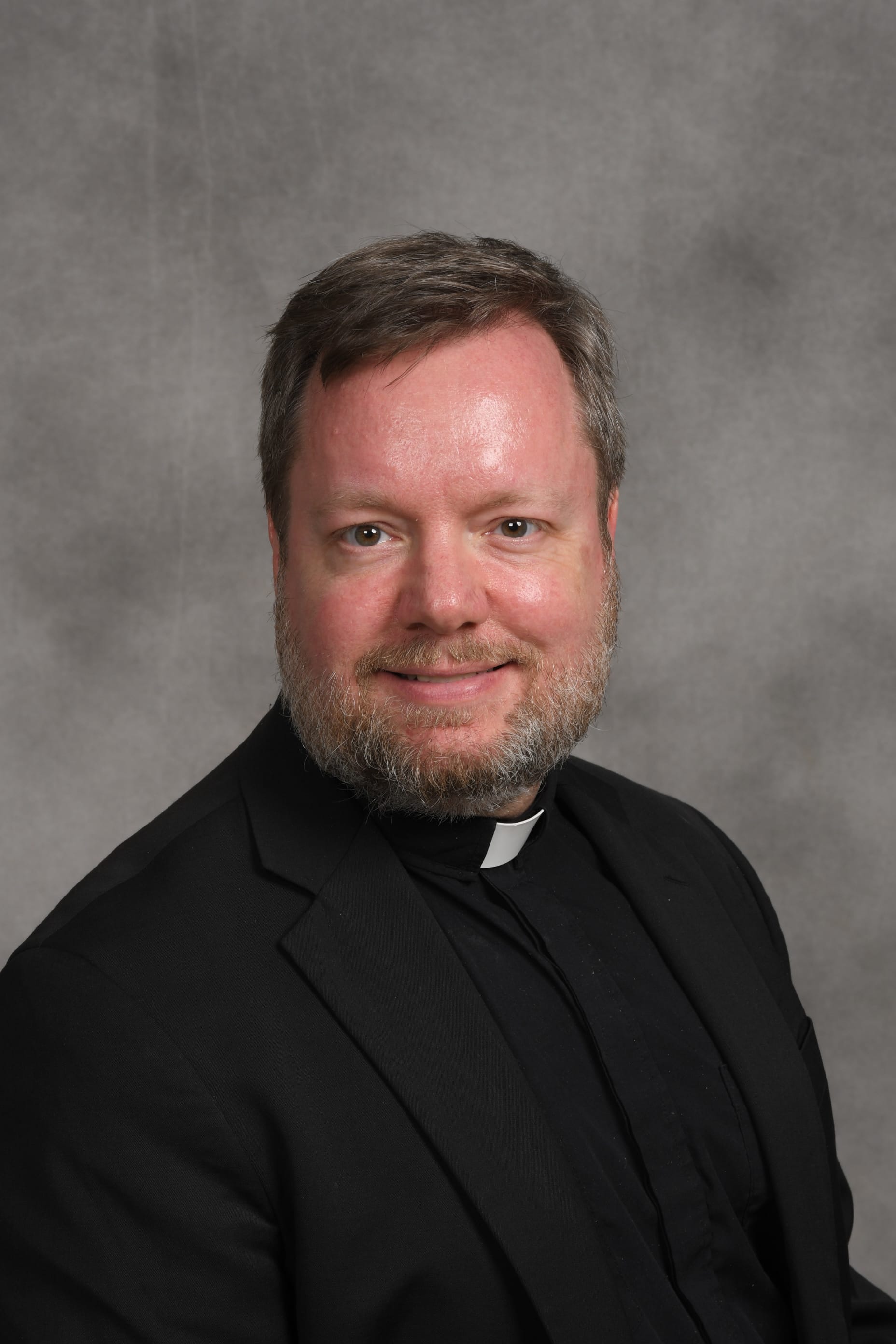
Father Jason Tyler is the pastor of St. Joseph Catholic Church in Fayetteville, Arkansas, where he has served since 2015. He is also pastor of Our Lady of the Ozarks Shrine in Winslow. He grew up in Morrilton, Arkansas, and was ordained for the Diocese of Little Rock in 2005. His previous ministry includes parish assignments in Little Rock, Springdale, Siloam Springs, Lincoln, and Huntsville.
Fr. Tyler received a License of Sacred Theology (S.T.L.) degree in moral theology from the Pontifical Athenaeum Regina Apostolorum in 2006. In addition to his parish assignments, he also serves as the diocesan bioethicist and as director of Continuing Education for the Clergy for the Diocese of Little Rock.
episode references.
- St. Joseph Catholic Church, Fayetteville: https://www.sjfay.com/
- St. Joseph History: https://www.sjfay.com/our-history
- St. Joseph Social Justice: https://www.sjfay.com/social-justice
- Diocese of Little Rock: https://www.dolr.org
- Mercy Health System, Northwest Arkansas: https://www.mercy.net
- Catholic Charities Immigration Services, Diocese of Little Rock: https://www.dolr.org/catholic-charities
episode outline.
- Content warning (00:00:01)
- Episode preview: saints and sinners — living in the tension of 2,000 years (00:00:28)
- Episode intro (00:02:41)
- Father Tyler's journey to the priesthood: growing up Catholic in Morrilton, seminary, and the call (00:07:51)
- Studying in Rome and the experience of being an outsider (00:11:34)
- What it means to be "ordained for a place" — the Diocese of Little Rock (00:14:13)
- How being bound to Arkansas shapes his pastoral outlook (00:15:37)
- The founding of St. Joseph in 1844 and the 1847 baptisms of enslaved people (00:17:40)
- Leading one of the most diverse congregations in Arkansas: 2,100+ families across continents (00:21:53)
- Sunday morning as the most multicultural event — a parishioner's testimony (00:26:18)
- The most segregated hour in America and why St. Joseph is different (00:26:27)
- Our Lady of Guadalupe: a bridge across cultures and a critique of colonialism (00:28:52)
- The Catholic Church's complex global inheritance: empire, resistance, and 2,000 years of tension (00:34:29)
- Catholic social teaching, the dignity of work, and corporate power in NW Arkansas (00:37:27)
- Labor, immigration, and the fear in immigrant communities (00:40:52)
- Belonging as an agent against fear (00:42:15)
- Biggest challenges: deportation and housing affordability (00:43:35)
- Catholic healthcare systems and the institutional footprint in Arkansas (00:45:28)
- Reconciliation, empathy, and the micro-level of moral life (00:48:38)
- Solidarity: the one word Father Tyler would offer the broader community (00:51:56)
- How to experience the Catholic tradition as an outsider (00:54:40)
- Father Tyler's fear: isolation (00:57:20)
- Wholeness: body, mind, and soul (00:59:19)
- Episode outro 1 / talk-back introduction (01:00:40)
- Talk-back: Monica and Mike process the interview together (01:01:26)
- Monica on radical welcome and the 1847 baptisms (01:02:04)
- Mike on reckoning, the thread from enslavement to today's diversity (01:03:24)
- The Guadalupe narrative as a gentle critique of colonialism (01:07:31)
- Immigration: the unresolved thread (01:08:42)
- The open invitation: belonging without requiring full commitment (01:11:42)
- Episode outro 2 (01:15:29)
episode transcript.
content warning.
[00:00:01] mike rusch.: Just a warning before we begin, this episode contains references to the enslavement and dehumanization of Black communities and the ongoing impact of immigration enforcement on immigrant families.
These are not abstractions. These are real things that happened to real people here in Northwest Arkansas. the underview is committed to honest storytelling about our place, and sometimes that means sitting with the full weight of what has been done here. Please take care of yourself as you listen.
episode preview.
[00:00:28] father jason tyler.: The Catholic church has 2000 years of history and we've got some great saints that we love to talk about. We also know there are some great sinners in our background and, and that's, that's part of the human condition for sure.
And, every one of us right now, as well as over the last 2000 years, lives in this tension of being in the world that we're living in right now and being in that sense, products of our own time and place with also this tension of being called to be in the world, but not of the world. And to be people who can go beyond, that limited sphere.
For us as Catholics and I would think for all Christians, that means trying to say, how do I live beyond simply my time and place? And how do I live the life that Jesus would call us to? And how do I treat others as Jesus would have me treat them?
We can look back and we see examples where, yeah, that didn't happen so well. If you're enslaving someone, you're not treating people as Jesus would want them to be treated. But within that I think we look and we say, okay, there was something was, wrong at that point.
We can also, as you say, look beyond and say, okay, we've got other movements and, whether it's abolitionists or civil rights leaders or just others who were looking out for, the good of the less fortunate the good of whoever was,downtrodden at that point.
episode intro.
[00:02:41] mike rusch.: You're listening to the underview, an exploration in the shaping of our place. My name is Mike Rusch, and this season, we're sitting down directly with faith leaders here in Northwest Arkansas and asking them to share their personal stories and the story of their traditions. We wanna know how they got here, what they believe, how they see their role in shaping the culture of this place. We wanna understand their faith, their theology as it flows from their institutions, and we wanna understand the weight those things carry into the world beyond Sunday morning.
Our first set of conversations will focus on some of the earliest Christian traditions that arrived here as a part of European settlement in Northwest Arkansas. The traditions that have been here from before statehood, as statehood arrived, and since before most of what we know about this region had even started.
Today, we begin that journey at St. Joseph Catholic Church in Fayetteville. The Catholic tradition may not be what most people think of when they think of the faith of Northwest Arkansas. However, it was the Spanish Catholics that first stepped into the land of the Quapaw, and with them, Christianity arrived.
Here in Northwest Arkansas, Catholicism may be considered a minority tradition. It arrived with the Second Great Awakening movement that brought waves of Protestants to this region. However, this parish has been on the ground in Fayetteville since 1844. That's eight years after Arkansas became a state, before the Civil War, before the university, and before most of the institutions that we now take for granted.
And in those earliest records, I found something that immediately caused me to pause. Their first sacramental act happened in 1847, and it involved the baptism of enslaved people, and a question from the parish's own history that I haven't been able to shake.
This is a season about what the church was built on and what it's becoming, And the Catholic story in Northwest Arkansas holds both of those things in tension in a way that I did not expect. A tradition that stretches back two thousand years, now showing up in a corner of the Ozarks where it's never been the dominant voice, and because of that, maybe seeing things the dominant traditions do not.
Father Tyler has been a pastor here for ten years. He'll tell you his story. What I want you to listen for is what it means to lead a community that spans continents, languages, and centuries. That today is building a church on a foundation that predates the Civil War, and that is right now, today, carrying the fear that Catholic immigrant families carry into the pews every Sunday morning.
This season, Monica and I are exploring the faith of Northwest Arkansas together. For this interview, she was not able to be in the room with me, so you'll only hear my voice with Father Tyler. However, Monica is always a foundational part of preparing questions, thinking through the research, and helping all of us see what we might otherwise miss. And to make sure we hear her voice in this episode, we came back together afterwards to process what we heard. You'll get to listen in on that conversation at the end of the episode. It's something we're calling the Talk Back.
Which leads me to one more thing before we begin. I want to say thank you for all of those that have shared your thoughts with us. The messages have been coming in behind the scenes, and they have been heartfelt, honest, and full of real truth.
Hard questions revealing pain that some of you may have never put into words before. And they contain other emotions like joy and doubt and the places that you're still wrestling with. We are humbled to receive them. We are reading every one, and we're asking that you send more.
Going forward, we want to invite you to add your voice to this season. There is more than enough room for you here. If you go to theunderview.com homepage, we've set up a way for you to record a voice message to us. Just click the Send a Voice Message button. It will cap you at five minutes, so plan out your comments accordingly. But we want you to share the truth of where you are. Tell us what you're hearing, what you're carrying, what you're still wrestling with.
Maybe you want to share a story from your experience or ask questions for Monica and I. You don't have to share your name, but we would love to know where you're from if you feel comfortable sharing. And then we'd like to include those messages in future episodes, whether that means responding to them, weaving them back into our talkbacks, or bringing them into our questions for future guests. This is not a debate. This is a collective process of discernment, and we believe that your voice belongs here also.
All right, we've got a whole lot to work through today.
Let's get into it.
episode interview.
[00:07:02] mike rusch. (2): Well I have the privilege today of sharing a table with Father Jason Tyler, who is the pastor here at St. Joseph's Catholic Church in Fayetteville.
Father Tyler, thank you for being available to sit and let us have a conversation about what faith here in Northwest Arkansas looks like from your perspective.
I'm really excited to do this, and so thanks for being here.
[00:07:23] father jason tyler.: Oh, glad to be here and glad to be able to speak to you today and to share a little bit of our story at St. Joseph.
[00:07:28] mike rusch.: Well, I'm excited. You've got an incredible story that spans not only millennia mm-hmm. but centuries here in northwest Arkansas. Yeah. And so I'll let you start wherever you would like, but I, I'd love to get a sense of of who you are and how you arrived in the place that you are.
[00:07:43] father jason tyler.: Sure.
[00:07:43] mike rusch.: And really your story of faith Yeah. About becoming yeah. A part of this faith tradition and mm-hmm. so I'll let you go, but tell, tell me your story.
[00:07:51] father jason tyler.: Certainly. Yeah. I grew up in Morlton, Arkansas, grew up in a a, a Catholic family, which is not a huge number in Arkansas by any means.
Right. Catholics are traditionally been pretty few in number. When I was a kid, I used to hear that we were about 2% of the population In Arkansas, I think it's maybe around 5% now, thanks to immigration, you know, either from Latin America or also even people moving from the upper Midwest that have come to Arkansas in the last 20 or 30 years.
But at any rate, I grew up in Morlton the oldest of four children, and as I was going through high school and attending a Catholic high school there in Marlton had begun thinking, you know, what am I going to do with life? And for a long time was thinking I was going to be a teacher. I loved the idea of service, of being able to pass something on to the next generation as it were.
But it was really late in my senior year of high school that I started thinking, wow, could I really maybe be a priest? And it had that same element of service there to it but it also connected something with with the celebration of what we call the sacraments within the Catholic church in, in the biggest of those being the Eucharist or Holy Communion. And that's something only a priest can do to take the bread and wine and change it to become the body and blood of Christ, which is what we believe happens, you know, at every mass. And, so as that thought occurred to me it was an interesting sort of thing because it was rather scary at first to say, gosh, no, I don't think I could do that.
And I don't know that I wanna live without getting married and having children and such myself. But yet the thought was still there and it kept picking at me as it were. Something that, that every time I was in church, every time I was at prayer, I would think about is this what God is asking of me in life?
I attended my freshman year of college at uh, lion College in Batesville. And uh, while I was there though, I decided I needed to go ahead and make the plunge into seminary life just to see, is this really God's calling for me? Because I thought I could go into the seminary and if it's not my calling, I'll figure that out within a year or two probably, and get back on track with everything else.
But if it is what God's calling me to, well then I can, can go through and prepare that way. So I spent my sophomore, junior and senior years at University of Dallas and Holy Trinity Seminary. That's connected to that. Got a philosophy degree there. And then for the graduate portion or theology study portion of my seminary training, I was was sent to the North American College in Rome. And so I spent five years there and was ordained in the year 2005, ordained for the Diocese of Little Rock. In the Catholic Church a priest is ordained not just to serve wherever, but is ordained typically either for a particular diocese. Or what's called a religious order. A religious order would focus on a particular type of ministry.
So like Jesuits, Franciscans, Benedictines are all examples of religious orders. And they may focus on education. They may focus on work with the poor. They may be monastic communities like the Benedictines. In my case though I had always wanted to be a diocesan priest serving in here in Arkansas. And the Diocese of Little Rock covers the entire state of Arkansas. And after ordination, I have basically bounced back and forth between Little Rock and Northwest Arkansas. My first parish assignment was at Christ the King in Little Rock. I was the associate pastor there. And then from 2007 to 2009, I was in Siloam Springs at St. Mary's. And that's where I tell people when they ask, where I learned Spanish, I'll tell 'em. I studied in Guadalajara, Mexico. They sent me to Guadalajara for a little bit of an immersion program. But I said I really learned Spanish in Siloam Springs because that was where I was using it all the time on a regular basis. And after two years there, I was back in Little Rock at St. Edward parish where I was the pastor there for a little more than six years. And then I've been at St. Joseph in Fayetteville since December of 2015. So a little more than 10 years now.
as an immigrant.
[00:11:34] mike rusch.: I love hearing the story just from an education perspective. But that took you to Rome for a time.
[00:11:39] father jason tyler.: Yeah.
[00:11:39] mike rusch.: I'm curious what that experience meant to you Yeah. And taught you to be away. I can only imagine as a young lad Sure from from Arkansas what that looks like to go to a place
[00:11:49] father jason tyler.: Yeah.
[00:11:49] mike rusch.: Like that.
[00:11:50] father jason tyler.: Right.
[00:11:50] mike rusch.: Yeah. I'm curious your perspective.
[00:11:52] father jason tyler.: Yeah. It was amazing, for one thing to go from a place where, again, there are very few Catholics on the ground, like Arkansas to a place that's just dripping with Catholic culture. Right. The local newspapers in Rome would, they have the day of the the day of the month and day of the year and everything. But then would also say what Saints Feast Day, that was on the, the main dateline, if you will, of the local papers and such. So there, there was that on the one hand the religious side that it was great. But it was also a very international context for me because although I lived at a building with other Americans and lived and ate and prayed there, my classes were in a very international university.
For the first three years I was at the one called the Gregorian University in the last two, one called Regina Apostle or Queen of the Apostles. And in both places, classes were taught in Italian largely. Now I could do my exams in English. That was good. But what I was listening to was in Italian, but I had classmates in those that were from not only Italy, but also Mexico and Brazil and Indonesia and Africa, Europe, wherever.
And it was an interesting sort of international experience in that way. But it was also interesting to. Move around through Rome and speak a little bit of broken Italian along the way. And it's something that helped me in two ways really to get ready to minister to a linguistically diverse congregation.
Because on the practical side of things, Italian and Spanish are similar languages. So having learned some Italian, I was able to, to transition to Spanish without much difficulty. And then on the other side of it, just knowing the experience of being someone out of place, as it were, being in a different place than where I grew up with different customs, different culture.
I have a, a sympathy then for those. Who have immigrated now very different experiences. And I'm aware of that, right? That I knew every time I was getting three meals a day at the seminary and I had a place to sleep and I wasn't having to worry about rent or mortgage or job and all the sorts of stresses that can go with someone who is in a a regular immigration experience.
Nonetheless, just knowing that feeling of being in a different place and being far from home as well I think has been helpful for me in doing what I do now.
[00:14:04] mike rusch.: Well, it's certainly from hearing all of the stories and all of the work that's happening, it certainly seems to reflect that. Yeah. Really beautiful to hear that.
[00:14:12] father jason tyler.: Oh, thanks.
ordained for a place.
[00:14:13] mike rusch.: Thank you. I'm really curious when you say you were ordained for a place maybe help me understand that a little bit more. What did context and understanding and framework, does that bring to a calling
[00:14:24] father jason tyler.: such as this? Yeah. It means, yeah, being ordained for a place means that I am giving my life, not only for I guess the abstract idea of priesthood, not only for my relationship with God, but in a real sense to serve the people of this place, in, in my case, again, the state of Arkansas.
And knowing that that this is, where I believe I'm called and where I believe I can serve best. And on the practical level, it's nice because I'm only a two hour drive from my parents. And I have one sister in Little Rock that's a three hour drive, but that's the farthest away of all my siblings. And so that's nice on that practical level. But on the, spiritual level, what's nice is to know that I get to be around people very similar to those that I grew up with. I get to be in a place similar, not the same, but similar to where I grew up. And to know that I'm bringing with me in my ministry, my whole life experience, not just the 20 years I've been a priest, but the 25 plus years, before that as well.
And that's true really for anyone in ministry, you know, of, of any religious background actually. But I think, you know, in knowing again, that I'm ordained for a place and it's the place where I grew up, there's there's some of that connection and that background that helps.
how ordained for a place influences outlook.
[00:15:37] mike rusch.: I'm curious mm-hmm. how that influences just your approach to, to, to the people here and to whatever may come.
That this is a place that you are called to Yeah. And so it, it sounds to me, you are tied to this place. And what happens here and to the people. In, in a really obviously powerful way.
[00:15:58] father jason tyler.: Yeah.
[00:15:58] mike rusch.: How does that inform how you view not only the work that you do here
[00:16:02] father jason tyler.: but,
[00:16:03] mike rusch.: Maybe what's ahead or what could be coming?
[00:16:06] father jason tyler.: So yeah, it does mean that, let's say if things were not going well for whatever reason I don't have really the option to just fish out my resume to different places and look for somewhere else. Again, another thing that happens as a Catholic priest, I take a promise of obedience. And so where I go within the diocese of little rock within the state of Arkansas is ultimately, my bishop's call in many ways, no I have, a certain ability to push back as it were if I needed to.
You know, if I thought there was a really strong reasons not to move at a certain time or whatever, I can, I can certainly make my case on that. But ultimately it is his his call, but even if something at some point when I moved outta here, 'cause I don't imagine I'll be here forever, but at some point when that'll happen, I'll move to somewhere else in the state of Arkansas.
And so I never leave this, this parish that I'm in, in a sense I never leave it fully behind and I definitely never leave the area fully behind because I guess the farthest away I could wind up is maybe Lake Village or somewhere at the opposite corner of Arkansas. But even there you're going to run into people that have connections back here to Fayetteville and I'm certainly going to know other priests who are, in various places of Arkansas as we get together. And in that sense even when the day comes, that I'm no longer physically in this location in Fayetteville. I'm still going to have various connections that can't go away. Even if, I wanted to and I wouldn't want 'em to, even if I wanted to, they wouldn't be able to.
[00:17:28] mike rusch.: It's fascinating to me, and I as I listen to you mm-hmm. this long trajectory of what it means to, to be called to a place mm-hmm. obviously has been represented by this faith community.
[00:17:39] father jason tyler.: Yeah.
the beginning of St. Joseph's.
[00:17:40] mike rusch.: Because this faith community, St. Joseph's here this story began in 1844. You right. Been here not too much longer after Arkansas became a state. Right. To a place when enslaved people were here, indigenous removal. This this is a place that you have a very long history in that I'm assuming, I don't wanna put words in your mouth, that you as the priest here look at that long trajectory, or how do you look at this place in its long history? Especially when maybe a beginning point of European settlement here began.
[00:18:10] father jason tyler.: I start off thinking of it in terms of just the Catholic church trying to be with people, wherever and obviously. In the American context the presence of the Catholic church has, in large part, followed where European settlement has gone. Just because, when you have your origins in a place that's where things are going to tend to go. And so it was with some of the Irish immigrants and such that were some of the earliest settlers or earliest parishioners at St. Joseph. And yes, we go back to 1844.
At one point, before there was any Catholic church or any Catholic building or physical presence, the priest would come up from Fort Smith on horseback and say mass in in someone's home. In the earliest days. We, again, 1844 is where we, we sort of trace those roots. By 1847, we have our first first baptism on the book. And and it's, it's again, tied up in the history of Arkansas in that sense too, that our first baptisms were of some enslaved persons. And so we run into that as part of our history. We recognize that in that sense, who we are as a community, again, it's not, we're not isolated from the broader world around us. And so as Arkansas was a slave holding state, so were, some, at least of the initial parishioners at St. Joseph. And but I'm very glad to see that, that, it seems that some of the enslaved persons were able to be baptized. We don't know details there, right? We don't know. Certainly we, I hope and pray that they. I asked for that baptism. Right. That was something they chose. And that's where I would start with that assumption. Certainly they did that, and in that case, we would see that as something good that was given.
And that's part of the Catholic view on something like baptism. It's not just ceremonial, it's not just symbolic, but we believe it really is a way of making real and effective the grace of God in someone's life at that point. And yeah, we don't know, a lot of those details I'm hoping then also those enslaved persons were then able to attend mass with with the white population, that was here at the time. But, those sorts of details, we, you know, I guess are lost to time in a sense.
[00:20:18] mike rusch.: It's fascinating story, just given what I assume was the context of the society at that point. What does it mean to you, from this parish's, first recorded sacramental act mm-hmm. was to people who at the time were not free.
[00:20:33] father jason tyler.: Yeah. It's, I think it's a couple of things. It means on the one hand attempting to be universal in one sense the word Catholic ultimately means universal. The Catholic church exists around the world. And I'm hoping that the mentality of the time among those, involved in that baptism was to say these are persons who have, they're human persons with the same dignity as everyone else. They have souls that are, is in need of salvation as anyone else. And we're going to make this baptism available. Certainly someone who's a slave holder, slave owner, it's hard to imagine what that thinking was like and how they could square that circle on the dignity question part.
But at the very least, my hope would be that the let's see, the priests and the others at the time who facilitated that would that was their that was their outlook was to say we're here ultimately for everybody. And that means yes, even the enslaved person or especially really, it's really better way to say it, especially the enslaved person is in need of that support and that, that grace of God.
[00:21:36] mike rusch.: Well, I'm biased. I think that story and that history as, and not to fast forward too far to today, but. This congregation is probably one of the more diverse congregations here in northwest Arkansas, if not all of Arkansas.
[00:21:53] father jason tyler.: Right.
a very diverse community.
[00:21:53] mike rusch.: Definitely one of the larger in the diocese of Little Rock. And so I'm curious, like, when you think about this responsibility of leading a community that really span this breadth of time. And today is an incredibly multicultural community.
How do you think about where you are today and what that looks like to serve a very diverse community?
[00:22:15] father jason tyler.: Right. Yeah, we are a very diverse community. As you say. We have five masses on a weekend. One of those is in Spanish, and it's our second largest mass and some weekends.
It's our largest, just depending on what's happening and everything. But that, that probably equates to around 30%, maybe as much as 35% of our parish would be Hispanic. And and they come from largely, from Mexico, but not always, we have some from Columbia, we have some from Venezuela, we have some from Chile, from Argentina, from Nicaragua and I'm sure a couple of other places I'm forgetting right now, right?
That it's, there's a good mixture there of where our Spanish speakers come from. And it was interesting recently, there was a Spanish speaker that was telling me how much he appreciated that diversity, even within. Just the Spanish speaking community. He said, he had grown up in Mexico and before he came here, he never knew people from these other countries of Latin America, but it was coming here that he's come to know them.
But beyond even our, just our Spanish speaking population, I can think of parishioners, attending our masses in English. We have a good number from Cameroon actually. We have some from the Dominican or the excuse me, Democratic Republic of the Congo. I know some from Haiti some from gosh, I know other places that are, I'm blanking on at the moment, to get into particulars.
But yes, it's, you look around it's a pretty mixed sort of congregation. I actually had a parishioner tell me not long ago that in his job they're doing some exercise and they asked, people to name, what's the most multicultural event you've done in the last month or in the last year or something like that, and his response was going to mass at St. Joseph. That, that was his, what he saw as the multicultural event. Just because you can look around at who's in the pews but as well as who may be the lector that day who may be in the choir, that sort of thing. And see folks from different parts of the world represented.
And it's not something we, we actively try for. It's not something where we said, okay, we're going to try to have this international congregation. It's really in many ways the result of being part of the Catholic church because the Catholic church is, again, it is worldwide. You do find it in different places. And thinking too about a couple get married here this summer, a couple from Rwanda, and they're bringing in a Rwandan priest who's working in Washington, DC. We had last year, two wedding. Of two different Kenyan couples where a priest from Oklahoma came and did those weddings in the Swahili language. Which is one I don't speak. But uh, you know, so there's, there's always something for me to learn in the process there too, because even as it is one faith around the world, there are a lot of customs that vary.
Things that I learned I'd barely heard of our Lady of Guadalupe at the time I entered the seminary, for example. And now that's a big part of what I do every year. December 12th, you have the Feast of Our Lady of Guadalupe that we celebrate. But even other little things like at one of the Kenyan weddings that we had last year, I was at the reception and it came time to cut the cake and the couple said, oh, one of the customs in our country is we. We feed a piece of cake to the priest. I said, really? And they said, oh, yeah. And so they, it was interesting that, I stand up there and open my mouth and they put a little piece of cake in and I'm like, okay, I didn't expect that. And yeah. But not something I grew up with, but something I wanna be able to respect as well as part of their their experience of the moment.
And so, ultimately, what does it mean for us, as such a diverse group? I'm hoping what it means is parishioners who maybe would never have met someone from Kenya or Rwanda, may end up sitting in the pew next to somebody like that, and then maybe having coffee with them afterwards. And may, be grabbing a donut after mass is over. And learning a little bit about some of those different backgrounds, just as I've had a chance as a priest to learn a little bit. And I know there's a whole lot more that I've not yet learned, but I've learned a little bit. I'm hoping our parishioners get that experience as well.
And then for for those who do come in from other countries, I'm hoping they see some of the best aspects of Americans and what it means to be an American and what it means to be in Arkansan here.
[00:26:18] mike rusch.: I've heard it said many times that Sunday morning is sometimes the most segregated time in America. Sure.
[00:26:24] father jason tyler.: Yeah.
[00:26:24] mike rusch.: And that doesn't sound like that's the case here.
[00:26:27] father jason tyler.: Right.
most segregated place in America.
[00:26:27] mike rusch.: What does that say to our broader community?
[00:26:29] father jason tyler.: Yeah. Yeah, I've heard that said before too, that Sunday morning can be the most segregated time in America.
For me growing up in again, in Morlton, Arkansas or in Conway where we lived briefly as well. I don't remember seeing that kind of diversity, in my childhood. A couple of things I think are different. One is just the immigration patterns and rates have changed a lot in the last, 30 years or whatever. But also Fayetteville itself is just a more multicultural city in terms of people's backgrounds than the small town I grew up in. So there's that, first of all, but, even that being said even a little place like Marlton, there were, I remember a few African American parishioners that were there with us.
I remember, a very small number in those days of Hispanic parishioners as well. We didn't have anything offered in Spanish at that point, but remember seeing a very small number there. So yeah, part of the, I think the other thing to consider St. Joseph is the only kind of regular, we say family type parish for Catholics in Fayetteville, there is St. Thomas Aquinas, that's specifically for the university community. But St. Joseph, as I like to say, people to people is for the other a hundred thousand or so people around. And a lot of times in other parts of the country a town the size of Fayetteville would have probably three Catholic churches.
Some of why we don't is just the growth has happened so quickly and it's happened at a time when in the Catholic church we don't have as many priests as we used to. And so we're allowing parishes to get really big rather than creating more of them. So what's happened, I think in some places, even within the Catholic churches, when you have more Catholic churches in a particular place, people can sort themselves a little bit, whether it's on socioeconomic lines or ideological lines or sometimes maybe ethnic lines.
But we don't have that here because, it's the one, one spot that we all have. So again, we, it's not that we're I guess actively trying to to be diverse in that way, but we certainly welcome it and we're certainly glad for it. And and again, a big part of it is I think just the nature of, of Catholicism being, on the global stage, and people being able to come in here and know that, if you're from say from Cameroon, you come in here and yeah, the music's going to be a little bit different. The language may be different, but there's a familiarity to what you find as well.
a bridge across people and cultures.
[00:28:52] mike rusch.: Father Tyler, you mentioned the, just the celebration of of the Feast of Our Lady of Guadalupe.
Yeah. And this is something that the entire parish is invited to. Yes. If I understand correctly. And that you've also written about how this is a figure for all Catholics. Mm-hmm. Not just those of Mexican heritage. Yeah. And I'm curious, as you think about how this becomes a bridge across people or communities or cultures.
[00:29:16] father jason tyler.: Right.
[00:29:16] mike rusch.: I'd love to understand that from your perspective.
[00:29:18] father jason tyler.: Sure. Yeah. Let me first mention a little bit about, the Guadalupe story itself and uh, and what that means for especially people of Mexican background but hopefully others as well.
So the story goes that in, I believe it's 1531. I may be off a couple years, well, one way or the other on that, but I believe it's 1531 that the Virgin Mary appeared to an indigenous man named Juan Diego. And Juan Diego was already a Christian. He was one of the few indigenous who had adopted the Christian faith.
Even though Franciscan missionaries had been in what's now Mexico for 20 years or so. By that point, they had very few that had accepted the faith because they saw the Christian faith and the Catholic faith which was, at that point it's one and the same, there were no Protestants coming in at that point. And I guess for most of that time, Protestantism didn't quite exist yet. But at any rate they, the indigenous saw the Christian faith as just being a European thing, being a colonizer thing, rather than something that they could take on for themselves.
With the apparition to Juan Diego the Virgin Mary appears and she appears in the appearance of, of one of their own, as it were. She appears, Aztec or in indigenous of the time with darker skin, she's wearing a, a cloak that with colors you, with kind of the green and red colors that were symbolic and meaningful for the people she's wearing Even a a black belt, which at that time meant a woman was pregnant in the Aztec culture.
Well, of course, this is December, we're coming right up near Christmas. And so on the Christian calendar you would say, okay, this is a time Mary is getting close to giving birth. And so she, she appears this way. She speaks to Juan, not in Spanish, but in his own native language. And Noal, I think is how that's pronounced.
And. She appears and she first says something along the lines of build me a church here. This is where we need to build a church. And Juan doesn't know what to do. He goes and tells the local bishop who was of course, a Spaniard as the clergy were at that point. And the bishop does what I think most bishops would do is like, okay, yeah, bring me some proof that you really did have a, a revelation. And then Juan going back the next time the Virgin appears to him again and she says the same thing. And she says, go back to the bishop and just open your cloak when you do. And he's wearing this this big kind of cloak covering, and he opens it and these large number of roses fall out and they all. Castilian roses that should not be growing in Mexico, should not be growing in December by any means. But there they are. And and so suddenly the bishop believes at that point that, okay, this is something divine. And he does start the work on building the church.
Well, but much more importantly than that church uh, getting built is then large numbers of indigenous people begin to accept the Christian faith based largely on this story. Because they see the image and they see paintings and things later and they say, okay, look she's not, pale white or whatever like the Europeans but she looks like one of us. And they're saying, Hey, this faith isn't just for them. It is for us. In Mexico nowadays. Sometimes the Guadalupe apparition that Guadalupe event is marked as being the, in some ways the birth of the modern Mexican people because it's something that's not purely Spanish, but also not purely indigenous.
That there's the combination of the Christian faith that, that, that came from the old world as well as the the appearance and the speech and everything of of the new world. What does that mean for the rest of us?
Well, what I like to say is for those of us, from the United States who have grown up here and maybe don't have any Mexican background, we still see this as a great kickoff in evangelization in terms of spreading the faith and the large numbers of people coming to know coming to know Jesus and being being able to be connected to him in that way.
But we also can see it as a way that, that God wants to make himself known in every place and in every time in different ways and wants to make himself known in a way that can really invite people in.
And so if the Franciscan missionaries weren't the right tool, so to speak, in Mexico, by that point, then he sends the Virgin Mary with making that appearance and making it again, not just in a way that says, I need all of you people to conform to this old way of doing things, but rather. Here we are in this, new way as it were of presenting the same same faith as before, but presenting it, in a way that, that is saying it's for you as well. And so I think that's valuable for any of us as a way of saying our faith is not meant to be simply something imported either from across the world or even just imported from our own parents' minds into our own, but rather something that is personal for each of us. And so the Guadalupe apparition was a way that, that we think we would say God is trying to make himself known to a particular people in time, but it's just one example of God reaching out in that way.
a complex global inheritance.
[00:34:29] mike rusch.: Thank you for sharing that story. Sure. I think, real, really beautiful to hear just that from a kind of a bridge. Mm-hmm. I don't know if that's fair to say. Yeah. Or not a bridge building. But, and you mentioned in this maybe this idea of this just like it is a complex global inheritance mm-hmm. that the church certainly has that, that bridges borders. Mm-hmm. Um, is, Is I don't know if it's fair to say is above borders in many ways. And I'm curious as you think about this complex history of both, sometimes colonization that you've mentioned but also this this idea, some really powerful resistance movements.
[00:35:02] father jason tyler.: Mm-hmm.
[00:35:02] mike rusch.: That have come through Catholic faith. Mm-hmm. Whether that be liberation theology in Latin America mm-hmm. or Catholic worker houses, Dorothy Day. Mm-hmm. I mean, I'm curious like how do you hold that complex global inheritance. Yeah. And that duality sometimes as a Catholic priest here in the American south.
[00:35:19] father jason tyler.: Yeah. The Catholic church has 2000 years of history and we've got some great saints that we love to talk about. We also know there are some great sinners in our background and, and that's, that's part of the human condition for sure. And, every one of us right now as well as over the last 2000 years, lives in this tension of being in the world that we're living in right now and being in that sense, products of our own time and place with also this tension of being called to be in the world, but not of the world.
And to be people who can go beyond, that limited sphere. And for us as Catholics and I would think for all Christians, that there, that means trying to say, how do I live beyond simply my time and place? And how do I live the life that Jesus would call us to? And how do I treat others as Jesus would have me treat them?
And again, we can look back and we see examples where, yeah, that didn't happen so well. If you're enslaving someone, you're not treating people as Jesus would want them to be treated. But within that I think we look and we say, okay, what was, there was wrong at that point. But we can also, as you say, look beyond and say, okay, we've got other movements and, whether it's abolitionists or civil rights leaders or just others who were looking out for, the good of the less fortunate the good of whoever was, downtrodden at that point. And so we said you, so the, power's attempting thing and wealth is attempting thing.
And so when people have wealth or power, no matter what their faith background is, you do have that temptation to to acquire more of it and to acquire more of it by by harming others sometimes if that's the way to get to the greater wealth or the greater power. And that's how I look at it at least, when I can say, okay, that say a Catholic king in a particular European country ordered something that we would look at today as, heinous or, very problematic to say, well, yeah, he was a person who professed the Catholic faith. He did this horrible thing. But it's also very much about, yeah, trying to hold on to his earthly power and maybe losing sight of that bigger picture of the faith that he was called to, to embrace.
power & NW Arkansas.
[00:37:27] mike rusch.: Well, you and my ears perk up when you use this, this term power. Right. Okay. Because I think in many ways, this is my perspective. This is the conversation of our world today. In this the enculturation that's happening.
[00:37:39] father jason tyler.: Yeah. Right.
[00:37:39] mike rusch.: Sometimes through the church. And when you look at this tradition, especially Catholic social teaching, when you look at this rich tradition of this preferential option for the poor mm-hmm. and the dignity of work. The common good. This is a region that is shaped by power.
Whether that be global corporations mm-hmm. The state. Mm-hmm. Obviously growing up, just what is the mechanization, industrialization of agriculture look like. Mm-hmm. These are, These are immense conversations that I think we're trying to, to navigate through. And I'm curious, from the church's social teaching perspective where is this tension of power and maybe the economic realities
[00:38:18] father jason tyler.: mm-hmm.
[00:38:19] mike rusch.: of how it shapes this place here?
[00:38:20] father jason tyler.: Sure. uh, I guess I would start first of all looking at, the experience of each individual, you speak about the dignity of work and the common good and those are absolutely paramount because the human person ultimately is we would say the high point of God's creation. And so when we speak about uh, the value of work has value because it's the, the time and the sweat, the energy of human persons. And and so yes, that's a part of Catholic social teaching is to say that we work in a sense to be co-creators with God to continue improving and building this world he has given us.
And that we work not simply to, make em make money and feed our families as important as that is. And there's a whole social justice component that goes with that in terms of just wages and things that are required. But work we have to recognize has a real dignity and value in, in being the contribution of a particular person or several particular persons to to this world that we live in.
So yeah, we need to start there and start to say, okay each worker at every job, whatever you can think of it is a. A work with its own dignity, its own value, its own goodness. And so if you're the person who is in charge of several hundred or several thousand or more people who are doing the work that's maybe not the most desirable, the work, that's the more menial the, that's the more difficult the thinking has to be, not just how do I turn a profit, how do I answer to my shareholders?
It has to be also, how do I treat with justice, with compassion? Those who rely on that paycheck that I'm signing, how do I set up the conditions so that things are safe and appropriate and everything as well?
And obviously there's a balance there because the the. The company has, if the company doesn't turn a profit, it closes and everybody loses that job. And that's not a good thing either, and we don't want that. So profit is not evil of itself. I mean, it's, It's uh, part of the necessary, movement of things in a sense. But with that, yeah, there has to be that, that emphasis on the value of each individual.
And if anything, my hope would be that someone coming to church, to any church really gets an opportunity to see people of different, not just different ethnicities, but different economic backgrounds, is a way of understanding that understanding more completely that value of each individual and understanding the value of those who are doing the kind of work that a lot of people don't want to do.
labor & the fear in immigrant communities.
[00:40:52] mike rusch.: Well, and maybe if I could go a little bit farther mm-hmm. because I, I think. Your church and your community is I guess my assumption would be is on the front lines. Yeah. What of, what this conversation looks like in our world. Mm-hmm. Mm-hmm. Not only probably many latino, Hispanic uh, congregants that came here. Obviously for work. Mm-hmm. and Maybe also some who are Yeah. Fearful of what kind of the rhetoric is around.
[00:41:13] father jason tyler.: Yeah.
[00:41:13] mike rusch.: The immigrant, right. And the stranger. And the foreigner here. Yeah. And so I'm curious from your perspective how do you speak into. Into these realities
[00:41:21] father jason tyler.: Yeah.
[00:41:22] mike rusch.: That are true here in northwest Arkansas.
[00:41:24] father jason tyler.: Sure. Yeah. You're right, there is a sense of fear among among many of our Spanish speaking parishioners, fear and concern about what will happen next. Fear about, can we go out and be out in large groups, in public even. What does that do for us in terms of what may happen next?
One of the things I try to touch on is to say that God is always with us, that there's a certain level of trust that all of us need at that point. And then I also try to say that the church wants to be continued to be there, wants to make sure we are there too, wants to make sure that we are able to offer, at minimum first, a spiritual home, a place where you can come in and and worship the Lord and be together and en enjoy events together and that sort of thing. But then hopefully beyond that, we can also be something that can appeal to people's consciences along the way.
belonging & fear.
[00:42:15] mike rusch.: As this church and this place continues to grow and evolve. I'm curious how you view the role of this faith community as being really this agent of belonging, this agent of place.
[00:42:27] father jason tyler.: Right.
[00:42:27] mike rusch.: Maybe that works against fear.
[00:42:29] father jason tyler.: Yeah. I'm hoping it works against fear, you know, having a place of belonging in a place where people can feel safe. And I'm I'm, yeah, again that's at one thing where at least we can start.
Beyond that, My hope would be to help, help our non-Spanish speakers to to see the real human connections that we have, among the different folks of different backgrounds of different, again, ethnic or national backgrounds, different language backgrounds to help everyone to recognize, the bonds that we have.
And I've spoken about that before in terms of even as baptized Christians and having that bond. But it, even beyond that too would be our common humanity and to recognize that that as much as we might want to have our town, our society, whatever, look a certain way or feel a certain way, like maybe it did at one point. And that's not necessarily a bad desire in and of itself, but at the same time, we have to ask what are the costs of that? And if the costs are trampling along on people along the way that's where we have to, to really stop and reevaluate that.
biggest challenges for St. Joseph's congregation.
[00:43:35] mike rusch.: As you look at your role here and the broader culture that that is here I'm curious what you think maybe some of the biggest challenges are that are facing the community here in Northwest Arkansas.
immigration status.
[00:43:46] father jason tyler.: In terms of challenges facing North West Arkansas again I'd go back to what the immigrant population's concerns are probably the ones that jump out at me most because I hear so frequently about that about the, concerns about deportation. It's not just those who have criminal records that are being picked up these days.
I've known parishioners that on a minor traffic violation wind up getting put through the immigration process or for, ultimately for deportation. And often they're leaving behind families that are really struggling at that point. I was visiting with one just this week that would fit that description actually, and. I gotta say it's an impressive thing that the case I'm just talking about when I just learned about that, like, I think it was a day before I'd had an email from one of our, English speaking parishioners who's grown up in this country, who said, father, I'm really concerned about what's happening on immigration. Is there any anything I can do to help? Is there any particular person I can reach? And then, the next day I said, well, actually, yeah, I've got somebody I can connect you with right now.
But so there's that and there, and even those who have legal status here have a real fear that status is going to be revoked, is going to be taken away, that they're going to get swept up along with with everyone else.
housing affordability.
[00:45:02] father jason tyler.: But that's not the only concern. The other thing I hear a lot from people are questions about housing, housing prices and how expensive it is to to. Live in this area now compared to even a few years ago the rising prices of rent and and other expenses and such.
And so that's, that would be another concern, that I hear a lot about, and that people wonder, what does that mean for for the future?
catholic health care systems.
[00:45:28] mike rusch.: I think one thing too that always strikes me as really beautiful about Catholic faith. Especially here in northwest Arkansas the work of the Catholic church. Even in our healthcare systems. Mm-hmm. Mm-hmm. So my family relies mm-hmm. upon the healthcare systems that are here because of Catholic tradition.
[00:45:43] father jason tyler.: Yeah. Yeah.
[00:45:44] mike rusch.: I'm curious how you view that larger cultural footprint, if you will.
[00:45:48] father jason tyler.: Yeah.
[00:45:49] mike rusch.: And what that means to our community.
[00:45:50] father jason tyler.: Right. So yeah, there are there are a lot of Catholic hospitals around in the United States, and Arkansas in particular has, I don't remember the exact number now, but it's a much larger number than most people would think, given how small the Catholic population is and has been in Arkansas.
But Catholic hospitals were largely founded by groups of religious sisters, nuns they might commonly be called, and a lot of those in the US would trace their roots back to the 19th century. And it was seen as simply, one way of living out commands of Jesus to care for the sick was seen as a way of continuing his ministry of healing the sick, and was seen really also as a way of helping and caring for the poor because the wealthy are always able to find the, the abilities in one way or another.
Um, So yes, you have Catholic Healthcare is a large presence here. So for Northwest Arkansas, there's Mercy Hospital in Rogers, and Mercy has also a large hospital in Fort Smith, and they have, various clinics connected to those. Little Rock has Catholic Health Initiatives. St. Vincent. Hot Springs has a Catholic hospital, as does Jonesboro. And those are the big ones. There are smaller ones in littler towns like Ozark or Morrleton or such. But and yeah, so that, that's, that's an example of kind of the, again, the idea of seeing how do we care for the poor? How do we care for the sick? And to my knowledge there was never a time when it was thought that, okay, we're going to build a Catholic hospital just to treat Catholic patients, it was always a sort of, this is a service for the community. I'm sure there was also, at different times to different levels, a way of saying, we want people to know who Catholics are. We want people to know what the Catholic church is and maybe someone wanna become Catholic as a result of that, and if so, great. But I think the larger emphasis has always been, again, caring for the sick, caring for the poor, continuing the healing ministry of Jesus. And that's, that's a spirit of that I think animates those hospitals very much today.
You don't have the large numbers of sisters around as you used to have. Just, and that's part of a trend that's happened nationally that there are, as much as we've had a, a drop in the number of priests over the last 50 years, the drop in the number of sisters has been even more significant in number, but their charism, their gift of the spirit, as it were, continues on. And yeah.
[00:48:01] mike rusch.: Yeah it is really beautiful to see that so much of our infrastructure especially in healthcare especially in a state where maternal healthcare and healthcare has been a challenge.
[00:48:10] father jason tyler.: Yeah.
[00:48:11] mike rusch.: I know I don't think that as often as I should, but to understand obviously that the Catholic faith tradition is is helping to provide for people in ways that sometimes we don't even think about. It's just, it's really powerful.
And I, I wanna shift if I can to this idea of reconciliation. And maybe that's not a shift away from healthcare. Maybe that's part of that. I wanna be careful how I say that. But I've noticed as I've listened and tried to be a student here, that there's such a strong expression of empathy.
[00:48:37] father jason tyler.: Mm-hmm.
[00:48:38] mike rusch. (2): And this consistent emphasis on this idea of reconciliation. And there was one recent sermon that focused on the obligation to reconcile before receiving communion.
And the congregation had about 15 minutes to just sit during part of the service. And gave space for this idea of reconciliation first.
[00:48:58] father jason tyler.: Mm-hmm.
[00:48:58] mike rusch.: I don't know if it's an urgency for reconciliation. I'm curious where this comes from and how this works itself out to extend not just within the church and the liturgy. Yeah. But it's the public life of this community. Sure.
[00:49:08] father jason tyler.: Well, just to clarify, the specific sermon you're referring to is actually given by one of our deacons and not directly by me, but it's definitely in keeping with the spirit of things I've preached on and that overall topic.
And I think if I look at my own say pattern of preaching and things I'm speaking on and that sort of thing, I tend to focus on. I guess you could call it the micro level rather than the macro level of the moral story and the moral needs that each of us has. And what I mean by that is to say, rather than talking about, what's the latest societal trend or what's the latest issue before Congress that we all need to have an opinion about.
I'm trying to say, okay, how do we interact with each other in such a way that that we can individually be more the people Jesus asks us to be with the hope that if we're doing that at the level of individual relationships, that it has a way of percolating up, so to speak, to to bigger trends in, in, in bigger areas of society.
And so the idea is to say that, yeah, we have a lot of conflict in our nation, a lot of conflict in our world. But there's also conflict within families. There's also conflict, within people who are in the same household. And that's true now as much as it was 200 years ago or 2000 years ago.
That's part of the human condition. I often tell people, listen, one of the challenges I can look at even as someone with a promise of celibacy, I can look at the idea of marriage and say, okay, I know why people struggle. Because you bring each of us as human beings has a tendency to look out for our own self-interest, our own needs.
You bring two people together, and they're now supposed to be looking for the interest of the two of them as a couple and as a family. Well, that's in tension with kind of this programming, as it were to to look for our own individual needs. Butso yeah, if we've got this idea that we've got some conflicts within families, we've got conflicts within workplaces and such as well, um. it, we can do a lot more to fix that than we can about what's happening, say nationally or internationally or whatever else.
And if we start by what we're able to focus on close to home then it can have that, hopefully that effect, in the broader world as well. And so the thinking is too, that if I can't be a peaceful person with those, I'm around most of the time, how can I be a peaceful person with someone, in the Middle East? Or, how can I expect the nation to be peaceful with other nations of the world if I'm not working for peace at home myself?
[00:51:40] mike rusch.: I honestly, father, you can just keep talking. 'cause I feel I feel like this is not, this is something that I could Okay. Never hear too often. Okay. Or enough of. Okay. And you don't have to, I'm just saying, but like,
[00:51:52] father jason tyler.: right.
[00:51:52] mike rusch.: I just, there's great peace as you lay that out. Yeah. So thank you for that.
[00:51:56] father jason tyler.: Certainly.
what does this tradition have to say to our community.
[00:51:56] mike rusch.: As we've talked about the broader culture mm-hmm. from your perspective and the perspective of the Catholic faith tradition. I'm curious what you would say to this community. What is it that's on your heart and on your soul
[00:52:07] father jason tyler.: Yeah.
[00:52:07] mike rusch.: That you would want to maybe offer up to the community? As a, as something to consider.
[00:52:11] father jason tyler.: Yeah. I would almost put it down at this moment to one word, and that's solidarity.
Solidarity is one of the principles of Catholic social teaching, which you brought up earlier. And solidarity is something that doesn't have to be a specifically Catholic thing. It doesn't have to be a specifically Christian thing.
It's a recognition of people being united, being in, in things together. And we recognize that in, in various ways. If we, if you leave your house and you're driving down the road, well, you're driving on a street, somebody else built, somebody else maintains it's a whole a network of people involved in every little thing we do. And you go to McDonald's and order a burger, well, there are people that have to cook that, people that have made that and brought it there. And I would say, one of the things I hope we can remind the world about would be to say that none of us, is really created to be an island.
None of us was ever really created to be separated from others. As Americans we're a country that's built and we, have our 250th anniversary this year. It's a wonderful thing. We're built on individual rights, which is a, the bedrock of our whole real legal system. It comes down to that.
That's what's great about us. Well, that's also what can be difficult in our society as well, because the strong focus on individual rights can make us forget about the communal or the societal effect that each of us may have.
And so, even if legally we're not required to care for the poor, so to speak, if there's nothing about an individual, right, that jumps in there, well, my gosh, can't we move, find our, in our hearts to be moved morally to be moved for the compassion to do that?
Even if we may not be required, in this system of individual rights to think about the broader sphere, can't we, do that voluntarily and from our own desire and our own heart and everything. And so that's what I would hope that solidarity could bring to to the broader society, that we could think along those lines to think of, how is it that my actions not only serve me and those that I know right around me, but how do they affect others that go beyond me? Others that I'll never even meet and that I'll never even know the names of, but yet are affected in some way or another by what I do.
[00:54:26] mike rusch.: Maybe just put that on repeat. We can just let that continue. To to go out and to form and shape this culture. I think I love that. I love that, that capture of solidarity and, yeah. We I think we need some of that in our world uh, in many ways.
how to learn more.
[00:54:40] mike rusch.: Mm-hmm. Um, I'm curious for those that may not be from a Catholic faith tradition. Yeah. If they want to learn more, they wanna understand what does it look like to
[00:54:48] father jason tyler.: Yeah.
[00:54:48] mike rusch.: To step into this place. What would you recommend?
[00:54:50] father jason tyler.: So one thing you're always welcome to come to a mass, right? That, that, that's open. But I also understand that can be a little intimidating for people, right? If you're, especially if you're coming on your own, if you don't have a Catholic guide to, to move you through it. People have said little things like, sometimes you guys just start singing without saying what you're singing from or what, where is, what's that all about?
And I said, okay I get that. I grew up with it. So I don't think about it in the same way, but I can see that as an outsider, that can be a little bit intimidating. If you've got a sort of Catholic friend that can guide you through it, that helps, if not little things like say the Guadalupe celebration on December 12th.
Now a lot of that's in Spanish. We, we say bilingual, but it's predominantly Spanish because it's, a feast that's really connected mostly to our Spanish speaking population, or they're the most motivated for it, I guess. And, and, and I certainly want them to be able to follow, everything happening that day.
But I do certainly preach in both languages when that time comes. But beyond just the mass that day, I would say the larger reception and food that happens afterwards. Other things, you know, we have every fall in September we get started, our new Christian initiation group cohort of those who are looking to become Catholic and some of them inner knowing they wanna become Catholic. Some just wanna. They're like, they're curious and they want to find out more. And they come a few weeks, maybe they come a few months and then they figure, ah, this isn't for me. And we're like, okay, thank you for coming. We're glad that you took a look at it. Glad that you maybe learned a bit more even, even beyond that. And then again, that starts in September. But if someone we're looking to jump in earlier, we have for our Sunday mornings after our nine o'clock mass, we have a kind of a called the Vine, one of our scripture study groups that's just jumping in deeper on the scripture readings we heard that day.
And so that may be a way to, to get to know a few folks and get to know more of what it is that the Catholic Church believes and teaches. And and so those I think are a few good, starting points that that could be helpful. And then never discount the value of individual connections and relationships.
The good thing again about being a, a bigger congregation is if you're listening to this, there's a good chance, you know, somebody who's Catholic and maybe that's the best place also to start. But don't be surprised if the friend you ask three or four questions and you get very quickly to similar. Huh. I don't know. I never thought about that. Because again, if you're, what we call a cradle Catholic you grew up being Catholic. There are certain things that you just absorb without really reflecting on until until somebody asks you that question.
[00:57:11] mike rusch.: Well, it sounds beautiful and it definitely, the spirit of welcome. I can, others can't see it, but I can see your face. It's just that spirit of joy as you speak through this.
fear.
[00:57:20] mike rusch.: Through every conversation I've had i've asked kind of two questions. Okay. And the first one is related to fear.
And I, I've always felt that if someone can name a fear it really helps people connect with,
[00:57:29] father jason tyler.: yeah.
[00:57:30] mike rusch.: I don't know. Maybe I feel that way also. Yeah.
[00:57:32] father jason tyler.: Yeah.
[00:57:32] mike rusch.: And maybe connects to our humanity in some ways. I'm curious is within the context of our conversation, within the context of your tradition and this community.
[00:57:40] father jason tyler.: Yeah.
[00:57:41] mike rusch.: I'm curious, what are your fears?
[00:57:42] father jason tyler.: I don't spend a whole lot of time thinking about fears, so let me let, give it just a moment. That's good.
[00:57:46] mike rusch.: That's good. I love that. Teach, teach us, teach me please.
[00:57:49] father jason tyler.: Maybe I'm a natural optimist in that sense, or always thinking something hopeful or something mo you know, for the future. But I, I guess in that sense, if I spoke earlier about solidarity as being something I think we, we can hopefully support and provide, I guess then my fear would be something like isolation. And I don't mean that on the world stage as much as, I mean on the individual stage. If we, if we become more and more of the kind of place kind of society where people are not hanging out together, spending time together making efforts to be in one another's company and to even waste time together, so to speak.
If we're not doing that, we're losing something. I think of our humanity along the way. And technology has allowed us to do so many things so efficiently. I do it myself. I got my smartphone all the time, and if I'm in line at the grocery store or something, I pull that phone out and I'm looking through something, was it 20 years ago, 30 years ago, we would've just stood in line and I guess glanced at the headlines on the tabloids at the supermarket or whatever.
But we might have also struck up a conversation with the person in line in front of us or behind us. We might have been a little more likely to have some of those. Those human connections. It's great that our technology, it unites us too, right? Social media has connected me with people I hadn't known or I hadn't seen in a long time, and they live far away, but I can speak to them now in that way.
But it does have that potential to isolate, and that's one of my, I guess one of my fears over the long term for our society is that if we become more and more isolated, it becomes less and less possible to have that, that important concern for our brothers and sisters that we need.
wholeness.
[00:59:20] mike rusch.: Well, I love that. And I, I think the flip side to that fear question, is this one of wholeness?
And these conversations, this trying to understand from everyone's perspective in our community this idea of wholeness for the person or wholeness for the community. You spoke to this a little bit but I'm curious, like, what does wholeness look like to you in this context?
[00:59:39] father jason tyler.: Yeah. Wholeness. Wholeness ultimately, I think has to touch on our our body, our mind, and our soul. Where is it that we physically are we in? Are we in, good shape and good health? First of all? And if we are we feeding our mind? Are we continuing to learn? Are we looking to to come to know something more about the world around us? And then finally, our soul. What are we doing spiritually?
What are we doing to recognize the presence of God with us? The way that he. He's reached out and offered his support along the way,
[01:00:09] mike rusch.: but I will subscribe to that.
[01:00:11] father jason tyler.: Okay.
[01:00:11] mike rusch.: Definition of wholeness. Thank you.
[01:00:13] father jason tyler.: Cool. Yeah, you're welcome.
[01:00:14] mike rusch.: Father Tyler. I'm just incredibly humbled to be able to share this table with you and to just hear just the wisdom and see the joy.
[01:00:22] father jason tyler.: Oh, thanks.
[01:00:22] mike rusch.: And to hear the stories of a community that has bridged the centuries here in northwest Arkansas and is so dedicated and so intentional and so complete and it's and it's desire to, to create a community where people feel welcome. And father Tyler, thank you for being here and it's been a joy.
[01:00:37] father jason tyler.: It's been great to be here. Thank you.
[01:00:39] mike rusch.: Alright. Thank you.
episode outro 1.
[01:00:40] mike rusch.: Well, I want to say thank you to Father Tyler for his time and his honesty and the welcome that he extended in letting us into his community story. As I mentioned at the top of the episode, Monica and I are co-hosting this season together. She is a foundational part of preparing the questions for every interview, and even though she wasn't in the room, she had a chance to listen to the full conversation.
And part of what this season looks like for us is processing these interviews together out loud on the record. We're calling it our talkback. It's about fifteen minutes, and it's where Monica and I sit down and share what we learned, what landed, what we're still sitting with, and sometimes what we're not sure we have an answer to yet.
This is our processing, our talkback about this episode.
episode talk-back.
[01:01:26] mike rusch.: Alright, Monica, we just had a chance to sit down with Father Jason Tyler with St. Joseph Catholic Church in Fayetteville. And it was really humbling to be with father Tyler and to sit there at St. Joseph's with him and to, to really be able to process through what this looks like for his faith community to be part of what it means to belong in northwest Arkansas in such a rich history of where they began and what the work that they're doing today.
And I, we didn't get a chance to do this conversation, this interview together.
So, As you've listened to this conversation, I, where do you wanna start? What do you take away from this conversation? Your first impressions, or what should our beginning point be as we process this together?
[01:02:04] monica kumar.: I think a couple of things stood out for me. Um. I mean, I thought it was, I thought it was very honest and authentic, and I loved hearing that voice from the heart. I felt like he was really really yeah true to himself. And we heard a lot of that. I think something that stood out for me was just, I had a sense of wanting to be a part of like radical, welcoming.
And be open the door to people even as they're questioning or not sure if they want to stay in the room. And I really appreciated that. That's something I really appreciated. And so that, that stuck with me a lot. And then I think one of the things. The sharing of the first baptisms of enslaved people.
I'm just really sitting with that. I can visualize it, I can feel it. I think it was really like, yeah and I appreciated the framing of that that there was a hope from him that. These people chose to be baptized and also he hopes they were welcomed to worship alongside white parishioners.
But I think that there was also space there and enough, like enough honesty there say that also could not have perhaps have been the case. And I think that was probably something that really stood out for me. How did you, how did that land for you?
[01:03:24] mike rusch.: It's a historical fact that I did not know until until we really started doing research about the St. Joseph's community. And I would say first and foremost obviously the Catholic faith tradition and just, and we talked about this a lot last season, with aspects of, the colonial impact of starting, in the Vatican with the doctrine of discovery and really. Bringing a Catholic faith to this continent and you know that's a really hard history to try to get your head around.
And so if we look back, over the 250 years or so, even farther than that, back into the 15 hundreds of when this Catholic faith tradition first arrived on this continent , I think it. You have to reckon with the reality of what that has meant over the centuries. But when we move forward in the story to this arrival into northwest Arkansas by this same faith, I think my assumption is right or wrong that there's still this element of this first Catholic presence in northwest Arkansas, and how did that look compared to when it first arrived in this continent?
And yet in this story, what you hear is maybe I hope something different, which would be this difference of the fact that this was recorded in their church history to me is really significant and maybe whether it's true and this is the reality of what was being worked through or whether it's what we would hope to be true.
Yeah, I think the fact that this is our history that we're looking down and that Father Tyler still holds that history within this tension to me gosh. I hear a reckoning with this history that now you look at where they are today of being one of the largest Catholic Spanish masses in the state and the people and the diversity that they are serving.
If this history plays itself out, like maybe we would hope that it would, you see this thread from the very beginning of this faith community being committed to welcoming people who, maybe yeah, who were not white and who were at the margins and how that continues through this thread today. So I could talk about this for a lot. 'Cause to me, and I, I want to give the benefit of the doubt that this is the reality of what's happening. And if I were to look at what's happening today, it would be really hard to argue that this is not true of who they are as a faith community today. And so to me that's really inspiring and really hopeful, and I love that we start with this conversation.
So that's my monologue on this, but tell me what do you hear in all of that?
[01:06:06] monica kumar.: Yeah, no I wanna just pick up on that thread of you sharing about the recording in 1847. I think that, yes, there's a narrative and a story to unravel there, and there'll be parts, and I think he pastor Tyler says this, that there's parts that we just won't know.
We don't know. We don't know the truth of it. And perhaps. We hold that alongside the fact that it was recorded and we can still talk about it today, and it's a part of the story in their narrative today. And speaking about like the diversity of the congregation, I think what really stood out for me was some, one of the p parishioners naming Sunday Mass.
At St. Joseph as one of the most multicultural events in their life. And I think that, I think what I noted most was that there was a delightfulness and a joy when that was shared from him. And I note that, and I think that also means something
[01:07:03] mike rusch.: that's good. When you think about this faith community, and this has really been my first exposure to this faith community, and you think about the environment of northwest Arkansas with a faith community that can span, gosh, almost 200 years here, how do you view that long view of this congregation?
Over time and maybe what you think or we think they've had to navigate through to end up where they are today?
[01:07:31] monica kumar.: Yeah. When a large part of, the conversation was around the Guadalupe narrative and I, and I heard a gentle critique of colonialism in the background there where these missionaries didn't, were telling a story and sharing a truth, their truth to indigenous Mexicans that it just.
It wasn't reaching them. And then because that faith was presented with that sort of colonizer lens and and it didn't feel true for them. And then the Guadalupe narrative kind of makes. Changes everything. It colors it into the language and the smells and the lessons and the, the narrative that they speak, they understand and feels like honest to them and authentic to them.
And I thought that that that was a really important part of the conversation and an important part of the journey. And I think informs a lot of where they are today too.
[01:08:30] mike rusch.: I'm curious, as you thought about lemme see here. I'm curious, as you listened to Father Tyler, just talk about maybe some of the things they're wrestling with as a community, if you had any takeaways that may have resonated with you.
[01:08:42] monica kumar.: I can't ignore. The work that I do and hearing the fact that, right now we are right in the middle of an incredibly complex time when it comes to immigration and and this, and when they sit, when I think Father Tyler shared that. 30 to 35% of their congregation is from multiple Latin American countries.
And then I think he shared other places like kt, Kenya, Rwanda, and other places. But I can't, yeah, I think that we didn't, there wasn't a resolution around. What that pol what this current political climate and what this current where we are right now in regards to immigration and the complexity and the difficulty that our immigrant brothers and sisters are facing right now.
That was acknowledged and I don't know that, I don't know how. I don't know what that looks like in the day-to-day life and living of the church and their congregation. But I don't think that, I think there was a re, it was brought up because it's clearly a part of their congregation life right now, and culture, and I don't think that, I don't think the church can ignore that or step away from it.
And clearly they don't. I love that he didn't want to, and he, it was mentioned and uplifted and I think it's incredibly complex and challenging. And I think going, there was a leaning into we are rad, we are, radically welcoming and we are here for everybody.
And maybe that's. Maybe that's that's a way to, to see it and feel it right now and hope, and perhaps at some time in future, it'll be something to unravel, not unlike the question about those first recorded baptisms, and maybe in future somebody will be saying we don't know the full story, but we know that they were.
They were included and they were joyful in their in their inclusion. I don't know. It's a thread that is hanging for me.
[01:10:48] mike rusch.: I love the way you laid that out because I think as I reflect on this conversation, like the one thing that I didn't walk away was like everything was neat and tidy.
Like it that it, it is really complicated and at times very messy, and yet I hear Father Tyler's pastoral heart coming through to at the end of the day. It always feels as I'm listening to him, he is focused on the people in front of him, caring for the needs in front of him, whatever they may be, at whatever cost it takes.
And so to me that's, it was just a really re beautiful reflection of not just a faith community, but also of a, I think of a pastor's heart in many ways.
[01:11:25] monica kumar.: I definitely felt and heard and felt the spirit of we are living in tension and we are holding the tension. We are not ignoring it but we also want to see how we can move through it.
[01:11:38] mike rusch.: Alright, Monica, any other takeaways that you pull from that conversation?
[01:11:42] monica kumar.: I think this is not a fully formed thought here, but what I heard was that from Father Tyler was that you, there's an open invitation to step in without fully un. Taking on and committing to every aspect of, the congregations or institutional ways of doing things, or, ways of being or ways of believing.
The invitation is open. The door is a jar enough where you can step in and you can lean into what feels comfortable and interesting or faithful to you or any one person without feeling like you have to fully commit to everything. And I, for me that's like a. Absolutely fun, fundamental part of what it means to bridge and belong and build bridging and belonging, which is open the invitation and don't expect people to show up in the way you are showing up or or engage exactly as you engage.
If you open up an invitation, invite them in and if they can be curious about where this, what they're stepping into, then that, that is an amazing place to start. And I heard that and I really respected that.
[01:13:02] mike rusch.: Yeah I love that. And I, I had the privilege of going to their offices and sitting in his office, and I've felt welcome whether I was Catholic or not the entire time. And definitely I, and I think this could be me growing up in the South and not being familiar with Catholic tradition, if you will not being Catholic, but. It, it can feel like there's a lot of moving parts and I think Father Tyler even talked about this, and so to maybe just for him to say that you it's okay if you don't understand that that is not the way that we expect you to carry.
We want you to come and feel welcome and to come eat, invited to come eat into their meals, into the Spanish language. mass after party, for lack of better word. Yeah, I mean I feel like that this removes some of, maybe some of our cultural understandings of what it means to step into a community like that.
And I love that you called that out 'cause you heard it. And I would say I just, I had the benefit of feeling that and so it was really good.
[01:13:59] monica kumar.: And I would say from my perspective, I'm probably even further from the Catholic Church than you are in terms of understanding it and knowing it, and most of my knowledge about.
Or most of my very superficial knowledge about the Catholic Church comes from a media perspective and what I have consumed or, in film and out of news articles because they are in the news a lot. And so I, I love hearing that nuanced invitation because it's not a message that I have been getting.
[01:14:31] mike rusch.: Yeah, I love hearing that too. I feel the same way. All right, Monica, thank you for this, and I think this is gonna be our journey, right? To process this together and to hear what we each hear and we'll come together and wrestle through that a little bit. But I really appreciate your voice in this and yeah, for what you hear, I think it's really helpful for me to kinda walk and decompress all of it. And so thanks for helping me through this process too.
[01:14:57] monica kumar.: Oh my gosh. I feel so incredibly honored to be invited along with you on this journey. and, I know I've said it before, but it feels like such a meaningful invitation to me, and it's, yeah, it's everything. Thank you.
[01:15:12] mike rusch.: I, that's incredibly kind. I feel the same way. We'll see how we feel eight episodes into this how's that
[01:15:18] monica kumar.: We'll see if we still wanna break bread together, right?
[01:15:20] mike rusch.: That's right. We're either gonna keep going or we're gonna pull the rip code. I don't know, but Monica, thank you.
All right. We'll talk next week.
[01:15:26] monica kumar.: Thanks, Mike.
episode outro 2.
[01:15:29] mike rusch.: Well, again, thank you to Father Tyler. Thank you for his time, for his wisdom, and for the joy that was just radiating from him as he shared the story of his community. It is clear that St. Joseph is led by someone who deeply cares about the people that are right in front of him, all of them, and that spirit of welcome was something I didn't just hear. I felt it in the moment that I walked through their doors.
I wanna come back to something that he said that I haven't been able to let go of. He told me his fear wasn't about politics or institutions. His fear was isolation, that we're becoming a society where people don't waste time together anymore, where we pull out our phones in the grocery line instead of looking at the person next to us, and then he offered one word to counter it, solidarity.
Not as a Catholic idea, not even necessarily as a Christian one, just a recognition that none of us was created to be an island. The road that you drive on, the food that you eat, the roof over your head, every one of those things involve people that you will never meet, and you will never know their names. And if you can hold that, if you can actually feel the weight of that connection, it could change what you're willing to do for a stranger and even more what you're willing to do for a neighbor.
Monica heard something I might have moved past too quickly. She heard a door that's open without demanding that you walk all the way through it, an invitation to step in, to be curious, to not have to commit to everything before you're welcome, And maybe that's what belonging looks like when it's real, when it doesn't require you to fully arrive fully formed. And maybe that's what the 1847 baptismal record is really asking of us, we don't know whether those enslaved people were actually accepted by those Irish families, But we can ask whether we, right now, are willing to hold that story, the beauty and the harm, and still show up for our neighbors, still say this is ours, still keep building.
I wanna say thank you for listening, and thank you for being the most important part of what our community is becoming.
This is the underview, an exploration in the shaping of our place, and as Monica said last week, in the shaping of our faith