
the season conclusion with Monica Kumar.
Monica Kumar's closing reflection on season three of the underview. A non-Christian co-host on what a year at the faith tables of Northwest Arkansas changed. Whiteness as the water, power without villains, silence as politics, charity versus justice, and faith at the ballot box.


episode notes.
The season ends where it began, in the hills. Co-host Monica Kumar walks out at dusk in November, the oaks holding the last of their copper, and takes stock of a year spent at the tables of Northwest Arkansas faith communities. She came in an outsider to the region's majority faith, a non-Christian who grew up Hindu in England and whose picture of American Christianity was built mostly from media, from stories, from what she imagined happened behind the doors. Then she sat with Baptists and Disciples, Muslims and Hindus, Buddhists and Methodists, a pastor who fell out of a deer stand at eleven and a father who lost his daughter, and the caricature didn't survive. The loudest version of faith, she says, is not the truest one.
What follows is not a recap. It is a reckoning in six movements. The water we swim in and who gets to name what swims in it. Power that needs no villains, only tired pastors and ready-made sermons. Silence as a political choice. The comfort of the forty percent who agree and leave anyway, and her own place among them. Charity that is not justice, and every tradition at the table saying share your bread while the region keeps more than it needs. She turns the questions on herself as often as on anyone, naming the model minority role she knows she plays, the gentleness she was taught, and the line she will hold from here. People deserve grace. Systems deserve scrutiny. Then, in the most personal words she has shared on the show, she says how her faith walks with her into the voting booth.
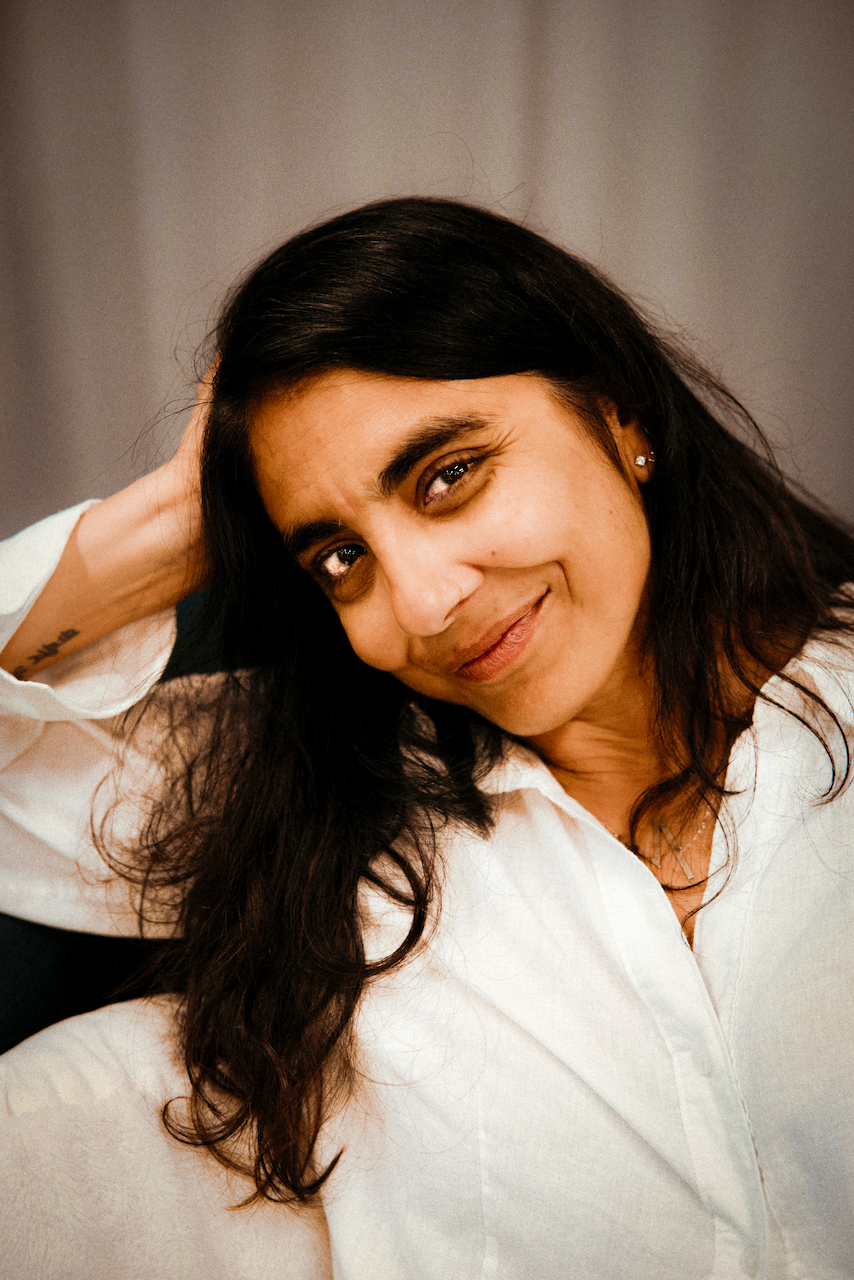
Monica is the Founder of Bridging Us, where she works with leaders, organizations, and communities who share a bold vision: to turn cities into communities, and disconnection into possibility. Through her work, Monica helps translate values into systems, relationships into infrastructure, and hope into collective momentum. Previously, she held regional leadership roles such as Strategic Consultant with Engage NWA, Director of Diverse Social Networks at Excellerate Foundation, and Executive Director of Downtown Bentonville Inc. Earlier in her career, she practiced immigration, human rights, and corporate law, bringing a systems lens and attention to rights, power, and structural accountability. Today, as the Cheif Operating Officer of Aiding Survivors of Human Trafficking & Child Abuse (AID), she finds herself circling back to that original calling—advocating for justice and dignity where it is most urgently needed.
With more than a decade of experience across nonprofit leadership, strategic partnerships, and legal advocacy, Monica operates at the intersection of narrative, networks, and systems change. Her journey has taken her into community coalitions, civic institutions, youth movements, and social justice spaces.
At Bridging Us, Monica leads a suite of services designed to strengthen relational infrastructure including strategic leadership collaboration, community experience design and interim executive function and succession planning services.
Monica currently serves on the Rhino Foods Foundation Board and the Advisory Council of the Bentonville Film Festival.
At the heart of Monica’s work is a conviction: community is not an outcome, but a practice. She believes that increasing belonging isn’t adding people to the edges, but mindfully reweaving the heart of our communities to reconsider and reimagine.
As co-host of this season of the the underview, she brings curiosity, grounded care, and an invitation to consider faith and our relationship to our humanity and each other as interconnected and vital to our future spiritual, emotional and physical health.
Monica was born in London, UK to immigrant parents from India and the Republic of Uganda. She is married to her soul mate and best friend, Kabir without whom she does not want to think about where she would be, and together they are raising their teenage son. Her personal story is interwoven with her professional one. Born in London to immigrant parents from India and the Republic of Uganda, Monica’s life has always carried the echo of displacement and the longing for rootedness. That history continues to inform her commitment to bridging across difference.
Monica’s work, whether in law, leadership, or community building, is ultimately about tending to the spaces between us to reveal those bridges that have always been present, from the very beginning.
episode references.
- Making Sense of Faith, episode 052, Religion and Politics (Adam Hamilton): https://resurrection.church/052-religion-and-politics/
- Adam Hamilton becomes the first Democratic senator from Kansas in nearly a century, NPR: https://www.wfae.org/united-states-world/2026-11-03/adam-hamilton-becomes-the-first-democratic-senator-from-kansas-in-nearly-a-century
- Abdul El-Sayed clinches win in Michigan Senate race, Complex: https://www.complex.com/life/a/tracewilliamcowen/abdul-el-sayed-senate-win
- James Talarico's Senate win breaks GOP's three-decade grip on statewide offices in Texas, NPR: https://www.stlpr.org/npr/2026-11-03/james-talaricos-senate-win-breaks-gops-three-decade-grip-on-statewide-offices-in-texas
- A Joe Rogan-Backed Democrat, James Talarico Draws National Attention, TIME: https://time.com/7304119/joe-rogan-james-talarico/
- Macklemore dropped from Ed Sheeran's US tour after Free Palestine remarks, Reuters via Philstar: https://interaksyon.philstar.com/celebrities/2026/09/15/319172/macklemore-dropped-from-ed-sheerans-us-tour-after-free-palestine-remarks/
- How Opportunity Takes Root, Walton Family Foundation and Gallup (May 2026): https://www.waltonfamilyfoundation.org/
- This Is Water, David Foster Wallace, Kenyon College commencement 2005: https://fs.blog/david-foster-wallace-this-is-water/
- "First they came," Martin Niemöller, United States Holocaust Memorial Museum: https://encyclopedia.ushmm.org/content/en/article/martin-niemoeller-first-they-came-for-the-socialists
- Seeing White, Scene on Radio season 2: https://sceneonradio.org/seeing-white/
- the underview, the southern baptist church with Pastor Dustin Barton (S03E13): https://www.theunderview.com/the-southern-baptist-church-with-pastor-dustin-barton/
- the underview, the home region with Robert Burns (S03E15 and S03E16): https://www.theunderview.com/the-home-region-with-robert-burns-walton-family-foundation
- the underview, the muslim community with Shahid Sheikh, part 1 (S03E19): https://www.theunderview.com/the-muslim-community-with-shahid-sheikh-bentonville-islamic-center/
- the underview, the muslim community with Shahid Sheikh, part 2 (S03E20): https://www.theunderview.com/the-muslim-community-with-shahid-sheikh-bentonville-islamic-center-part2
- the underview, the disciples of christ church with Rev. Dr. Don Morrow (S03E21): https://www.theunderview.com/the-disciples-of-christ-church-with-rev-dr-don-morrow-first-christian-church-waterway
- the underview, the hindu community with Sriman Ubhaya Vedanta Venugopala Swami Gattu (S03E26): https://www.theunderview.com/the-hindu-community-with-sriman-ubhaya-vedanta-venugopala-swami-gattu-northwest-arkansas-bentonville
- the underview, the cost with John Ray (S03E27): https://theunderview.com/the-cost-with-john-ray-vine-branch-church
- the underview, the reckoning with Monica Kumar and Mike Rusch (S03E30): https://www.theunderview.com/the-reckoning-with-monica-kumar-mike-rusch
- the underview, the membership with Dr. Jared M. Phillips (S03E33): https://www.theunderview.com/the-membership-with-dr-jared-m-phillips-university-arkansas-ozarks
- Send us a Voice Message, the underview: https://www.theunderview.com/
episode outline.
- a walk in the hills at dusk, the end of season three (00:55)
- the loudest voice in the room, a caricature that didn't survive (04:10)
- Barton, Morrow, and Ray, faith met through people (04:10)
- "don't introduce yourself to Islam based on CNN and Fox" (04:10)
- the other side of the table, two fish and the water (08:13)
- whiteness as the water, and the model minority (08:13)
- belonging assigned, not earned, and who holds the pencil (08:13)
- who gets to name you, Hindu, American, local (08:13)
- power without villains, tired pastors and ready-made sermons (08:13)
- too close to the fire, staying silent is a political choice (20:01)
- the mess, the forty percent, and choosing ease (23:04)
- the economics of faith, charity is not justice (25:42)
- every tradition said share your bread (25:42)
- people deserve grace, systems deserve scrutiny (25:42)
- a place for faith and politics, voices from the midterms (33:10)
- I pray, then I vote, then I pray again (33:10)
- thank you, Mike, and thank you, listeners (33:10)
episode transcript.
[00:00:55] monica kumar.: I'm out walking in the hills this evening, and it's that beautiful gold now which dusts everything with a glow. It's November, and the trees have pretty much finished their turning. The oaks are holding on to the last of their rust and copper. The hickories have gone golden, and every time the wind picks up, a few more leaves let go and drift across the path in front of me.
From up here, you can watch the hills fold into each other, ridge after ridge, each one a little paler, a little bluer than the last, until they just kind of dissolve into the sky. And the sun is going down slowly. It's low and orange, resting right on the edge of the far ridge, and it's pouring this long, warm , beautiful light across the valley.
The kind of light that makes everything , every rooftop, every bare branch look like it's been lit from the inside. There's something about this hour when the day isn't quite over, the night hasn't quite come. Everything is in in-between, and that feels about right because that's probably where I am too.
So, here we are, the end of the third season of The Underview, and with it, my conclusion as a co-host in this extraordinary experience with my incredibly talented and thoughtful and generous friend.
When Mike invited me to co-host this season, I thought I basically knew what I was walking into. I mean, I know I'm an outsider to the majority faith that shapes almost everything in Northwest Arkansas, but I also feel like I've lived here long enough to feel at home and feel at home away from home.
And in this season, oh my gosh, we got invited to tables with multiple faith leaders. It was incredible. Incredible local pastors, people who've devoted their whole lives to their faith, people who've wrestled with it, lost it, and many like me who have found their way back. And somewhere along the way, I realized that what I thought this was about became about something else altogether.
I thought I was walking in, and I was gonna ask questions of people about their faith And then the turning point became that it was me asking my questions, myself questions about mine. And these questions, they almost became the answers. And that in turn became a beautiful, unexpected gift. And this segues to what I'm sitting with right now and some reflections that I wanted to share, if you'll indulge me.
Things that moved in me, some of them are gentle, some of them aren't, and a few of them I'm still a little uncomfortable saying out loud. Nothing I'm gonna say is anywhere near the truth or is anyone else's experience, and I don't mean to speak for anyone else. Of course I don't. But I do think that I want to honor where I started. I wanna honor where I am now, and in many ways, where I think many of us are here together in this place we share. So if you'll indulge me, if you'll give me some grace and some space, and if you'll give me the honor to join me as I walk and share a few things that are on my mind as we approach the end of season three of The Underview
the loudest voice in the room.
[00:04:10] monica kumar.: One of the things, ironically, one of the loudest things that I learned is that the loudest version of faith is not the truest one Let me back up a little bit. I'll be honest about where I started, and I told you this. I'm from England, but I'm not Christian.
My relationship with Christianity, especially Christianity in Northwest Arkansas and in America, it was mostly built through the media, through stories, through what I'd heard and what I'd read, and what I thought happened behind those beautiful church doors.
But not through people, not as much. I knew some of the history. I know the different traditions and how they've shown up in this country. But if I push myself, if I push myself in the way we've invited our guests to push themselves, in the way we've asked you to push yourselves, then I'm gonna have to admit that what I walked in was louder, crisper around the edges than the reality. I feel like it was more of a caricature of Christianity with very little understanding of the character.
And then I sat at tables, and what I met was a chorus of different voices, different interpretations, real disagreements, not just about opinions, but really importantly also about purpose. You know, I was incredibly moved to meet Pastor Dustin Barton of Baptist Greenland, you know, and he shared that he fell out of a deer stand when he was eleven years old. He spent a year angry at God. That resonated with me so deeply, and he found his faith watching his baby si-sister breathe through a tube, a really simple, profound experience.
I learnt so much from Reverend Dr. Don Morrow of First Christian Church in Bentonville, who, when he was ten, heard his Sunday school teacher ask the class to pa-pray for his Jewish aunt and uncle because they weren't going to heaven. And the ten-year-old Don Morrow knew, even then, in his heart, that just doesn't seem right. I got the honor and pleasure of meeting John Ray of Vine and Branch in Fayetteville, who shared about how he tragically lost his daughter, who told us that after that, everything changed. And for him, seminary didn't just save his faith, it saved his life That really resonated with me because I've had personal experiences where I felt like my faith was the only thing I had to hold onto.
So the first thing that didn't survive this season was my assumption that the loudest version of a faith is the only version, or at least the truest one, or the one that deserves to be heard. And I keep asking myself, why did I think that and why do we do that? Why do any of us let the people with the biggest microphones speak for the people with the quietest prayers?
But I also want to be not nostalgic about this. I want to be honest and true, and the tenderness , that I met in those rooms was real, and also so was the power. Both of those things sat at the table with us every single week. Shahid Shaikh at the Bentonville Islamic Center said something that I just can't forget.
" Don't introduce yourself to Islam based on what's on CNN and Fox." He was asking us to meet Muslims as people, as individuals, as humans. And I think, if I'm honest, this season -- asked me to do the same with Christians. I would've said I was doing that, but if I'm really honest, then I have to admit that I don't know that I was. I think I had my guard up. And then it asked me to do something even harder. It asked me to hold the person and the institution in my hands at the same time without letting either one cancel out the other. Once I started looking beneath the surface of a person, once I started looking at the institutions , at what was surrounding it, that's when I started noticing what everything is swimming in.
the other side of the table.
[00:08:13] monica kumar.: And this comes to my second thought. When I think about that water I think about the whiteness of the water and how it dissolves into a feeling that it's not even there because you don't know it's there because it's water. John Ray and I talked about, , a story that a friend of mine always likes to share about two young fish, where an older fish swim---- swims by and says, "Hey, morning, boys. How's the water?" And they swim on a bit, and then one of the little fish says to the other, " What's water ?" And this season, we heard very different readings of , the same water. Pastor Barton told us Greenland has reckoned with its racial history and moved beyond that. Swamiji told us that the Hindu community has never faced any kind of obstacles, and that they've always felt welcomed here. And Shahid Sheikh told us that there were moments when he's reminded that I'm a minority in this place when someone looks at my beard or my daughter's hijab.
So what is the water? I think for me, the water tends towards the default, the normal, the normative. And I have to be honest, in our community, in our country, plainly, the water is whiteness, the thing that needs no introduction and no name. It doesn't have to define itself because the rest of us get defined by our distance to it or from it. And I think about slavery. Most of us do acknowledge in this country that American has a history with it, but I think that it's our distance from the danger that shapes how we reckon with it.
Whether we think we've reckoned, whether we think it's ours to reckon with at all, whether we've grappled with the past enough to be informed in the present, the telling of the history is telling. Who is telling the story? Who is left to tell it? What is their relationship and proximity to it? I think that that's where the water fills every gap.
It lets towns and communities and whole countries feel like they've moved beyond race because the past has been pushed so far away it never has to show up. And when , people that it does still touch, when they raise their hands, and they ask questions, the water kinda drowns them out, and what's left is a history that quite literally feels whitewashed.
And that's what I mean by the water Now I wanna address Swamiji's answer because that was hard for me, and of course, personal. I'm Indian. I identify as Indian. I'm not a practicing Hindu, but I certainly grew up as one. I wanna first of all say that I believe him. I believe he's been incredibly welcomed by this community. I believe it because I felt the same way. I feel welcomed and loved by this community. But I also know the particular and specific place that some South Asians occupy in this country. Not all of us, but some of us. Those who come in with education and all the privilege that it carries. And alongside that, there's a learned colonization that runs deep in us.
At least for me, it does. It says, "Be grateful. Say thank you. Don't make trouble. Keep your head down and your children's grades up." Some of that is genuine gratitude for real opportunity, but some of that, for me and for others that I know, it's survival dressed up as gratitude. So I'm not blind to the role I play with my model minority brownness.
You know, I'm sitting there, I, - upholding racism and inequity in this country in a very specific way, and I'm only speaking for myself here. But there is a role that someone like me plays in the systemic inequity in this country, and I have to acknowledge that. And Mr. Sheikh said something that I think so many non-white people in this region maybe have felt.
Maybe they haven't shared it, maybe they haven't said it out loud, but I've heard, it, and I've certainly felt it. When they don't have to hide who they are or explain and justify their existence, then we belong. And he said, "I'm not there yet." He's not there yet. A hugely successful businessman, he employs a hundred people. He's living the quintessential American dream, and still not there yet. What does that tell us about how belonging gets handed out here? It tells me that it isn't always earned. It's not always a pull yourself up by the bootstraps and you'll, you know, win the lottery. Sometimes it's assigned, and sometimes the people doing the assigning don't even know they're holding the pencil. And again, for me, that's the water.
So I'll share the question I ask myself because I acknowledge and know the privilege I carry with my education, with my accent, with my light brown skin, with my closeness and adjacency to the water. And I'll ask, ask specifically our white listeners to sit with it too.
What does your life get to skip? What do you never have to explain? What do you get just because you are? Whatever that is, that's probably in the water.
And if whiteness is the water, then I think for me, the next question that I think about and have thought about this season is then who gets to name everything that swims in it? And so I think here, I think whoever names you holds the power. Swamiji told me something really interesting or shared with all of us, something I didn't know, that Hindu was a name given by foreigners. He thinks the British when they colonized India and that teachers in his tradition prefer Vedic or Sanatani. Mr. Sheikh, when people tell him to become American, says, "Define for me what that means, because even white America, quote unquote, can't agree on it." And I told Shahid Sheikh as a, as a little girl, I prayed to wake up white. That was a really honest thing I shared, and I didn't plan to say it. But I was a child with samosas in my lunchbox, and everyone else had sandwiches. And I asked God for two things: to wake up white and to wake up not smelling of spice. Mr. Sheikh had the same story. Kids on the school bus telling him he smelt like onions, him coming home crying, angry at his mother for cooking him breakfast with love.
What does that mean for a child to be ashamed of his mother's tenderness because someone else named it foreign? I think that that's what being named by someone else does to a person. I think we've all felt this to some extent. It teaches us to edit ourselves before anyone else deletes us completely.
And Swamiji's point goes further than and deeper than vocabulary. Empires name things so they can sort them, govern them, tax them. A label handed down by power is a filing system. And he wasn't bitter about it. He just kind of accepted it and said, "Well, it's gone viral now. It's very hard to unroot it."
That really undid me. Imagine carrying a name for your faith that your faith never chose, and then accepting it and making peace with it because the alternative, it's just exhausting and demoralizing, and you don't see the end of it. So then the question is, who's holding the dictionary here in our region?
Who gets to define real American, real Christian, real Arkansan? Who gets to call a Marshallese family, a Mexican family, a Pakistani family, welcomers, while maybe a family can move from Chicago and they're simply local? I think Mr. Sheikh's answer is the right one. Invite them to define it, because The moment we try and request a definition, it collapses under the weight of everyone it leaves out.
I think naming is a kind of power. But this season, we kept bumping into a deeper, quieter kind, the kind that lives behind a pulpit And I think one of the things, one of the other things that I realized is that power doesn't require villains. It just needs tired people or people who feel like they have nothing to gain and everything to lose.
You know, in the room with Pastor Barton, I said I felt incredibly fragile about how much power leaders hold. And I think fragile is a really strong word, and I meant it because I think I've seen what a voice from a pulpit can do to someone who trusts it blindly. We've all seen it because faith reaches a place in us that's underneath and above argument.
It's where we keep our children, people we've lost, our fear of being unloved, our fear of having to look at ourselves in the mirror and not like who we see. And whoever has unfiltered access to that incredibly fragile and, u-uniquely you place, they're going to hold an extraordinary kind of power ' cause that place, that's where we can heal someone.
But on the flip side, we can also do harm that never heals from that place. You know, John Ray said something about this. He said that most people walk around feeling, that if they let out all of their fear and hurt, he said the blast radius would just wipe out everything around them and that this makes people really vulnerable to manipulation of easy answers and political, religious, market manipulation.
And I sat with that, and I still do. And it makes me think the wound is the doorway, and anyone who wants to move a population knows exactly how to find it and how to open it because we've built so many doors and windows in this hyper-connected world. And I don't think that's ever been more true than it is right now.
Faith can become such a powerful Trojan horse, but the things that are not true and no questions are asked, and no answers are required And Dr. Jared Phillips, the historian at the University of Arkansas, he described what happened to young pastors in the seventies and eighties. "Picture it," he said. "You've got small kids, you've got a con-congregation of a hundred or two hundred pe-people. You're overwhelmed, under-resourced, and suddenly there's a ready-made sermon from an institute in Washington, free with Bible verses attached.
Well, of course you use it. You don't have a choice, almost." Dr. Phillips said some walked in willingly, and others, they just kind of, over a period of a decade, suddenly turn around, they find themselves in a place, in a country that maybe they don't recognize.
It's not a conspiracy, and it's not an intention to do evil or anything bad. I think , the danger of it lies in the fact that it's much more ordinary. It's a convenience that becomes a conviction. It's the frog that's boiled so slowly, it never noticed that the water got hot. So I think there's a question: Are pastors and faith leaders holding power, or are they being held by it?
And I think the answer lies in that -- power does not need leaders to be a villain or to be bad. It just kind of needs them to be a little bit tired, under-resourced, unsure of their next step, and worried about how to keep the doors open, their words alive, and people coming in. My faith is one of the most intimate, private things in my life.
So I wonder, why have we built a world where faith is so easily wholesaled, priced, sold? And I think the antidote is a congregation, a community of faith that holds it lead-- its leaders and its fellow believers accountable. I don't think it's about less faith. I think it's about more faith, more proximity, more closer-- closeness, more looking inward.
too close to the fire.
[00:20:01] monica kumar.: Which brings me to the question that came up in one form or another in almost every room: Should faith speak or inform politics at all? And I think that this brings me to another reflection, which is that staying silent is a political choice We heard two pastors give answers on faith and politics.
Pastor Barton's church got, in his words, too close to the fire over a wet/dry vote, and he came out of that believing the pulpit should never tell you how to vote. And on the other hand, Reverend Morrow remind us of-- reminded us that Jesus suffered a political execution, and he shared, " When you start not talking about something because it's political, you're being political just by not talking about it."
I was there for both of those conversations. They were both incredibly deep and moving, and I think this is where I've landed. For me, I cannot separate politics from policy from people. There's a line, I think, sometimes dotted, sometimes really bold, between faith, power, politics, and how all of it shows up in our homes and our communities.
I think I'd be lying to myself and you if I pretended that that's not what I thought and that I felt like the line wasn't there. Even Pastor Barton, when he reads James one:twenty-seven, he says that true religion is caring for orphans, and he feels there's a gap in not talking about the policies that make that care possible.
And he also knows exactly what it costs when religious authority gets fused to a political outcome. The fact that this question burns so hot, well, that tells me that there is real political power behind prayer. So I'm with Reverend Morrow on this. When we don't examine something that shapes our lives so deeply, that silence is political, tremendously so.
Honestly, I'm concerned at best and fearful at worst of any institution or religion that claims it has no relationship with power. The claim is the proof that it does, and that kind of opaqueness and misdirection, I think it's dangerous. I have a really hard relationship with neutrality, with this isn't the time or the place.
Because when something touches our ability to assemble, to pray, to speak, to love however we want and in peace, that does not feel abstract to me. That feels dehumanizing, and it's a question for the people in power and the people we place there to answer. So when we're bullied or scared into silence, I think we have to ask, "Who does my silence benefit?" And also, "Who might my silence implicate?"
For me, belonging to a faith isn't about questioning who we pray to or how. It's about asking, " Does anyone get hurt, harmed, dehumanized by my God or my faith?" Of course, knowing silence is a choice does not make it any easier to break.
the mess.
[00:23:04] monica kumar.: In this next one, I turn on myself.
Another thing that I sit with is that ease is not easy. John Ray shared with us that when Vine and Branch opened its doors to everyone, he expected the people who disagreed with him to leave. But what broke him was the other group, the forty percent who did agree with him, and they left anyway because they didn't wanna deal with the mess.
I'm gonna be honest, I think a lot of times I'm in that forty percent. I'm in it more often than I'd like to admit, and I won't let myself off the hook for it, even when it's the only answer I've got in the moment because I don't have the energy for the fight. Here's the thing about power and fear, and they work so often together as partners, fighting partners.
The dominant culture rarely has to make huge, big threats. They don't have to claim murder or violence. They just own your mortgage. They pay for your groceries. They sign your paycheck. And that's many times how power stays in place, not through the people who hate, but through people who agree quietly and then do the math and then quietly step back. And maybe you earn some ease that way, but then I wonder, is that even true? 'Cause I'm not sure that it is.
Something that's been sitting with me a lot recently is Ed Sheeran and, , his choosing not to stand with Macklemore when he said Free Palestine. Macklemore has become an icon for so many people, for his faith, for his backbone in speaking out about a genocide, and Sheeran's supporting acts walked away in solidarity.
He's had to explain himself again and again. He's had to explain why he chose ease. And you know what? That doesn't sound easy to me. So what does choosing ease actually gets us? What does it feel like to me? It leaves me many times standing with everyone else who picked ease over justice, and I have to live with that.
And I think of Martin Niemöller's poem that ends, "Then they came for me, and there was no one left to speak for me." I don't wanna end up alone because I picked ease over courage. I don't want to be-betray my faith or my God. I have to and want to hold myself to a higher power and belong to the people who are scared and made the hard choice anyway.
At the end of the day, I answer to myself, I answer to my son, I answer to my husband, and ultimately, I answer to my faith in God, and that makes a choice easy, but it's never a choice of ease.
the economics of faith.
[00:25:42] monica kumar.: And nowhere do I feel the pull toward ease is stronger than when it comes to money. We heard it in almost every conversation, and I wanna talk about it now.
I think charity is not justice, and it's not a framework that upholds faith.
Reverend Morrow told us about the waitress who served him lunch three times a week, and then one Christmas Eve, he saw her standing in line at his church's giveaway, and she looked away with shame. He said Walmart and other companies like that have done nothing that's out of bounds of the system, and maybe that's where the problem lies.
Shahid Sheikh went even further. He talked about compound interest. He talked about the war economy, trillionaires built on taxpayer subsidies, an elderly couple watching their savings drain away while the news story tells them to worry about Iran. And in that room, I shared, we have been bamboozled to believe that it is about God, and it's not about God. It's about money and power.
That was a big thing to say. I was nervous saying it, but I'm gonna stand by it. I do say it carefully, though, because I love this place. I know people at every one of the institutions in this area that are kind and generous and good. And I think we can hold ourselves and each other accountable without shame, and in fact, we must.
So here's my challenge to me and maybe to us: a moral pivot. Moving away from charity, which can be started, stopped, stopped again, started again, and a movement toward justice. Justice that's written into our policies, our processes, our politics. One where we move away from valuing work, and we move toward valuing workers. From maximizing profit to minimizing the gaps between us.
Think about everyone we sat with this season. We sat with so many Christian perspectives. We sat with Muslims, we sat with Hindus, Buddhists, Vedics, and they all told us essentially the same thing: Share your bread. Shelter and protect your neighbor. Be mindful of how much you take, and be generous with how much you give. So if that's what we heard, and it was, then I have to ask, which faith tradition is telling us to hoard power, to steal bread, to take more than we need? Because I did not hear it in a single one of the voices, this season, and yet I see it.
I see it in our communities. I see it in this country. I even see it in the congregations and the people that gather. So that brings me having to talk about systems and my role in it because, yes, being in the system is exactly why I have to question it. I am inside, and I have advantages in systems of power. Of course I do.
But being inside, that doesn't mean I don't have the right to question it. I have to wonder how to make it better. If anything, in fact, that's exactly why I need to. If I don't, then I think I could be compliant with complacency. Robert Burns of the Walton Family Foundation shared a line from his, their regional strategy." The most meaningful progress happens when communities help shape the solutions that affect their future." And the research Walton Family Foundation commissioned from Gallup found that only about one in three Americans believes anyone would listen to their ideas for improving their community. The feedback channels exist, people know they exist, and yet we don't use them because we don't believe that anyone listening, anyone's listening and anyone cares.
So the question becomes imperative: How do we build places and spaces where every voice is heard and given real weight? Dr. Phillips asked us to picture the ten-year-old who crossed the Darien Gap, the kid from the Marshall Islands, the Hmong family, and he asked, "How do we get that ten-year-old's imagination to be at the table? That is the job of the church," he says.
And I'd say it's the job of all of us, and I'd say it's especially a calling for people of faith, which means I have to look honestly at the table we set this season and how I sat at it. I believe I can and most lovingly have to, but with discernment, question my place at the table, my space at the table, and my choices there.
Which leads me to one of my most admired Christian practices, people deserve grace. And my addition to that, and systems deserve scrutiny. I've been called out a little on this podcast for not confronting opinions enough, for being too gentle and unconfrontational, so I'll try and be short and clear.
I didn't take on this season to walk into a room and shame anyone or shut anyone down. I didn't see any need for another voice to do that, and I certainly wasn't gonna do it on this podcast. I was inspired by and tried to emulate James Tallarico's episode on Joe Rogan's podcast before the midterms. He wasn't loud, he wasn't aggressive, he didn't disrespect a host he disagrees with on almost everything.
He went in to build connection, to widen the coalition, to break out of the echo chamber, and it ended with Joe Rogan telling him that he needed to run for the President of the United States. And I tried, probably clumsily, to learn from that, to sit at a table with my arms and my heart wide open. I was there to listen. I was there to learn. I didn't feel like I needed to interrupt, and I didn't feel like I needed to put anyone's faith on trial.
And I genuinely believe that that approach that we took, Mike and I decided on that, that together, it gave us a depth of understanding that we would not have reached otherwise. I know that Mike feels the same, and his opinion was one that I was guided by and led in this process. Respect and kindness are not the opposite of courage. They sit at the same side of the table. Every time we hosted someone, I held onto this. Me, I'm not the worst thing I've ever done. I'm also not the best thing I've ever done.
I'm somewhere in between, and also that applies to everybody else. It's not my place to judge them, but it is my place to learn and decide for myself how I want to show up in the world if I want to align or delineate from what I'm hearing. But I didn't extend that same grace to systems, and I don't to inequity, to policies and laws that dehumanize people. Again, I'll say it, people deserve grace, systems deserve scrutiny. So I'll say it plainly.
There were guests at our table who represent and uphold unjust systems of power, whether they recognize it or not, and I don't give them or their institutions a pass for that. And maybe some of my gentleness also comes from being a brown woman, culturally Indian, who was taught to overextend herself first.
I know myself, and I know that the story of colonization and brownness lives in and on me. But maybe I'll examine that in another podcast
At some time, everyone, every person, including our guests, we sit in well-meaning silence. And I've sat there too when I've needed to for safety, for security. I'd be really surprised to meet anyone who hasn't. So I'm not going to judge them, I'm not going to judge you, and I'm gonna try and not judge myself.
However, I am gonna hold myself accountable to be critical, to be thoughtful, and to be discerning in how I live my faith in the world, and to be constantly vigilant of myself and my motivations and my actions.
And there's no place that gets tested more plainly than at the ballot box.
a place for faith and politics.
[00:33:10] monica kumar.: Which brings me to my final reflection In my opinion, there is not only a place for faith in politics, but we are better citizens and better humans when our faith in a higher power guides our decisions on the ground. I was elated to see progressives in this election embrace and share their faith and center diverse individuals' rights to worship and pray or not as each of us choose. I've been dismayed to see the far right claim a divine right to God and progressives and others concede spiritual and religious space.
Throughout history, Christianity, Judaism, Islam, Hinduism, to name a few, have upheld democracy and mobilized to protect freedoms. And to my heart's delight, these midterms upheld that tradition in so many ways.
I have to share a few of the voices that have moved and inspired me so deeply.
" Should your faith shape your politics? I challenge the myth that religion and politics don't mix, and why staying silent on justice issues might actually contradict the teachings of Jesus."
That's Adam Hamilton, senator-elect for Kansas.
" Up until right about now, you might have noticed I always say inshallah or God willing whenever the outcome of this race was mentioned. But today, tonight, we can turn that inshallah into an alhamdulillah. Praise be to God"
Abdullah El-Sayed, senator-elect for Michigan.
" every single person bears the image of the sacred. Every single person is holy, not just the neighbors who look like me or pray like me or vote like me. Two thousand years ago, when the powerful few rigged the system, that barefoot rabbi walked into the seat of power and flipped over the tables of injustice. To those who love our country, to those who love our neighbors, it's time to start flipping tables"
James Talarico, senator-elect for Texas.
And so I end this reflection on my most personal and value-- vulnerable perspective of any I've ever shared.
I am completely guided by and in submission to God and my faith when I show up in the world, how I show up in my work, and most especially when I cast my vote in the ballot box. I'm guided to my voting choices entirely by my faith and my spiritual beliefs. I pray, and then I vote, and then I pray again. It's that simple and that complicated.
As I close, I want to thank my co-host who has lived and guided me through this seasonal journey. I started in one plane and ended up in another dimension and Mike has patiently, lovingly, and generously inspired and brilliantly lit the way forward.
Mike, there are no words for the love and care that bind everything you touch, especially in this craft. I am, and I always will be in debt and in awe. Thank you.
And finally, all of you, our patient, discerning, forgiving listeners, thank you for listening, for teaching me, and most of all, forg-forgiving me my mistakes and stumbles.
They are all mine to own, but I would never have felt brave enough to stumble through them if it were not for your encouraging support and your kind words. With deep gratitude, I thank you.
My name is Monica Kumar, and this is the third season of the underview, an exploration of the faith of Northwest Arkansas.