
the hindu community with Sriman Ubhaya Vedanta Venugopala Swami Gattu.
Inside Bentonville's Hindu temple with chief priest Swamiji Venugopala Swami Gattu. Vedic teaching, the word Hindu, Om, Holi and Deepavali, belonging in the Bible Belt, and a definition of wholeness that begins with the soul. Northwest Arkansas faith, season three.


episode notes.
Inside the Hindu temple of Northwest Arkansas on Regional Airport Boulevard in Bentonville, Monica Kumar leads a conversation with Sriman Ubhaya Vedanta Venugopala Swami Gattu, the temple's chief priest, whom his community calls Swamiji. Born into a family of priests in Hyderabad and trained under Sri Chinna Jeeyar Swami, he came to Tulsa in 2001 to serve a new temple there and began driving to Bentonville most weekends the following year, when the local community was perhaps a hundred and fifty families praying in each other's homes. He moved here for good in 2012, the year this building opened. The conversation opens with a Sanskrit prayer and moves through what the Vedas hold as their most basic teaching, why many teachers in his tradition set aside the word Hindu altogether, what a temple gives a community that home worship cannot, and why the sound of Om is understood to make the whole universe answer.
Swamiji tells the stories behind Holi and Deepavali as his tradition tells them, describes the temple's blood drives and food collections for the wider region, and explains what he means when he says there are many paths and no conflict between them. Asked the two questions every season three guest is asked, he speaks about what his tradition teaches in a time of clashing perspectives and offers a definition of wholeness that begins with the soul and ends with how we see one another. This episode sits in the season's fourth movement, what is emerging, and asks what a place gains when a community decides to make a piece of ground holy on purpose.
about our guest.
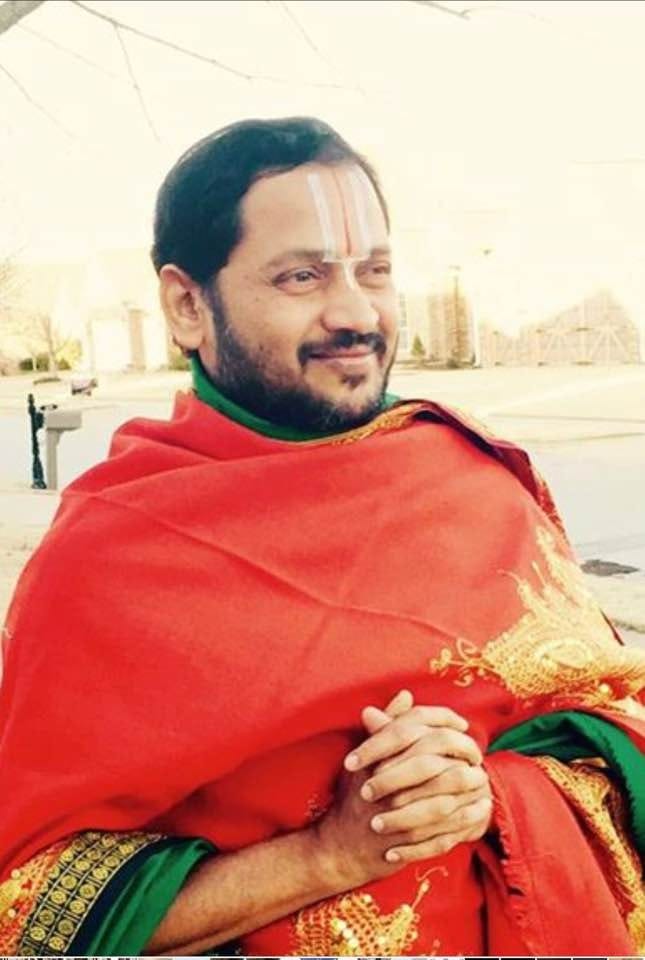
about our guest.
Sriman Ubhaya Vedanta Venugopala Swami Gattu was born to Srmt Gattu Ramadevi & Late Sri Gattu Venkatacharyulu, in traditional archaka family. Married to Srmt Gattu Narmada and blessed with two daughters Gattu Mrudula and Gattu Jahnavi. His Acharyas are “Srimath paramahamsa parivrajakacharya”, “Visishtadwaitha Siddhantha pravarthakacharya”, “Ubhaya Vedanta pravarathakacharya” and “SriSriSri Thridandi Srimannarayana Ramanuja Jeeyarswamiji”.
He mastered Brahma Sutras, Upanishads, Pancharatra Aagama, Dravida Sampradaya grandhas from his masters Sri Ubhaya vedantha pravarthakacharyas, Sriman Nallan chakravarthula Raghunadhacharyaswamivaru, Sriman Maringanti SriRangacharyaswamivaru, Sriman Sribhashyam Appalacharyaswamivaru, Sriman kandadai Venkatacharyaswamivaru, Sriman STP Ramachandracharyaswamivaru, Sriman kandadai Ramanujacharyaswamivaru, Sriman Samudrala Ramakanthacharyaswamivaru, Sriman Chalamacharla Seshacharya Swamivaru.
He is decorated with the title “Sata Krutu” by Sri Jeeyarswamiji.
His knowledge and devotion to better humanity, inspired by his devotional thoughts and his gurus' blessings, he conceived the idea of "World First Geetha Sthoopa", in HANWA Hindu Temple, which now is one of the well-known attractions in North West Arkansas Region.
episode references.
- Hindu Association of Northwest Arkansas: https://www.nwahindutemple.org/
- Encyclopedia of Arkansas, Hindus: https://encyclopediaofarkansas.net/entries/hindus-4358/
- Talk Business and Politics, Hindu population grows with supplier community (2012): https://talkbusiness.net/2012/11/hindu-population-grows-with-supplier-community/
- 5NEWS, First Hindu Temple in NWA Celebrates its Grand Opening (2012): https://www.5newsonline.com/article/news/local/outreach/back-to-school/first-hindu-temple-in-nwa-celebrates-its-grand-opening/527-391f38e1-72cc-40ac-ba0c-94ed0fa7dff9
- Neilsberg Research, Indian Population in Arkansas by City (ACS 2019 to 2023): https://www.neilsberg.com/insights/lists/indian-population-in-arkansas-by-city/
- Pew Research Center, Hindus, Religious Landscape Study: https://www.pewresearch.org/religious-landscape-study/religious-tradition/hindu/
- Hindu American Foundation, Statement against Caste-based Discrimination by Sri Chinna Jeeyar Swami (2011): https://www.hinduamerican.org/press/caste-statement-sri-chinna-jeeyar-swami/
episode outline.
- Episode preview (00:00:00)
- Episode intro (00:01:51)
- Opening prayer and how Swamiji came to Northwest Arkansas (00:06:48)
- A family of priests in Hyderabad and training under Sri Chinna Jeeyar Swami (00:10:55)
- The Vedas and the foundational tenet, see God in every entity (00:13:33)
- Many paths, one destination (00:16:38)
- The priest as a bridge between devotee and God (00:18:47)
- From Gentry to Bentonville, a lamp at home and a streetlight for everyone (00:20:44)
- The sound of Om and why the universe responds (00:22:53)
- What the opening prayer means (00:25:51)
- Feeling welcome in Northwest Arkansas (00:27:11)
- Interfaith conversations and the wider community (00:28:28)
- Welcome from the Christian community in the Bible Belt (00:30:24)
- What do Hindus believe, and why teachers prefer Vedic and Sanatani (00:31:59)
- The tenets of the Vedas, atma and paramatma in every being (00:34:38)
- How a Christian fits into the many paths (00:36:04)
- Interfaith coexistence and an open door (00:37:53)
- Holi and Deepavali, the stories and the meaning (00:40:32)
- Blood drives, food banks, and serving the whole community (00:45:10)
- A time of clashing perspectives, and what the tradition teaches (00:46:47)
- Wholeness (00:50:09)
- Closing thanks (00:52:14)
- Episode outro with Monica Kumar (00:54:02)
episode transcript.
episode preview.
[00:00:00] swamiji.: The foundation for this, religion is Vedas. Vedas, the very, important tenet is to see God's presence in every entity, in each and every entity. Not only the physical form, but, it recommends us to feel the presence of God in everywhere and, wish for the elevation, wish for the improvement, development of welfare of each and everyone.
Wherever we go, we say it as, "Sarve janāḥ Sukhino Bhavantu Lokāḥ samastāḥ Sukhino Bhavantu." That means may everyone be safe and peaceful. May all the worlds be safe and peaceful. That is how we start the prayer, and we conclude the prayers.
episode intro
[00:01:51] mike rusch.: We are listening to The Underview, an exploration in the shaping of our place. My name is Mike Rusch, and today we're sitting inside the Hindu temple in Northwest Arkansas on Regional Airport Boulevard in Bentonville with the priest who has served this community for the better part of 25 years.
His name, as the temple presents it, is sriman ubhaya vedantu venugopala Swamygatu
Most of that is his title. It is both honorific, it is his credential, and it means he's been trained in both scriptures his tradition holds sacred, the Sanskrit and the Tamil. Swami is the title of respect for a teacher. His name is Venugopala Swamygatu and the people who walk through the doors of his temple every day call him Swamiji. So that's what we call him too. Swamiji is what the tradition calls a temple priest. He was born into a family that has done this work for generations. He comes from South India, and he was trained by one of the most recognized teachers in his lineage.
If you've been to a Hindu temple almost anywhere in America, there's a decent chance that one of the priests there was trained by the same man. He is not a pastor. He does not stand up on Sunday to preach. His work is service to God and to the people who come there in a language that most of them don't speak.
Hold that because it's gonna come back up.
I need to say something about my seat in this conversation. Monica and I go together. However, this is not a tradition that I know, but it is the one that she grew up in. So I was excited coming into this conversation, and I was also very aware that it was Monica's time to lead. I stepped into this one humbly. I asked what I didn't know, and I'd encourage you to listen the same way.
Now, some history because this is a place where story comes before everything else. The first Hindu family that we know of in Arkansas arrived sometime in the 1950s, a professor and his wife into Pine Bluff. For decades after that, Hindus in this state worshiped in each other's living rooms. There was no building to go to. The first temple in Arkansas didn't open until 2005, and it was in Little Rock.
But Northwest Arkansas is a different story, and the difference is frankly Walmart. When the supplier community grew up in Bentonville and when the technology jobs came with it, families came from India to fill them. The Hindu Association of Northwest Arkansas was formed in 1999, and by 2002 they were gathering in homes, maybe 150 families.
They bought land in Gentry first and then sold it and bought here in Bentonville. they broke ground in 2011 and then opened the building that we recorded in today in July of 2012. Four thousand square feet built square on purpose so that it could be a temple and a community center at the same time. The whole thing took 12 years. That was 14 years ago. Today, Bentonville alone is home to nearly 6,000 people of Indian descent. This is more than twice the number in Little Rock, and it's about 40% of every Indian origin resident in the state of Arkansas in this one town.
Bentonville schools went from a few hundred students from India to more than 1,000 in the space of a few years. This community roughly doubled in a decade, and in 2020, on the grounds of this temple, the community built something that exists nowhere else that we know of, a monument in bronze to every verse of their most important scriptures. We didn't get into that in this conversation, but if you visit, you will see it. And Swamiji, he conceived it.
So here's where our episode sits in this season. We've spent a lot of time this season on what was planted here and what holds power here. This is a story about what is emerging, a tradition that did not exist in this valley a generation ago, building a house for itself on ground that belonged before this to someone else's church. This here in the middle of the Bible Belt, and doing it by Swamiji's account without a single door closed in its face.
A few things to hold while you listen. We are not here to evaluate anyone's faith, not Swamiji's, not Monica's, and not yours. That stays holy ground. What we can listen for is what this tradition carries and what this temple as an institution in this place has decided to build. Listen for the word that he uses for himself and his people, because it's not the word you're expecting. Listen for how he talks about paths, and listen for the question we ask everyone, "What does wholeness really mean?"
Because his answer is one that I've been turning over ever since we left. And I'd ask you to listen for what a place gains when someone makes it holy on purpose. That's what a temple is. Somebody decided that this patch of ground on the way to the airport was going to be sacred, and then they did the work to make it so.
And if you followed this show for any length of time, you know that's the question underneath it. How do we make a place ours, and how do we make room for it to be someone else's also? If something in this conversation stirs a question for you or you're not sure what to say or something you're wrestling with, send it to us.
There's a Send us a voice message button on theunderview.com. We listen to every one and some of them end up in our show.
All right, a whole lot to work through today. Let's get into it
episode interview.
[00:06:48] monica kumar.: welcome. It's so-- It's always wonderful to sit down with you for these conversations, and I feel particularly excited today that we get to be in the Hindu temple in Northwest Arkansas with Swamiji.
, We have been anticipating this conversation for so long, and I'm, I'm just thrilled that we were able to get it on your schedule. Um, and thank you so much for making time for us.
[00:07:11] swamiji.: Thank you. Thank you, both of you.
[00:07:13] monica kumar.: So, Swamiji, before we start, maybe you can just give us a sense of how you want us to refer to you and maybe just a little bit about, your story, how you found yourself in Northwest Arkansas, and your role here in this temple.
[00:07:31] swamiji.: Sure. I will, uh, start with a prayer.
[00:07:35] monica kumar.: Wonderful.
[00:07:36] swamiji.: Krishna, rakshatno Jagatraya Guruhu Krishna Namasyamyaham. Krishne Namarashatravo Vinihataah. Krishnaya Tasmai Namah. Krishna Dev Samuthitham Jagadidham. Krishna Syadaso Smiaham. Krishne Tisthati Vishvame Tadakhilam. He Krishna Samrakshamam. Jai Srimannarayana. Jai srimannarayana.
My name is Venugopala Swami Gattu. I, I am from Hyderabad, South India. When I was there in one of the temples and working as a priest, uh, some community, uh, members, they have their relatives here in Oklahoma State. So they started one temple in Tulsa, Oklahoma, in 2001. Mm-hmm. So they were wondering if they can get a priest from Hyderabad or somewhere in India.
So that's how they could connect to their relatives. Their relatives, uh, recommended that I am, you know, good for them. So they came down to India, and they recorded my chantings and all that. They distributed among the community main leaders, and, uh, they took a voting of it , and they selected me. Then they did all the paperwork.
I came down to Tulsa in 2001. So ever since I came there, every weekend I used to come here from almost two thousand two onwards. Those days it was a very small community, maybe one fifty families or something. But whatever they have this, uh, spiritual, religious needs, they used to come to me, and so I used to come here most of the weekends and cater their needs.
And, uh, in about two thousand twelve, I think, uh, I just wanted to come out from that place. Then, uh, this, uh, community is ready to take me. So that's how I came here and, uh, until then, uh, this community leaders, they used to have prayers in individual homes. And, uh, the-- we have one house. We used to have.
They just demolished to renovate. We had all these, uh, we call them as, uh, murtis. You know, the idols, we don't call them i-idol. We call them as murtis or vigrahas. You know, these small forms. We used to have them in this house. So I come here and, uh, take care of all these services, and slowly community has built up, and they could, uh, you know, come up with some kind of plans to, you know, do this.
Uh, and they finally made this possible. So that's how I started serving this community and, uh, this community has been with me, has been welcoming me for last almost twenty-five years. So now, significantly, the community has grown, and there has been so many devotees enjoying the flavors of this religion.
So,
background and life journey.
[00:10:55] monica kumar.: Thank you. Thank you for that, Swamiji. Yeah. Um, so a couple of things I'm lis- I'm hearing from you. You grew up in Hyderabad, in India. Yes. Um, your English is excellent. Thank you. So would really appreciate maybe you just taking us back a little bit and sharing about your life journey in Hyderabad and India and then when... and how you came to find yourself, one, a person of faith, and then, two, somebody who wanted to lead in this religion.
[00:11:21] swamiji.: Yes. I belong to the family of, uh, the priests. My grandfather, my father, all of them were in this line. So I did a little bit of my regular education and, uh, along with that, I also learned, uh, our religious, uh, scriptures. My acharya, my guru, my spiritual teacher is, uh, Sri Chinna Jeeyar Swamiji. In America and in all other countries, foreign countries, most of the temples, at least one or two priests you will see coming from my acharya, Sri Chinna Jeeyar Swamiji.
He has trained so many students and who can sincerely serve the community. So that's how I learned my spiritual, uh, and religious scriptures. There, I started working in, uh, one of the temples. So Not only as a, this pro- occupation coming in the lineage, but also I have that, uh, faith and passion towards it.
My brothers also, my siblings also have got the same amount of passion, so we are all into this, uh, line. Yeah.
[00:12:42] monica kumar.: Thank you. Um, maybe we can... Maybe a good place to start, um, I'm familiar, uh, pretty familiar with Hinduism, and enough to know that there's so many different practices and so many different- Yes
ways of, of living the traditions, um, because my family, uh, background is Hindu. Um, but maybe where we can start is for a lot of our listeners, this might be the first time they're engaging with Hinduism in a way that is perhaps thinking about it from a community perspective and not something they've heard on TV or seen in a movie.
So maybe you can just start with sharing some, some foundational values, tenets, beliefs. Um, and I know that there's... And it real- there's so many practices, but maybe you can help us start to think about what are some of the foundational values and traditions of Hinduism.
[00:13:33] swamiji.: Yeah. So the very authentic, uh, scripture, the foundation to this religion, is called Vedas.
Vedas are prominent authoritative scriptures. It is said because Vedas said, we believe in God. So- The foundation for this, religion is Vedas. Vedas, the very, important tenet is to see God's presence in every entity, in each and every entity. Not only the physical form, but, it recommends us to feel the presence of God in everywhere and, wish for the elevation, wish for the improvement, development of welfare of each and everyone.
So we always do that in temple. Wherever we go, we say it as, "Sarve janāḥ Sukhino Bhavantu Lokāḥ samastāḥ Sukhino Bhavantu." That means may everyone be safe and peaceful. May all the worlds be safe and peaceful. That is how we start the prayer, and we conclude the prayers. So that is very basic and very important tenet from this religion and from the scripture.
Yes.
[00:14:52] monica kumar.: Are there some values that c- that you can share, um, from Hinduism that show up, uh, in, you know, in pe- in people who practice Hinduism in their lives, how they're supposed to connect with community, with each other, maybe even their practices with people who are not, who are not Hindu? Like, what, what does, what does that look like for someone who practices Hinduism?
[00:15:15] swamiji.: Um, we don't, uh, look it so different, you know, because there are so many paths leads to one destination. Different, different, uh, ways to reach one goal and different, different opinions. Opinions always differs, does not mean that we have a conflict, does not leads us to fight each other. Even in one family, the members are different, their opinions are different, their feelings are different, but yet they are one family.
They try to be together. So also we believe in that. There, uh, I see there are so many people who walks in who are not, uh, who are not into religion, this religion, but they still walk in, and we welcome them. We try to have them a feeling that they are not entering into a strange place. It is their home.
And, uh, they enjoy that. They try to learn few things, you know? So we-- I, uh, I mean, when I first came to America also, I did not feel any different, uh, seeing others who are not into this Hinduism. I did not have any kind of, uh, different feeling towards them. Somehow I felt everyone is, you know, under one umbrella.
paths to God.
[00:16:38] monica kumar.: Can you talk a little bit more about-- You, shared, , everything leads to the same destination or, all paths lead to one entity. , Can you share about that? What do you mean by that?
[00:16:50] swamiji.: Yes. What it is, is, I mean, um, the very ultimate purpose for a human life according to our Vedas, not to again be born into this cycle of birth and death This cycle of birth and death always have pains, sorrows, no matter how wealthy you are, how powerful you are, how, you know.
So you, you tend to ge-get through, you tend to go through all kind of ups and downs. So as and how we always, uh, look forward, uh, a promotion in every aspect. You know, when you are a child, you want to be promoted. Uh, you want to get good marks and in the class and get into good college and then marriage, then children.
At work, I want to be promoted. Like that, we-- our common tendency is to get promoted, get elevated. So also, in this life, what we need to crave for is, yes, I want to be elevated to a level where from I don't need to come back to this, uh, cycle of birth and death, where I can be eternally joyful, eternally happy.
So, uh, in that perspective, you know, whoever thinks to-towards that, what the path they are taking does not matter. But some of the paths may lead to halfway of it. You never know. But who constructed that path depends on that. So that may, uh, lead to only halfway of it. And again, they probably will learn from there to get into, again, a right path, which can lead to the ultimate destination. So that's how we always, uh, think, uh, whoever, whatever they follow, nothing wrong in it.
But, uh, it's always about learning, you know, what is the right, most authoritative, most authentic path to reach that e-eternal goal. So that, uh, is always should be there with everyone. That craving towards learning.
role in the temple.
[00:18:47] monica kumar.: Swamiji, can you share a little bit about your role specifically here in the temple? And, how do you see yourself? A leader, a guider, an advisor? , Can you share about that? And, and who comes to you, and how do people find themselves here? Yes. And what can they expect when they do from you?
[00:19:03] swamiji.: Yeah. Uh, being a, um, you know, the priest, chief priest of this temple, I welcome the devotees, and, uh, they come here to pray for their welfare. Whatever the problem they have, they want to pray on behalf of them. So I basically, uh, become a bridge between the devotee and, uh, God.
So I present them as it is to Bhagavan God. We call God as Bhagavan or Narayana. And, uh, here in the community, when they have a new home, they want me to come and bless the home. When they are blessed with children, they want me to come and bless them. There are so many things that, uh, first haircut, we, they, we, you know, bless that, uh, ceremony.
Mm-hmm. Naming, we bless that. First letter writing, we bless that. Mm-hmm. So all these, so many, uh, each and every step, uh, of the child is growing, they need, uh, the priest's presence. Um, and marriages where, you know, all these things. That is how I become useful to the community. And, uh, yeah, I get, uh- people's attention because, uh, I am only the one here present in this, uh, entire, uh, Bentonville, Arkansas, Rogers, Arkansas.
So that is how they look, uh, forward to meet me for any kind of, you know, consultation, counseling, all those things
Thank
[00:20:44] monica kumar.: you. So you mentioned that, um, people used to practice, uh, um, in, in a home r- uh, here, and then now we are obviously in the temple. Um, and can you share with us how the community moved from practicing in a home to building this temple? Uh, was this building already here? Was it built? How, how did you end up, uh, with this, with this space?
[00:21:09] swamiji.: Yeah. Um, we used to have a place in Gentry first, but that was kind of far from the city. So our community leaders, they found this place and immediately sold out, and they got this one. And, uh, they started bringing the community together to build this place, and we have this temple ready. So yes, people do worship at home.
Just because we have the temple, they do not let, uh, that go. They still worship at home. They come here and worship here. I usually exemplify this one is like, uh, home, worshiping at home is like a light at home. Mm-hmm. You know? But, uh, worshiping and having the temple as, uh, together for the entire community is like a streetlight.
Mm-hmm. It works for everyone. It doesn't mean that just because we have streetlight we'd, we would not have lights at home. So we still maintain both. And they come here... Um, I mean, here the, the vibes, the positive vibes, divine vibes will be more because, uh, I chant, you know, the passages from Vedas. All the devotees come here, uh, and chants.
With all this, those vibrations retains in this place. It is, uh, different from the temple, um, the home to, uh, temple. So as the people walk in, they feel that, uh, positive vibe, divine vibe, and they quietly sit and enjoy that peace.
sounds, significance of Om.
[00:22:53] monica kumar.: So you've shared something and I, , that makes me wanna ask a very particular question around, like, sound and, , particularly the significance of Om.
So I think that I would love for you to share a little bit of the history of why like you said, vibrations and that, that very particular, , chanting. , How is that historically significant? Because I do feel that it's been appropriated in many ways. , And so I think it's really important for me to hear that from you
you know, when I think about, like, if I walk into a yoga studio and I see Om, um, symbols or people talking about Om or I see it on a T-shirt, you know, I grew up with, with the significance of that, and I would love for you to share about that.
[00:23:38] swamiji.: Yes. So, uh, if we go into very deep level, this, uh... There is such a beautiful, uh, evaluation that entire world, entire, uh, the creation, uh, at the time of dissolution that comes into one single place.
Everything gets withdrew, and it becomes one. Every object has a sound to address that All these utterings what we are doing also comes down to one letter. This entire, uh, objects also be- comes down to one object. So at that time, that object is addressed with one letter that is called Om. So when it again creates one after one, one after one, it comes and becomes so big, and all these letters also, utterings also, words also come out.
So the very subtle form of all these letters is Om. So that is why the religious Vedi-- sorry, the Vedas says that when you say Omm The entire universe responds to you in a positive way. If I say anywhere without looking at you, "Monica," then you immediately responds to me nicely. I mean, how I sound depends your re- you know, that's how you react.
If I nicely call but not looking at you, just say the, uh, that, uh, uh, you know, I, I utter, "Monica," you response to me. You will respond to me. So that's how every letter that we utter, there comes some kind of response from some corner of this universe. All together, when you say Om, that, uh, makes this entire universe respond to you in a positive way.
That's the... That's how it is proven in our, uh, Vedas, Vedic scriptures. So that is why everyone says Om, and every chanting that we begin and end, that is also with Om.
[00:25:50] monica kumar.: Thank you.
prayer meaning.
[00:25:51] mike rusch.: It's a really beautiful concept. Uh, and I've, I've never heard anyone explain it that way, so very, uh, thankful- Thanks ... for your, uh, explanation of that for me who is not familiar, so thank you.
I, I'm curious, you started this conversation with a prayer.
[00:26:05] swamiji.: Yes.
[00:26:06] mike rusch.: I'm curious if you would tell me what that prayer said since I only speak English.
[00:26:11] swamiji.: Right. I understand. But I'm curious. Even those who speak my language also would not understand the, um, meaning of, uh, the passages, the, you know, slokas, the prayers that we chant. So the sloka that I chanted is addressing, uh, the Supreme, the one who is the cause behind this entire universe, the one who is preserving this, uh, you know, universe, the one who is, whenever it is needed, dissolves this universe into Him.
Um, I address that Supreme as Krishna. And I say that in every aspect and respect, I bow my head. I feel that I surrender to you. I feel that I am your property. You are my proprietor. So that's the meaning of, uh, the chanting that I have done in the beginning.
[00:27:09] mike rusch.: That's really beautiful.
[00:27:10] monica kumar.: Thank you.
[00:27:11] mike rusch.: As, as I listen to you, it's a really beautiful, , description of this community and the people here and, , the foundation and the root, , of, of how this, of how this community is, yeah, , is placed here. I'm curious, as you, , maybe come to Northwest Arkansas and your experience here, maybe what have been some of the things that have been, made you feel like you're welcome here or that you belong here? I'm curious how you feel in relationship to this place.
[00:27:41] swamiji.: Yes. , As I said, when I was living in Oklahoma, Tulsa, I was welcomed by the community over here. As I started coming every weekend, I felt that I belong to this place. So I did not have to put, uh, much of my effort to move here. I felt like I just moved Without even second thought. Uh, entire community, the not only Hindu community, I came across so many other, uh, you know, religious leaders over here and the followers over here.
Everybody was so friendly. And, uh, I did not feel, did not see any kind of, you know, non-welcoming, uh, attitude.
the community's belonging.
[00:28:28] mike rusch. (2): It's really encouraging. There's a very large, uh, community of people here in Northwest Arkansas from, I would just say South Asia, if that's fair. Um, I'm curious, as you've listened to those who are here for work, uh, or for family, how would you, uh, maybe understand their feeling of welcome or belonging here?
And I know that may not be fair to ask you to speak on behalf of everyone. Uh, but I think one of the things that we're always trying to do in these conversations is to understand, uh, how people feel welcome and how they belong. And so I'm so glad to hear that you have felt that and that has been your experience.
Uh, I'm curious if you feel like that is a shared experience across, , the greater community that's come here to Northwest Arkansas.
[00:29:18] swamiji.: See, our, um, uh, religious, um, uh, leaders, some of our, uh, founding members, they also go and attend inter, uh, um, interreligious, you know, interfaith conversation they attend. I also have attended several of them. And, uh, Siloam Springs, some of the universities also called me to address the student community and give them some, uh, you know, basic things about this, uh, religion. And, uh, yeah, as I said, I was very much received by everyone good, in a very good way. And we also treat, uh, everyone here who come walking, and they felt very good. Some of them also started coming, you know, uh, very often to feel that peace over here.
[00:30:13] mike rusch.: I'm really glad to hear that. , I am curious, so I grew up here. I come from a Christian faith tradition. Uh, that's obviously the predominant, , faith tradition here.
[00:30:23] swamiji.: Yes.
welcome from christian tradition.
[00:30:24] mike rusch.: , I'm curious your perspective about how, , this community and maybe the larger Christian-based community, what have you found as far as welcome? , How do you feel like these two communities, , fit together or don't fit together? And if, you know, if, if you have found that to be maybe an obstacle or a place of welcome, , with a larger community of people who probably look like me and grew up in a tradition, , that is, that is different than yours. I'm curious how, yeah, how you would feel about that or how you comment about that or what your experience has been.
[00:30:59] swamiji.: Yeah. Very good question. Yes, uh, I, as I said, from 2001 onwards, uh, when I started coming here, even though it was so small community, about 100, 150 families, they too never, uh, shared any of, uh, their, uh, you know, adverse experiences.
They never, uh, faced any kind of obstacles in, uh, you know, observing their own, uh, practices, either at home or at work or in the co- you know, community also. So we never felt, as you said already, that it is a, a major Bible, Bible Belt, you know- Yes. ... call it as. Yes. Yet we did not feel any kind of obstacle. So it was so good, and entire major community welcomed this, uh, minor community to fit in and to, you know, helping us, uh, to observe our own, uh, practices.
[00:31:57] mike rusch.: That's good.
[00:31:57] swamiji.: Yeah.
[00:31:58] mike rusch.: Thank you.
what do hindus believe?
[00:31:59] monica kumar.: If somebody says, you know, "What do Hindus believe?" what would be your answer to that? If somebody asks you what, like, basically, what do Hindus believe?
[00:32:08] swamiji.: Hindu believe in Vedas That is the f- uh, most, uh, authoritative answer. And, uh, I just want to give some insight to the word Hindu. Usually, the very authoritative religious, uh, leaders, uh, teachers, they would not accept the word Hindu so Hindu is a term, Hindu is a word given by foreigners to the people who were living in the banks of, uh, an Indus Valley. It is more, uh, to signify you with geographical location.
[00:32:50] monica kumar.: Uh-huh.
[00:32:51] swamiji.: Nothing to do with, uh, spiritual or religious scriptures. So that is why most of our, uh, teachers won't, uh, take this word Hindu at all. They always take us, call us as Vedics, Sanatanis. So because we believe in Vedas, we are Vedics. Because, uh, Vedas are eternal, we believe that it's not, uh, started some time back or it's not going to end some time. So it is eternally existing. That is called as Sanatana. So because we believe that, uh, Vedas are eternal, we are called ourselves as Sanatanis, and, uh, we are called as Vedics, not Hindus.
[00:33:36] monica kumar.: That's fascinating-
[00:33:37] swamiji.: Yes, uh- ...
[00:33:38] monica kumar.: and so interesting.
[00:33:39] swamiji.: Yeah. And thank you for that history. Yeah, Hindu word is given by Britishers, I guess.
[00:33:44] monica kumar.: Yeah, yeah.
[00:33:45] swamiji.: So still we are, uh, hanging to that.
[00:33:48] monica kumar.: Yeah.
[00:33:48] swamiji.: That's okay, but
[00:33:49] monica kumar.: It's okay, but it's a colloquial term.
[00:33:51] swamiji.: I mean, yeah, it's, it's gone so popular, it's now very hard to unroot it.
[00:33:56] monica kumar.: Yeah, yeah.
[00:33:57] swamiji.: And but, uh, in this kind of podcast, I would like to- Yeah ... emphasize the very fact that we belong, we, we, we belong to Vedas. We are called as Vedics.
[00:34:07] monica kumar.: Well, um, that's exactly why we're here, to learn. Yeah. And, and that's, that's an
[00:34:13] swamiji.: incredible-
[00:34:13] monica kumar.: See, we- ... learning for me. So thank you.
[00:34:14] swamiji.: Yeah, as far as we live in Arkansas, we are called as Arkansans, you know, something, um- Yeah, yeah whatever, Texans, Oklahomo. But if we relocate, we do, we are no longer, uh, called with the same name, right? Yeah. So also we are not living in Indus Valley anymore.
[00:34:29] mike rusch.: Yeah.
[00:34:29] swamiji.: Everybody moved out. But, uh, we don't want to be called as Hindus- Yeah ... but it is, it has gone so viral and everybody's
what are the tenets of the vedas.
[00:34:38] monica kumar.: So- So then I wanna push you a little bit and ask you, so what are the tenets of the Vedas that you would believe?
[00:34:45] swamiji.: Yes, Vedas tenets is to- Yeah ... wish for the welfare of the entire world, entire universe, not to see difference just by seeing physical differences, physical appearances. Physical appearances may be different, but the one who is existing in each and every entity is called called soul, atma, jiva. So our Vedas says that try to immediately perceive the existence of atma, perceive the existence of paramatma, that is, uh, supreme, in every entity, that it is movable or immovable.
So once you do that, you don't feel like, uh, causing any harm to anything. So that's the-
[00:35:31] monica kumar.: So it sounds like the Vedic tenets have a lot of space, and it's very expansive. If you believe that, if you start with that one basic foundational tenet, then the path to, to the Vedas, to the path to this tradition is there are many paths.
[00:35:49] swamiji.: Many paths.
[00:35:50] monica kumar.: Yeah.
[00:35:50] swamiji.: Many paths, yes. Whatever the, you know, taste of individual that it, you know, it attracts, um, based on that, you know, they get influenced by one path, and then they start leading in the same path.
relationships to christian faith tradition.
[00:36:04] mike rusch.: You know, as I listen from a, a Christian faith tradition in my upbringing, , and you talk about the different paths, I'm, I'm curious how you may view, , a c- someone from a Christian faith tradition. How, how do they fit into those paths? Or, or do they fit into those paths?
[00:36:20] swamiji.: Yeah, yeah, yeah. They do. Whether, uh, it is, uh, extracted from Vedas or not, but, uh, what happens is, uh, when there is a small passage, let us say from Vedas, they interpret that passage in different, different ways
That interpretation depends on how, what kind of mood they are in, what kind of circumstances they are in, what kind of influence their mind has. Depends on that, they interpret that passage, and that becomes one path, and they take that into the... They start preaching that. And some people may not like the entire of that path.
They take only one small wing of that path. They start preaching that one. That's how so many paths, so many sub-wings came into existence. Everything that we see here in this world, what they follow, has a root somewhere started. But, uh, over the period of time, that changes and changes and, you know, that gets, uh...
That loses the very root of it, but that becomes more of, uh, you know, uh, more of the how do, how can I attract the people? In that mode, so many paths has gone, they changed their originality.
view of interfaith conversations.
[00:37:53] monica kumar.: So I think an extension of that question for me is to go back to something you said earlier about, , participating in interfaith conversations.
So I suppose I'm curious, How would you see Christianity, Islam, Vedic traditions? , I... Do you see it... In these conversations and in the discussion and in the world as it's working itself out, is there coexistence? Is there conflict? How would you categorize and, and see that? What's your vision on that?
[00:38:26] swamiji.: There is not much of conflict I have seen on, uh, I mean, as far as the conversation that we all came it's all just, uh, different, uh, you know, way, different path. That's all. No conflict
[00:38:42] monica kumar.: So in this space, you welcome anyone to come in from any faith practice or no practice, any spiritual questions that they have. Um, they are a part of... They could find themselves on the path here.
[00:38:59] swamiji.: Oh, yeah.
[00:39:00] monica kumar.: Yeah.
[00:39:00] swamiji.: Definitely.
[00:39:01] mike rusch.: I would be curious, uh, if you've seen that happen very often, um, or maybe even one time. Mm-hmm. And, and the reason I ask that question is not out of a spirit of welcome of, of your welcoming or this place's welcoming, but I, I think about our larger maybe culture, and do they carry an understanding that they would be welcome in a-- in this place, if they would be welcomed by this community?
And so I'm curious if you see people, um, maybe who are not from this tradition or maybe from a different place in the country, if, if they come here seeking, um, to belong or maybe having questions for you.
[00:39:43] swamiji.: Yeah. They-- I mean, as far as, uh, I came across the people that they felt they welcomed by the entire community.
When there were thousands of people gathering here in this entire premises, they were part of the community. Mm-hmm. They were not, uh, treated as different
[00:40:05] mike rusch.: at all. No.
[00:40:06] swamiji.: They felt they belong. Everybody felt that they belong to us. They felt that they fit in this. So...
[00:40:14] mike rusch.: I, and I, I think anyone, they won't be able to see this 'cause this is probably audio how they're listening to it, but the smile on your face- -and just the glow is just...
I can-- When you say those words, your whole face, uh, lights up, and there's just a spirit of- Yeah -joy and welcome in that. And I think it's really beautiful to, to see that.
festivals
[00:40:32] monica kumar.: Can we, can we touch a little bit on some of the, , festivals that are very common to our community, to this community? Because they show up in this-- they show up in our world a lot, but they also show up in this community a lot. And I would love... i've seen, like, Holi is practiced at the Momentary now.
Um, it moved from here. We used to come here to do it. Um, we, we-- There was a grounds that they used to do it on. Now it's spread downtown center. , People are-- If they are not familiar with all the parts of Diwali, they know that Diwali is a concept and, you know, and it's normally around, um, November, December.
So can I ask you, let's take Holi, let's take Diwali, , let's start there. Can you give us a sense of some of the history and the tradition and the practice of what do they represent? What is the meaning behind them? So maybe as people are thinking about going to Holi, because I want everyone to participate in Holi, they might just have a sense of what they're walking into and why.
And it's not just a You know, again, I would say a little bit of an appropriation by, um, modern cultures into like, "Oh, it's a color run." Like, I've seen that a lot, and there's nothing that, like, hurts my soul more than seeing that because these have very deep, , spiritual reasons for practicing. So can we, can we start with Holi and maybe Diwali?
[00:41:52] swamiji.: Yes. Every festival we have some stories, uh, from the history, and that story's morality, morality is you don't, uh, have to be so alert from the external enemies, but you definitely have to be very alert from the internal enemies Lust, anger, you know, too much of desires and, uh, uh, too much of, uh, passion.
These things, uh, always will be attacking you and, uh, making you go in a wrong path. So holy is something, the conquering anger And, uh, because we could con-conquer our anger, we could bring our anger into control, we celebrate. That feels so happy. You know, when you overcome your, uh, anger, your, uh, all kind of bad thoughts, then you feel so peaceful.
You feel so much, feel like celebrating. That is, uh, the background behind, uh, the Holi is to celebrate because that is the se-- that is the indication that we conquered anger. And, uh, Deepavali is, uh, conquering the lust, the bad desires. And coming out of that is, uh, lighting the lamp in our heart. It is wisdom.
When you have that wisdom, you have, uh, the, you have the knowledge of, uh, what is to be done, what is not to be done. You have that. So based on that, you will try to do good things. So victory over, uh, victory over bad, victory over, uh, all these, uh, bad thoughts and, you know. Every festival has that kind of, uh, back, uh, story.
Yeah. If I come back to Deepavali, there used to be a king He, uh, captured so many girls, and he kept under his custody. And one fine day, Narayana comes, Krishna comes, the Supreme, he comes in a human form, and he kills. So that king wanted everything to be his. His, uh, possessiveness has gone so much. So God teaches him that that's not good, that destroys you.
So he destroyed him. He released all the girls. That when the community has seen, they started lighting the lamps. Deepavali means, uh, lighting, uh, rows of lamps. And that slowly got into the, you know, how we celebrate, how we express our happiness has no limits, you know? So it, it has gone to crackers. It has gone to, you know, fireworks like that. Things have taken kind of changes, uh, you know? So also Holi. Yeah.
[00:45:09] monica kumar.: Thank you.
role
[00:45:10] mike rusch.: Well, thank you for sharing that. I, I am curious, as you think about, uh, the larger Northwest Arkansas community, uh, and this community, maybe this temple or your role, how you understand, uh, your role in the community, if there are programs that you have or ways of serving the community, , that, , resonate with, with the people here.
, Or, you know, is your perspective maybe that the needs within your own community that people that come to this temple, uh, you know, are the primary ways of, of serving their community? I'm curious how you view that.
[00:45:41] swamiji.: Yes. , We conduct blood banks. We collect the food and give it to the orphans, orphanage. We, uh, go to Walmart and other places. Uh, we... You know, food banks, blood banks, so many things. So many ways that we try to not just within the community, but also to the major community. We want to serve the entire community. It's not our and theirs. No. It is our community altogether. So we teach the same here.
Okay. And, uh, we try to distribute fruits and all that in the orphanage and all other places. Yeah.
[00:46:27] mike rusch.: Uh- Well, I love hearing that, for sure
[00:46:29] swamiji.: Several nonprofit, , under this, uh, temple and within the-- in Hindu community, they came up with several nonprofit organizations to support entire community in several ways. Yes
fears
[00:46:47] monica kumar.: That's wonderful. Thank you. , And I've seen that in the community. Um- Yes ... it's one of the, one of the ways I ended up being able to connect with you was-, through my friend Shree, who does a lot of- Yes ... community connecting. She does so much. Yeah, she's amazing. Yes. Um, and that's how I know her to be, um, a, a very active, engaged community member. Oh, yes. And she connected us, which I'm so grateful for. , I think we, we always ask two questions of all the people that we speak to, so I'm gonna, I'm gonna ask the first one.
You know, I, I know that at every given time in history, it always feels like the most complicated time and the most challenging time, but I do think that we're in a unique time right now. Um, in, in this region, in our country, I think in the world, we're seeing, um, we're seeing a lot of different perspectives clashing, being in conflict.
A lot of people, um, maybe clinging to, to perspectives that I thought we had moved away from. , And I'm curious to hear what, uh, from, from your Vedic tradition and standpoint, and the fact that, this tradition is, if it... Am I right in saying it's the oldest tradition in the world?
[00:48:04] swamiji.: It is the
[00:48:10] monica kumar.: oldest- Or at least one of them ... we can say, but it is eternally existing. There you go. Eternally existing, and certainly one of the oldest documented. Yes, yes in human history. Um, and so I'm curious to hear from you, um, how are you... , what are some of the ways that you're thinking about this moment? How are you sharing with your co- with the people that come here about how to engage with where we are right now? And then what are some of the fears that are coming up for you, , having the knowledge and the teachings and the access to, to his- you know, all the history of what happens when we start making decisions that are not for the benefit of all of us?
[00:48:44] swamiji.: Yeah. Uh, what, uh, we always, uh, try to understand and teach is irrespective of, uh, the faith, different faiths and different paths and anything, but never look into as a fighting conflict, because after all, we are all humans, and some of them are animals around us. How we treat our pets, no matter what body they have, you know, we never punish them.
We never, uh, you know. So also, no matter what, but, uh, as a human, your basic nature should be sharing. Sharing should be your, uh, you know, basic nature. So never, uh, bring, uh, these religious faiths and all these things into that. That is something, uh, you know, related to the soul. Nothing to do with this, uh, externally existing.
Here on this
earth, we all should be together, help each other, help each other live in a peace. That should be-- That is our understanding. That is what we always try to-- our, uh, teachers teach, uh, taught us, and we always try to teach. Yeah. Our kids also in the schools does the same, you know. They help each other We never feed this kind of, um, faith conflicts to the, uh, kids at all
wholeness.
[00:50:09] mike rusch.: , One question that we've asked, uh, everyone we've spoken with, and, and I think one of the core themes of all of these conversations is trying to understand from everyone's perspective what wholeness means to our community and what wholeness means from your perspective. What does wholeness look like from your perspective or your faith tradition's perspective?
[00:50:31] swamiji.: Wholeness always, uh, goes with the soul.
This body is, uh, you know, uh, it, it tends to have the changes, it tends to go through in, you know, a deterioration, but the soul is there forever. So when you think that you are soul, but it is not you, you, your body. Uh, also, we try to perceive the soul's existence in every entity. That includes trees and other things also.
And, uh, that soul, this soul, your soul, everything is same by its form. The form is an embodiment of wisdom. Soul has no physical form. Soul is an embodiment of knowledge, wisdom. So we are same. That brings us the wholeness. That, uh, that ki- You know, we will forget about what bo- body is looking like, what path the, he, that body is going in.
Nothing. So when I look into that kind of aspect Then, uh, I feel so peaceful. Extreme amount of peace exists in me that time. That we need to have a consistent, constant perception. That is what we always put our efforts. We meditate, we pe-- we, uh, recommend people to meditate upon that aspect so that as they just immediately see anyone, my s- my perception should go, my vision should go to the soul
[00:52:14] mike rusch.: I'll take that definition of wholeness any day.
[00:52:17] monica kumar.: I love that. Thank you. Thank you. That was a beautiful place to end, I think, and begin.
[00:52:22] swamiji.: Yes.
[00:52:23] monica kumar.: Well, I'm just so incredibly grateful to you, Swamiji. Um, I will say for myself that you, that I have learnt so much. Thank you.
, And assumptions of words I'd used and history that, , I thought I knew, um, you have helped me reframe and understand, and I appreciate that so much. , And you know, I always, if I take nothing else, you know, I, I consider myself spiritual.
I'm not necessarily a Hindu or a Vedic or m- you know, any particular religion. But if I- ... but if there's one thing that has never left me, , it's a sense of being connected to God and a sense of being connected to my own light- Yes ... and looking always to try and challenge myself, and sometimes it's very hard, but I always want to be a person who is looking for the light in everybody, , regardless of our earthly, - Yes existence and also perhaps our earthly conflicts. , So I appreciate so much your definition of wholeness. , And I just really appreciate you bringing always the light into the room and reminding us that the light is in all of us. So thank you so very much for sharing your light with us today, for sharing your community and your space. It just means everything to, to me and Mike.
[00:53:39] swamiji.: Thank you so much.
[00:53:40] mike rusch.: Yes, definitely, thank you, Swamiji. Just very humbled to be able to come and meet you and to sit here and to be welcomed here. , Thank- so thankful for, for your role and your place here in your community, , and just the gift that it is to so many. And so thank you so much for this time- Thank you ... to sit with you.
[00:53:57] swamiji.: Thank you.
episode outro
[00:54:02] monica kumar.: Coming into this conversation, I knew from my background and upbringing that this particular one would be challenging to place on one plane, because Hinduism itself opens doors to every path, and because the tradition believes they all lead to one ultimate truth. Indeed, no family or even individual sometimes practices in the same way, and that is exactly what we learned and heard, and that has been reinforced through my life and my childhood.
Swamiji shared that the whole universe dissolves back into itself. Everything, every sound, every object collapses into a single letter, Om. And when it unfolds again, everything spills out back from that one point, every word, every form, every person. He gave us a story to hold alongside this. A king so consumed by wanting that he stole what wasn't his, captured and kept it in the dark. And when he was finally undone, the people didn't just celebrate. They invited light into their lives with lamps, rows and rows of them, which is the root for what we know as Diwali or Deepavali. And the temple itself, he said, is not the only place light lives. If we light a diya in our home, this acts as a guide for one household.
And when we come to the temple, it's akin to a streetlight, the same light with the same purpose, but now with enough power that it reaches everyone walking in and praying together. For me, that thread pulled all the way through to the end, when he described wholeness as seeing past the body entirely, past our faces and our pasts, the faith someone was born into, to the soul underneath, by which we're all internet- interconnected to each other and to every living thing on Earth and beyond. That is the lightness of We Are the Light.
For me, this resonates so deeply, and while I don't practice any specific religion, this belief that Hindus hold so close, that the light within recognizes and connects to every other light within every other person and every other living being in the universe, I have always had 100% faith in the truth of this for me.
It shows up in my work continually. It shows up in these conversations and the way I approach them. It really shows up in the way I live my life. So thank you, Swamiji, for welcoming us. It was so wonderful to be invited into this special light-filled space and to participate in this thoughtful exchange.
I'm Monica Kumar, and this is season three of the Underview, an exploration of faith in Northwest Arkansas.