
the historic missionary baptist church with Pastor Jonathan F. Lowder, Sr.
Pastor Jonathan Lowder Sr. of The Historic St. James Missionary Baptist Church in Fayetteville on faith, belonging, the prophetic tradition, and what Northwest Arkansas owes the people who don't yet have a place here.


episode notes.
From hush harbors to becoming a cathedral of resistance, The Historic St. James Missionary Baptist Church has been asking the same question since 1865: what do we owe the people who don't yet have a place here? Founded by Squire Jehagen, a man who had been held in bondage, in the same year the Civil War ended, St. James has outlasted arson, displacement, and every force that tried to silence it. It housed University of Arkansas students when the university wouldn't. It has fed this community through every generation since Reconstruction. And it is still showing up , organizing prayer vigils for immigrant neighbors swept up in ICE enforcement, running a food pantry that feeds nearly 2,600 people a month, and carrying a prophetic voice that has never been willing to separate Sunday morning from Monday's injustice.
Pastor Jonathan Lowder Sr. came to Fayetteville from Georgia with twenty-five years of ministry behind him, shaped by a father who gave away everything he had, tested by grief, and called to a congregation he had never heard of. As an outsider reading this place from the inside, he brings a perspective that those of us who grew up here sometimes can't access. In this conversation, he reflects on what it means to inherit 160 years of resistance, why the question "do you care?" is the only question that matters, and what Northwest Arkansas has the opportunity, and the obligation, to become.
about our guest.
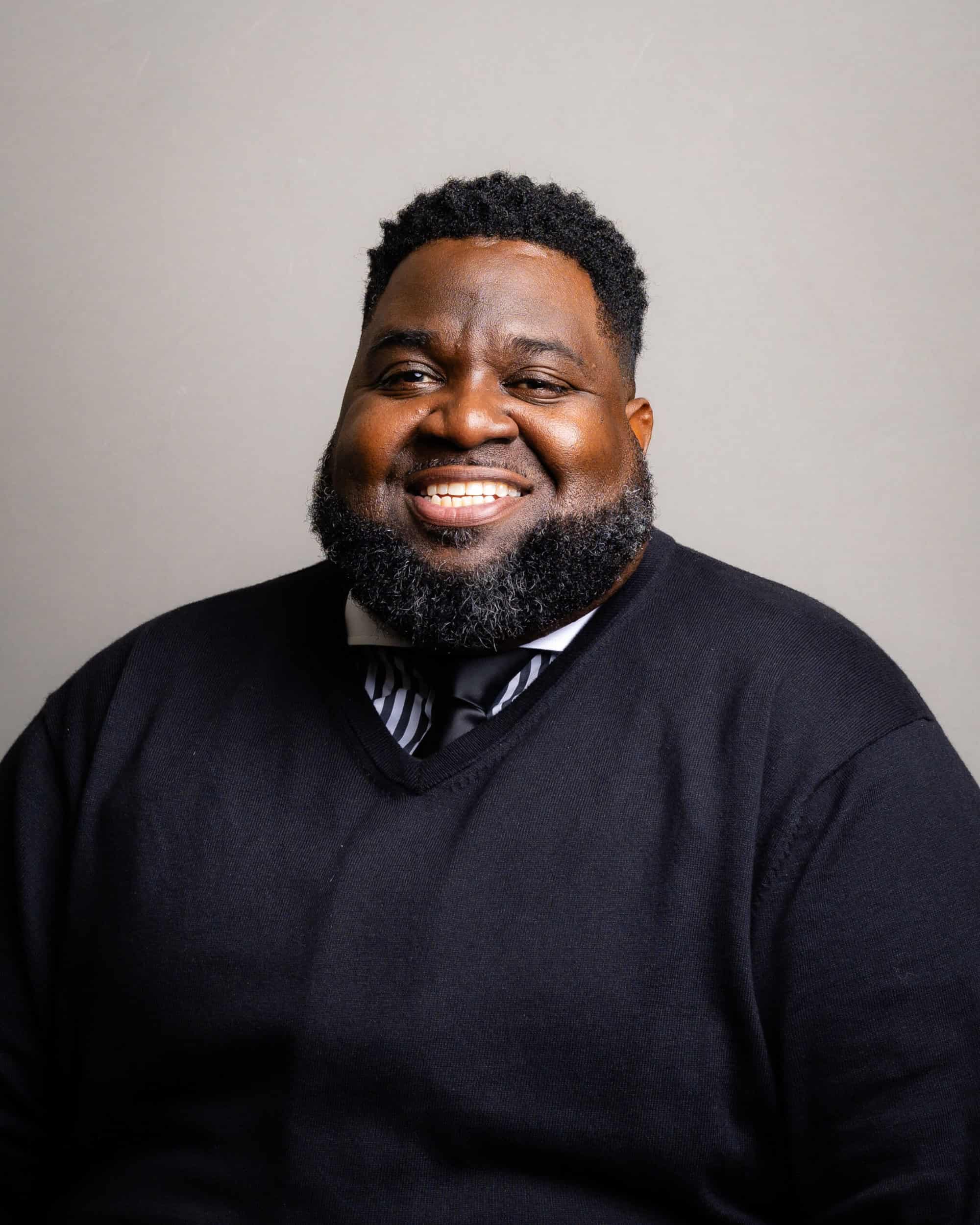
Pastor Jonathan F. Lowder Sr. is a third-generation preacher, born and raised in Warner Robins, Georgia, the son of a bi-vocational pastor and engineer and a mother who was an educator and the songbird of the church. He was baptized at age five, sensed a call to preach at fourteen, and spent years wrestling with that call before surrendering to it in 2000. On November 26th of that year, he preached his initial sermon, When the Storm Comes, from Job chapter one, at St. Mary's Missionary Baptist Church in Macon, Georgia.
Over the course of twenty-five years in ministry, Pastor Lowder has served in multiple roles across the Missionary Baptist tradition, as worship leader, assistant youth director, executive pastor, and youth pastor, under the mentorship of his late father, his godfather Bishop Willie Reed, and Pastor Dr. Morgan. He served at Fellowship Bible Baptist Church from 2009 to 2016 before being called to the pastorate at Mount Zion Missionary Baptist Church in Bolingbrook, Georgia, where the rural congregation shaped and deepened his preaching and his love for people.
In 2024, Pastor Lowder was called to serve as Senior Pastor of The Historic St. James Missionary Baptist Church in Fayetteville, Arkansas, one of the oldest faith communities in the region, founded in 1865. He also serves as a Southwest Regional Board of Directors member for the National Baptist Convention, representing the state of Arkansas. He and his wife of more than twenty-two years are the parents of four children and make their home in Centerton, Arkansas.
episode references.
- The Historic St. James Missionary Baptist Church: https://stjbc.org/about/
- Squire Jehagen Outreach Center / St. James Food Pantry: https://stjbc.org
- Historic Context Statement — The Historic Black Community of Southeast Fayetteville, City of Fayetteville: https://www.fayetteville-ar.gov/
episode outline.
- Episode preview — Pastor Lowder on government, civil rights, history, and waking up (00:00:01)
- Introduction of Pastor Jonathan F. Lowder Sr., Senior Pastor, St. James Missionary Baptist Church (00:01:18)
- Pastor Lowder's story — Georgia, third-generation preacher, wrestling with the calling (00:01:53)
- Faith over a lifetime — his father's faith in action, giving everything away, trusting God (00:12:46)
- Coming to Fayetteville — the call to Arkansas, missing the deadline, landing at St. James (00:10:00)
- The whole self — God is not just concerned about part of me (00:51:57)
- Do you care? — Mark 4, the storm, the only question that matters (00:53:34)
- Community care — the food pantry, tiny homes, the Squire Jehagen Outreach Center, the Walmart neighborhood effect (00:47:20)
- What this tradition offers — the shepherd and the sheep, leading with love (01:00:39)
- Fears — fear of failure, fear of letting God down, time as gift (01:04:16)
- Holiness and wholeness — lemonade, Color Purple, "I may be ugly but I'm here" (01:09:27)
- Closing — "Well done." (01:13:38)
- Talk-back with Monica Kumar — care, unity, power, honesty, and the cost of not waking up (01:13:59)
episode transcript.
episode preview.
[00:00:01] jonathan lowder.: We're in a country where we have a government who shifted from the right to pursue liberty and the pursuit of happiness and all its freedoms to where tactics to hinder the marginalized, but still enhance the elite has become the more.
It's amazing you can find money to fund a war, but you can't find money to increase teacher's salary to feed those that are hungry, to put snap benefits in there. You are cutting Medicare and Medicaid for people who need it.
My ancestors lost their life, lost money, lost resources going for civil rights. ' cause civil rights is really human rights, and we're arguing over a land that was stolen.
You have a people, a generation, watch this who is now waking up and you want them to stay asleep. But you want us to stay asleep 'cause we're now finding our way.
episode intro.
[00:01:50] mike rusch.: Well, you're listening to The Underview, an exploration in the shaping of our place. My name is Mike Rusch, and today we're sitting with a man who stepped into one of the oldest faith communities in Northwest Arkansas, a congregation whose public story begins in 1865, the same year that the Civil War ended. It was a man named Squire Jehegan, who had been held in bondage, walked free, and the church he organized stepped into the light. What began in hush harbors became a cathedral of resistance. This faith community has walked a road most of us can never fully understand. And it has refused to be silent and worked to shine its light in the darkest of nights.
Because survival and resistance, they carry a great cost. The church buildings have been burned twice, both times arson. It has housed students the university wouldn't, and it has fed this community through every generation since Reconstruction. And through all of it, it has never put down that prophetic voice, still carrying it today, organizing prayer vigils for immigrant neighbors swept up in ICE enforcement. Because to care for the soul has always meant caring for the body when it is suffering.
St. James has never been willing to separate Sunday morning from Monday's injustice. And it is still asking the same question that it's always asked: What do we owe the people who don't have a place here yet?
Pastor Jonathan Lowder Sr. Came from Georgia. He grew up in a church, literally a preacher's kid, born into faith, shaped by it, running from it, and eventually being called back to it. And twenty-five years of ministry has followed, a lifetime of learning what it means to love people in the specific and difficult and unglamorous ways that actually matter.
And as he came here to Northwest Arkansas, he was learning a place that is still learning itself. As someone who's not originally from Northwest Arkansas, maybe he has something to offer those who grew up here and sometimes can't see. He is reading this community through us, this region, this particular expression of faith in the Ozarks, and what he sees and what he is willing to name may tell us more about ourselves than we can expect.
St. James was planted at the very root of this place before the university, before the corporations, before the trails and the bike paths and the museums, there was Squire Jehagen, who organized a people and said, "We are here, and we matter, and we're not going anywhere."
Pastor Lowder carries that forward, and he has some things to say about what it means to belong and what it costs when a community isn't willing to engage in the full story.
All right, a whole lot to work through today. Let's get into it
episode interview.
[00:04:19] mike rusch.: I have the privilege today of sharing a table with Pastor Jonathan Lowder Sr. Who's the senior pastor here at St. James Missionary Baptist Church. And so Pastor Lowder, thanks for being a part of this conversation.
[00:04:31] jonathan lowder.: Thank you, Mike. Thanks for having us, and glad to be chosen to discuss.
[00:04:34] mike rusch.: I can't have these conversations uh, without your voice in them, and so I'm humbled and honored to be able to Yeah. Just dig into this conversation about faith.
introduction of Pastor Lowder.
[00:04:44] mike rusch.: Yes, sir.
And what it means to our community and trying to navigate through this crazy world we live in. I would love for you to share a little bit about your story and Gotcha. and maybe we can start there.
[00:04:55] jonathan lowder.: I am a third generation preacher. My late father was a pastor. My mother was the songbird of the church and so I was in the, introduced to faith in the womb. I am the product of. I promise God made to my mother. My mother experienced four miscarriages before she had me, and that's why she named me Jonathan. Because it means God gives grace. And so I try to live my life that way by extending grace. And then from there born and raised in Warner Robins, Georgia. I am a Georgia, born, Georgia bred, back home, they say when we die, various in Georgia, red, but been in ministry preaching ministry since 2000.
Served my late father as his assistant till 2004. Let me back up. I was baptized at age of five. I professed Jesus, my Lord and Savior, five years old, recommitted my life to him at the age of 18. I knew I was called to preach at the age of 14, but I was in high school. I didn't want to, I wanted to do, I wanted to be a teenager. So I wrestled with that calling. And in wrestling with the calling, I even experienced walking in it without forcing it. I was the president of Fellowship Christian Athletes. I was vice president of the prayer club voted team chaplain and team captain of my football team. So when I graduated in 1998. That started my trek of running. I ran to Atlanta, Georgia and got in at Clark Atlanta University. Didn't even decide a major. I walked on the football team, played made the practice squad, made the team, but then started going to DeVry University while I was there. 'cause I tore my knee and I didn't wanna come home. And really, I think the tearing of my knee was my, what I call Jacob experience. God alright, I'm gonna give you a limp and make you remember who it was of your experience with me. And so I recommitted my life back to Christ again. Age 19. Called my dad Easter of 1999, no, Easter of 2000 and told my father, I'm tired of running and I'm going to walk in my calling of preaching ministry.
And my dad took me on a nine month, what I call bootcamp . There was no clubbing. It was a nine months of silence. I was not put in front of the church to do anything unless he authorized. I couldn't go out with my friends. When I was working I moved out to try to get some freedom and he was still on my tail. And so finally, November the 26th, 2000, I preached my initial sermon when the storm comes from job chapter one. And it was five o'clock in the evening at the St. Mary's Missionary Baptist Church of Macon, Georgia. And for the last 26 years, this year it'll be 26 years, I have been striving to be who God has called me to be.
Not perfect, made some mistakes, fell short, but by God's grace, here I am.
And I pastored, I served as a youth pastor at an executive pastor at the Fellowship Bible Baptist Church from 2009 to 2016. Prior to that, I was the worship leader and assistant youth director, youth middle school director at the Bit Mount Zion Church, where I served under Lake Teddy Parker. And when I got the fellowship serving under my lake godfather Bishop Willie Reed, that's where I really, the call to the pastorate really began to. Choke on my heart. I tried to run from it 'cause I got comfortable being a youth pastor. And there were churches within those timeframes that approached me to be there, the pastor.
But God never said yes. And then finally in a place I had never been before in my life. Only way I knew of them was because their, my predecessor at that time was best friends with my godfather, the Mount Zion Missionary Baptist Church of Bolingbrook, Georgia. Country church in the woods.
My dad pastored in the rural country before he came back to Macon in nine, from 89 to 91. And then when he came to Macon Georgia and pastor at St. Mary's for close to 20 years, then I found myself not, basically not in the limelight, but in the woods being developed. That church helped formulate me and developed my preaching.
Even the more pastoring loving people, even the more, and then the pandemic came, the pandemic really proved to me that God was inside of me. Even the more, because you didn't have a, all you had to preach to was a camera. You didn't know who was watching, but you still had to find a way to serve people.
Love people, care for people. And so in that initiative, when the pandemic hit in March, the funny thing is March the 15th, 2020 was that church is a hundred and 50th church anniversary. I had to announce to the church that day we were shutting down and we was closing our doors for, to be keep people safe, not knowing we was gonna keep our doors closed almost two, two years. And in that time, I experienced COVID myself.
I think that's even, I believe God, to have to keep you grounded allows you to really experience what the people you serve are experiencing. ' cause you cannot preach to them about anything that you have not experienced. You can talk about it from a third person narrative, but there's a difference. We have first person narrative. A pastor there experienced the transition after the pandemic. My mother passed january 25th 2024. I was ex hardest, worst season of my life. ' cause that was the first time in my life I had to experience what orphans feel like.
You don't get to see your parents anymore. You, all you have is memories . And so for. Almost. I tried to preach through it, but I was experiencing grief, depression, and so March of state of Arkansas got put on my spirit back in 2023. I didn't know what God was saying. I just heard, he said, you're going to Arkansas.
I thought, okay, maybe somebody's gonna call me to come, do a revival or something. He was like, no, you, your season is up here in, in Georgia. You prepare yourself. And I was still dealing with my mother's, her transitioning during that time. And so when I finally got, after she passed, it hit me again during my sabbatical. I took a sabbatical to deal with my grief. I did not preach at my church then from March of, after the third Sunday march until after Mother's Day, I did not preach. Really, it was June, the first Sunday in June when I stepped back in the pulpit to preach. I just had guest preachers come in. I showed up to church crying every day.
I was going to the office crying and to the point it took my wife and my pastor like, you need to go to counseling and just take a break. ' cause I tried to do what I did when my father passed, preached my way through and it didn't work. It's society, but it didn't work. But something about being. My mama's boy that shifted me.
And in the midst of a shift, I was, a friend of mine called me and said, Hey Jay, have you heard about this church called St. James in Fayetteville? I was like, no, I don't know nobody in Fayetteville. Where's, what's, only thing I remember about Fayetteville was University of Arkansas. That was it. That's the only thing I knew. And I sent my, prayed about it, and I sent mine package in, and I missed the deadline. 170 people applied for this pastoral position. I didn't know anybody from here didn't. I missed the deadline? And I didn't. When they let me know I missed the deadline I simply replied, my prayers are with you all praying that whatever God has for you all, it is what we done.
About 30, 45 days later, I get an email, Hey, you made the top 25. What? Thought I missed the deadline. They interviewed me. Then they did, had me fill out a questionnaire. I made the top 10. They interviewed me in the top 10. Got a call July 26th, which happens to be my anniversary, wedding anniversary been married to my wife for 22 and a half years.
[00:13:02] mike rusch.: Beautiful.
[00:13:03] jonathan lowder.: And it's the love of my life and. We were talking about where we were going on vacation and I saw this 479 number pop up on my phone and I answered it and they said, Hey we wanna bring you in. You've made the top three. Wanna bring you in to interview.
Have the official interview with the staff and the leadership and members, ministry leaders. Okay. Can you come August the weekend of August 6th through the eighth? Sure. I'll find somebody preaching my church and I'll, I won't tell. I had to walk in silence that whole time. And Mike, what hardest thing for me is not be able to talk to people.
I'm used to having somebody. I can be an outlet. Only person. I had purpose to talk to outside My wife was my pastor, Dr to Morgan. He's the only one I had the purpose to talk to. And his thought to was, don't overthink, which I have an issue doing everything I do, but he said, there's nothing to talk about.
Just let God get you to the microphone. So the second Sunday in August, I stepped to the podium. And first Sunday, in September, I wanna say it was solidified. That was the new pastor I store, St. James, Missouri Baptist Church.
So I left what I knew my whole life. December the sixth, I came here and preached my first sermon in 2024 as a senior pastor.
And that's my life. And ever since then, God has been doing what God does best add to his church. Save souls. Our church is growing tremendously, spiritually, physically, emotionally. It's a, some people call it a honeymoon. I call it just a work in progress. Trying to get to know the area, which is a learning curve.
[00:14:40] mike rusch.: We'll talk about that.
[00:14:41] jonathan lowder.: Yeah. So that's really, I'm the father of four children. One is with the Lord. My, my daughter was a twin. She's the baby. I have a 19-year-old son, Jonathan Jr. Who's getting ready to be a rising sophomore at University of Arkansas. I have a 18-year-old son, Micah, who is who serves at our church as a trombone player. And he goes to Bentonville West. He's graduating this May. So I'll have two college students. Pray for my wallet, but also have that baby girl and she's 11. And pray for my wallet and my mind because my wife and I were like yeah, 2032. There gonna be empty nesters maybe, but God is good and I'm grateful, and I'm just thankful what he's done does my life.
I'm simple. I love God, love sports, love Topgolf. I'm simple. Love, love playing Uno cards. I'll play Madden every now and then. I'm so happy that the NFL draft is tonight. I dunno. 'cause I love, I just love life. And so that's who I am.
[00:15:34] mike rusch.: First of all, pastor I'm just sitting across from you, the joy in your face is I wish everyone could see that. I'm smiling because you're smiling. God bless you. You. And so thank you for the joy in that in that.
This is your whole life.
Yes. From as probably first memories.
[00:15:48] jonathan lowder.: Yeah.
faith over a lifetime.
[00:15:49] mike rusch.: How do you think about faith in this way over your whole life?
[00:15:53] jonathan lowder.: Faith has been instilled in me since I was born.
My father who dealt with sickle cell anemia. I have a trait. I watched my father battle, caring for my mother, who I didn't find out till 2023. She, for her whole life since she was 15, was battling bipolarism depression and dealing with schizophrenia. But my mother, who was an educator, my father was an engineer pastor, bi-vocational, I saw him trust God with nothing. He was a city boy who married a country girl. And he trusted God like his faith. Was he believed scripture always says if you speak to the mountain, it'll be it'll, you can say it'll be removed and be cast into the sea. That's the faith he had. He did not instill in me, God, if you don't move the mountain, gimme the strength to climb. No. He said, no the Bible says speak to it. And so any obstacle he faced, I saw him conquer it. I saw him, and if I could be transparent, the very thing I loved about him and the very thing I ended up hating about him. My father was one and I didn't understand at, until I became a pastor. ' cause as his son, I saw him choose the church over his family.
I saw him give sacrifice, what he was getting as a pastor. Now understanding he was blessed as a engineer working for brown Williams Tobacco Company as an engineer and as a shift leader. He had to make good money. But I sought him, give the people, not consult my mother just give, if he had a shirt, if he saw somebody on the side of the street with no shirt on them or no food, he would literally go to the crystals or go to Church's chicken, grab them a meal and put money in their hand, put 'em in a hotel, and he's driving on an eight tank of gas money that he knows he needs to put in his tank, but he will give it 'cause he trusted God with faith that God was gonna supply. And I very saw the very people that he passed turn on him. Very people he chose over his family. And it wasn't until I, I chose to leave up under his leadership because I told him in 2004, going into the beginning of 2004, I told my father, dad, I don't need you to be my pastor anymore. At this point in my life, I just need you to be my dad. ' cause me and my father, we were so much, I like him. We, I just couldn't, I didn't wanna be him. I never wanted a pastor. I didn't, I was gonna be a ministry. I didn't want a pastor because what I saw him go through, but I saw his faith. I saw him deal with faith, having back surgery, but still having my mother sit next to his bed while he's, after back surgery.
And he has his commentary in the Bible and he's laying on his stomach, writing out his sermons. He's planning ministry, all this stuff. He took a neighborhood that nobody knew about other than crime and started a daycare center, started a afterschool program in that city for underprivileged kids and did not charge one family.
He was talking, he was writing grants before people knew what grants were. He would take money out of his own pocket and fund it and. I saw my dad trust God with what others call convenience. But to him, if he saw somebody hurting, he would rather inconvenience himself than to see them hurt. I saw faith in action.
I saw my dad when he chose to retire, go start a ministry of feeding the homeless and having a food pantry. But because of his heart, the pastor turned it into a church. And at that moment I told him, I was like, dad, he wanted me to join and come back and be his assistant I go Dad that's something God's calling me to do. And he put, when he gave me that silent treatment, until he found out that his first grandchild was gonna be his son. I'll never forget that conversation. I walked in the house and he was sitting at his desk at his computer and my mother knew. She said, son, you gotta go tell her. I was like, I don't wanna talk to him.
We, anytime, every time we talked it was real short and quick. But at this point I was like, okay, so swallow your pride. I walked in and said, told him, dad, I love you. He said, I love you too. I said, I got some news for you. You about to be a grandfather. Now, mind you, I have a older brother and older sister.
My older brother passed in 2007. My older sister, she's still living there in Macon. They're actually my first cousins, but I didn't know that till I was 19 years old. Found out I had a family. Really? My dad raised him 'cause his older brother passed in the Korean War. And so he adopted them while he was 17 years old.
Adopting them, became their father. My mother started dating my mother when he graduated high school. And they, their first two children when their first couple years of marriage, they're raising two kids.
[00:20:32] mike rusch.: Wow.
[00:20:32] jonathan lowder.: And so I didn't know they were my actual first cousins until I was 19. Cause my father didn't raise them any different. And so I always tell people I'm the middle child of five, I'm the oldest of three. And I saw how he handled them. I saw all those things. And when I told my dad, you're gonna be a grandfather, I hadn't, I couldn't even remember the first time I and my dad ever hugged me outside of a football game. My dad, literally, I showed him the sonogram and I'm bigger than my dad. And wait, that six foot 2, 225 pound man picked me up off the ground like I was a baby and said I'm sorry, for everything. I wept. Like a, I wept, like a
[00:21:11] mike rusch.: I bet.
[00:21:11] jonathan lowder.: Yeah. Because I was, that was the words I wanted to hear, but I still wrestled with some of the conversations that I did not get to have from my dad. Because of that. But. He built my faith. So you know that when I couldn't talk to him, he always told me I could talk to God. So my faith is secure and built on the mere fact that I have gone through fire. I have treaded through floods from illness, from dealing with betrayal in my own life. I found out sometimes you can be more loyal to people than they are to you, but that shouldn't affect your faith in God because God always proves that he is who he said he is a friend to the friendless, a father to the fatherless, but he'll always send help in those moments of life that we feel trapped in the cave.
So my faith came from really studying his word, hearing my parents, my mother made me read every kind of genre of literature from Shakespeare to James Cone, and my father he was strictly on, you need to have the Bible and the newspaper in your hand at the same time. Bible on one hand, newspaper in the other, because you can't preach hoping the people's reality if you're living in a fantasy.
And so I, I instilled that and saw him walk by faith, saw how he handled my mother. I saw how my mother, after he passed continue that faith. She never stopped singing even till her last breath. She left me with one phrase when she was transitioning. She didn't say this to anybody else in the house. My last moments were, she said, Jonathan, don't do nothing stupid. Jonathan don't do nothing stupid. I'm like, mama, why would you say that to me? She knows her son.
[00:22:49] mike rusch.: Yeah.
[00:22:49] jonathan lowder.: And I really feel what she was saying is, baby, don't lose your faith. Don't let what you're seeing called you to stop believing. ' cause they had taken me as far as they could, even with being a grown man. And I think any man will tell you, the only woman who can melt your heart is your mother outside of your wife, unless Lord bless you with a daughter. That those are those moments melt you, but they make you, inform you. And so I learned to pray more. I don't, I'm not gonna sit and tell you, oh, I spent hours in prayer. I don't think prayer should be bragging about my prayer life with God is how I'm talking to you. That's really how, that's beautiful. That's really how faith in God should be. The Bible says that God ina walked with God like a, as a friend of friend.
To the point where God took him. And I'm gonna be honest with you, I'm not afraid of death and dying, but I wanna experience the rapture. I really do.
[00:23:37] mike rusch.: You're like, bring it on.
[00:23:38] jonathan lowder.: I'm like, bring it on. Let's, come on. Lord. That's what I wanna experience.
[00:23:41] mike rusch.: Yeah.
[00:23:41] jonathan lowder.: Because that's where my faith is. If he said, if he chooses to come after that, I'm still gonna be with him. So the same faith I have seen in the depth of those connected to me, it's the same faith I live by. 'Cause I'm connected to him and I try to express that to others. I don't beat people up with the word. I, you can't beat people into Christianity. You can't beat people up in faith. Everybody when they come to Christ has a measure of faith. Question is how you, are you going to activate it?
an all consuming faith.
[00:24:07] mike rusch.: Pastor, What you're describing is not like some internal only, self-reflective. This is like where the rubber meets the road in the world.
[00:24:16] jonathan lowder.: Yes. Yes.
[00:24:17] mike rusch.: This is a faith that is tangible. Yes. That is active.
[00:24:19] jonathan lowder.: Yes.
[00:24:20] mike rusch.: This as I watch you and listen to you talk about your father bible in one hand, newspaper in another. This is this is not a faith that is still
[00:24:28] jonathan lowder.: No.
[00:24:28] mike rusch.: Walk me through that understanding, if you will of, of how and you have a little bit.
[00:24:34] jonathan lowder.: Yeah,
[00:24:34] mike rusch.: you have a lot. There's a lot that we've gone through. But like when you think of faith, it feels, the way you talk about it, it's just all encompassing.
[00:24:43] jonathan lowder.: Yes.
[00:24:43] mike rusch.: Everything.
[00:24:44] jonathan lowder.: Yes.
[00:24:44] mike rusch.: Help help the rest of us understand that.
[00:24:47] jonathan lowder.: So we, we hear scriptures that sometimes people like, what is that saying? The just shall live by faith. But then they ask the question do we really want God to be? Just because to be just means to be fair and to be honest with you, God ain't fair.
' cause God, if God was fair, we wouldn't be here. Faith is like the waves of the ocean and not a monument. It's a movement. So your faith is what carries you to even when life says quit, your faith says, keep going. A great mentor of mine who is with the Lord now was Bishop Steven Hall. I love me, Bishop Steven Hall. I challenge every preacher, nowhere is to look him up.
And he told the story of a old revivalist who was traveling with his daughter to the point I sometimes use his illustration of my sermons. And they, he preached the revival. He was tired and he gave the keys to his daughter to drive them home. They were in a truck, they were driving down the highway and when the, while driving a storm hit and it got so bad where it was affected, the visibility.
And the daughter asked her father, should I pull over? He said, no, keep driving. It kept getting worse. Lightning flash, flashing thunder roller. And she was like, dad, I think we need to pull over. He said, no baby girl, keep driving. He kept, she, she was like I'm having trouble seeing you. She said, baby girl, keep driving.
Other cars was pulling over. And so finally they drove out of the storm and the father told the daughter, pull over. He says, now come with me to the back of the truck. She said, what we need to keep driving. We're clear and clearing. I said no. I need to show you something. So she walks to the back of the truck with the father and he says, now I want you to look straight ahead.
What do you see? She says, I still see the storm. And she says, what else do you see? She says, I still see cars. She says, you know what the difference is between you and them because you kept driving. You came out.
They're still stuck in the storm. That's what faith does. Faith says, keep going. No matter the elements, no matter the environment, because that's when you'll learn the lesson about God. Not when you stop, but 'cause you chose to keep going because after you doing the word to my father, either you're in a situation, headed to a situation or you just came outta one. And that's where this faith continues to move.
We sing a hymn in church called Hold to God's Unchanging Hand. And the first stands of that song says, "time is filled with swift transitions. None on earth unmoved can stand, but build your hope on things eternal and hold to God's unchanging hand."
The question I've always wanted to ask, how do I hold God's hand? Is basically putting my whole entire being mind, body, sight, everything things I can control and things I know I can't in his hand. 'Cause that's when I'll find out. It wasn't about me holding to him. He was always holding onto me. So to me, that's the faith which only comes no matter what we encounter in this world. We have to believe and trust the God who created us, who wrote the script to our story is always in control. We're just acting it out. And the scene is always unfolding, but you'll never know that if you just quit.
So that's how I try to live my faith, trusting his word. Believing what he said. 'cause the fortunate, unfortunate thing is where others can have books on life and books on all these things, and it's all well and good when people come to St. James and when I'm standing behind and someone standing in the pulpit across this country, I can only go to that pulpit with one book.
And I have to try to find hope in a story that never changes. And that's where I ask God to deal with me, to show me in my own life who he is so I can express that to others, so that when the storm comes, I'll still be standing.
[00:28:39] mike rusch.: You have a gift to be able to do that.
[00:28:41] jonathan lowder.: God be praised.
[00:28:42] mike rusch.: I feel like I just need to say please keep talking. But then you would say you just need to come to church
[00:28:46] jonathan lowder.: every Yeah. I believe a couple seventies. Yeah.
[00:28:49] mike rusch.: So you're here in Fayetteville.
[00:28:50] jonathan lowder.: Yes.
[00:28:51] mike rusch.: Grew up in Georgia.
Yep.
Came here.
[00:28:53] jonathan lowder.: Yep.
[00:28:54] mike rusch.: Trying to understand what this place is.
[00:28:56] jonathan lowder.: Yep.
arriving in Northwest Arkansas.
[00:28:56] mike rusch.: I, I don't know where to start with that conversation, but walk me through, what does that look like to come to a place, a new place? But to one of the oldest faith communities. Yeah. In the whole state. Really? How do you navigate through that? What do you find?
[00:29:10] jonathan lowder.: I use the line here at St. James. Y'all ain't no different than your cousins there in Georgia. The, I think the difference here, the one Fayetteville is rich in the history. It's a college town. It was also a transient town.
St. James' name was founded by Squire Jahagan, but he called it St. Gave the name St. James to it because of a man who gave him the land. He's a free slave in the area. Man gave him a parcel of land and he took that time, started the church. And since 1865, which for African Americans is an important year.
[00:29:46] mike rusch.: Yeah.
[00:29:47] jonathan lowder.: Because in June, on June 19th, 1865, the final slaves were freed.
Can you imagine that President Abraham Lincoln gave the decree, the Emancipation Proclamation way before that. But it wasn't until June 19th that people find out that. And, everybody has their opinion on, that. But the culture here, African Americans are not even in the top two highest percentages of demographics racially here. We're right now, probably in the fourth or fifth. And so it's a perfect picture of a melting pot of ethnicities who all of us are trying to figure out the same thing.
And what's amazing to me is from September to end of November, every Saturday at Don Reynolds stadium, nobody cares about black and white. Everybody's concerned with cardinal and white. The colors of the Razorbacks. People are concerned, people are more happy about doing the pig suey cry. I've been to the games. I didn't see one, I've had people behind me who didn't know me was high fiving at the games. They were getting mad with the coaches and everything. I went, the games I went to, I saw something that amazed me. Arkansas started well, but finished horribly. And the people, even when they left, they still had hope.
[00:31:08] mike rusch.: It's true.
[00:31:09] jonathan lowder.: That's true. They left and the same people who left MAD decided to come back the following week.
[00:31:13] mike rusch.: Yeah.
[00:31:14] jonathan lowder.: To see the same team try to get victory again.
[00:31:16] mike rusch.: I've been a Razorback fan my whole life and I,
[00:31:18] jonathan lowder.: So you understand.
[00:31:19] mike rusch.: I still, I do, I'm still struggling with hope though.
[00:31:21] jonathan lowder.: But can you imagine that's life?
[00:31:23] mike rusch.: I can,
[00:31:24] jonathan lowder.: That's really what it is. I it shouldn't, my life should not be based on the color of my skin. As a matter of fact, all of us are trying to achieve the same thing, but what we've done, we have allowed I a tactic of the enemy Satan themself to cause us to what I'm actually gonna be preaching on Sunday to focus more on flesh and blood than on the spirit that's inside the person that's using them, do what they do.
So here in Northwest Arkansas, the moment I'm living in Centerton, Bentonville area and what I experience sometimes in Georgia, in certain places, I still experience him sometimes having to look over my shoulder.
In Georgia you can say hi to everybody and say, Hey back, you say hello here. Sometimes it's I'm just saying hello, but everybody has the same thing in common. Everybody's trying to get food. Make a living, provide, make it one day at a time, and trying to connect with the right source people, college students trying to get their education.
High school students are in this quandary where things going. You have Fayetteville, which is, a good mixture of black and white Marshallese. You have Hispanics, you have Arabs, you have all here. You have Africans who come from overseas, Chinese will come overseas, Asian overseas to come here to get an education. And the opportunities that they have here, 'cause of places like Walmart, Tyson, Harps, Proctor and Gamble, you name it, it's here. And everybody's trying to get the same thing.
But we allow one thing to separate us because we've allowed the climate of the culture to take our focus off the authenticity of Jesus Christ and putting more on politics and all these things that's happening around us instead of what can we do to come together to make everybody's life better.
Christmas time shouldn't be the only time we hear peace on earth.
Goodwill to all men every day. You ought to want somebody, I don't know anybody who wants to live in a horror story, but people are, yeah. Let's throw all the cards out on the table.
We're in a country where we have a government who has shifted from the right to pursue liberty and the pursuit of happiness and all its freedoms to where tactics to hinder the marginalized but still enhance the elite has become the more, it's amazing we can, you can find money to fund a war, but you can't find money to put, to watch this, increase teacher's salary to feed those that are hungry to put snap benefits in there.
You are cutting Medicare and Medicaid for people who need it. I can't imagine my grandparents having to live in today's climate. I would literally probably have to put them under my roof. My parents if they were allowed to have them under their roof. But it we have someone who wants to act like he created a word , that's been a word that everybody believes in. We want life to be affordable. We wanna experience we wanna experience pursuing justice and not be treated as an infidel or just treated as somebody who, like you don't care. My, ancestors lost their life, lost money, lost resources going for civil rights. ' cause civil rights is really human rights and we're arguing over a land that was stolen.
See, I believe the problem is if you don't read your history, acknowledge your history, you'll end up repeating history. So what we're seeing in the government now is we have the 2.0 version of Richard Nixon in President Donald Trump.
We have Republicans who. Help push the narrative of freeing slaves, right? But now want to enslave people again, because history, you have a people, a generation watch this who is now waking up and you want them to stay asleep. My generation was called the woke generation. But you want us to stay asleep 'cause we're now finding our way. We're not denying things. The Civil War, we're not denying the Revolutionary War. We're not denying Jim Crow. We're not denying none of that. But can we be honest of a history can erase in Fayetteville, Arkansas, that African-Americans could not live on campus. So St. James was the hub of being the place where African-American students not only could come to church and worship, but they would get fed, they would be housed and taken care of.
And then from there, when you have people like Dr. Merlin Augustine, and people like TA Walton who went to those schools and thrived and are still here in the area making a difference and still getting the credit they deserve. But then you have a coach. The first coach one, the one the coach to lead the University of Arkansas 1994 basketball team to a national championship.
I imitated, I wore Corless Williamson's number in high school, 34. 'cause I wanted to be him.
But we, we have all these things in our area that used to draw people together, but we still let one thing separate us and then the very issues we should be holding people accountable on, we're quiet about. So when I preach about it, when I speak about it, all I'm asking is not that you agree. Acknowledge what we're saying is true. We listen, the most segregated day on, on a week is Sunday morning between the hours of 11 and one o'clock. Now most churches 10 and one. Yeah. That time was the most segregated time, but that's not everywhere. Here at St. James, our congregation, even though we are the eldest, started and oldest started African American led congregation, predominantly African American congregation. We are a multicultural congregation. I look at, people look like me on Sunday. Look like you on Sundays we have Iranians, Arabs, we have some those with Asian descent in our congregation. And we're all here for one thing. Tell me about this Jesus who loves me.
Who cares about me and wants me to be a better version of me so I can be better for the world so I can let my light shine so that the only place we don't come together is at Reynolds Stadium or in Bud Walton Arena.
Fayetteville is an intricate city. Northwest Arkansas is intricate because it's a transient place. People come through here, look at where we sit. We are five hours from Dallas, three hours from Kansas City. You're two and a half, three hours from Oklahoma City, Tulsa.
The home of Black Wall Street is an hour 15 to an hour and a half, hour and a half away. History is there. Northwest Arkansas has history. It's the home of Walmart. It's the home of where a man had a dream of providing resources at a reasonable rate. And where Mr. Sam Walton turned that in for, what was Sam's Club started off as a, to Walmart to now through that because of, was this not just his family, but people who came in?
Black, white, all you name it came in with the mindset, we can make this thing better. And now you see a generation when you walk on eighth Street in Bentonville, it's a testament to the evolution of really what the United States of America, if we pull out resources together and stop looking at not just the color of our skin, but a color on something that has no value, which is the dollar bill, and start looking at the heart of people to make things better, I thought love should be our currency.
[00:39:11] mike rusch.: I've just got hundreds of questions for you. That's
[00:39:13] jonathan lowder.: good. I think I'm, I may have 99 answers, but I don't,
[00:39:16] mike rusch.: I don't want to interrupt you because I'm just, I'm gonna let it flow. Yeah. As you talk about this place and it's history, this is real. Yes. You talk about this faith that is not just an internal still thing.
[00:39:29] jonathan lowder.: Right.
[00:39:29] mike rusch.: As you lead a community, a faith community here with a history
[00:39:34] jonathan lowder.: Yes, sir.
[00:39:35] mike rusch.: That you do.
[00:39:36] jonathan lowder.: Yes, sir.
[00:39:36] mike rusch.: In a place like this.
How do you think the church, a church, what is their role here? And I, and before you answer that the things that you, I said today. As I've listened and tried to do my research.
The things you have spoken about from the pulpit, there's not a lot of pastors, let rephrase that. I don't know of any other pastors that are willing to say some of the things that you've said, speaking to the community.
And I would love to understand even more in this world of faith and culture, politics, policy, how do you as a pastor, lead a community in a world like this that we're in?
[00:40:16] jonathan lowder.: I would say this, God calls us not just to be holy, but to be honest, everybody's story is not the same. So to lead this church in the history that it has in this area, you, I embrace people's story and I introduce them, not to a story, but the story, which is the Bible, the word of God. I don't add to it. I don't take anything. I don't delete anything out of it. I try to preach authenticity and show it how, show people how it aligns with today's. I even try to, you have people think. Not that I'm trying to hype them on some holy hyperbole. No, I want you to. God calls us to think when Jesus walked this earth, he told parables that made people think, the parable of the talents.
One was given 10, one was given five, another one was given one. Matthew, mark and Luke all talk about it ' cause that's their aim. Those are really the synoptic gospels. John is just the, is considered a gospel because it's basically proven that Jesus is not just the son of God, but that he is God.
So I try to do the same thing. So when I look at the Pairable talents, the one who took his 10 doubled it. The one who took his five doubled it. But the sad part is the one who had one, he buried it. So when the master returned, the ones who used there as and multiplied it, he said, well done th good and faithful servant.
When is it the most time you hear that at a funeral, you've been faithful over a few. I'll now make you rule over many how's that apply to the earth that we live in today?
It's not a promotion, it's a responsibility to say, I'll make you a ruler over many please. I've got more responsibilities. That means he can trust me with more. So God will not trust you with more if you still have the mentality of the one who buried his.
All of us have a gift. The Bible even teaches us in Proverbs. Your gift will make room for you and bring you in the presence of great people. I don't consider my gifts to be that ose. I don't boast on that at all.
But I Look what you're doing today, that's a gift.
And so we try to find a common ground to where everybody can learn about Jesus on their level where everybody can feel God's love.
It's the goal of the church should not be to segregate. It should be to congregate, bring people in. The hurting, the lost. Or as I say here, sometimes the well off to the overwhelmed, there's not too many in between. But if you are, you can find a place here. And I think every church should be that way because the center voice is God, is Jesus Christ. And so we leave here hoping that the Holy Spirit, who's our gift of Christ in us, while we'll wait for Christ to return, hoping that it will lead us and guide us. As it says in all truth, the only people who like to live it and lie are people who are ashamed of their reality.
a call to the community to gather.
[00:43:03] jonathan lowder.: Your work to bring people to the table. And this is my, from an outsider observation A Good Friday service. You brought together pastors and congregations from across traditions, multiple churches.
[00:43:17] mike rusch.: You gather people from a vigil for those that have been affected by what's happening in our country around immigration and ice. You're doing this? Yes. What are you seeing? What are you feeling as you move into these spaces to call people to this community table? What has that experience been like?
[00:43:34] jonathan lowder.: Challenging, because sometimes where I wanna be in the background have people who bring, sometimes they'll bring the ideas like, we need you, and I have to be very careful everybody who wants you to some, sometimes there's an ulterior motive, right?
But if it's about fulfilling the mission of Matthew 25, I was hungry and you fed me, I was nicking and you cloth me, I needed shelter and you provided for me. I'm with that all day long. If we're about caring for people the way Jesus cares for us, I share with our church, I wanna say it was Resurrection Sunday.
That the main problem that Pharisees and Sadducees had with Jesus was not what he did, it was what he said. His words had power and his words were connected and walk parallel with his actions. They didn't contradict. Well. We're seeing in today's world is people got a lot of talk, have no game.
We, we can love is not a. Love is. You can say it, but I'm not gonna believe it till you show me. That's what I'm called to do in trying to bring unity. Do you wanna see people better? Yes. Come sit to this table. What are you experiencing? And I'm gonna listen tentatively, intentionally so you can hear what I'm experiencing. And you don't have to, you'll never understand a man's steps until you walk in his shoes.
' cause there are some privileges that certain people never, some that people have that others we would never experience.
Now, if I have a difference with somebody I'm alienated. They don't want to hear me. They don't want I don't exist. But those would be the same people who show up at your funeral and the very things they could have said to you while you were living. You can't hear it. And so in this community, I don't want that to be a stigma. I want us to be, I'm, I wanna be a person that it said he tried to make others better. He lived his life pleasing God and not trying to please people. That's all I wanna be able to do. And bringing people to the table, it takes work. I'm excited about connections that we're making and just to people like yourself. And I'm glad that, but I didn't just start doing this when I got here.
Yeah. I was doing this back over in Georgia. You don't. Get to a place. God doesn't put people in a place until they've proven that they are prepared for that place. And being in St. James as the pastor, as the lead servant, ooh, that's a lot of weight. I'm following people like pastor j Hawkins, pastor Curtis Smith. I'm following Pastor Moton. I'm follow, I'm following gentleman who led this church through its highs and its lows. And what we're trying to redo here in St. James is to build back some of the bridges that were burned. ' cause I think every time St. James got comfortable, ' cause when you are, one thing that's in Northwest Arkansas, there's not a lot of, not a lot of African American lit churches. I can count on one hand that, that I know there's St. James, there is redemption Restoration Fellowship of Champions, and then there's Bishop Benford in Bentonville. Those are the only ones I know. We have ministers, we have people that are connected unlike other places. But then, and we have multicultural congregations. Each of us you have Genesis Pastor, Jody Farrell's, one of my dearest brothers. Only thing I don't like about him is a Green Bay Packers fan. I'm trying to get him delivered.
I'm excited about meeting the pastor of CLC pastor Grant, meeting him soon and matter of fact, having lunch with him next week, excited about that. I met Pastor Faulkner. First Baptist, I know, had know different things, but it's not just about Sunday. I wanna bring, there's some community organizations and we're blessed to have Squire Jahaghan Center, that's our outreach center that connects us, that feeds thousands of people, provides, resources across this northwest Arkansas area so that you don't have to go all the way down to Little Rock to get assistance.
You have it right here. We have people from Missouri and Kansas and Oklahoma come through here just to experience. When we had our, that resurrection weekend, that Good Friday service, that whole weekend was mind boggling for me. It was, I. I didn't know what God was going to do. I just knew I just know I heard God and I know, 'cause I know before I got here just learning, I tried to make sure where, when I'm, when somewhere I had the mentality that I had when I played football, I studied my opponent. I had to study where I'm going.
And one thing that coming here that I knew was at the forefront was outreach. The second thing that was at the For Forefront was I knew that on Good Friday, churches came together. And so myself, pastor Dave Abney pastor Edwin is Sean Strickland, pastor William Lane, pastor Jody Ferrell. I just called him to the table and really, pastor Dave Abney reached out to me First. It was like, I was already in the planning stage like, Hey, what's, what do y'all got planned? Because that, that excited me. So I knew God was in it. And so it was this year that I chose, again, it was my choice. I wanted our people to hear from others in the community of who Christ is to them. Let them share that. And we worship together and we prayed together, we praised together, and then we ended the night with communion.
That's what Jesus did before he left and died and got up out the grave. He had, he brought his people together. And here's what a lot of people don't understand. All the disciples weren't from the same place.
[00:48:58] mike rusch.: No, they weren't.
[00:48:59] jonathan lowder.: So if all the disciples of Jesus weren't from the same place and they could come together, what you think could happen we all come together. But we have to be, we have to want to, and have to be willing to do that. And so I think that's, I know that's one of my assignments being here. So Yeah.
[00:49:16] mike rusch.: What's holding us back as a community?
[00:49:19] jonathan lowder.: Pride. Pride. Pride.
You can see someone hurting and you know what on, I don't know how true it is, but I, it was told to me that, we have a major homeless problem here, but. People get in trouble if they're on the corner begging. What? ? I understand you want, not everybody on the corner has good intentions, but even with that,
what if that was you holding the sign?
Closed mouth don't get fed. Closed fist can't receive. So if I am driving and my wife knows how I am, and I don't brag about this at all, but it's just my heart and I got it from my father seeing him, if I'm clothed in, you're naked, what can I do to get you in the position that I am? If you're hungry and I'm full, what can I do to ensure that you get full?
' cause the Bible even teaches us we may be entertaining, angels unaware. And when I stand before God, I don't want it said you had a moment and you didn't fulfill it.
[00:50:22] mike rusch.: You told me when we were talking before, you said, "what concerns humans concerns Christ?"
[00:50:27] jonathan lowder.: Yes. I have a friend back home name is Brandon Moore. We were having a conversation and he made that statement and something in me woke up What concerns me, concerns God, and what concerns God should concern me. I can't wait to bring him up here. He's he's Brandon Moore is, I call when I love good preaching, I get this from my pastor.
He's the Lord's preacher. And the revelation God gives him, we said that we it just, something woke up in me. And I want to ensure that my life that I live is indicative of people understanding what concerns God concerns me. What concerns them? Concerns God. And what you are concerned about. I'm concerned about, I don't,
I can't remember it was, I was having a conversation with, it may have been something I read. It said a grandfather gave his son a truck. That son, when he became a father, gave his son a car. That son, when he gave a father, gave his son an SUV. And that son, when he became a father, left his son nothing. What happened?
The father gave a son, Lincoln father gave his son, Chad's son, father gave his son. But each one of them, you never see what they work for. They had to give it some way, but sometimes we could are giving that we'd never teach people how we got it. So if somebody's hungry and I put food in their hand, okay, I'm doing good for that moment.
But if you give a man a fish, you'll eat for a day. Teach a man how to fish, you'll eat for a lifetime. So that's, I think that's the place where the community, the church, have to really come build that bridge. Let's teach people not just about providing, but how they can get it themselves. And it's not a competition.
Even though we live in a dog eat dog world. So I'm trying to take what has made St. James, by God's grace, a stable in this community through Squire places like Squire, Jay, and. Places like Common Goods North, north, those partners that we have in this area who are doing things, we're trying to, I have college students that come to our church every Sunday.
They don't just come to get Jesus alone. And I know being a former college student, one of the worst, one of the best things that happens to you is when you go to a place and they feed you. So I'm in my mind trying to figure out opportunities to reach our college students no matter where they come from. So that, and we're actually gonna start this in August. When school starts, back when college, when every first Sunday we're gonna feed our college students. That's good. I asked for only one thing, have a valid college id. So you can go to U of A, you can, if you're home from UUCA home, from University of Arkansas, Pine Bluff.
If you go to NWACC, it don't matter if you going online, have a valid college. 'cause on that day, in that moment, you won't have to worry about a meal. But that's not the only place we're gonna feed. ' cause whatever we have left over, I wanna make sure it goes to someone. Let's take it to a shelter. Not just one for mother and kids, but there are men too.
When I came here, it hurt my heart. ' cause I saw, see when I camera people gathering by just laying, sleeping on next to that, pardon? That's on the other side of our church. They would lay there sleep and you, we knew they were sleeping there. So it's been placed on my heart and we've had partnerships that we're working with ULI and others, even don't, knowing what we need here at St. James is a community development center that we can be a one stop shop to help people, the resource. And that's one part of our vision that, we're looking to, I'm looking to be able to show our people what the edifice will look like, how we can really have our church be the place, the hub or another hub, the extension of God's hands, but put in tiny homes around the perimeter so that if somebody is, they wont' have sleep outside, provide a homeless shelter where it's a rehabilitation center as well.
[00:54:19] mike rusch.: I've grown up here in northwest Arkansas. I've been here for, gosh, 40 years or so.
[00:54:24] jonathan lowder.: That's what You're 35.
[00:54:25] mike rusch.: Yeah. Thank you. Very, I knew I liked you, but it's I'll carry that with me for the rest of the day.
There you go. But I've grown up here and maybe this is my limited exposure. Maybe this is the tradition I've grown up in. What I hear over and over from you is this, just this incredibly active faith in the community. There is no, I don't hear a either or. It is a both and.
It's not a, there, there's not one place over here and another place over here. And I maybe that's been my experience growing up, is that these weren't necessarily connected connected all the time.
[00:54:59] jonathan lowder.: Correct.
whole self.
[00:54:59] mike rusch.: None of those things that you're describing are bad, but to pursue who God is meant we would prioritize the issues of the soul. I don't hear that from you, pastor
and I'm gonna assume I'm not alone in northwest Arkansas. When you talk about bringing people to the table, when you have a prayer vigil
when you talk about tiny homes. This feels like spirit, body, soul, all of it. Have you seen this? Is this a maybe? I would love to understand and I know you've been talking about this as we've been working through, but this idea of this whole. Person, the whole self, whole faith.
How do you view this?
[00:55:36] jonathan lowder.: God is not just concerned about part of me.
We're getting one body on this side where my soul belongs to God. And how I treat my spirit is indicative of how I treat my body. So if God, since God is concerned, not if God since God is concerned about the complete man, even knowing there's no good thing in my flesh, there's it is. If I don't have God's spirit, the spirit of Christ in me, I will be the most selfish person.
I know you've heard this before. If you wanna know somebody's character, give 'em some power. That's the America we're living in. People have power to make a difference, but they're selfish. When I become selfless, God, I see God being sufficient and he places me 'cause he can now trust me to get it through me.
God, I believe does not give anyone anything that he knows that he cannot get through them.
do you care?
[00:56:36] jonathan lowder.: on one of the conversations we had leading up to this, you said, can we find common ground beyond our denomination, our financial status, our social status? As you're talking, I this quote that you gave to me comes back to me, and I guess my question is how do we do that in this community?
[00:56:55] mike rusch.: When we think about the role of church and faith, I think what you've laid out is it's really beautiful to listen to, and the work that's happening here at St. James is really beautiful. When maybe we explode that a little bit larger. What is holding us back from finding ways to bridge across things like social status and financial status and across denominations,
[00:57:16] jonathan lowder.: the spirit of this age, we are ran by more what we see a problem, but we don't try to position ourselves to be the answer.
And I think maybe if we would really be honest about the posture of our heart, do we care? Maybe that's the question that somebody needs that answer. Do you care? Do you care about anyone beyond those who have your last name?
Your bloodline? Do you care? Reminds me of when Jesus and disciples were on the boat. Jesus was asleep.
Mark chapter four, I wanna say, yeah. Verse 35 through 41 is the most intriguing passage of scripture ever. I think jesus has preached all day. Finally tells them, let's go to the other side. One of the gospels says that other ships went with them. Jesus told 'em, leave them. Let's go to the other side. Some people just disobedient.
Jesus goes to sleep and it happens on a lake, a place where peace is supposed to be at. Go fishing at the lake, they have a picnic by the lake. Just chill by the lake. Read your book. A storm took place on the lake at night in the dark.
And disciples who are supposed to be expert fishermen and shippers, it got too much for them. They don't have what we have today. There are no flashlights. There's no only light they had at night. It's the moon, but they on a lake, a closed in body of water and the storm almost made them forget the instructions, but one of them we don't know who cried out, master, do you care?
Jesus did not get up and say, y'all, this is y'all job. He got up, walked to the front of the boat ' cause his humanity was asleep because not him being gone. He looks at the at them and he says, peace. He looks at the elements and says, be still. And immediately the storm ceases and they begin to question and he looks back at him and said, where was your faith?
That's the only thing he asked him. He done beat him up. He just said, where's your faith? If I'm with you? And I say, let's go to the other side. I can't. I'm not going to die. You're not going to die. Because my instructions and my word is law. And so to prove that he cared, he did something. You said earlier nobody knows that you care until you knows your glove home, until you show it. Not when it benefits you, but sometimes when it inconveniences you. I'm not praying that God puts all of us in, sees Word. 'cause somebody has to have some kind of sufficient somewhere, be able to do something.
But all of us are going through something, but not all of us are going through the same intensity of something. But does, is there anybody who cares and will do something about it And Jesus walking to the front of the boat, calming the storm, speaking to them, prove that he cared. 'cause he could have just stayed asleep.
And I think what we're doing is, and I'm gonna say this with all heart, it's time for those of us who are in a position to make a difference. To wake up, wake up, get up, move up and do something and make somebody better so that, 'cause I've never seen a U-Haul follow anybody to the graveyard. If you die and I don't have a will or you don't have a will, the government comes and takes all the stuff so if a government would take something that they didn't have to work hard for of yours that you worked hard for to leave, wouldn't you think you do something now while you have breath to ensure that everything you work hard for is left in the right hands?
If you can't, if you don't have an heir, donate it to someone. I don't just want a house. I want land where I can create generational wealth for my children and their children until Christ returns. And I want them to pass it on. I want them to see , my wife and I are blessed to have the children that we have.
Each one of 'em have a piece of us that they do. They got my gift of athletics. Even though my wife tries to get out there and teach my daughter how to play defense. And I'm like, you've never played basketball in your life.
[01:01:02] mike rusch.: Did you say that to her out loud?
[01:01:03] jonathan lowder.: I do. I do. I do. I do. I do. I'm like, honey, you, but she's been around it.
[01:01:08] mike rusch.: Yeah.
[01:01:08] jonathan lowder.: She married into a sports family.
[01:01:10] mike rusch.: Yeah.
[01:01:11] jonathan lowder.: And but at the same time, my daughter's into dance.
And into music. Like her father. My sons are into music and athletics, both of them. My, both of my sons are in some sort of arts. My oldest son is a photographer. Does great. Just. I've seen him less in the last six months since we moved here.
He's always going, doing something and I'm happy. I'm proud. ' cause I believe in investing in them. Yeah. ' cause they're gonna invest in somebody else and they see me invest in others. ' cause I saw my father do the same thing.
I was blessed to have Committ a two-parent home, but I saw friends of mine, people I went to school with, their father was in jail or parents on drugs. And my dad stepped up. I knew after football practice, the back of my dad's truck was gonna be full if football practice at six 30. We weren't getting home until almost nine. Don't know why he dropped off every one that he could before he dropped it off. He fed him.
I remember coming to the house one time, I think we had every, he asked him what they want.
Somebody wanted knew what his hot dog, somebody wanted Hardy's. Another person wanted Burger King. Why the one Chicka? We came home, had every bag of a restaurant and my mom was like, y'all could have called me. I done cooked this meal. Oh, that's not ours. That's the trash woman than the, it was my father was that kind of man.
And I wanna be able to be the same person or be a better version. And that takes time to probe. Show people that you care. You're not just with your words. I wanna make a difference. And partnership matters. We don't have to reinvent the wheel. If somebody else is doing something, I don't have to go and try to build my own thing.
Hey, let me come alongside you. How can my resources help you? To the point where if what we're if together we're expanding more, we need, all right, we'll, let's, I can handle this side we'll add more to this side so that we can, it's, I call it the Walmart neighborhood effect.
Walmart neighborhood got introduced to my home area. I probably don't say just before the pandemic hit, we knew we had Walmart, we used had Super Walmart, but we didn't know about neighborhood Walmarts. But then we turned around, I got up here and you see a neighborhood, Walmart, if not one on every exit, at least two on every street.
They're side, they're right where needs so that people don't have to drive all the way this side of town. They can go right there and if the neighborhood Walmart doesn't have it, they can go up the street to the super Walmart That's generalized. The church community, the non-profit community, can do the same thing.
And not stem, but we just have to prove the people that we care and that not only we care, we're gonna do something about it.
[01:03:42] mike rusch.: From place that you sit in the role in this faith community, this tradition what do you believe it has to offer to the broader community here in Northwest Arkansas? What would you say to them?
[01:03:51] jonathan lowder.: We're better together. There's a statement that's used amongst pastors that we try to relate to our congregations, and it's evolved over time, right? God is the ultimate shepherd. Do Jesus Christ says Our Savior, the Holy Spirit is our God. We're called the under shepherds. Our parishioners of those who come to our church, who lean into our voices on Sunday, they refer to a sheep.
The job of the shepherd is not to produce sheep, is to protect, guide, and lead them and provide a place for them to grow. Okay, it's perfect of Psalms 23.
I can't make I can lead sheep to the pasture, but I can't make 'em eat. Nor is the shepherd's job to reproduce the sheep. Sheep produce sheep. So if I, through the word, through my teachings, through my life, prove that I care, hopefully the sheep would imitate that amongst each other and to others.
And the true testament of a shepherd is he has to spend time with the sheep. ' cause that way the sheep could not only know his scent, but learn his voice. Bible says is my sheep. Jesus said that my sheep hear my voice and a stranger and they know it. And a stranger they won't follow. Some people come in disguised as wolves with sheep clothing 'cause.
They say they love the sheep, but then they do everything to tear it apart.
I'm seeing that in our country now.
People who should be shepherding us, leading us, they're not shepherding us, taking care of themselves. So my challenge to all of our leaders, faith leaders, community leaders, who's following you? Are they imitating you? Do they know your voice or are they following somebody else? ' cause a great man, put it this way, if you say you're a leader, nobody's following you.
You're just taking a walk. That that, I think that's the ask. Know your sheep. Spend time with them. I think that's one thing I love, I try to do here with St. James is provide moments of fellowship community engagement. I'm already thinking of next year even this year, with our church, we have planned fellowships and I, beyond St.
James, I serve as the Southwest, one of the southwest regional board of director members for the National Baptist Convention. I represent our state with that and coming together with leaders across this country, we all hearing the same things. But even in the state, I don't wanna be, I don't wanna be globally known and not known locally.
I'd rather be known where I am and where I'm doing outside of here matches what I do here. And I think that, that is I want the, I'm not craving for the influence of Nolan Richardson, but I, wherever he goes yeah. He's revered and respected because of not just what he did with his team on the basketball court, how he impacted this community. And so I challenge all of our leaders, just people in general. If you say you have a relationship with God, I'm not saying want your name on a, sign that on, because I don't want that either.
If, it's our campus, my name is nowhere on the campus.
Because, and I know they want, they wanna put we want your name passed on, signed. I get that. God bless you. That's all well and good,
but I want 'em to ensure that. The God in my heart matches the god in your heart.
So that it's not a sign on a building that makes you respected, but it's your actions that you put out that Cause people wanna respect, have respect and revere and want to walk alongside you to that's my goal today
' cause when I leave here, I just wanna hear two words. Well done.
[01:07:18] mike rusch.: I asked you questions to everyone that I've spoken to over the past few years. The first one is about your fears. And I asked this really more. I know we, maybe I carry them, I'll say that for myself. But for those in our community who for whatever reason are carrying those to me it is always felt good to normalize that, maybe to speak it out loud. Yeah. And I'm just curious, when I ask about fears, do you carry any fears for this place?
[01:07:44] jonathan lowder.: Yes. Fear of failure, but that's my person. That's when I was interviewed for the pastor and they asked me what do I feel is my strength and what do I feel is my weakness? And my wife was on the other side of the Zoom called listening.
Because that's when I had the first interview for, I was actually brought here, up here for it. And I felt like I froze. And I just said my strength and weakness are the same. It's the fear of failure. I work hard 'cause I don't want fail. Not fail youth. I don't wanna fail God. And failure to me cannot be the option.
I'm gonna keep trying. And my fear is that I'll run outta energy and time. So time matters to me. So ' cause time is a gift. You, once you lose it, you don't get it back. Tomorrow's not promised. Everybody's people are planning for tomorrow, but it's not promised. And there's no nothing wrong with that.
But even God when we wake up, a day's like a thousand years. But when I, if he grants me the gift of waking up tomorrow, he won't call it tomorrow, call it today. So the way I try to navigate through fear is not by pressuring people from a place of fear, but understanding the fear.
I don't wanna stand before God, who is the great judge and knows all, he knows my mess up, my hidden fears my hangups. He knows all that. He knows. What I think before I do it. He knows all that stuff. Yeah. He still gives me a chance not to prove him wrong, but for me to prove to him that I need him.
And my greatest fear is letting him down. And when I do fall short, I don't go blame others. Have you hadn't put me in that position? No. You put me in for a reason. God, I wanna be better. I want, I don't want to. I don't wanna be, I don't, I'm not afraid to get caught. Everybody gets caught doing something. My fear when I got caught as a child with my parents was not was my fear. My fear was the consequences.
But not everything we're acquired was the same result. Sometimes I got caught, I got a whooping. Sometimes I got caught. I got talking to, sometimes I got caught, got put on. I got restriction, but I never left the father's house.
Did I suffer the consequences? Yes. But I never left the father's presence. So my greatest fear is failing to the point in disappointing God that it cost me his presence. David is revered, king David is revered to as a man after God's own heart. But if you ever did the study of David's life, this man was, you're trying to figure out, thank God he did all that.
But then you really look at the study when you study God's word. David wasn't the only one.
[01:10:14] mike rusch.: Yeah.
[01:10:14] jonathan lowder.: Adam fell in the garden. Noah got drunk. David was a murderer and an adulterer. His son Solomon lost his mind in the latter part of his life. Jeremiah wanted to quit. Peter denied him. Judas betrayed him. But God still used them.
And we may not like the vessels and what they did, but God still had a plan for them. So I'm not going to condemn Judas knowing that I betrayed Jesus and betray others at times, not only with, not with words alone, sometimes with my actions. And so my fears, my fear is I wanna say probably the biggest fear that I'd have to navigate this even too, is I don't want to hear him take the part from me.
That's one of the greatest it is the Bible says many people this day. When he returns, we'll call him Lord, and he'll say, I never knew you. That's what I don't want heard. I can be if my name is planted on a signboard of being this person, but when I die and see him and he says, I don't know you,
it ain't gonna matter. So that's, I think trying to navigate through those things. And that's why I try to encourage the hearts of people like I know I can, I live by the motto, if I can't help you, at least I won't hurt you, because that's what, that's how Christ did for me. Yeah. So that's my fears.
Just that's it's all in. Yeah. So hiding together with that, so Yeah. But you find a way to navigate it.
wholeness.
[01:11:38] mike rusch.: The other side of that question it's this idea of wholeness. We're trying to understand as we've had all these conversations with people pursuing this idea of how can we be more whole as a community, when I use that term, I'm curious, what does wholeness look like to you?
[01:11:52] jonathan lowder.: So I grew up in a neighborhood, I'll use this as an example. I grew up in a neighborhood. Where if my mother had the vegetables, a cat across the street had the meat,
Mr. Mike next to us had the Kool-Aid.
They all came together and made a meal and everybody got fed. If we needed a a cup of sugar, my mom would send me across the street from this cat. And I'm like, Hey, Ms. Ka, my mom wants to know. Can she borrow a cup of sugar? Sure baby. Come get it. And went like you again. Every time I talk to you, you need something.
No, it was this picture of holness is what I believe Jesus really put when he said I came, that you
[01:12:29] mike rusch.: might have life and have it more abundantly. Nothing lacking, nothing missing.
[01:12:36] jonathan lowder.: If he's the sinner and the core, he's the one that makes us whole. No matter how incomplete we feel without him, we're made complete with him.
And so in this life. What you have is valuable to me. What I have is valuable to you and if we put it together, have you ever seen someone try to drink lemons?
[01:12:55] mike rusch.: I have not.
[01:12:56] jonathan lowder.: I have you ever seen somebody try to drink grapes?
[01:12:59] mike rusch.: I have not.
[01:13:00] jonathan lowder.: So how does a lemon become lemonade and how's the grape becomes? Not even, they're crushed.
They take the good lemons are bitter and to just take bitter lemons and squeeze them in the water. That's not what makes a lemonade. Then add some honey or some sugar to it, and you stir it up. You mix it together and it makes a great drink. Some people don't like it too tart. Some people don't like it.
Don't like it overly sweet. But you can find the perfect mixture when you bring it. That's the, that's how we become whole.
We come together, we come, I said it in an opening. If we can come together at Don Reynolds and have our hopes dashed because of, thinking that we should be better than this right now, but we don't take into account of what we've done.
At least. At least we're here.
My favorite movie, and don't crucify me on this, I have two. One is Gladiator, my other one's color Purple. And that movie, Mr. In the original one, played with Whoopi Goldberg as Sealy. Mr. Played by Danny Glover tells her, nobody wants you, you're black, you're ugly. But she finally gets something herself and says, after she's in a room with people, that they are who she is, despite what she says. She jumps in the car, she go, gets in the car and drives off with Suge Avery her new boo.
And she looks back and while running, she says, I may be black, I may be ugly, but dear God, I'm here. You may be black, you may be white, you may be pretty, you may be ugly in some people,
[01:14:26] mike rusch.: but you're here.
[01:14:27] jonathan lowder.: And because you're here, you matter. And I'd rather be the vessel God uses to add to your life than be the enemy to you that keeps trying to take from it or keep you from getting it.
So when we can really get in our minds to come together. Not allow what divides us and separates us to be the focus, but what is our need and focus on that. I know God will be pleased. And we'll see each other be better. And I'm hoping maybe what's going on in our country today calls us to ask ourselves the hard question, do we care?
Do we want better? And I think Northwest Arkansas has a wonderful opportunity to be the blueprint of that. I really feel in my heart that we do, because most people in northwest Arkansas, or like yourself, a lot of us who's here now aren't from here. We've navigated here. But those of you like yourself who have seen the evolution of this place and be like, man, diversity is a gift.
It helps me learn more about people. I wanna know, I want to know what concerns you. I wanna know what I can. If just because we dance in our church in shallow bear expressive, that doesn't mean our faith is greater than yours. You may be reserved, but if you have faith, guess what? We both can find out.
God has power. And we can hold onto that and we can ask our position, us to be able to understand each other and do everything. I have a cousin who has two left feet, but once we taught him how to do the electric slide and he's a country Western fan, I said, you teach me how to do the hold down and I teach you how to do the exercise.
We found out we was actually doing the same moves just to a different beat. But if we never came together and we just said, oh, I don't like that kind of music. I ain't gonna lie, ain't nothing wrong with little Gar Brooks every now and then. And that just us, there's nothing wrong with little Ray Charles, little Fantasia, it's we learn from coming together and actually for judging, we, we listen for understanding.
And I think the more we do that, more opportunities we at, and then we gotta stop just sitting at the table. Once we've come to conclusion, let's get up from the table and do something about it. ' cause then that way when we get back to the table, we can see what we've accomplished and now begin to work on the next issue.
closing.
[01:16:40] mike rusch.: Pastor Lowder, I will subscribe to that definition of wholeness every day of the week and twice on Sunday. Thank you for yeah for being here. I'm glad. Welcome to Northwest Arkansas. Thank you. I love hearing your story and please keep doing what you're doing.
[01:16:53] jonathan lowder.: I'm humble that you happy me and any way I can be of service to you in the future, just let me know.
[01:16:56] mike rusch.: Thank you so much.
Thank you,
talk-back transition.
[01:17:00] mike rusch.: Well, an incredible thank you to Pastor Lowder for that conversation. Truly incredible. If you'll stick around, Monica and I are going to process a little bit about what we heard. And as you do the same, don't forget there's space in this season for your voice also. You can simply go to the underview.com website, click on the button, send us a voice message, and we'll look to include those comments in future episodes. Okay, here's our reflections on this episode
talk-back.
[01:17:22] mike rusch.: All right. Monica, we just had a chance to talk with Pastor Lowder, and what an incredible conversation. Just humbled to be able to sit with him. Uh, You've had a chance to help frame this conversation and listen to it, and so where do you wanna start? Let's just dive right in.
[01:17:38] monica kumar.: Yeah, that was incredible. I felt like I really went to church and in a, in the m- all the really incredible, amazing ways. I think I know you and I heard s- some... We heard a lot of the sim- similar things, and then I think that things that s- sat in our hearts I would love to call out some of those.
Um, I think one of the first things that I heard that Pastor Lowder talked about how, in this we all want similar things, and we're allowing, w- that's trust, and g- good schools for our kids, and safety, and love, and connection, and food, and shelter. And then we allow the climate of our culture and politics um, to divide us.
And I think his call out to say, our focus should be how, if we're all human, and we're all God's children, then, how can we all live lives where we are all trying to make each other's better, and I think that really sat with me.
[01:18:37] mike rusch.: I'd love for you to go on because I know one of the takeaways for me was just this idea of- The partnerships and the caring that he has, and I'm curious how that resonated with you.
[01:18:47] monica kumar.: Yeah, for sure. I mean, When I think about belonging, that is exactly what I think about, that caring um, connection and coming together.
And him framing it as a partnership I have not thought of it in that lens before, but it felt really strong to me, and it felt to me like he was saying that community partnerships and community gathering and caring for each other is even more important than the corporate partnerships and businesses that we create.
And so They should have the same tone of reverence and importance um, if not even more so. and I had not thought about that framing before, but that will not move from my heart and my brain for a long time. That what would it look like if we took community as seriously as we take business?
[01:19:36] mike rusch.: it's hard to listen to him and to not see that it- that's exactly what he's doing in some of these partnerships that... Or at least it seems like that to me, that as he moves into thinking about partnerships and bringing, having church service together on, Good Friday, for example, that he's he's living that out in a way that, that is about building partnerships, and it's also about this idea of unity.
And it's going to be unity around what the community needs and cares for, whether that be something as, as really difficult as what our immigrant neighbors are going through and making that a, kind of a an awareness rally around the effects of immigration o- on our community uh, to, to just the relationship building that, that may not have a cause necessarily associated to it.
But you see that so clearly in some of these new... A- you know, and he's I think Pastor Lauder too I think he's been for, here about a year, if I remember correctly. And these are... He's not waiting. He's not messing around. He's moving into that very very quickly.
And so I just would applaud all of St James for that kind of work, which I think is great. I'm curious, as you think about those partnerships and unity there's no question that one of the things that came out in these conversations is there's just a strong undercurrent of what power looks like.
Oh- Did you pick up on that? Or how- Absolutely ... how did you
[01:20:46] monica kumar.: feel? Oh, my gosh. Something that Pastor Lauder said that, about, around power, and it just... I don't think I'll ever... This will... I will be thinking and marinating on this for a long time, which he said, and I'm paraphrasing, that, "If you want to know someone's character, give them some power."
You know he said that as a sentence, but the depth of that, Mike. I start thinking about everybody I know and myself, and how do I act when I feel like I'm in a sense of p- in a power in r- or I have power in a relationship as opposed to when I feel like I'm not as... I don't have the s- you know, I don't have the same leverage.
And what do I look like, and how do I show up? Yeah. What did you hear around that, Mike?
[01:21:30] mike rusch.: And this is my bent, and those that have been listening or have listened to season two will know that, we tried to take this long arc of understanding power in Northwest Arkansas historically, right?
And so I think immediately when you think about someone who can speak about what power does to a community I just need to listen to what Pastor Lauder has to say, right? Because this is not a theoretical conversation within St James. This, you go back to the story of Squire Jehan Hagen, which he was immediately connected to and sees himself in this... I think it's fair to say he sees himself in this lineage dating back to the original founding and origin and the beginning of this church coming from the underside of power. Into where it is today. I think when I've ... I think when a church that has, has this historical rootedness and being on the underside of power speaks about power we should not only listen, we should, we should kind of sit up straight and listen in a way uh, because it's, it's a conversation of power that was born at an incredible cost that I don't know I have the capacity to understand.
And so I think listening to him talk about power, and then when he speaks about power, especially from the pulpit, he has said some things that there is no ambiguity in speaking to power from a place of understanding what power can do to a community of people. And to me, I just I just am so grateful uh, is my first response.
And then at the same time I'm like I, I want to hold the recognition that this conversation about power was ... That knowledge from, and I think he uses this word, of ancestors um, was born at such a great cost. And this is a man speaking of faith, and faith has carried them through what power can do in the worst of humanity, and I would hope as they move forward into the best of humanity.
And so I feel like I could talk about this forever, but this conversation about power rooted in this historical narrative to me is I j- I just need to sit and listen to that because I don't think I can get my head around it at all, if I'm honest. Sorry. Yeah I'll ramble on, but I think these are the conversations.
And maybe I'll make one more point, and then I'll be quiet. Because the response of what it looks like to, to understand power and have that context the response is, we go back to where we started, the response is a call towards unity, right?
And so that power held in community in a unified way that looks at everybody and what they have to offer is at the beginning point of just inherent human dignity to me is just such if I'm honest and unbiased, to me, that's the prophetic voice and prophetic call of a faith community. And so I just, gosh, I... His kindness and sitting in those conversations with him I don't know. I could continue to listen for a long time. So anyway, I don't know if that answers your question or not, but that's where I'm at.
[01:24:29] monica kumar.: No, for sure, Mike. And I also think about it really reminds me of, the power that he speaks with as a pastor and from the pulpit, and the honesty. The, it reminds me that it is often the people and our communities that have the most to be worried about, concerned about, and in fear of that speak with the most clarity and take on the most, the hardest conversations and the hardest actions.
And that, that just, again, going back to the history of the church he is just so clearly authentic and clear about his calling and his purpose, and doesn't shy away from conversations that n- you know in many ways St. James has so much to lose from having, being in the center of.
[01:25:15] mike rusch.: And I know, Monica, 'cause we've talked about this, like that, this idea of this historical rootedness and just, almost 200-year perspective there, there's a, another side of that which is that their community has probably been the recipient of, which is this kind of just this propagation of I think it's fair to say almost dishonesty in what truth looks like in these spaces.
I'm curious, I'm curious what that stirs in you from thinking through that.
[01:25:40] monica kumar.: Thank you for bringing that up because, something that, that Pastor Lowder said around, he brought up civil rights, and he said something like, my ancestors lost everything to fight for civil rights."
And then he was very clear in saying, "And civil rights are human rights." And his sort of conversation about or his connection to saying if we're not learning that history, which is a human history and it's an American history and we're not learning it, then what we are, what we are What we are in danger of is that we repeat history, and specifically the mistakes of history.
A w- something he said that just really and I hate to say this, but it really woke me up was h- was his talking about being woke. And he said, his generation and that generation really focused on becoming awake and that is what wokeness is. It's learning history. It's learning fact.
It's learning who we are. It's learning where we came from. And he's saying the danger is that the opposite of that learning, and education, and f- and factual knowledge, is that we can end up asleep. And so he said in order to know how to do better in our future and in our present, we need to know our historical past.
And that just truly, and the truth of our historical past, and that just truly really yeah, I consider m- I think about that and have a conversation with Pastor Lowder on that for hours.
[01:27:01] mike rusch.: I I, gosh, I c- I can't help but think back um, to season two when we spoke with Melissa Horner, who spoke about this disconnection. And I'll speak not for all white communities, but as a white human being who identifies that way, that this disconnection from my own origin story because of some of the impact of colonialism has severed me from my understanding of where my ancestors have come from. And I, I remember talking with Melissa just such clarity of what the knowledge that's carried in the ancestors of of most indigenous communities is that guide through this idea of understanding history and its impact on people, and how we view today.
And obviously Pastor Lowder and the community at St. James carries this knowledge of what their ancestors have had to go through in a way that that we have to listen to. We have to listen to, because I don't have these examples of what it looks like to be on the right side of history very often, and which is, I think, part of this series, and we heard this in the earlier conversations the, the past few episodes in the beginning of reconnecting back to these stories and learning what it looks like to reckon with our history and to learn from it. And I think this is an area that I have so much to learn from people like Pastor Lowder and from Melissa Horner that we've been...
so I think we've gotta listen, and I don't know, I'm biased, but we have to listen, we have to sit up straight, and we have to pay attention in these spaces. So, I love the way that you framed that, I love the way that he framed it, and I think it's a real learning that, that we can learn in this season as well, too.
[01:28:37] monica kumar.: Mike, I feel exactly the same way, and something Pastor Lowder was talking about and connecting thinking about faith and thinking about my relationship with God, Pastor Lowder said, "God calls us not just to be holy, but He calls us to be honest." And that ties into being honest about our history, honest about who we are as a country, where we are globally.
And and then he goes on to say, w- you know, our relationship with honesty is so incredibly strong and deep and connected to God that if we don't want to live in honesty, and we might look to live in a life of a lie, then the only people that, that would do that are ashamed of our reality and their reality.
And that, to me, speaks about everything, because Pastor Lowder is not just talking about white people or Brown people or Black people, he is talking about all of us as humans, saying that any time, and I think he means it in the big national or global sense, but he also means it in the behind our closed doors sense, which is any time we are not connecting to honesty, we are se- you know, disrupting our relationship with God and perpetuating a relationship of shame
[01:29:55] mike rusch.: Yeah I can't say it any better than you just did.
[01:29:58] mike rusch.: I'm just deeply thankful for, yeah, your partnership and your wisdom in the space, and for helping us all to process it. So Monica, thank you so much
[01:30:07] monica kumar.: Thank you so much, Mike.
episode outro.
[01:30:09] mike rusch.: Well, again, an incredible thank you to Pastor Lowder. I'm thankful for his kindness, his work towards unity, and that he helps hold the St. James community's memory alive, not letting any of us forget what has had to be overcome to stand where they are today.
Our conversation is exactly what this season is about. Faith that doesn't stay inside the walls. A tradition that has never confused the spiritual with the comfortable. A community still asking the hardest question, do we care? Not do we mean well, not do we have good intentions, but do we care enough to show up when it costs us something?
That question, the one Squire Jehagen answered in 1865, the one this congregation has answered through fires and displacement. That very question belongs to all of us right here and right now.
Monica named it well. God calls us not just to be holy, but to be honest. Honest about our history, honest about our power, honest about what we've looked away from and what it cost the people who stood in those shadows.
Pastor Lowder asked the question about who we are and where we've been, and if we can't be honest about that, it's not just a civic failure, he would say it's a spiritual one. St. James has been telling that truth since before it was founded in 1865.
So my deepest thank you to Pastor Lowder for his time, and his generosity, and his willingness to let us into this story. And to Monica, thank you as always for helping us see clearly, understand what we're hearing, and try to wrestle with how it informs who we are today.
I wanna say thank you for listening and thank you for being the most important part of what our community is becoming. This is the Underview, an exploration in the shaping of our place and our faith