
the membership with Dr. Jared M. Phillips.
Ozark historian Dr. Jared Phillips brings the season home. How the faith of the Arkansas hills moved from resisting power to seeking it, what the 1970s newcomers & the corporate boom changed, why nostalgia is more dangerous than Christian nationalism, & who is allowed to ask what this place becomes.


episode notes.
The season comes home. After a reckoning with what the show found in its own region, a sociologist's definition of white Christian nationalism, and a national practitioner's answer to it, the underview returns to the ground with the one guest who has been with it since season two. Dr. Jared Phillips is a historian at the University of Arkansas, director of its new Ozark Studies program, and a sixth-generation Ozarker who farms above the Muddy Fork of the Illinois River with draft horses. He grew up in a Baptist church off Emma Street in Springdale that became one of the largest churches in the South. In season two he said something the show could not put down. The Baptists of the poor South were historically anti-power, the loudest voice at any county meeting against imposition, and the shift to seeking power is something nobody has reckoned with. This is the episode where that sentence gets its hour.
Phillips interprets rather than recounts. He traces how the faith communities of a disconnected hill country once connected the place the way a railroad did, and how a region that emptied out in the fifties was refilled in the seventies by two populations, a counterculture that came for the frontier myth and a far larger wave that came looking for an America they believed still existed here. He describes the energy those newcomers brought into half-empty pews, the sermon kits that arrived with Bible verses attached, and the call to arms that fell on prepared ground. He names what happened when the money arrived and the biggest churches grew up alongside the biggest companies, and he refuses to pretend anyone has explained how that squares with the Sermon on the Mount. Then he asks the question the season has been circling. Not what this place should become, but who is allowed to ask.
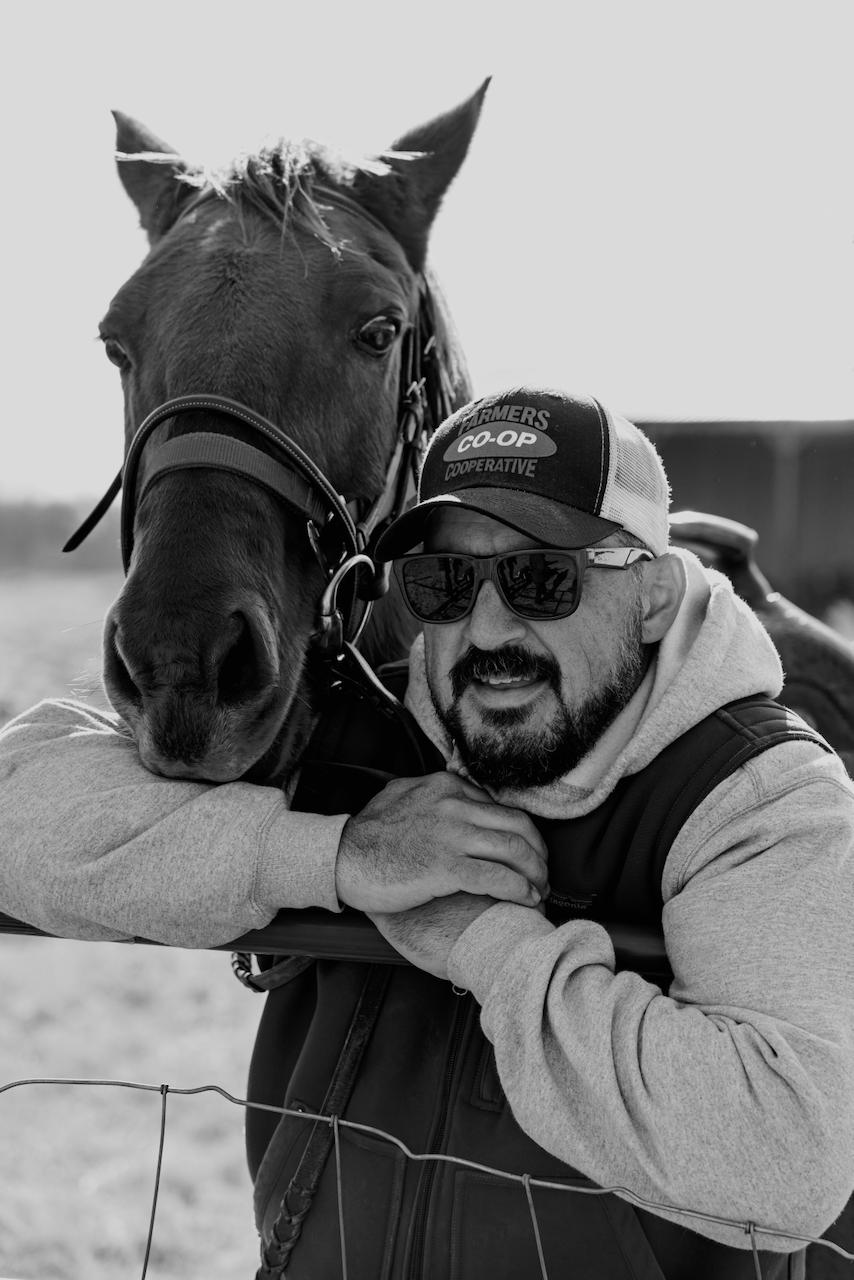
about our guest.
Dr. Jared M. Phillips is a writer and farmer from the Arkansas hill country. He and his wife farm above the Muddy Fork of the Illinois River, relying on draft horses for their farm work. In addition to farming and writing, he is a historian at the University of Arkansas where he teaches on Ozark and rural history and is working on a history of the Ozark Organic Growers Association and the development of the USDA Organic program. He’s an alumnus of the Rural Writing Institute, led by Wainwright Prize winner James Rebanks (A Shepherd’s Life; English Pastoral; A Place of Tides). In addition to his academic book Hipbillies: Deep Revolution in the Arkansas Ozarks, other work can be found in Front Porch Republic, Skipjack Review, the Arkansas Times, and the Arkansas-Democrat Gazette.
episode references.
- Dr. Jared M. Phillips, University of Arkansas Department of History: https://fulbright.uark.edu/departments/history/directory/index/uid/jmp07/name/Jared+Phillips/
- Hipbillies: Deep Revolution in the Arkansas Ozarks, Jared M. Phillips, University of Arkansas Press: https://uapress.com/?p=7884
- Wendell Berry, The Peace of Wild Things, Poetry Foundation: https://www.poetryfoundation.org/poems/155264/the-peace-of-wild-things
- Wendell Berry obituary, PBS NewsHour, 31 August 2026: https://pbs.org/newshour/arts/wendell-berry-kentucky-born-author-who-advocated-a-simpler-life-has-died-at-92
- John Paul Lederach, The Moral Imagination: The Art and Soul of Building Peace, Oxford University Press: https://global.oup.com/academic/product/the-moral-imagination-9780199747580
- Gary Snyder, Poetry Foundation: https://www.poetryfoundation.org/poets/gary-snyder
- J. William Fulbright, The Arrogance of Power, Encyclopedia of Arkansas: https://encyclopediaofarkansas.net/entries/james-william-fulbright-110/
- John Paul Hammerschmidt, Encyclopedia of Arkansas: https://encyclopediaofarkansas.net/entries/john-paul-hammerschmidt-1627/
- Vada Sheid, Encyclopedia of Arkansas: https://encyclopediaofarkansas.net/entries/vada-webb-sheid-4486/
- Brooks Blevins, Missouri State University: https://history.missouristate.edu/profile-display.aspx?p=brblevins
- Blake Perkins, Hillbilly Hellraisers: Federal Power and Populist Defiance in the Ozarks, University of Illinois Press: https://www.press.uillinois.edu/books/?id=p083009
- Regnat Populus, the Arkansas state motto, Encyclopedia of Arkansas: https://encyclopediaofarkansas.net/entries/state-motto-6031/
- Arkansas voter turnout, U.S. Elections Project: https://www.electproject.org/
- the underview, the president and religion in the south with Dr. Jared Phillips (S2E34): https://www.theunderview.com/the-underview-the-president-religion-in-the-south-with-dr-jared-phillips/
- the underview, the history of faith with Rachel Whitaker, part 1: https://www.theunderview.com/the-history-of-faith-with-rachel-whitaker-part-1/
- the underview, the white christian nationalism with Dr. Andrew Whitehead (S03E31): https://www.theunderview.com/the-white-christian-nationalism-with-dr-andrew-l-whitehead
- the underview, the more perfect union with Rev. Adam Russell Taylor (S03E32): https://www.theunderview.com/the-more-perfect-union-with-rev-adam-russell-taylor-sojourners
- Send us a Voice Message, the underview: https://www.theunderview.com/
episode outline.
- episode preview (00:01)
- episode intro, today we come home (01:47)
- welcome back, and the Ozark Studies program (05:55)
- six generations, a farm on the Muddy Fork, and a church home (07:02)
- picking up the sentence from season two (10:09)
- Baptists, independence, and faith as the railroad of a disconnected place (11:09)
- Christendom and Christianity (15:23)
- the good and the bad of the old mountain church (16:51)
- is it about race, class, and place? Fulbright and the mirror (18:30)
- contrarian until recently, Hammerschmidt and the split ticket (21:16)
- the exodus of the fifties and the two populations of the seventies (23:36)
- Mountain Home, Vada Sheid, and who did not want a college (28:40)
- fertile ground for the call to arms (30:20)
- willing or organized? Sermon kits, seminaries, and the new public theologian (31:53)
- nothing happens overnight (37:34)
- Walmart, Tyson, and the campus down the road (38:00)
- capitalism as God's chosen economy (40:30)
- a more Ozark question (43:50)
- moral imagination, John Paul Lederach (46:08)
- where do we begin? Gary Snyder, stay still somewhere (47:52)
- the radius of action, and the lesson of the plain communities (51:24)
- who is allowed to ask the question (53:41)
- power, extraction, and being sent to Little Rock (55:04)
- a new thing for the Ozarks (58:30)
- nostalgia, more dangerous than Christian nationalism (59:18)
- broken, or working as designed? The dirt roads and the tired (01:01:27)
- the halls of power and the Global South (01:04:57)
- the ten-year-old's imagination, and the job of the church (01:06:40)
- fears (01:08:40)
- membership, in honor of Wendell Berry (01:09:51)
- episode outro, who is allowed to ask (01:11:02)
- The Peace of Wild Things (01:16:43)
episode transcript.
episode preview.
[00:00:01] dr. jared m. phillips.: But if we hew to this old idea of making a home and a place and caring for our neighbor, which is a profoundly Sermon on the Mount sentiment. Then that forces us to ask different questions. That does not mean that these big churches as they exist today cannot be here. It does call them to a higher standard of action.
It calls all of us to a higher standard of action, right? And if the crux of being an Ozarker is figuring out how to live, to build a home in a difficult place, and care for your neighbors, then that should be the standard that we're asked to uphold, right? And to build a home and to care for your neighbors does not mean that we exploit the place and exploit the people. It means we care. And to build a meaningful community of care requires a capacity for moral imagination that is profoundly lacking in a Christian nationalist system
episode intro.
[00:01:47] mike rusch.: Well, you're listening to The Underview, an exploration in the shaping of our place. My name is Mike Rusch, and today we come home. When we started this season, we asked one question: How does faith shape this place? Not whether faith is good or bad, not whose faith is right, but how does it shape the ground that we stand on, the schools our kids attend, and the land that gets bought and sold? Who gets a seat at the table, and who gets told to wait outside?
We have asked this question of faith leaders across Northwest Arkansas. We have asked it of people whose families have been here for 200 years and people who arrived within the last decade. And every one of them, in their own language, told us the same thing. Faith is not a private matter here. It is the water that this place swims in.
Then the water got harder to ignore. Monica and I sat down for a reckoning with what we found in our own region. We stepped outside of our region for a moment with Dr. Andrew Whitehead and learned about white Christian nationalism, what it is and what it is not. And we learned that Arkansas ranks first in the nation for it. Then we sat with Reverend Adam Russell Taylor, and we heard what it looks like to answer that from inside the faith at a national level. Those were necessary conversations.
But this show has always been about this place, these hills, these watersheds. The people who were here, the people who were pushed out, and the people who keep arriving.
So as we near the end of this season, we wanted to return and ask the question one more time: What does the faith of Northwest Arkansas have to say about this place?
To do that, I went back to the one guest who has been with us for a long time now. In season two, we sat with Dr. Jared Phillips, who is a historian at the University of Arkansas and the director of the new Ozark Studies program, who spoke into our history here in the Ozarks, And then again about how faith in the South and politics started to merge together in the person of Jimmy Carter.
Dr. Phillips has called these Ozarks home for six generations, and today he farms above the muddy fork of the Illinois River. He grew up in the Southern Baptist Church off of Emma Street in Springdale That became one of the largest churches in the South, and today he sits in a small Presbyterian Church community in Prairie Grove. He has written the history of this region. He teaches it. He lives inside of it. He is not studying the Ozarks from somewhere else. He is studying his home.
Earlier this season, Rachel Whitaker gave us a long chronology of faith in these hills. Circuit riders and brush arbors, churches that acted as judge and jury over their own members, denominations splitting over slavery, the Klan marching into a sanctuary in the 1920s singing hymns. So today I'm not asking Dr. Phillips to tell that story again. I'm asking him to help us interpret it, and to help us understand what happened between then and now, what changed, when, and what it cost.
So here's what I would ask you to hold as you listen. Think about the church that you grew up in or the one you drive past every day. Ask yourself what it was for when it was founded and what it is for now. Ask who moved here in your lifetime and what they came looking for. Ask what it means that the biggest churches in this region sit down the road from the biggest companies in this region, and ask the question this whole season has been circling; who gets to decide what this place becomes?
And one more thing, and I'll keep saying it until the season ends. This is not a conversation against Christianity. It is not a conversation against this country, and it's certainly not a conversation against this region. This is a conversation about us. This is a conversation about how power works in this place, who has it, who wants it, and what happens to a place and its neighbors when that power is used by faith communities to influence who belongs and who does not.
And I would assume that you'll have thoughts and questions, and you'll be wrestling with this episode just like me. And if you do, we would like to hear from you. You can go to the underview.com homepage. There's a send us a voice message button there. Use it. We listen to all of them.
All right, we got a whole lot to work through today. Let's get into it
episode interview.
[00:05:55] mike rusch.: well, I have the privilege today of sharing a table again with Dr. Jared Phillips, who is a teaching associate professor here at the University of Arkansas, and the director of the Ozark Studies Program here, which is a new program, and I'm I feel like I need to go back to school for that. So- ... Dr. Phillips just welcome back.
You- Yeah ... we've had the privilege of having you here a few times before and it's always been so well-received. And I think as we start to kinda think about wrapping the season up, I wanted to come back to you to kinda help us recenter, if you will all this conversation about faith here in Northwest Arkansas and in the South, conversations about you name it, the gamut of how faith looks, all kinds of different faith traditions.
And then we've run into white Christian nationalism, where we've been talking through here lately. And I wanted us to end in a place of kinda recentering ourselves here back in Northwest Arkansas, and I can think of nobody who would be more qualified of doing that than yourself. So- ... don't let us down.
[00:06:46] dr. jared m. phillips.: That's high praise, and a high a high bar, yeah to try to get over. Yeah, no, I'm happy to be back. Absolutely, yeah.
[00:06:52] mike rusch.: Well, thank you very much. And so, yeah, maybe for those that are listening to season three that are not familiar with your story, would you maybe do us the honor of just kinda reintroducing yourself a little bit and give us a little background?
[00:07:02] dr. jared m. phillips.: Yeah. Well, like you said I'm a professor at the history department here at the University of Arkansas, and my wife and I own a farm on the western edge of Washington County. And both sides of our family have been here since or before the Civil War. And so depending on how you, which... if you count on the patrilineal or the matrilineal side, we're five, six generations deep in the Arkansas mountains and for the most part, here on this western edge of the state.
Yeah. And then a- and I've never really left, I work- I went away for a little while to work a- and then I, like everybody else that goes away for a little while, I came back and have decided to really not leave again. I don't even leave my county very much anymore, so yeah.
[00:07:41] mike rusch.: And this is not an ab- abstraction for you. This is your home Right But this is also the place you study as both a- Right, right ... an academic and a practitioner and a farmer- Right ... as well. And so, this aspect of faith and history and your own life I don't wanna say it for you, but it feels like these are some threads that have been running-
[00:07:59] dr. jared m. phillips.: Oh, yeah
[00:08:00] mike rusch.: in your family for a very long time.
[00:08:01] dr. jared m. phillips.: Yeah. Like every- I mean, like everybody, we grew up going to church. Okay. My family, we were... we grew up Mountain Baptist to a certain degree, and then when we moved to, up here to Washington County, so my, my family's from southern, like from Sebastian County and from Logan County and, When we moved up here, we started to go to one of the many Baptist churches on, off of Emma Street and then, and the, which ultimately turned into the First Baptist Church of Springdale, which then become Cross Church, right?
So I grew up in, in not just a Southern Baptist tradition, but a, in one of the kind of the leading Southern Baptist megachurches, of the '80s and '90s. But then, like a lot of other families, we, my family, we transitioned away from denominational faith into non-denominational faith, right? Which there's like a whole other conversation to have about what that even means.
But we, so we transitioned from a Southern Baptist church into s- a very, still a very conservative evangelical model at another church. And then when my wife and I got married, we went to another non-denominational church. And then when we moved out to Prairie Grove, we started to, we went back to denomination, but we went to we went to the Presbyterian Church.
And so we... and there's, I think we're not that unique in a lot of, y- Either people, I think people either in the faith traditions around here have done a couple of different things. They've either doubled down into whatever it was that they grew into, right? So y- once a Southern Baptist or once a conservative Methodist or whatever always, right?
That's fine. That's their path, right? Then you've got folks that say they grew up in it, and then they're like, "Oh, no, I'm out. I'm never going back." As soon as they graduate high school or leave or whatever, for whatever reason, and their stories are also, uniquely valid, they're like, "I'm out."
And then, but I think a lot of us have followed this, what, I hate to use this word 'cause it's overused, we followed a somewhat of a deconstruction path, right? And so what that meant for us is that we transitioned to the Presbyterian Church in Prairie Grove and sometimes in a small country church, if you're the only person standing, you end up being asked to sit on committees.
It's university life, actually. If you stand around long enough, you get put onto a committee. And so we're not as active in that congregation right now as we have been historically. But that's if, when we when we're asked to describe a church home, it's First Presbyterian in, in Prairie Grove.
Yeah.
[00:10:09] mike rusch.: So yeah, last time we sat down, we had a really great opportunity to talk through religion in the South and the president.
At that time, it was about Jimmy Carter because he had just passed away. And so it was really the formation, if you will, about I would say, modern evangelical movements within the Ozarks and where those came from. And you said something during that conversation that really resonated with me, and you said that "this thing about Baptists in the poor South, they were anti-power. And the loudest voices against imposition, and that the shift to seeking power is something that nobody has reckoned with."
[00:10:41] dr. jared m. phillips.: Right.
[00:10:42] mike rusch.: And I said, "Maybe we'll address that in another season." And-
[00:10:45] dr. jared m. phillips.: Today's the day ...
[00:10:45] mike rusch.: today's the day- ... we wanna reckon with that. And I would wonder if you could maybe take us back to that conversation. Yeah. And maybe understand a little bit whatever direction you wanna go, of where that kinda tradition started as being anti-power, and if you wanna come forward to today and talk about what's that relationship with power look like, and maybe not specifically just the Baptist Church, but really churches in general here in, in this region.
[00:11:09] dr. jared m. phillips.: Yeah. So I mean, one thing to think about, the Baptist tradition in the United States, whether you're thinking about the, the sort of normal convention or the Southern Baptist Convention or, there's several competing Baptist kind of conglomerations. The roots all come out of this idea that they wanna be independent.
They don't want to have somebody telling them what to do. Right. They wanna be able to decide for themselves what their congregation's theology is gonna be and what that outworking in the community will look like. And it's a similar impulse that we see in other mountain congregations, in other rural congregations.
Now, some of them are gonna be more structured. So the Methodists and the Presbyterians tend to be a little bit more structured. But they all have this, at the end of the day, the daily outworking of life is determined, should be, in their minds, determined by and for their own community, right?
And they took most church congregations took the idea of being separated from political power quite seriously for the, certainly for the 19th century and the first part of the 20th century. Things shift after the Second World War for any number of reasons. But one of the things that, that stands out in the Ozark tradition and probably also in places like Southern Appalachia is that congregations because they were unwilling to be dictated to they they bring in with them a kind of a funny like almost like a dualistic problem, right?
So on the one hand, they don't wanna be dict-dictated to, and they're-- but they're happy to dictate. And then on the other hand, they're also solving or trying to help solve very real problems in the Ozarks. The Ozarks of the 19th century, late 19th century and early 20th century, is still a very disconnected place, right?
Not unconnected, but a very disconnected place, and faith communities help connect the place just as much as a railroad does in a way, or some kind of a new market adventure. And one of the things that they do, aside from having a church building, is they'll help with education initiatives.
They will help with setting up relief systems during the Great Depression, for example, or whatever. And so there are all these different things that are not partisan issues in the way that we think of how religion, no matter if it's liberal religion or conservative religion, steps into that debate today.
It was just seen to be this is the act of the church, right? We're gonna do this. It's almost... growing up as a Baptist, I always think about the Home Mission Board, right? And y- and and so this was the-- there's the work of the Home Mission, M-Mission movement, and there's the work of the Foreign Mission movement, right?
And they were both held in equal esteem and the-- and by, by the population that they were serving and by the congregation itself. What this means then is that there is an intensely local understanding of what problems are that is always offering a different voice to what the prevailing political power structure is offering, right?
And so like in Reconstruction or in the Progressive Era or during the New Deal, even though you'll have whatever the idea is being administered in a top-down perspective that may or may not be a good idea, you're going to always have tension because the local community, in some cases anchored by the institution of whatever that religious community might be, is going to say, yeah, okay, maybe that's a great idea, but that's not what we need here.
What we need here is this. And so there's going to be a clash of values, if you will, like of what is the role of politics in place versus what is the role of religion in place. And I think that helps to set mountain and rural religion apart a little bit from like urban religion, if you will, because in urban religion, you can have multiple churches along City Avenue and you're going to have interaction, more ready interaction between things and you're going to see more interaction between the halls of power or whatever.
But if you have a little mountain church community in Ray's Mill or in Viney Grove, that is in 1905 or 1900, that's a long way away from the county seat. It doesn't feel like that today, but it is. It still is in miles today, right? And so you think about like that's where power is felt and power is understood.
But it has a different outworking than the way we think about the application of power from a religious community today. But there are still some seeds in those moments that help us understand how we get to where we are today.
[00:15:15] mike rusch.: Because it, if I'm listening correctly you're not describing something that's aligned with necessarily state power- No
or national power either.
[00:15:23] dr. jared m. phillips.: No. They're not... they're... This is what we think of as the Evangelical movement does not become a political movement in any serious fashion whatsoever until after the Second World War. You have bits and pieces, right? So some of us are probably familiar with the the Scopes Monkey trial in Tennessee.
Some of us might be familiar with some of the anti-communist scares, in the, early decades of the 20th century. Or like discussions around sexuality in the early days of the 20th. So there's moments where religious congregations will come together and advocate on a particular issue, but not on a whole platform, right?
That changes, right? The, there, after the New Deal, after the sort of the assumption of the Cold War, we're gonna start to see the fracturing, right? And we're gonna start to see religion coming together and th- or religious groups coming together and thinking about what it means to exercise power as a voting bloc, right?
And now, and I should be really clear here, there's a distinction that should be made then and should be made now between what is it that re- that religion is thinking of as an act of politics, and what religion is act- thinking about as an act of personal outworking of faith, right? So it's the distinction that I make with my students between Christendom and Christianity, right?
So Christendom is this idea of the political institution of the Catholic Church or the European empires, right? And then Christianity is the outworking of people living by faith by, every day, right? And there is a lot of overlap between those things, but they are not mutually, or they are not the same thing, right?
[00:16:51] mike rusch.: Because when I think about this evolution, not that religion in this state or this region or this country, has ever been perfect, but I'm curious, like, when you think about the values at that time from what we can discern like how did that work itself out? Was that a healthy version of what faith and community and... what are the good things or maybe the problems that existed within that kind of yeah, within that kind of world?
[00:17:16] dr. jared m. phillips.: I think it's reflective of the population, right? I think, so there's the good things, and I think there's bad things. So just as much as there's this impulse for education and community aid that we see, those things are also problematic, right?
They are a type of class-based forced assimilation to a certain degree, right? So those mission schools that are being developed by any given denomination they are making assumptions about who we are and what we can achieve as a space, right? But the, these are also The same communities that are, in, in many cases, they have no problem with the creation of a lily-white Ozarks, and the enforcement of a particular understanding of what the Ozarks should be, regardless of if they ever were that way, right?
So I think it's... You take the lessons that you're hunting for from it, right? I think you can pick any congregation at any moment and you might could find whatever you want to find, be it a good thing or a bad thing. So I think just like today, it's complicated. I would say, though, that today, because of the way that we interconnect so rapidly and because of the vastly different economic structure that we have in the place, there is a there are some new tensions that we did not see then, but those tensions exacerbate those existing, or those older ones, if you will.
[00:18:30] mike rusch.: One of the things that I asked Dr. Andrew Whitehead in the conversation we had about white Christian nationalism was, is this a new thing, or is this something that has, been with us since the beginning, right? And I'm curious, as we think about the Ozarks, and you mentioned this becoming a lily-white space, right?
I think in, There, there seems to be an effort at some point to, to say this is not about race, or this is not about labor, or this is not about class. I'm curious if the history record would reflect that.
[00:18:57] dr. jared m. phillips.: That it's not about those things? It's absolutely about those things. It's 100% about those things.
I mean, the reason why we are here in, in the state of Arkansas is because of the Louisiana Purchase, which is a function of the colonial project of first the UK, then the internal colonial project of the Jefferson administration, right? Sure, it was a really good land deal. It was bought for pennies on the dollar, and then out of that comes, this becomes the dumping ground. Before we become the Ozarks, we're the dumping ground for Native American removal, and sure, we don't have the level of enslavement that say Chicot County does, but there are still several, I mean, I mean, several hundred enslaved persons across any particular Ozark County, certainly on the e-edges where we are, right? In the interior of the Ozarks, maybe it's a little bit different.
But and then it's also we are-- this is a poor place, we're as poor or poorer than Appalachia, depending on what year we're looking at and what county we're looking at. And a lot of these projects are functions of how do you keep, how do you either develop poor people in a way that you think is better for them des-despite what they may want, or how do you keep them where they are, right?
And so it-- this is Christian, white Christian nationalism. Nationalism whether you append a, a skin color or a religious tint to it, nationalism is profoundly about like race and class and place and like subjugation. That's the-- that's its job, right? It's not the same thing as patriotism, right?
And the Ozarks have a role to play in that conversation. I mean, in the '40s and '50s and '60s, this is the heyday of Senator J. William Fulbright, right? And Mr. Fulbright, he he's a-- he's just as problematic of a figure as the Ozarks is as a space, right? So on the one hand he is an adherent of we wouldn't have called it, a, a white nationalistic South, but he was an adherent of that, right?
And you can argue about as to why, but at the end of the day, his name is on the Southern Manifesto, right? He does not come out swinging against some of the progre-- what we would think of today as progressive racial issues like we would hope to see from the senator who creates the Fulbright program and who says that we-- the, the way forward is peace through education, and who writes a book where he has a, the-- called The Arrogance of Power, and he make- takes great pains to distinguish between nationalism and patriotism, and thinking through these things.
So we are-- in this case, the Ozarks are just as much a mirror to the country as any other particular region is.
[00:21:16] mike rusch.: I think one of the things is, we've had, I feel like, many conversations about this. You've always... And I think there's a sense of pride to it, and I, and I understand why, so if there's not, you can- ... push back on that. But "you've called this place deeply contrarian in religion and in politics." Oh,
[00:21:30] dr. jared m. phillips.: yeah. Until recently.
[00:21:32] mike rusch.: So let's... Can we talk about recently?
Yeah. I'm really curious your perspective on when that change happened, how that change happened and to the extent of how that change is happening maybe today.
So- Yeah ... maybe open that up.
[00:21:44] dr. jared m. phillips.: Well, the Ozarks are contrarian, right? And I'm very proud of that.
[00:21:47] mike rusch.: Good.
[00:21:48] dr. jared m. phillips.: And as are most of my neighbors and kinfolk, I think. But I- The current, the contrarianism is a little bit of a function of all these things we're talking about. It's it has a dark edge to it, I think.
But but it's also a reflection of the landscape. If you're gonna succeed here, a-and when we say succeed here, I do mean just eking out a living for the most, for most people in most counties. You have to be going against the grain to wanna be here. This is a poor place. We have poor soil. We got poor access. Even today, it's still hard to get around. I was talking to a student of mine before you came in about trying to get to a conference that we're holding over in the Missouri side, and there is no straight path to get there. Yeah. You know what I mean? That's just the nature of the landscape.
So we are... To be here, you are somewhat contrarian, if not entirely contrarian, and most of us are pretty proud of that. And what that meant for us historically is that our politics were relatively contrarian. We're gonna follow some of the national trends, right? So, like, when Herbert Hoover was booted out of office, we're gonna vote for FDR, and we're gonna be largely a Democratic place.
But then in the middle of that, we elect one of the most effective congressmen we've ever had from Arkansas, John Paul Hammerschmidt. He is not a Democrat. He's a Republican. He's a different kind of Republican than, Mr. Womack is or whomever. But this is, this is indicative of our contrarianism.
We'll happily vote for him and for J. William Fulbright or Dale Bumpers at the same time. We see no problem with that whatsoever. And today, you'd be shunned on the street, right, if you split your ticket that way. And uh, a-and so this is kinda how we think about it. We also, we're, on the one hand, we are-- we're contrarian in our social customs as well, right?
So on the one hand, we're very, we're a deeper religious population. But we are also we're... There's a reason why the caricature of us as the lawless bootlegger exists, because we were also that as well, right? We're gonna go to church on Sunday morning, and it'll be a Baptist church or whatever, and so you're not supposed to consume alcohol.
But then that same guy sitting in the middle pew is al- makes the best shine in the county. You know what I mean? And so we have these-
[00:23:34] mike rusch.: I don't know what you mean. Okay, so ...
[00:23:36] dr. jared m. phillips.: So we-- The caricatures don't come out of nowhere. And so, but things, again, I think a lot about the post-war moment for us.
So, and post-war, I mean World War II. '50s and '60s into the early '70s is a sea change across the country. But what it does for us in the Ozarks is it puts us on a path, And more similar to other places than we ever had been before. And we start to see a change in the contrariness. And so what will happen is, by the '60s the Ozarks, broadly speaking, have been experiencing a massive population loss.
So that contrariness is leaving. And we're leaving because there's nothing here in a way, right? The economy of the place has, has been ta- You know, most places in the country grow economically after the war. We take a hit in a lot of places. Not everywhere. And even the things that are coming on board that should be anchoring us, like the poultry industry or the cattle industry, are rocky.
It's just a rocky road. And so people leave, some people come back but for the most part we're gonna see a mass exodus of Ozarkers, and they're gonna go-- They're gonna go to work that they know. So they're gonna go to the apple orchards in the Northwest. They're gonna go to oil rigs and oil fields in California or in Texas.
They'll go to the steel plants and the auto manufacturers up north. They're just gonna be a part of that broader Southern, Southern exodus. But when the South left in the '30s, we leave in the '50s, is the way to think about it. And then in the '70s, people start to move into the region, but they move into the region-- There's two populations that are moving into the region.
One there's a population that I've written about before- ... the counterculture moves in, right? And they're moving in for-- in part because of the mythology of the, the contrariness, the fact that we have, rightly or wrongly, people perceive us as h-holding on to the mythology of the American frontiersman and that can-do attitude.
And they disregard some of the other baggage, right? In part because the Ozarks had done a very good job in whitewashing its history, quite literally whitewashing its history. And so we didn't know. We didn't have a-- I-- When I say we, the people moving in, who are all relatively well-educated, they're students of the civil rights movement.
They understand what happened in '57 in Little Rock. But there's really not much knowledge that there was a significant population of African American citizens across the Ozarks that was expunged. They were forced to leave or beaten into submission. And even in progressive places like Fayetteville or, in Springfield.
And and so they they come in without any knowledge of this, right? And so they're not off the hook, but they don't have a complete understanding of it, right? And they're not thinking about this place in that lily-white refuge, right? The other population that's moving in here is thinking about it this way.
And in many cases, not for everybody, right? But in many cases, they are, and these are the folks that are either retiring out of the chaos of '68 Chicago Democratic convention when, student activists are threatening to put LSD in the water supply, and there's race riots. They're coming out of LA. They're coming out of DC. They're coming out of Manhattan. Or they are-- So they're retiring. They're done with their working-- They've done their job for the country. They wore the uniform in maybe in World War I, certainly in World War II, and probably Korea maybe even in Vietnam. They're done, and they wanna go, and they wanna go where America is.
And America's in the Ozarks. It's close, it's in the middle of the country. You can't get more heartland Americana than the middle of the country. And there's no troublemakers here, right? And then and d- by which we mean there's no hippies, but they found out that was wrong. And then there's no Black people here.
There's no Chicano labor movement here. There's no second-wave feminist movement here. All of these things are not correct, right? To lesser or inter- to varying degrees. So these pe- folks retire in here, but then there's also a whole population of people that move here specifically because they're still active in their economic involvement in the nation's economy.
And they move here because they can come here and set up the kinds of businesses, live in the kinds of communities that they wanna live within. So Arkansas is a right to work state by this point, so that means we-- It's not that you can't have a labor union, but that it basically gives you no protections in the law.
We are a profoundly anti-civil rights state, right? - We are a reconstructed state. We still are a reconstructed state, right? And what that means then is that at least until recently, we were under federal edict over how we have to administer elections and what we have to do for integrating schools and that includes schools in the Ozarks.
Even though because we had forcibly evicted the majority of the African American population, integration wasn't a thing that we were dealing with in the same capacity, but people are thinking about it, right? It's on the news, and it for sure is in the minds of the people that are moving here from Chicago and Kansas City and St. Louis and Dallas and wherever. To the point that in the '60s as there's a boom to try to create community colleges and expand educational opportunity, which is historically a thing that the Ozarks has welcomed, right? From back from those old mission school ideas. Over in Mountain Home there is a, there's an effort to develop a community college in the 1960s.
And the, the state rep, so the rep from Mountain Home down to Little Rock, Veda Sheid was her name, fantastic local politician. And she's having to fight a battle with not Ozarkers, but with people who have moved in recently who do not want to have a community college put in Mountain Home for the same, or for some of the same reasons that they don't wanna have expanded sewer capacity and expanded sidewalks.
They moved to the Ozarks because this was low tax, no unions, no government, no, no New Deal style government interaction. And then also they don't want a college campus 'cause a college campus brings in Black people and hippies. Right? And so this right here from the late '60s and the '70s, as these populations move in, and the retiring and incoming business community that's coming in, far and away outnumbers the counterculture that moves in, right?
And it only expands as we go through the 1970s and into the 1980s, right? And this is when we start to see, at least when I look at the data and there's a couple other folks we banter about how this change occurs, and I think there's several paths to get to the change, right?
And so but when I look at the data, and when I kinda think about it from the perspective of a long, familial descendant of Ozark, kind of perspectives this is the change that is occurring, right? And it's occurring at the same time that the national evangelical movement is mobilizing for war, right?
And I mean a political, cultural... Like, when we think of it by the '90s and Newt Gingrich is the cultural wars, they're mobilizing. They have a long strategy that starts at the end of the '60s, and it takes them until Reagan, really even until the backlash against Clinton to really find their footing.
And the Ozarks are-- we are, in a way, front and center for this. We don't have Focus on the Family. We don't have Heritage Foundation or whatever. But we've got we have a population of religious communities that has never been interested in being told what to do. We're c- and, but they're Southern.
We're Ozark, but we're Southern. So we're coming out of the civil rights movement in the '60s, and we're in the early '70s, and they're being told what to do. We're also being-- we're also afraid of all of the chaos that we're seeing on TV. The economy starts to crash. Working people are losing real income as inflation jumps.
And so all of these woes, all these things that normally these religious communities are there to take care of, we're trying to figure out what to do. And the promises that have been given to them, that they maybe had voted for wholeheartedly or maybe a little bit tepidly, but from the New Deal Democrats we've seen as fading.
They're concerned about America's fate on the global stage as communism is whatever, mythically growing in the 1970s. And, a-a-and as this happens, and as they're, they have an injection of energy, of a particular kind of energy from these folks that are moving in, many of whom are, I'm sure, are personally lovely people, but they have a particular understanding of what's happening.
They've come here for a particular reason. They this-- and they are all churchgoers, 'cause y- the mythology, right, is that everybody in America went to church in the '60s and '70s and '80s, which is not true. But this is the-- certainly at a higher rate than we do today. And they inject these congregations with a particular kind of energy.
That doesn't have to emerge the way that it does. It just so happens that all of these different threads are coming together so that when Reagan, when Jerry Falwell and when Ronald Reagan and all, this whole host of characters from the 1980s puts out a call to arms, that call to arms falls on fertile ground.
And then out comes the world that we have today
[00:31:53] mike rusch.: Well, it's great that you're describing the 1970s and '80s, and not today, right? I mean- ... a- as you're talking, I'm like I'm, like, flipping back and forth in my mind to you're talking about today now, right? And we're looking at a 50-year span now- Yeah
from this time period. And, from your perspective, you're watching these religious communities here in the Ozarks. I don't know if you would characterize it as willfully step into this space, or are they being organized themselves by these outside influences?
[00:32:21] dr. jared m. phillips.: That's a great question, and it's one I don't know that we that I would wanna make a hard and fast statement on for a couple reasons.
O- one, I don't know that we'll actually ever be able to know the answer to it, honestly. The historian in me says that we might know for some congregations sometimes, but not for enough to say for sure yes or no. What I think is happening is that most of the time, you've got a pastorate that is concerned about their church.
Church number, churches, small country churches are closing or consolidating not in the numbers that we see today, but certainly enough that people are worried about it. It's a talking point on nightly news and in cultural programs into the late '70s and the early '80s, the fate of the country church, whatever.
This is, how do we deal with this, right? What do we do with it? And they're, and they have a population that's coming in. They're also being given access to a new kind of information resources they've never been given before, right? Y- this, they experience a revolution of connectivity that is utterly unknown i- in the degree with which it impacts them or can impact them, and the speed, relatively speaking, the speed with which it moves, right?
And so if all... By the end of the 1970s and the early 1980s, you've got a surge in theological school, seminaries, right? Most of which are skewing towards a more culturally conservative, maybe not worrying about a political discussion, but they may be more culturally conservative. So, you can think about Dallas Theological.
You can think about what will become Liberty. You can think about the, the school in Tulsa. I mean, there's several, even in the area that are easy to look at. So these are starting to turn out more graduates, right? Both in the pastorate and in the lay population. But then you also have the, the conservative think tanks and religious activist groups are be- are kinda coming online by this point, and so we're starting to see Heritage Foundation is putting things out.
We're starting to see American Enterprise Institute is putting things out. We're seeing the beginnings of what's gonna become the kind of the broader focus on the family industry, right? And they're following a p- playbook that the, kind of the liberal side of American life had been following since, the progressive era, right?
And it had been very successful. And but what they're doing is they're making for free or for very little charge access to all these resources, and it comes with Bible verses. You know what I mean? It's like here's-- Well, hey, if you're, if you wanna give a, a sermon on X topic, here's some things to think about.
Here's some points to think about, right? And if you're a young pastor, you've got your, you're presumably married, you got small kids, you've got a, you've got a pa-- a congregation of 100 or 200 people, and you're trying to figure out how to manage all the competing resources that-- and the competing problems that pastors, especially at that time, had to do with such a small staff.
Man, like you're probably gonna avail yourself to these things, right? And so while I think there are some that walk willingly into this-
[00:35:01] mike rusch.: Yeah ... '
[00:35:01] dr. jared m. phillips.: cause it aligns with them, or they align with it or whatever, I think you're also gonna see some that just like by happenstance, just kinda like over, over a period of a decade suddenly turn around, they find themselves in a place in a country that they maybe don't recognize, right?
And maybe they're not opposed to that, but they're like, "Well, how did I get here?" So I think, I think it's complicated, right? And I but I-- then I also think by the end of the 1980s and the end of the early 1990s Pastors and churches become a bigger fixture in, in thinking about a, a certain type of public intellectual than we were accustomed to them being, right?
So before theologians that were, were in that public intel- intellectual space, you're either Billy Graham, right? And so you're like- Yeah ... you're running major tent revivals, and we all have heard that on the radio or whatever, or saw that on... or saw a television special, right?
But that's catering to a very particular demographic, and a lot of early Billy Graham work is not terribly political. Right. It becomes political or is interpreted later as political but he himself not necessarily in the early days was this. Or you have public theologians who are expressly political, but they're political , not in the pulpit, right? They're not necessarily pastors.
And so I think about somebody like Reinhold Niebuhr, who was one of- ... the inspirations for Dr. King. And Professor Niebuhr I mean, he... I mean, he's like the rest of American religion. He's confounding, in what he thinks. But, he's writing books that are v- I mean, pretty they, th- they can be seen as philosophically difficult to grab at, try to understand. You gotta understand a whole bunch of what's happening in the world around you to really understand what he's saying. But he's not writing that for the guy at the parts counter. He's writing that for the guys in the State Department.
You know, And for the intelligentsia, right? He's not meaning for this to be a part of the public discourse.
That all goes away, and when churches basically copy the public television model and start to put together their own broadcasting networks, be it radio or television or publishing industries or whatever, that changes the game. And it, and now folks who may or may not have a, a strong amount of intellectual training uh, and like, rigor behind them now start to put out their ideas without any vetting from even their own denominations or own communities. Then that also is gonna start to to change the game. And I think... And then that makes them become... You get on the news then that way, right? You get to write a, you get to write a weekly column in your local or state newspaper. And I mean, even the best of us at once... when your ego gets stroked to this degree, it's hard for you to put that down, I think. Yeah. Or to step back and be like, " W- like, where am I going? What, what country am I heading to?"
[00:37:34] mike rusch.: I think it's really helpful because this is a, a shift over time. It doesn't happen overnight.
[00:37:39] dr. jared m. phillips.: It's kinda- Yeah, there's nothing overnight in history for the most part, right?
Yeah. I mean, if these are... I mean, this takes, this is a, I can speak with confidence over this long... This thing happens in this way because I have the benefit of hindsight, right. And I've had the privilege to sit and look and think and research and read and write about this stuff for a long time.
But most actors in the moment don't understand where they're gonna end up. You know what I mean?
[00:38:00] mike rusch.: And maybe that's the point of like,
I think where we're trying to understand is cause this shifted, and it shifted maybe quietly, softly, little bit by little bit over a long stretch of time.
And yet at the same time, you see a huge economic engine arrive and grow out of Northwest Arkansas. I'm curious h- how does that influence start to either move us within the faith communities? And, and I think maybe the question is like, what is that relationship over time between what we're, religious faith communities, their standing, the politics, but now, we're starting to watch the rise of Walmart and Tyson's and JB Hunt and the poultry industry and there's a different kind of economic engine that emerges that I think it's fair to say has a pretty good relationship with faith communities.
[00:38:48] dr. jared m. phillips.: Yeah. That's a good question. I think that the experience of religion in Northwest Arkansas changes when Walmart becomes such a big deal. And this is not necessarily like a, a hit on a Wal- on Walmart or what they do, right? Right. They're doing what they do because they're doing what they wanna do.
The religious communities are understanding that there is a population that for what, for better or for worse, is moving in, and, I mean, to, to use the phrase so many of us are familiar with, needs to be churched. Yeah. Right? And they are more than happy to meet that need, right? And so some churches are already established in Benton County in Lowell or in Rogers or wherever to kinda service that need, right?
But not all of them have the prestige of some of the other churches in the region. And that matters, I think because this is, in my mind whether it's actually the case or not, the appearance of this of First Baptist Church in Springdale, for whatever the internal decisions were, right?
And so these are private records, and we probably never will know all of the ins and outs of what the church leadership was thinking. But when they decide to build what will become Cross Church, that campus in Pinnacle that w- a- and move so much energy and attention from what had been A little country church on the end of Emma Street that had turned into a, a church complex and private school that grows out of partially the backlash against civil rights.
Next, across the road from the Georges and not far away from Tyson corporate headquarters, and then go- goes... So there's already a question there. Whether there is any meaningful relationship or not, people are gonna ask this question. Then it goes to Benton County, down the road from Walmart corporate headquarters What this does for you, it's not necessarily I think that Walmart calls and says, "Hey, come up here," or that, Dr.
Floyd called and said, "Hey, I'm gonna... Can I come up here?" What I think it is, it's a, it's uniquely representative of how intertwined certain versions of faith and American capitalism have always been. It's not a new thing, it's just more visible now, is what I would suggest. A- and it's, but it is new in our experience of faith in the Ozarks.
And so, certainly after the Second World War, even before, capitalism was seen as God's chosen economy, right? I- if for no other reason than, Marxism manifesto has so many quotable one-liners, right? And so religion is the opiate of the masses or something like this, therefore communists cannot believe in God, and because communists don't believe in God and they also don't believe in capitalism is therefore God's chosen- economic form, right? Which is like obviously- There's
[00:41:19] mike rusch.: a little bit of variation in that.
[00:41:20] dr. jared m. phillips.: Yeah.
[00:41:21] mike rusch.: There's- It's not quite as black and white as that.
[00:41:22] dr. jared m. phillips.: Yeah. Like it doesn't make that... I mean, like it's just the same thing as saying that democracy is the best form of government. No, it's not. It's the form of government that we have right now.
It doesn't mean that it's the right one, right? Right. If you wanna get really technical about it, God doesn't ordain democracy or republicanism to be- Right ... a form of government. He chooses Saul and David, right? So a theocracy and not a Christian theocracy, is the only form of government that is actually ever ordained, and I'm sure a, a student of the Bible would bicker with me on that, but m- more, but when you just kinda do a casual kind of political study of the system, you're like, "Okay, all right. Th- this is different then," right? But nevertheless the American Christianity, certainly mainline Protestant denominations and the growing non-denominational movement which really kicks off in the '70s and '80s and '90s, they align themselves hardcore with what we can think of today as neoliberal systems, right?
And I don't know that there was a ton of reflection on it. I think there is some of this okay, free markets make a free man kinda idea. We want freedom of religion, freedom of things, right? Freedom from oppression. And so I can see some of the linkages there, right? That totally makes... I understand it, right?
But what's remarkable to me about it is the degree with which there is a consistent desire by this particular marriage, the way Americans understand capitalism as, in, in our area expressed by Walmart or Tyson or whatever and the way that Ozarkers understand religion expressed y- by a church like Cross Church, although there are plenty of lovely people- Sure
that are there, right? In their leadership and all the way down. To ignore some of the very basic fundamentals of what Jesus says to do. And I... And it's a reconciliation that I would l- I have never really seen anybody satisfactorily explain, right? And it's one that myself, like many other people, 'cause I grew up in this environment, I never really thought about.
'Cause I grew up and it was, to me it was just, yeah, capitalism is what we do. That's the right way to go. And I'm not saying that we shouldn't do capitalism. It's like- Right ... there wasn't a, a question of, like- ... let's think about it. Right. Well, may- is it? Or if it is it the way that it's functioning, is that the best way to do it, or should we revise it in some other way?
And and your last guest w- from Sojourners was- ... was talking about this a little bit. Right. If we're gonna say that this is the thing that's important to us as a co- we're gonna d- decide that we are a Christian nation, which is not historically correct. But if we're gonna make this claim, okay, then what do we mean by that, right?
So are we gonna decide that we're gonna use the version of Christianity that's melded itself with economics and politics as we see it today?
Or are we gonna ask a different question, and frankly, one that's a more Ozark question, even with all the bagg- baggage that we have as Ozarkers, 'cause l- Lord knows our history is just as troublesome if not more troublesome than any other region of the country.
But are we gonna ask a more Ozark question, be... That mean- meaning be contrarian in this and say, "Oh, actually, wait a minute," this is a place historically that has had to figure out how to make do and take care of its own with whatever resources that we had kinda no matter what, right? This is a place that any time those very same corporate powers that we are now aligning ourselves with come in and say, "Hey, we're gonna fix you," it always turns out badly for the rest of us.
Right? And you can look at, you can look at studies that have been done by Brooks Blevins, you can look at things that I've written, you can look at things by Blake Perkins, you can look at things by a- any number of us, Lynn Morrow, Kimberly Harper. Pick a, pick one of us and we can give you an example of it.
Any time these things come in, if it's coming down and being imposed on us in this, in, by this capitalist system, by this economic system, this political system, it causes trouble for the rest of us, right? We lose farms, we lose communities, we lose the membership, as Wendell Berry would say, right?
But if we hew to this old idea of making a home and a place and caring for our neighbor- ... which is a profoundly Sermon on the Mount sentiment Then that forces us to ask different questions. That does not mean that these big churches as they exist today cannot be here. It does call them to a higher standard of action.
It calls all of us to a higher standard of action, right? And if the crux of being an Ozarker is figuring out how to live to build a home in a difficult place and care for your neighbors, then that should be the standard that we're asked to uphold, right? And to build a home and to care for your neighbors does not mean that we exploit the place and exploit the people. It means we care. And to build a meaningful community of care requires a, capacity for moral imagination that is profoundly lacking in a Christian nationalist system
[00:45:59] mike rusch.: Keep going. I mean, I mean, I I feel like I'm at the Dr. Phillips Church right now. I don't know what denomination you just started, but like- uh, tell me where to meet on Sunday,
[00:46:08] dr. jared m. phillips.: well, I just stole that from John Paul Lederach, who is, he's a Mennonite not a horse and buggy Mennonite, but he was a professor at the at the Kroc School of, or Institute of Peace Studies at Notre Dame. And he has a lovely book called Moral Imagination, and he's actually talking about conflict resolution and peace building, right?
Which is again, if we're saying that we're this particular kind of thing, we're gonna be a conservative, we're gonna be the... We are the state, we're the region that holds onto a certain set of values, imagined or real, and we're gonna line them up, and we're gonna say, "We're gonna vote for Jesus," right?
Okay. Then let's do that. Yeah. Right? And I don't believe that has to hew to a particular party, right? Because there are periods in history where the Republican Party did a better job on these issues than the Democratic Party does, and there will be periods in history again where that happens. These...
Or we'll have new parties. This, these things are... These are imaginative structures that we make, right? They have no value other than what we put into them. And so they will change as we decide they need to change. So are we going to decide they need to change? But having that capacity for moral imagination, I think is, is crucial.
And I do mean a specific thing when I say that. 'Cause you can have a... I mean, H- Hitler has a moral imagination, right? Stalin has a moral imagination. Y- the Klan has a moral imagination. Moral imagination is not inherently good or bad, and so what is the foundation, what is the starting point for our moral imagination?
And so what I hope is that the, the starting point for a moral imagination of the Ozarks, to me, should be something that is asking about home and neighbor and care of those things, right? And what is that... and the recognition that you will not always get it perfect, and you're gonna have to go backwards, and you're gonna have to have a hard conversation.
Be like, "Wow, we screwed that up. How do we fix it? Who do we apologize to? How do we make it right?" Right? And then move. Get it done.
[00:47:52] mike rusch.: I think there's probably a lot of people in Northwest Arkansas who would say, "Yes I agree with that." But given kind of some of the history that you've laid out of this being like a, whether it be race or class or l- labor movements this has always been a part of the conversation.
We don't seem to be addressing that in this world today. I mean, we've got a huge increase obviously in our Hispanic neighbors and people coming from other places. Marshall Islands. This become, has become a much more diverse place where and this is from m- my opinion of one, but it's be- becoming or has become i, in many ways even more, like, siloed and divided and pushed apart.
We don't seem to be reckoning with the reality of these things, and yet the, the vision that you lay out, there, there are other people trying to tell a different story of what these Ozarks should be. How do we reconcile this? What is the work to do maybe in front of us? Like, where do we begin in this conversation?
If we're listening to what you have to say and we're like, "Yes, it should be that," or, "It is that," where do we reflect back inside to to really find the gut check of how do I work that out in my community or in my neighborhood or in my church or in my office place? Like, how do we get to that place?
[00:49:07] dr. jared m. phillips.: Well, I wish I had a silver bullet for you. I don't. I don't believe in them. What I can say is that, For me, and I won't even implicate my wife in this, but for me, I think a lot about the beatnik poet Gary Snyder who said at one point basically " If you're looking for home, stay still somewhere."
And at that moment, he's talking into a... when he says this in the '60s or in the '70s, he's talking to a population of young people that are just like frantically moving around trying to figure out how to flee, s- the San Francisco or Chicago or whatever. And I actually think when we look at a statement like that, there's a lot underneath it because to be home means to be present in place.
And that means a conscious limiting of what you of what you consume and it means a conscious limiting of your choices. And I think a lot of people at the personal level have a hard time with that and that because of the world that we live in today, right? And so I think about it like this, like I love my students dearly.
Like I am impressed by them continuously. Every single semester I have kids come in and they're like, "What do I do? How do I go forward with this?" And it's because they walk in and they have a sheet full of options for them, and that's amazing that they have that privilege, right? And they would tell you that's amazing as well.
But they're crippled by the inability to choose because they have too many things to choose from. And if we say as a place- ... that the metric for our choice is home or not, home building or not, then that immediately starts to limit the things that we have to try to choose from.
And then if you take that away, the energy that you have left to focus then on that thing, 'cause you're not having to siphon out all this other stuff, right? S- so think about it like this. You walk into a grocery store, right? So if I walk into a super center, a Walmart super center, which I have not been into in a long time, but if I walk...
Last time I walked into one, it was utterly overwhelming to me. There's too many choices. I don't need that many choices. No human needs that many choices, right? But we've defined freedom and success as the choice, right? The ability to have that choice, right? But in reality, all we've done is we've overwhelmed ourselves, right? And so more people that I know than not will walk out of a superstore, whatever it may be, Walmart, Lowe's, Target, pick a company , and they're, they're exhausted. They're not exhausted because they were shopping, 'cause they were out, they bought like milk and bread or whatever.
They're exhausted because they had to wade through static.
[00:51:24] mike rusch.: Yeah.
[00:51:24] dr. jared m. phillips.: Right? The decision to say home, to stay home, to be home, to create home eliminates much of, not all, but much of the static. And then it also begins to point you into the directions where you act, right? And so I don't act across the state of Arkansas because it's too big.
It's not... Ar- I live in Arkansas. I love my state. I'm a proud Arkansan, but I live in Western Washington County. I live in the Illinois Watershed. I live above the Muddy Fork. I live on my farm, right? And so my, the radius of my action is immediately this area, right? And then as, as if opportunities come, then some- then I will think about okay, should I go beyond my radius or should I not, right?
And this isn't even a lesson of- of a Gary Snyder or a John Paul Lederach. This is, I mean, this is as simple as just like how far could you travel in 1880, in 1880, it wouldn't be possible for me to have this job that I have now. I have the economic opportunity, and we have the technological capacity for me to go from Prairie Grove, the west side of Prairie Grove, to Fayetteville to teach, but it's- It's this... and I think it's that, like that being willing to limit yourself to the choices and the m- and the moral or ethical implications of limitation, ? And so I think a population that's been moving into the Ozarks, less so on the Arkansas side, but more so in Missouri has been various versions of the plain community, so the Amish or the Mennonite communities, right?
And so, and while, there's any number of things that we can argue that, that are m- maybe troublesome about these communities and should be discussed, one thing that is interesting about them that I think is a valuable lesson for us is that question of impact on home, so does this thing impact our ability to build and maintain a home place, a home community, or does it not?
And if it does impact, what is the impact? Is it negative? Is it positive? Do we even know enough yet to make a decision about it, ? And so, and I think that's how we have to approach this, right? I don't think we all need to start using, steel wheel buggies and, no zippers.
But I think there's a lesson here, right? That we can adapt to this- Right ... to this current moment. But it's a lesson that's similar to what Ozarkers of the past would've thought. This how do we think through what this place looks like? And it's not that they did that right.
Good Lord, we just... we've talked about some of the ways that they did this wrong. But the effort to try to understand what does it mean to build a home and to sustain that home matters, I think.
[00:53:41] mike rusch.: I guess my question would be like historically, I mean, who's asking that question? Because what-
[00:53:47] dr. jared m. phillips.: I think the better question is who's allowed to ask the question?
[00:53:49] mike rusch.: Go on. Yeah.
[00:53:50] dr. jared m. phillips.: Because, for a Black resident of Springfield or Harrison, they were not given the option to ask the question, right? They were... The answer was pushed upon them, right? For, for indigenous occupants of the place before we showed up, they weren't given that question, the option to ask that question either, right?
Neither are, the, the poorest of those today in, in the region. No matter if you're a new immigrant into the place or if your family's been here since 1750 or whatever. So, before the question can be asked, we have to accept that everybody that's trying to build a home here has a right to ask the question. And there's gonna be answers that we don't agree with, right? I'm gonna-
[00:54:25] mike rusch.: Right ...
[00:54:25] dr. jared m. phillips.: I'll sit across the table from somebody that profoundly disagrees with me on all these points. Okay, that's fine. That's a part of the system. That's a part of building a home. Even families do not agree with each other on everything.
But the point of having moral imagination is that you can then use that imagination, say, "Okay, if we all agree we wanna have a thriving and successful and beautiful home, if that's our end goal, well, I can come at it from this side, and you can come at it from that side. We can figure out a way if we're both willing to engage in the work."
If we've included enough voices, and it will be messy, and it will take a long time, but if we've included enough voices in, and we're giving everybody the chance to speak if they wish Then that's how we start that process, is what I would say.
[00:55:04] mike rusch.: I mean, is it fair to say that, m- today these conversations, especially within Arkansas, I mean, we appear to be, from a local, county, state work, I mean, really aligned nationally to power, to what is happening.
[00:55:20] dr. jared m. phillips.: Yeah.
[00:55:20] mike rusch.: We're, we have this story of growth. And when we talk... I mean, when we start running into where that power is held, there's no question that there is an alignment back to faith communities- ... that are either being influenced by or are influencing to make these things happen. And this is not the question that they're asking.
This seems to be a power conversation.
[00:55:42] dr. jared m. phillips.: Why would they give up power? Right. If the goal has been to exact power for whatever reason, right, if the goal of some of these voices, be they religious voices, be they economic voices, be they political voices, is to figure out how to extract, to continue a legacy of extraction from rural America writ large, not just from the Ozarks.
Rural America has been the extraction point for whatever political, economic, or cultural class, whether they're on the left or the right, since the founding of the country. This is a part of the reason why we have Shays' Rebellion for crying out loud. Yeah. You know what I mean? Then then they...
U- unless there is a sufficient amount of interest from the population to say, "No, we might actually ultimately agree with where you wanna go, but you need to include us in a meaningful way." So when we think about that, when we drill down to our local elections that we're coming to right now, there's a lot of different options out there, that people can in good faith vote for-
I think. I may disagree with them, you may disagree with them, but I think I can... You know, when I look at the different, say the ballot measures in Arkansas, we've got four that are coming up. While I may disagree with some of them or be on the fence about one or two or whatever, I can understand why somebody would say, "Oh, that's important to me and the values in my imagination of what a home should be."
Then okay, that's, in good faith. But no one of those initiatives came from the people. Yes, they came from people that were sent to Little Rock, but being sent to Little Rock is not the same thing as acting on behalf of the people. And if Arkansas means regnat populus, which I would hope that it does, because the county politics and the country that my, my grandfather put the uniform on for and served in meant-- he believed in regnat populus, then we need to do something. We need to change the way this is functioning. And so, and, this is the... And this is the same kinda conversation that we saw in Franklin County with the prison, right? Franklin County, which was the home of Dale Bumpers. And so, like, if the state that Dale represented in the Senate is to truly be represented, then the people have to be given the option.
And so the people were not given these options. Even if they may agree with all four of them, there's a fundamental problem because they-- these were not voter-led initiatives, right? And so was the population of the state allowed to function?
And so we can even drill deeper, right? We can look at my county, Washington County. So you live in Benton County, I live in Washington County. Each county has its own particular struggles right now. But the... I mean, there is a, there's a bitter fight over the county judge seat in Washington County right now. Both of the men that are running are good men. They will both do a good job. I'm not... I mean, pick who you want on that one, right?
However, one of the reasons why this fight is so bitter is because of the past county administrations here. Not even the current judge who lost his primary fight, but the judges before that. Up to a certain degree, they did not listen to the people of the county, for better or for worse.
And listening to the people, if you have a particular political agenda, that just gets in your way, which is why we wanna-- you see this concentration of power, right? Right. It's why, it-it's why Ozarkers don't agree often or historically. It's why Blake calls us hellraisers in the title of his book, because we have a strong distrust of people, like, trying to ride roughshod over us, right? What's unique now, though, even with all this other stuff, is that the way that religion and economics and power have aligned is that for whatever reason, there is a plurality of people or a majority of people that are okay with being run roughshod over. It's anti-historical for the... or ahistorical for the Ozarks.
It's not, the normal way of thinking for us. It's a new thing.
[00:59:18] mike rusch.: Is that a thing that can change? Is that a thing we can return to, or is it broken?
[00:59:23] dr. jared m. phillips.: Well, I don't know that we should necessarily return to all the ways of the past, right? So I don't like-- I think I've told you this before, but I don't like nostalgia. I I'm accused often of being this overly nostalgic, which is fair. Sometimes I suppose I am like anybody else. But however, I think, and I've said it before, I'll say it again, nostalgia is probably the most dangerous force in our cultural life. I think it's more dangerous than Christian nationalism.
Without nostalgia, we wouldn't have Christian nationalism. Without nostalgia, we wouldn't have the lost cause mythology. Without nostalgia, we wouldn't have so many of these different things that are out there, right? And I guess for listeners like, nostalgia is not the same thing as reminiscing fondly about Christmas at grandparents.
We're talking about two different forces at work here, right? So I don't know that we wanna go back wholesale to the way that we were. Our contrariness was not always helpful. But nor do I think that we're, we need to stay where we are, and I don't think that we're broken. I think that we can change.
All things change. This is a truism, right? Physicists tell us this, yeah. And while I don't understand the math behind it, apparently it's true. All things change. I don't know what we will change into, but I do know that we have the capacity to influence that change. And the question is really how many of us are too defeated, too disheartened to take up that cause?
And if, and if-- And that's a different question than can we change or are we broken, right? Because if you're too beat down to stand up, it doesn't matter what you dream of in the cave, right? If you don't have the energy, if you don't have the capacity, If you have to work two or three jobs and take care of a kid or two kids and an ailing parent, when do you have the capacity to go vote When do you have the capacity to go sit at a county meeting?
It's a privilege. When I go into the county to go sit at a planning meeting or whatever, it's such a massive privilege that I'm able to do that because I'm... Like, I have childcare. I have a job that, I don't have to work, m- a million hours a day. You know what I mean? Like, So if we, if we are not willing to to think through this as well then we haven't had a big enough imagination on how we change the system
[01:01:27] mike rusch.: As I listen to you, like the question, is the system, is it broken or is it acting just exactly as it was designed to do?
[01:01:33] dr. jared m. phillips.: I don't know.
I mean, I'll be honest, I don't know. I-in part, it's acting exactly like it's designed to do. You know what I mean? Like Revolutionary War History 101 is that the American Revolution is not a revolution, right? This... Even Fulbright tells us this, it's a... It is not a non-revolution, but it's not revolutionary in the sense that it creates a whole new structure.
It does in that it creates a sort of a new structure, right? It mimics some things, right? And it's hugely inspirational, right? But when we see, how hard we had to fight to get a Bill of Rights, that tells you a lot about it. And so I think to a degree, the system is working exactly as it was built to work.
But I also think that
I think inertia happens. I think that like cultural inertia and bureaucratic inertia happen and it creates... it's a little bit like trying to turn the Titanic before it hits the iceberg is what I think. And that it's not that we're the Titanic hitting an iceberg. I mean, maybe we are, but I think that we're at a crossroads is what I think. And I don't really know what that means. like, I don't know that we're veering into something akin to the Third Reich. I know, some of my colleagues and friends think that. I don't know that we're veering off into, a progressive, like utopia. I don't know. I think what I know and what I would say is that in the countryside, so not along I-49, but out on the dirt roads where people are trying to figure out how to live, where families are trying to figure out how to pass farms down, where country churches are trying to stay alive I think people are too tired to ask the question, and I think they're afraid, and I fault no one for that.
[01:03:09] mike rusch.: Yeah.
[01:03:09] dr. jared m. phillips.: I don't care how you vote. I don't fault anybody for that.
[01:03:12] mike rusch.: Yeah.
[01:03:12] dr. jared m. phillips.: Because if you look around, if you look around, if you're a farmer and you look around and gas or diesel is $6 a gallon, it's a little bit less than that today. Good for that, but like it's still twice what it was this time last year.
If you look around and you're-- you just realized that yet another rural clinic closed. If you look around and because of the LEARNS Act, your kid's school is becoming unrecognizable, which is a conversation that my wife and I were having like yesterday. Like this, like what do you do? You just try to take care of your family and your neighbors, right? And maybe that's where it has to go back to. And that was the goal, right? In part, that's the goal of the country, right? We're gonna-
[01:03:48] mike rusch.: Yeah.
[01:03:49] dr. jared m. phillips.: Yes, there's the removal question. Yes, there's the enslavement question, of course. But when people hit the Eastern Shore, they're asking a different question than I think a lot of us recognize today. They're asking, "How do we take care of ourselves?" We could not do it there for whatever reason.
[01:04:03] mike rusch.: Right.
[01:04:03] dr. jared m. phillips.: But how do we do it here? And the systems they set up are just as flawed as they were, but they're trying to answer that question. And so... And that, that's what when people moved to the Ozarks after the Louisiana... before and after the Louisiana Purchase and after the Civil War and after the '50s and '60s, that's the same question that they're asking: How do we figure out what to do here? How do we take care of ourselves, and how do we set up shop so that we can be ready to help the nation become what it becomes next?
[01:04:26] mike rusch.: Yeah.
[01:04:27] dr. jared m. phillips.: Right?
[01:04:27] mike rusch.: The question that you've laid out, like how do I survive in this place? Do I get asked the questions of what do I want this place to become? It sounds like it's becoming harder and harder to do both of those things
[01:04:39] dr. jared m. phillips.: It is
[01:04:39] mike rusch.: To one, have a voice to number two, to try to figure out how to make it work here. And yet, at the same time, we're... the story of like, economic growth and progress and all the things we have to do to prepare for growth, all the decisions that other people are making, is there a way to reconcile those two things?
[01:04:57] dr. jared m. phillips.: Man, so I think you're right. It's getting harder and harder to just make do here. You know, I, again, I sit with immense privilege in that- Right ... I have a good job. Yeah, me
[01:05:06] mike rusch.: too.
[01:05:06] dr. jared m. phillips.: I have a farm. I have a lovely family, like-
[01:05:09] mike rusch.: Yeah ...
[01:05:09] dr. jared m. phillips.: so I understand that when I say that, I don't have that lived experience of trying to make it work like so many other people do. But I think in a way, Because I am afforded that privilege what I would suggest is I think people in the halls of power here, be it in a church, be it in the county courthouse, or at the NWA Council or the Walton Family Foundation, they need to stop assuming that they know anything because they know nothing. They have reports and they have statistics, and they've got their own cultural biases, and that, that's all fine. Everybody does. But they have come to a place that they do not understand, are not willing to understand, and they treat the place, they treat a place like the international development community treats much of the Global South
The difference is that the majority of their population are middle-class aspirant white people who have the same cultural aspirations that they do, and so they think they can get away with it, and they are getting away with it. And they're just profound because they're asking bad questions, and so they just should stop asking questions for a while, and there should stop be assumptions about what we should do, what development looks like Because if you don't have a clear understanding of what that means in place, where everybody's come to the table and everybody's been allowed to say, "This is what I'm imagining.
When I think of home in Washington County, after I've come through the Darien Gap, I've made it all the way across. I've come through legally or illegally and now I'm here, and I'm working in a processing plant. But I came here because I had a vision for what my family would be." Right? Or if you're from the RMI, or if you're Hmong, or if you're like me and you come out of Southern Appalachia in the 1850s, like we all have a vision for what that'd be.
None of that it was working in a industrial chicken processing plant or in a Walmart processing facility. Nobody wakes up as a ten-year-old kid and says, "That's what I wanna do with my life." So how do we get that ten-year-old kid's imagination to be at the table? And that's the job of the church, I think.
Like in this place. The Sermon on the Mount here means, at least at this moment, I think, as a not trained theologian that you give space for that ten-year-old kid who had an imagination of what his life or her life would be, and then you say, "Okay, well, maybe we can't get there. We can't all have castles and ponies and whatever," even though that would be pretty cool.
But what that tells me is that you were inva- envisioning a place that was healthy That op- provided opportunities for you to be creative, for you to thrive for you to have connection, human, real human connection and connection to place. And market connections do not do that. They cannot do that. That's not what they're for. They... It's asking them to do something that's not what they were ever designed to do, but religious communities, whether you're a Christian community, a Buddhist community, a Sikh community, whatever, they afford you that, and so how do we allow those things to do what they were meant to do, right?
And the way that we do that is we make space for them to do that in an honest way, not forcing them to shift and change. And so I think the simplest thing that that people like us can do who have the opportunity to speak into this situation, whether it's you and I, or it's a pastor or Nelson Peacock, is to ask questions and instead of what I have been doing, declaring what we should do
[01:08:40] mike rusch.: I know I've asked you this before, but given this day and where we're at, what are your fears today?
[01:08:45] dr. jared m. phillips.: Honestly, coming into an election cycle, I'm worried about January 6th. That is in my mind. Not because I think it's gonna happen again, but because it has happened before, and so now it will always be a fear of mine in a contentious election cycle. I imagine it's similar to how people felt after the Civil War for a while.
It's just gonna be contentious. I'm still worried about my home. Since the last time we talked about all this stuff it's harder and harder for rural residents to make a living, whether they're farmers or not. It's harder and harder for them to stay in the countryside. And so the more of them that leave the countryside, the more the countryside gets turned into something that's profoundly un-Ozark, at least in the ways that I understand that to be. And then there are competing ways to think about that, sure.
But I'm also-- I, I fear for the broad section of the population, whether you live out and about or live-- whether you live in town. This has always been a place where poor folks can make do, and we can't now. And I-- we, I'm not poor, but like folks that are struggling, it is even harder now than it ever has been before.
And I don't see very few people in the halls of power actively attempting to address that, and that, that makes me afraid
[01:09:51] mike rusch.: I've asked you what wholeness means to you, and maybe in honor of the passing of the late Wendell Berry, I'll ask you maybe to replace that concept with what does membership look like in this place today?
[01:10:05] dr. jared m. phillips.: I think that membership means People thinking about home first I think that membership means being able to not just read his poem, The Peace of Wild Things, but to experience that. I think that membership means a, a social system that no longer is so fractured by a political system or a religious system.
And we have had moments like that. This is a-- This isn't aspirational. It is, but we've had moments like that in the Ozarks. We've had moments where the sectionalism wasn't as bad. We've had moments when we could all, we could be a Republican or a Democrat, and we could vote either way.
That's how Hammerschmidt gets elected, right? We've had moments like this. We can do it. We know we can do it. And so to a certain degree, membership means being willing to do that again
[01:10:47] mike rusch.: Dr. Phillips, it's a privilege to be able to share a table with you. Thank you for the work that you're doing. Yeah. Thank you for your voice. Any time. Thank you for letting us step back and to remember who we are and where we land, and maybe what our opportunities are in front of us. So thanks so much.
[01:11:00] dr. jared m. phillips.: Yeah, of course.
episode outro.
[01:11:02] mike rusch.: Well, I've been sitting with that conversation because Dr. Phillips has made a case, and I think it's a strong one. So let me put his claims back on the table as questions and ask what we would have to reckon with if he is correct.
He says the faith of these hills was once a different voice from power. Suspicious of Little Rock, suspicious of Washington, suspicious of anyone with a plan to fix us. But Rachel Whitaker sat at this same table and told us those same congregations were judge and jury over their own members, and had no quarrel with a county that emptied itself of Black families.
So the church here was never only one thing. It stood against power from the outside, and it held power over its own. If that was true then, could it be true now?
Which means the question for a church in this region is not whether it has power, it does. The question is who that power protects and who that power leaves on the outside of belonging.
He points to a change in the '70s. People came here looking for an America that he says actually never existed, and the churches that were here, they took on that energy. If that is right, then the faith of Northwest Arkansas is not only about what was planted here, it is also about what was carried here.
And when the economic success or the money started to arrive, the biggest churches grew up alongside the biggest companies. He was careful about that. He said that nobody called anybody, but the question stands: Can a church that grew up inside an economic structure like this still be a different voice from it?
He says that what has changed most is that people here stopped pushing back. A place that once questioned every plan handed down, it now accepts. The same region that initially refused the Confederacy also refused to let anyone tell us who could live here. Leave us alone meant literally leave us alone. It also meant leave us the way we are. So if we wanted to recover a more Ozark question, we have to decide which Ozarks we're reaching back for, the one that resisted power or the one that used it to keep this place uniform
He handed us a tool for that. He told us that nostalgia is the most dangerous force in our culture, more dangerous than Christian nationalism, because it is what makes the rest possible. So the question is really ours. Where is the line between remembering this place at its best and longing for a place that never was?
And he says the better question is not who is asking what this place should become, but who is allowed to ask. The indigenous people removed , the Black families who were driven out, the family that crossed a continent to work a line in Springdale. All of them were handed an answer and never offered the question.
That may be the hardest thing this season has asked us to sit with, and it raises another question.
If everyone gets to ask, some of the answers will be ones that some of the old members do not like. Are we ready for that? And is home something everyone in this region can afford to choose? Or is it one more thing that's defined by someone else for the people who can't decide for themselves?
For three seasons, this show has been trying to describe something we call a communal theology of place. Not a doctrine, a way of asking what this place and the people in it and the faith they carry owe to one another. Dr. Phillips gave us the hardest version of that question I have heard yet. Not what this place should become, but who is empowered to decide? And does the power in this region, political, corporate, and religious, open that question up or close it down?
Well, I wanna say a deep thank you to Dr. Phillips again for returning to this table, for his honesty about his own faith, his own position, and for refusing to hand us some sort of silver bullet.
Dr. Phillips is our last guest of the season. Next week, we're gonna step away, and the microphone will be silent while this country goes and votes. Not because this conversation stops, but because the questions that we have been asking all season are about to be answered at the ballot box in a way that no episode can, and we would rather that you spend that week in your own community than with us.
And I would say that we all have an obligation to vote. And as a reminder, Arkansas is not a red state or a blue state. It is a state that does not vote. In the last presidential election, only about half of eligible Arkansans cast a ballot. In the midterm before, about 4 in 10 actually went and voted.
You may believe your vote does not count, but when 5 out of 10 people decide for everyone, the policies of the state will reflect the 5 and not the 10. And we have to go back to the beginning because the motto of this state is one that no other state in the union carries.
Regnat Populus, the people rule. And that only works if the people express their will through their vote.
When we come back, Monica and I will close the season out and try to answer the question we started with: How does faith shape this place?
And before you go, when I asked Dr. Phillips what membership looks like, he pointed to a poem. It was a poem that Wendell Berry wrote, and Mr. Berry, he passed away this fall at age of 92. And I will leave you with it in his own voice.
Thank you for listening, and thank you for being the most important part of what our community is becoming.
This is the underview, an exploration in the shaping of our place and our faith
[01:16:41] wendell berry.: The peace of wild things. When despair for the world grows in me and I wake in the night at the least sound in fear of what my life and my children's lives may be, I go and lie down where the wood drake rests in his beauty on the water, and the great heron feeds. I come into the peace of wild things who do not tax their lives with forethought of grief. I come into the presence of still water. And I feel above me the day-blind stars waiting with their light. For a time I rest in the grace of the world, and am free.